
One weak vendor account can turn into blocked care, paper workflows, and millions in losses. I’d sum up this article like this: healthcare ransomware usually follows the same path - entry, spread, data theft, encryption, and extortion - and the best way to stop it is to find weak links before attackers use them.
Here’s the short version:
- Ransomware in healthcare is a patient care problem, not just an IT problem.
- Attacks often start with phishing, exposed remote access, weak vendor controls, or older connected systems.
- From there, attackers move across systems, steal PHI, lock files, and demand payment.
- The cost can be steep: 17 to 19 days of downtime and about $1.9 million per day in losses.
- A single vendor breach can spread far beyond one hospital, as shown by the Change Healthcare attack.
- Censinet’s role in this article is simple: help risk teams find, check, and fix vendor and control gaps earlier.
If I had to put the article into one plain takeaway, it would be this: the earlier a health system finds supply chain security challenges, the better chance it has of stopping ransomware before patient care is hit.
A few points stand out:
- 44.4% of studied ransomware attacks disrupted care delivery.
- Healthcare organizations saw 67% ransomware impact in 2024, up from 60% in 2023.
- The Change Healthcare attack affected about 100 million people and led to about $2.4 billion in response costs.
- The article argues that evidence-based vendor reviews, continuous visibility, and tracked remediation can cut exposure before attackers move deeper.
I’d describe the article as a plain walk through the attack chain, paired with a simple case example of a mid-sized U.S. health system. It shows where ransomware starts, how it spreads, what it does to care, and how Censinet is positioned as a tool to help stop that chain earlier.
Ransomware attack on hospital chain causes chaos
sbb-itb-535baee
The Attack Chain: How Ransomware Spreads Through a Healthcare Environment
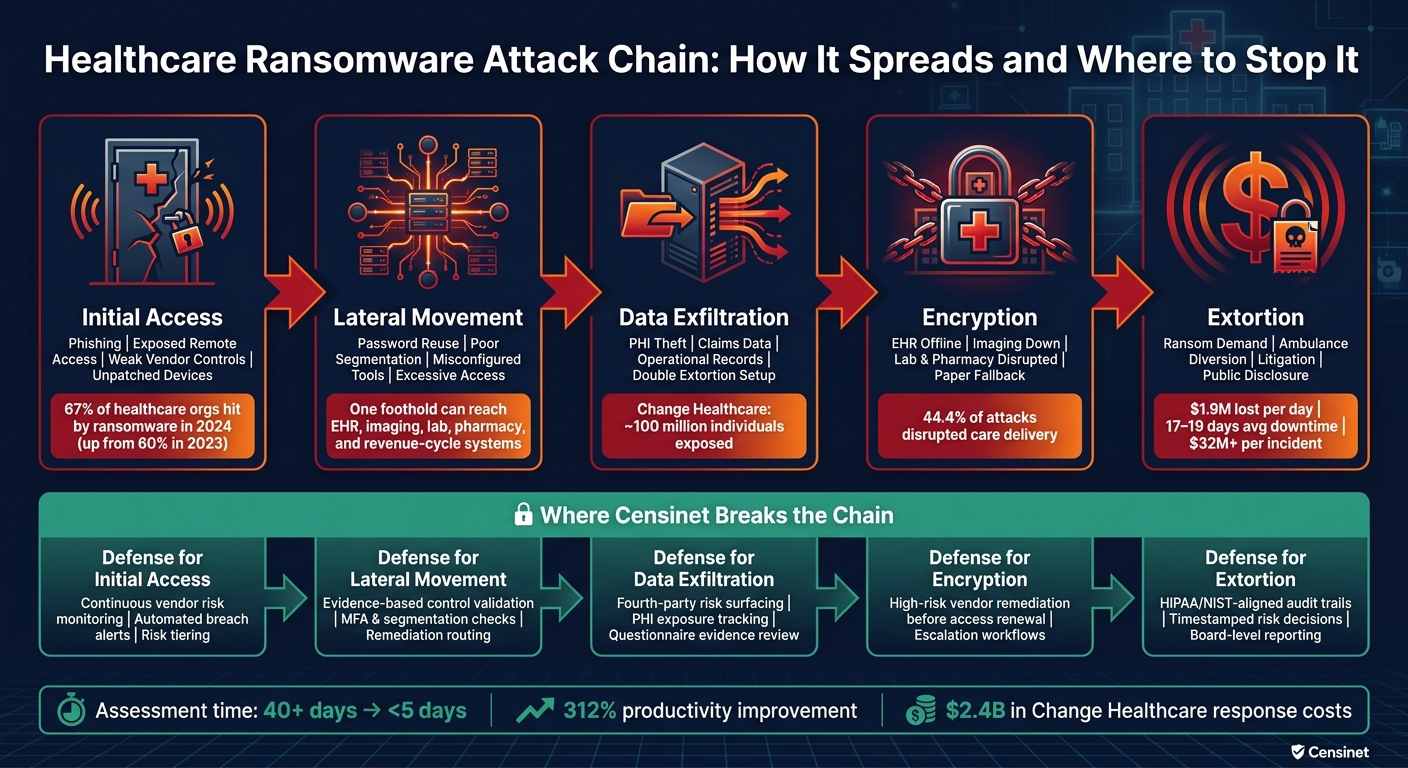
Healthcare Ransomware Attack Chain: How It Spreads and Where to Stop It
Ransomware moves in a pretty clear pattern: initial access, lateral movement, data theft, encryption, and extortion. In River Valley, that chain often begins with one compromised vendor account or an exposed remote access tool.
Initial Access: Vendors, Phishing, Exposed Systems, and Medical Devices
In many healthcare settings, the attack starts with a compromised vendor account, stolen phishing credentials, exposed remote access, an unpatched legacy system, or a connected device with a known weakness. HHS materials point to phishing emails, unpatched vulnerabilities, and exposed remote access services as leading initial access vectors in healthcare.[1]
Healthcare has a hard problem here. Older systems, a large vendor footprint, and tight patch windows give attackers more ways in. Connected medical device security risks add even more complexity because they may run older operating systems or depend on vendor-approved maintenance windows. Sophos found that 67% of healthcare organizations were hit by ransomware in 2024, up from 60% in 2023.[5]
Lateral Movement, Privilege Escalation, and Double Extortion
Once attackers get in, they start looking for weak spots they can use right away: password reuse, poor segmentation, misconfigured remote tools, and accounts with too much access. One foothold can be enough to move into EHR, imaging, laboratory, pharmacy, or revenue-cycle systems.
And they usually don’t stop at encryption. Many attackers steal data first, then lock systems after. That’s double extortion. PHI, claims data, and day-to-day operating records become leverage for payment and silence.
Operational Disruption: Downtime, Care Delays, and Recovery Pressure
When systems are encrypted, hospitals may have to fall back to paper workflows. That sounds simple on paper, but in practice it slows almost everything down. Imaging, lab, pharmacy coordination, scheduling, and transfer decisions all take longer, and clinicians lose timely access to records, orders, and results.
Once inside, the attacker’s path usually looks like this:
| Attack Stage | Clinical Operations | Patient Safety | Financial Impact | Regulatory Exposure |
|---|---|---|---|---|
| Initial Access | Monitoring burden increases | Latent risk before disruption | Vendor oversight costs | Third-party access control questions |
| Lateral Movement | Teams lose confidence in system integrity | Risk of undetected tampering | Incident response costs begin | Segmentation and access scrutiny |
| Data Exfiltration | No immediate outage | PHI and operational data at risk | Legal and notification costs rise | Breach notification obligations |
| Encryption | EHR, imaging, lab, and pharmacy may go offline | Delayed diagnoses, medication delays | Downtime and restoration costs escalate | Active breach response and mandatory notifications |
| Extortion | Recovery pressure extends downtime | Continued care disruption; possible ambulance diversion | Ransom demand, recovery, and litigation | Public disclosure risk and reputational harm |
The 2024 Change Healthcare ransomware attack showed how far one incident can spread. A single vendor compromise exposed PHI for about 100 million individuals, disrupted claims processing across the country, and led to roughly $2.4 billion in response costs.[4] The next section shows how Censinet breaks those links before ransomware spreads.
How Censinet Breaks the Attack Chain Before Ransomware Spreads
Healthcare ransomware often gets in through vendors, internet-facing systems, or weak access controls. The aim is simple: shut those doors before a cyber event turns into a clinical outage.
Third-Party Risk Assessment and Continuous Visibility
Censinet RiskOps™ brings vendor risk profiles, assessment workflows, risk ratings, and follow-up actions into one place across the healthcare supply chain. Instead of juggling spreadsheets and long email chains, risk teams get a single view of their vendor base. That makes it easier to sort vendors by criticality, track where each assessment stands, and focus on the relationships that carry the most exposure.
Vendor risk doesn't stay still after onboarding. Censinet One™ supports on-demand assessments and continuous portfolio visibility, with automated reassessment triggers, breach alerts, and risk tiering updates.[6] That cuts down the time between a change in vendor risk and a response from the healthcare organization. Put plainly, it helps stop initial access before an attacker gets into the network.
Evidence-Based Questionnaires, Control Validation, and AI-Assisted Scale
Self-attestation has limits. A vendor can mark "yes" on a questionnaire and still lack a working backup process or leave remote access tools unpatched. Censinet's healthcare-specific questionnaires push past that by asking for actual proof, such as patch logs, MFA settings, incident response documents, and backup validation records. That evidence-based method checks whether controls are in place in practice, not just on paper.
Censinet AI™ speeds up the parts of the process that usually slow teams down. It helps vendors finish questionnaires faster, summarizes submitted documents, surfaces fourth-party risk exposures, and flags missing or weak evidence for analyst review. The final call still sits with people. Risk teams set the rules, review flagged items, and decide what happens next. That shorter review cycle gives teams more time to fix issues earlier. Censinet's own data shows the effect clearly: vendor assessment time dropped from more than 40 days to less than 5 days, with a 312% productivity improvement.[7] That's a big shift, and it leaves less room for weak controls to slide by unnoticed.
Supply Chain Workflows, Clear Oversight, and Human-Guided Automation
Censinet routes findings to the right stakeholders, whether that's the vendor owner, security operations, compliance, or procurement, and tracks remediation until the issue is closed. If a backup control review fails, the system escalates the open item before the vendor's access is renewed. That routing helps close the gap between spotting a problem and fixing it. In healthcare, that timing matters a lot, because delayed remediation can leave connected clinical systems exposed during a ransomware event.
Here's what that shift looks like in day-to-day work:
| Risk Management Area | Before Censinet | With Censinet |
|---|---|---|
| Vendor intake | Manual, inconsistent, spreadsheet-driven | Standardized profiles and tiered onboarding workflows |
| Assessment speed | 40+ days per vendor | Significantly faster AI-assisted completion |
| Evidence quality | Self-attestation, limited verification | Evidence-based review with documented control validation |
| Risk visibility | Point-in-time snapshots | Continuous portfolio monitoring with breach alerts |
| Reassessment triggers | Scheduled or ad hoc only | Automated triggers based on breach events and risk changes |
| Remediation tracking | Email follow-up, no central record | Routed workflows with escalation and audit trail |
| Stakeholder coordination | Siloed across IT, compliance, and procurement teams | Unified across GRC, cybersecurity, and clinical teams |
| Supply chain exposure | Hard to see until an incident | Fourth-party risk surfaced during assessment process |
These workflow changes are what lower breach exposure, downtime risk, and compliance gaps. They help teams fix issues before lateral movement begins.
Those changes reduce exposure and help prevent ransomware attacks before they reach clinical systems.
Case Results: What Changes When the Chain Is Broken Earlier
Reduced Breach Exposure and Lower Downtime Risk
Breaking the chain earlier changes two things fast: how far the incident spreads and how long recovery takes.
In healthcare, ransomware doesn't just slow down IT. It hits care delivery and revenue at the same time. U.S. healthcare organizations hit by ransomware face about 17–19 days of downtime per incident, with estimated losses of $1.9 million per day. That means a single major attack can climb past $32 million in lost revenue. [3][10]
When action happens earlier, the damage is smaller. Initial access gets blocked, or the attack is contained before it can move laterally and trigger encryption. At River Valley, using Censinet earlier means high-risk vendors get fixed before they turn into entry points. And if an attacker still gets in through a compromised ancillary vendor, the impact stays contained instead of spreading across the network. Downtime is more limited. Recovery is shorter.
That difference shows up in patient care, not just on a balance sheet.
- Scheduled procedures keep moving.
- Ambulances don't need to be diverted.
- Clinicians keep access to orders, imaging, and medication records.
That's what early intervention looks like in practice. One program steps in before the attack gathers momentum. The other reacts after systems are already down.
Those day-to-day gains also make the compliance work after an incident much less painful.
Stronger Alignment with HIPAA, NIST, and Healthcare Risk Governance
The controls that cut downtime also help produce the records regulators want to see. HIPAA requires ongoing risk analysis, action on known risks, and documentation tied to ePHI. HHS OCR's 2024–2025 audits are focused on Security Rule provisions linked to hacking and ransomware. [9] This isn't a someday issue. It's a current expectation.
Censinet helps by creating a clear record of how to effectively manage third-party risk by documenting how vendor and system risks were found and addressed. Risk treatment decisions - accept, mitigate, transfer, or avoid - are timestamped, versioned, and exportable. If OCR reviews risk tied to a third-party clinical application, the organization can show a structured audit trail that maps to HIPAA and the NIST Ransomware Profile across Identify, Protect, Detect, Respond, and Recover. [2][8]
For the board, continuous monitoring turns technical warning signs into plain business and clinical terms. Leaders can see how many high-risk vendors connect to critical care units, how exposure has changed over the past quarter, and where remediation is overdue. That changes ransomware from an occasional IT update into an ongoing governance issue, with shared responsibility across IT, security, clinical operations, supply chain, and compliance.
Conclusion: Ransomware Defense Starts by Fixing Weak Links Across the Healthcare Supply Chain
Healthcare ransomware tends to follow a pattern. That pattern is bad news for providers under attack, but it also points to where defense should begin.
In many cases, the first crack appears in the supply chain: an exposed system, a phishing email, an insecure device, or a vendor access point. From there, attackers move inward through vendors, devices, and access paths until they reach core clinical systems.
The effect on care is immediate. Teams face delays. Staff fall back on manual workarounds. Patient risk goes up. Studies have linked these attacks to a 34–38% increase in mortality among already-admitted patients [11][12]. That's the cost of leaving a weak link in place.
That leads to a plain takeaway: defense has to start before lateral movement and encryption. Once systems go down, the damage is already unfolding. The groups that contain harm fastest tend to know where their highest-risk vendors are, which controls have been checked, and where gaps still exist.
Breaking the chain earlier takes steady oversight of vendors and controls. Censinet RiskOps™ supports that work with centralized vendor inventories, evidence-based questionnaires, continuous risk visibility, and human-guided automation through Censinet AI™. The goal is simple: close the gaps attackers use. Risk decisions are documented, auditable, and aligned with HIPAA and NIST, which helps support both compliance and resilience.
The attack chain is predictable, which means it can be stopped. In U.S. healthcare, the weakest link is often the supply chain.
FAQs
How do vendor accounts become ransomware entry points?
Vendor accounts can turn into ransomware entry points when attackers misuse the same access vendors need to keep hospital operations running. The usual weak spots are pretty straightforward: weak or shared remote-access credentials, missing multi-factor authentication, and poor network segmentation.
Once a vendor connection is compromised, attackers may move laterally into core clinical systems like EHRs or patient monitoring networks. That’s where a small gap can become a big problem. Unvetted subcontractors and insecure vendor software updates can also bring in hidden vulnerabilities.
What should healthcare teams validate beyond vendor self-attestations?
Healthcare teams should ask for hard proof of a vendor’s actual security posture, not just a checkbox answer or a signed statement.
For high-risk vendors, that means looking at things like clinical continuity plans, downtime procedures, proof that backups and restores have been tested, annual vulnerability and penetration testing results, and evidence that MFA is in place for all remote access.
It also helps to ask who else is involved behind the scenes. Which cloud providers does the vendor use? Which subcontractors handle data or systems? Those details can reveal fourth-party risk that might otherwise stay hidden.
For critical vendors that manage EHRs or medical devices, an on-site audit can help fill in the gaps. Questionnaires and documents matter, but they don’t always show how things work day to day.
How does earlier risk remediation reduce patient care disruption?
Earlier risk remediation helps reduce disruption to patient care by fixing vulnerabilities before attackers can use them. That means staff are less likely to fall back on manual, error-prone workarounds when systems go down.
When organizations deal with risks in systems tied to core clinical operations, they can avoid chain-reaction failures that lead to canceled procedures, delayed lab results, or ambulance diversions. Continuous monitoring and structured remediation help keep clinical services up and stable during a security event.
