
AI can turn audit logs into a live warning system for PHI risk. In healthcare, that means using logs not just to store records, but to spot odd access, trace AI-driven actions, monitor medical devices, and send issues into review before they grow.
Here’s the short version:
- I need audit trails to show who, what, when, where, and which system
- HIPAA expects logs and related review records to be kept for at least 6 years
- AI helps sort through millions of daily events that people can’t review by hand
- Good AI audit records should log model output, human approval or override, and the final action
- Logs should also include items like model version, confidence score, source system, session data, and downstream changes
- If I can’t trust the log, I can’t trust the review, so append-only storage, hashing, and immutable records matter
- AI monitoring works best when it looks for things like after-hours access, mass exports, provider mismatch, and odd privilege changes
- Alerts only matter if they move into incident response, risk review, and tracked remediation
A simple way to think about it: standard logging tells me what happened. AI-backed monitoring helps me see what needs attention now.
| Area | Basic Audit Logging | AI-Supported Monitoring |
|---|---|---|
| Main job | Store system activity | Review activity and flag risk |
| Scale | Hard to review at high volume | Built to sort large event streams |
| AI context | Missing | Includes model actions and human response |
| Forensics | Basic event history | More detail on cause and follow-up |
| Response | Often manual | Can feed alerts into risk workflows |
If I’m leading privacy, security, or compliance work, the main takeaway is simple: better audit trails are not just about storage. They are about evidence, monitoring, and action.
Ensure Data Integrity and Compliance with Zifo's AI-enabled Audit Trail Review
sbb-itb-535baee
Regulatory and Governance Requirements for AI-Driven Audit Trails
As AI takes on more monitoring work, HIPAA still expects governed logging for any system that handles PHI. In plain English: smarter monitoring does not replace recordkeeping. It only helps if the underlying records can stand up as compliance evidence.
HIPAA Audit Controls and Retention Expectations
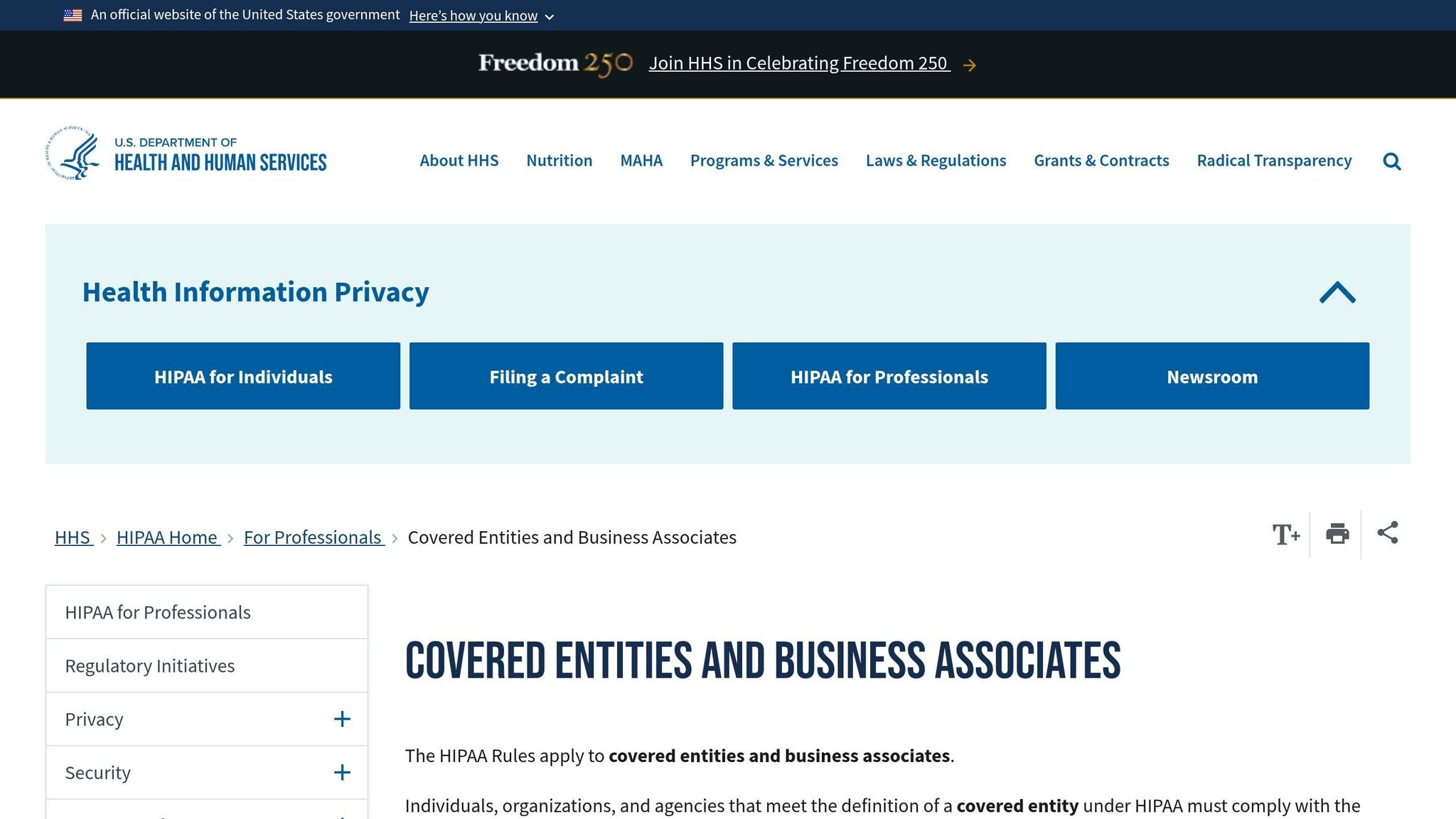
HIPAA's Security Rule requires covered entities and business associates to use hardware, software, and procedural mechanisms to record and review activity in systems that contain PHI.[2][3] For healthcare organizations, that usually means logging events like:
Under 45 C.F.R. § 164.316(b), organizations must keep required policies, procedures, and actions for at least 6 years from the date they were created or last in effect.[2][5][6][8] That same 6-year minimum also applies to audit logs and records that show those logs were reviewed.
HIPAA does not set retention periods for medical records themselves. State law may require records to be kept longer.[5][1] If state law is stricter, the stricter rule wins.
Logging AI Recommendations, Overrides, and Decisions
That puts a clear burden on each AI event record: it needs to show the model output, the human review, and what happened next.
If an AI system flags a possible anomaly, suggests a PHI-related action, or shapes an administrative decision, that output should be logged as part of the audit trail. It should not stop at the downstream action a user took later. Otherwise, part of the decision path goes missing.
A solid AI audit log entry should show what the model recommended, whether a person approved or overrode it, and what system action followed. Human overrides matter a lot here. They show how staff handled AI output and preserve the full decision chain.
Connecting Audit Evidence to Enterprise Risk Management
Once logs expose risk, that evidence has to move into response and remediation workflows. Audit logs sitting on their own don't cut risk by themselves. Findings from log reviews should feed incident response processes and the organization's broader risk management work so leadership can respond to material exposures.[6][7]
In practice, unusual access patterns found during log reviews should inform incident response and any follow-up review the organization requires. Platforms like Censinet RiskOps™ can route audit findings into enterprise and third-party vendor risk management workflows, which helps leaders act on those findings instead of letting them sit in a queue.
Core Technical Components of AI-Supported Audit Trails

Traditional EHR Logs vs. AI-Supported Audit Trails in Healthcare
AI audit trails only help if the logs are structured, complete, and tamper-resistant. In plain English, the record has to hold up when someone looks closely. That means each log entry needs to track not just human access, but also the AI context tied to PHI access and movement.
What a Complete AI Audit Log Entry Should Contain
A basic access log tells you that someone opened a record. An AI audit log has to go further. It should also show the model context and what happened next.
At a minimum, each entry should include:
- Timestamp from a trusted, synchronized source
- Unique event ID
- User identity and role
- Patient ID or hashed token to protect privacy while keeping traceability
- Source system, application, or API
- Action taken
- Device, session, and source IP or location
- Model version and prompt settings
- Confidence score
- Downstream updates triggered
For clinical NLP models, teams often need even more detail. Fields such as document_id, extracted_value, ICD-10 code, confidence_score, model_version, processing_duration, and validation_status help investigators rebuild what the model did.[9]
Without the model version and confidence score, a team may be able to confirm that an action happened, but not explain why it happened. That creates a gap during incident review or a compliance audit. Some frameworks also include lineage and fairness fields.
Data Lineage, Tamper Resistance, and Centralized Monitoring
Provenance tracking answers something plain access logs can't: where did this patient data come from, and what happened to it before the AI used it? A strong lineage record shows the source system, any middle processing steps, and the downstream systems that received the AI output.[10][11][15]
That matters because healthcare data doesn't sit in one place. It moves through EHRs, analytics platforms, identity systems, and AI tools. If something breaks, investigators need to know whether the issue began in the source data, the transformation pipeline, or the model itself.
Then comes integrity. Append-only storage and hashing do the heavy lifting here. Append-only design lowers the risk of silent edits or deletions. Hashing helps teams spot unauthorized changes to log files after the fact. Integrity checks should run on a regular schedule, and teams should document them so auditors can verify that records stayed intact from creation through review.[13] In higher-assurance settings, especially where PHI access or AI-driven clinical decisions are involved, immutable storage adds another layer of protection.
Centralized monitoring through a SIEM or analytics platform pulls the full picture together. When logs from EHRs, AI tools, identity systems, and endpoint tools all feed into one place, teams can connect events across systems, trigger automated alerts, and investigate faster. Without that setup, strange patterns that stretch across multiple systems can stay siloed and easy to miss. That's the extra context that sets AI audit trails apart from standard EHR logs.
Traditional EHR Logs vs. AI-Supported Audit Trails: A Side-by-Side Comparison
The gap between a standard EHR log and an AI-supported audit trail isn't just about volume. It's about the kind of evidence each one gives you.
| Dimension | Traditional EHR Logs | AI-Supported Audit Trails |
|---|---|---|
| Scope | Access and transaction history for human users | Human actions plus model recommendations, overrides, and AI-driven outputs |
| Data fields | User ID, timestamp, action, record accessed | All standard fields plus model version, confidence score, configuration, provenance, fairness metrics |
| Scalability | Designed for human review of sampled events; can struggle at high volume[12][13] | Built for high-volume, machine-assisted analysis and automated correlation |
| Anomaly detection | Mainly rule-based alerts, such as failed logins, mass exports, and after-hours access[12][14] | Behavioral analytics, pattern recognition, and AI-flagged deviations across users and models |
| Forensic detail | Shows what happened | Shows what happened, which model was involved, how certain it was, and whether a human overrode it |
| AI traceability | Not applicable | Logs alternative interpretations considered, feature importance scores, and validation check results[9] |
| Review method | Manual queries and retrospective review | Automated parsing, correlation rules, and alerting |
These fields are what make real-time anomaly detection possible.
Using AI for Real-Time Monitoring and Anomaly Detection
Structured audit logs only go so far on their own. The big shift happens when AI watches those logs in real time.
AI can continuously ingest log data from EHRs, identity systems, APIs, file transfers, and connected clinical applications. From there, it applies behavioral baselines to spot unusual PHI activity as it happens. When logs include identity, source, and model context, AI can flag suspicious behavior right away. That turns an audit trail from a record of what happened into a live monitoring control.
Behavior Analytics for PHI Access and Insider Risk
User and entity behavior analytics, or UEBA, learns what normal looks like for each role in your organization. Clinicians, billing staff, service accounts, vendors, and administrators all use systems in different ways. AI looks for departures from those patterns that may point to curiosity, misuse, or a stolen credential.
In healthcare, some signals tend to matter more than others. The most useful ones often include:
- after-hours PHI access
- unusually high chart-review volume in a single session
- repeated chart lookups outside a care team
- mass record exports
- access to celebrity or VIP records
Research on EHR audit data found that provider mismatch and off-hours access were the strongest anomaly signals in an AI-based detection approach, which makes them high-priority events to baseline and monitor.[16]
HHS insider-threat guidance points to practical signs investigators can watch for, including bulk downloads, forwarding sensitive data to personal addresses, and unauthorized employee access.[19] Those signs matter because they can help teams contain an issue before exposure spreads.
This kind of monitoring works best when logs are enriched with HR, shift-schedule, and identity data. Off-hours access might be normal for rotating clinical staff or on-call teams. For a billing clerk, that same pattern could look very different. Tuning thresholds by role and unit helps keep alert fatigue down while keeping the signal useful.
Continuous Monitoring for Misconfigurations and Incident Response
AI is also useful beyond user behavior. It can compare current configurations, access rights, and workflow settings against expected baselines to surface privilege escalation, orphaned accounts, excess permissions, risky API exposure, and unexpected role-mapping changes. In healthcare, EHRs and third-party integrations change often, so configuration drift can slip by until something breaks or data is exposed.
During an active security event, speed matters. AI helps investigators search and summarize large log volumes, trace user activity across systems, reconstruct timelines, and spot related anomalies such as lateral movement or shared-account misuse.[17][18] The point is simple: cut the noise and narrow the logs to the highest-risk events so analysts can focus on cases that need attention first.
Real-time monitoring should cover EHRs, identity systems, VPN/VDI, cloud apps, endpoints, print and USB activity, and connected clinical systems. Looking at those signals together gives teams a fuller picture than reviewing each system on its own.
AI-Based Monitoring vs. Rule-Based or Manual Review: A Side-by-Side Comparison
| Dimension | Rule-Based Monitoring | Manual Review | AI-Based Monitoring |
|---|---|---|---|
| Speed | Near real-time for defined rules | Slow; limited by analyst capacity | Near real-time across high log volumes |
| Coverage | Limited to pre-written rule scenarios | Selective; relies on sampling | Broad; can surface unusual patterns at scale |
| False positive risk | High if rules aren't tuned | Low for targeted investigations | Moderate; improves with feedback loops and tuning |
| Staffing load | Low to moderate | High; does not scale well | Low once configured; frees analysts for validation |
| Explainability | Easy to explain; logic is transparent | High; analyst reasoning is documented | Requires documented detection logic and versioned models |
| Regulatory defensibility | Strong if rules map to control objectives | Strong for targeted cases | Strong when thresholds, exceptions, and escalation paths are retained |
In practice, healthcare teams are starting to blend the two approaches. Rules give you dependable coverage for known cases, while machine learning helps sort and rank alerts. Those alerts should then feed directly into incident response and enterprise risk workflows.
Putting AI Audit Trails to Work in Healthcare Risk Management
Detecting an anomaly is only the first step. After that, teams need to send it to the right owner, set a due date, and confirm the issue was fixed with proof. That’s where many healthcare organizations get stuck.
Audit logs, AI governance, vendor risk reviews, and remediation tracking often sit in different systems. Different teams manage each one. And without a shared workflow, findings can stall out.
Healthcare delivery organizations need a central risk operations model. One workflow should handle intake, triage, evidence collection, risk scoring, approvals, and remediation across PHI, clinical applications, medical devices, and supply chain relationships. That’s what turns an audit finding into work that someone owns.
How Censinet RiskOps™ Supports Audit-Related Risk Management
When monitoring flags risk, the next step is simple in theory but hard in practice: get it into a tracked remediation process. Censinet RiskOps™ connects audit findings to enterprise and third-party risk workflows, assigns ownership, sets remediation deadlines, tracks closure evidence, and uses cybersecurity benchmarking to help teams decide what to fix first.[20][21]
This gets even more important when a third-party risk management is involved. Say monitoring shows unusual data transfer patterns from a vendor-hosted clinical application. Teams can connect that event to the vendor’s assessment, contract obligations, and remediation plan in one place.
How Censinet AI and Censinet AI™ Support Scale with Human Oversight
Reviewing vendor questionnaires, policy documents, and control attestations takes time. A lot of it. Censinet AI™ summarizes vendor evidence, flags missing artifacts such as BAAs or validation reports, and surfaces risk-relevant passages in long control documents.[20]
People still make the final call. Censinet AI routes findings to the owning team and keeps human review and approval in place before closure.[20] That review step matters most when audit outcomes affect patient data protection or compliance readiness.
Conclusion: What Healthcare Leaders Should Prioritize Next
Strong AI audit trails depend on two things working together: disciplined logging and coordinated risk operations. Logs need to capture PHI access and AI decision context as immutable, timestamped records with integrity controls. But those records only help if they feed a workflow that sends findings to owners, tracks remediation, and keeps proof of closure.
Healthcare leaders should focus on four priorities:
- Complete and tamper-resistant logging
- Clear governance over AI-supported recommendations and overrides
- Fast routing of findings into enterprise and vendor risk workflows
- Verified remediation evidence
Audit trails matter when they lead to accountable action.
FAQs
How is AI audit monitoring different from standard audit logging?
AI audit monitoring does more than standard audit logging. It shifts the process from manual, after-the-fact review to proactive, real-time oversight.
Instead of leaving teams with static records that take time to sort through, AI keeps data organized across systems, flags unusual activity like unauthorized after-hours access or bulk downloads, and automates compliance reporting for more consistent, audit-ready documentation.
What should an AI audit log capture for PHI access?
An AI audit log for PHI access should record six core elements:
- Who accessed the data
- What action was taken
- When it happened
- Where the request came from
- Why access was needed
- The outcome
For AI-driven decisions, the log should also include the model version, input hashes, confidence scores, and the human reviewer’s identity.
And this part matters just as much as the fields themselves: logs should live in tamper-proof, immutable systems and be kept for at least six years to support HIPAA compliance.
How can healthcare teams reduce false positives in AI alerts?
Healthcare teams can cut false positives and ease alert fatigue by setting rules that fit their risk tolerance and day-to-day workflows. That matters because not every alert points to a true emergency or security issue. Review and approval steps give staff a way to check what happened before they act.
Audit trails help here too. When teams study that data and use it to tune algorithms, model accuracy can improve, with first-pass accuracy gains of 15–20%. Censinet RiskOps™ supports this work by bringing monitoring into one place and automating evidence collection.
