
Healthcare malware tools do not solve the same problem. If I’m picking one, I need to match it to the risk: endpoint attacks, network movement, device drift, imaging file threats, or vendor risk.
In this review, I compare eight platforms across the points that matter most in care settings:
- CrowdStrike Falcon
- SentinelOne Singularity
- Trend Vision One for Healthcare
- Vectra AI Platform
- Corelight for Healthcare
- Crytica Security
- Varist DICOM Detection Engine
- Censinet RiskOps
I’m looking at each one through four simple lenses:
- Detection quality
- Clinical uptime impact
- PHI/ePHI support
- Fit for EHR, PACS, DICOM, and connected devices
The short answer: endpoint-first teams should look at CrowdStrike or SentinelOne; network-heavy hospitals should look at Vectra or Corelight; imaging teams should look at Varist; and teams that need vendor and enterprise risk tracking should add Censinet RiskOps. Trend Vision One fits health systems that want one platform across email, cloud, identity, servers, and network layers. Crytica fits places that care most about system-state change on high-integrity devices and workstations.
The risk is not small. In 2025, healthcare organizations reported 710 large breaches to HHS OCR, affecting at least 61,556,256 people. And in the Kettering Health ransomware event, 1,695,382 individuals were affected, about 600 digital applications went offline, and Epic EHR access was down until June 2, 2025. That is why tool fit matters.
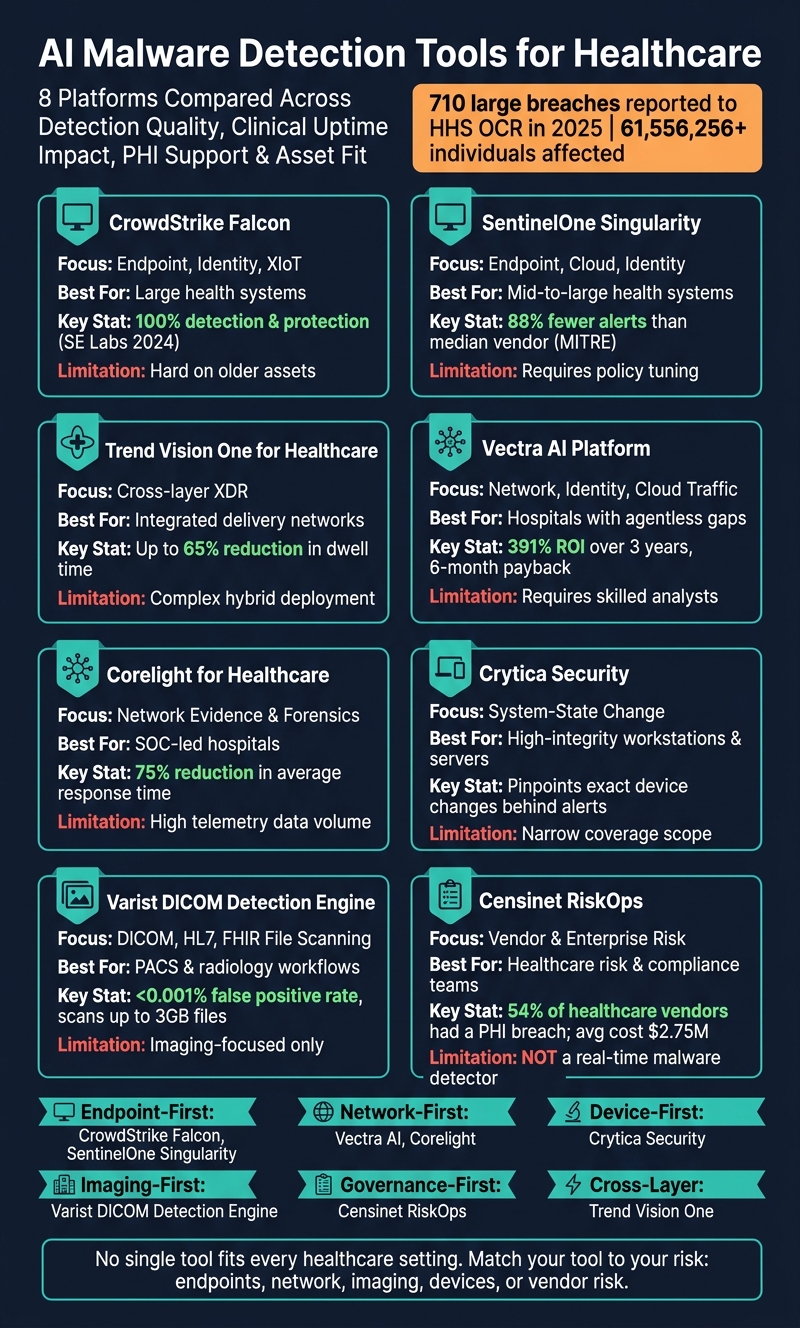
AI Malware Detection Tools for Healthcare: 8-Platform Comparison
AI in Healthcare: Hidden Cybersecurity Risks
sbb-itb-535baee
Quick Comparison
| Tool | Main Focus | Best For | Main Strength | Main Tradeoff |
|---|---|---|---|---|
| CrowdStrike Falcon | Endpoint, identity, XIoT | Large health systems | Strong endpoint detection and MDR option | Endpoint reliance can be hard on older assets |
| SentinelOne Singularity | Endpoint, cloud, identity | Mid-to-large health systems | Auto containment and rollback | Policy tuning matters |
| Trend Vision One for Healthcare | Cross-layer XDR | Integrated delivery networks | One view across email, cloud, endpoint, identity, and network | Hybrid setup can take more work |
| Vectra AI Platform | Network, identity, cloud traffic | Hospitals with agentless gaps | Finds attacker behavior in network traffic | Often needs analyst depth |
| Corelight for Healthcare | Network evidence and forensics | SOC-led hospitals | Deep packet, Zeek, Suricata, and telemetry detail | High data volume |
| Crytica Security | System-state change | High-integrity workstations and servers | Shows exact device changes behind alerts | Narrower coverage |
| Varist DICOM Detection Engine | DICOM, HL7, FHIR file scanning | PACS and radiology workflows | Inline scanning for imaging-file malware | Imaging-focused only |
| Censinet RiskOps | Vendor and enterprise risk | Healthcare risk and compliance teams | Tracks remediation and third-party vendor risks | Not a live malware detector |
If I were building a shortlist, I’d start with the asset mix first, not the brand name. Endpoints, network, imaging, devices, and vendor risk each need a different layer.
1. CrowdStrike Falcon
CrowdStrike Falcon works well for hospitals that want endpoint, identity, and XIoT detection in one platform. It brings together next-generation antivirus (NGAV), endpoint detection and response (EDR), and extended detection and response (XDR) through a single lightweight sensor. It uses signatureless machine learning and Indicators of Attack (IoAs) to spot known, unknown, and zero-day threats.[4]
Detection scope
Falcon's AI models review telemetry on a continuous basis and connect signals across endpoint, identity, network, and cloud sources to flag real threats fast. In SE Labs' 2024 Enterprise Advanced Security EDR Ransomware Test, Falcon posted 100% detection, 100% protection, and 100% accuracy against the ransomware campaigns in the test, with zero false positives.[6] That's a big deal in healthcare, where a false alarm can throw off care workflows almost as much as an actual attack.
Healthcare asset coverage
Falcon for XIoT extends EDR and exposure management to IoMT, IoT, and OT devices, including infusion pumps, patient monitors, and imaging systems.[10][11] Those devices feed into the same SOC workflows as standard IT endpoints, so security teams can work from one shared view instead of bouncing between tools.[10][11]
A TEI-style analysis projected $7.25 million in three-year benefits for a composite healthcare delivery organization.[12]
Compliance and risk alignment
For healthcare buyers, strong detection is only part of the job. It also has to fit HIPAA-related processes. A Coalfire assessment found Falcon addresses eight HIPAA technical requirements, and CrowdStrike signs BAAs for PHI-bearing environments.[8][9]
Case studies add another layer here. Organizations using Falcon-based managed identity solutions reported a 100% compliance rate and HIPAA audits that were 3× faster than before.[7]
AI response automation
Falcon's AI helps automate triage, investigation, and response, cutting response time from hours to minutes.[3][5] That means healthcare teams get prioritized leads instead of a pile of raw alerts. If an internal SOC is thin or not staffed around the clock, Falcon Complete MDR adds 24/7 managed detection and response plus proactive threat hunting.[2]
There is one clear risk to weigh. The July 19, 2024 Falcon update issue disrupted 759 of 2,232 U.S. hospitals (34.0%), affecting EHR access, lab processing, and elective procedures.[13] For hospital teams, that drives home a simple point: rollback procedures, change control, and third-party risk management plans aren't nice-to-haves. They're part of the job when temporary protection gaps can spill into patient care.[14]
2. SentinelOne Singularity
Where Falcon puts more weight on broad visibility, Singularity leans more into autonomous containment. It’s an AI-driven XDR platform that brings endpoint, cloud, and identity protection into one console. For healthcare teams, the focus is clear: autonomous detection and rollback across endpoints, identity, and cloud assets.
Detection scope
Singularity uses behavior-based detection, which means it looks at how processes act, not just file signatures.[15][16] That matters because many attacks don’t show up as a known bad file at first.
In MITRE ATT&CK Enterprise evaluations, Singularity posted 100% detection with zero detection delays for five straight years. It also produced 88% fewer alerts than the median of evaluated vendors.[20][21][22] For short-staffed healthcare security teams, fewer alerts can make a big difference. It cuts down the noise and helps staff focus on what needs attention.
That shows up most clearly in mixed healthcare fleets, where old and new systems often sit side by side.
Healthcare asset coverage
Older Windows devices and shared nursing-station workstations are common ways attackers get in, and Singularity’s endpoint coverage helps close those gaps.[1][16] That’s a big deal in healthcare, where you can’t always swap out aging devices on your own schedule.
For teams without an in-house SOC, SentinelOne’s Vigilance MDR service reportedly resolves more than 99% of threats without analyst escalation. The average analyst-notification time is about 3.3 minutes after detection.[23] In plain terms, that gives smaller teams a way to respond fast without building a full security operation from scratch.
AI response automation
Singularity can autonomously kill malicious processes, isolate infected devices, roll back encrypted files, and restore systems to a pre-attack state - often without analyst involvement.[1][15][16] That kind of response can stop a bad incident before it spreads from one machine to a whole unit or facility.
In a hospital setting, that speed matters. A contained event is one thing. A ward-wide outage is another.
Fast containment also helps with audit trails and HIPAA-related workflows. For organizations needing to scale these efforts, on-demand cyber risk management can help align technical controls with broader institutional security goals.
Compliance and risk alignment
Singularity supports HIPAA technical safeguards, BAA coverage, access controls, audit logging, and transmission security.[17][18][19]
3. Trend Vision One for Healthcare
For hospitals that need a clear view across email, cloud, identity, and network layers, Trend Vision One casts a much wider net. It extends detection beyond endpoints and pulls telemetry from endpoints, servers, email, cloud workloads, identity, and network traffic into one XDR platform.[24][26]
Detection scope
The platform uses AI to connect activity across those layers, which helps security teams spot multi-stage attacks that might look harmless when viewed one event at a time. For example, unusual PowerShell activity on a workstation plus lateral movement toward an EHR server can point to an attack that separate tools might miss.[26]
According to Trend's healthcare materials, this approach can cut dwell time by up to 65% compared with older tools.[26] In a hospital setting, that earlier signal matters. Attackers don't wait around, and neither can defenders.
Healthcare asset coverage
Vision One is built to cover the full attack surface of a healthcare delivery organization. That includes cloud-hosted clinical apps, on-premises EHR servers, and legacy and OT devices that can't run agents.[24][26][28][31]
That last part matters more than it might seem. Many hospitals still rely on medical devices that are hard to update or lock down. For systems like infusion pumps or imaging equipment, network and cloud telemetry can still spot odd behavior, such as unexpected outbound connections or unusual data transfers.[24][26]
AI response automation
Once that cross-layer visibility is in place, Vision One can automate response across several controls. Its playbooks can:
- isolate endpoints
- quarantine malicious email attachments
- stop suspicious processes
- block command-and-control domains
Healthcare case studies report about 10 hours saved per week and 70%–80% MTTR improvements.[25][27][31] That's a big deal for short-staffed security teams that are also trying not to disrupt patient care.
To protect clinical continuity, tiered automation makes sense here. Confirmed ransomware can trigger full auto-isolation, while lower-confidence alerts can go to analysts for approval before any action is taken.[24][25]
Compliance and risk alignment
Vision One maps to HIPAA Security Rule requirements, including malware protection, audit logging, and incident response documentation.[29][30] Trend also says it can support HITRUST through continuous posture assessment and virtual patching.[24][33][34][35]
Its console can generate board-ready reports for audits and breach investigations.[30] Pricing is quote-based, and Trend offers a 30-day full-access trial.[24][32]
4. Vectra AI Platform
After tools that lean hard on endpoints, Vectra looks at the network itself. That shift matters in hospitals, where attacker activity often leaves traces in network, identity, and cloud traffic long before a device throws a clear alert. Instead of chasing one malware strain at a time, Vectra looks for behavior patterns that tend to show up during an attack, such as lateral movement, privilege escalation, command-and-control (C2) traffic, and unusual file-encryption activity.[36][43]
Detection scope
Vectra's Attack Signal Intelligence™ is built to spot zero-day and stealthy attacks by finding attacker behavior in network traffic, even when endpoints stay quiet.[36][37][43][45] In healthcare, that's a big deal. EHR and imaging traffic can show signs of compromise before an endpoint tool sees anything useful. A simple example is unusual SMB traffic moving between EHR servers.[36][37][43][45]
Healthcare asset coverage
Vectra monitors EHR, PACS, VNA, cloud workloads, and connected devices without agents.[37][39][41][42][46] That makes it a strong fit for hospital gear that can't run endpoint software. It can help teams spot odd outbound connections or signs that an attacker is pivoting from one system to another. When a security team needs to go from alert to containment fast, that kind of context can save precious time.
AI response automation
Vectra gives teams detailed detection context, including attacker timelines, asset risk scores, and linked behaviors.[38][40][44][45] When it's tied into SIEM, SOAR, EDR, or identity tools, that context can kick off response workflows automatically. That might mean isolating a network segment, disabling an account, or triggering endpoint containment after a high-severity alert.[38][40][44][45] In setups where network telemetry gives the clearest sign of compromise, this is where Vectra stands out.
Compliance and risk alignment
Vectra's continuous monitoring and detailed incident timelines support HIPAA audit controls, integrity monitoring, and incident documentation.[36][37][39][41][42][43] Its outputs also map to NIST CSF and HITRUST controls, especially in the Detect and Respond functions.[43][44] One analysis of Vectra deployments found a 391% ROI over three years, an average payback period of six months, and about $793,000 in yearly productivity savings.[47]
5. Corelight for Healthcare
Where Vectra focuses on attack behavior, Corelight keeps the network evidence behind that behavior. Built by the creators of Zeek, it brings together Zeek logs, Suricata IDS alerts, packet capture (PCAP), and NetFlow to turn raw traffic into forensic evidence.[48][49][50]
Detection scope
Corelight works best for finding malware traces in network traffic, not on endpoints. It can surface signs of beaconing, lateral movement, and exfiltration while helping teams tell the difference between actual threats and normal device polling or vendor remote support. That matters in healthcare, where an alert alone often isn't enough and security teams need proof they can investigate.
A healthcare data solutions provider uncovered ICMP tunneling, suspicious RDP activity, and unauthorized cloud scans through Corelight's Splunk app.[48]
Healthcare asset coverage
Corelight is a strong fit for settings where agents can't be installed. When deployed at network choke points, it can watch EHR, device, and OT networks without touching the devices themselves. That's especially useful for legacy imaging equipment and other connected systems that can't run endpoint software.
AI response automation
Corelight's main role is to speed up investigation, not handle cleanup on its own. It uses AI for triage and enrichment, then passes that context into SIEM, SOAR, EDR, firewall, and ticketing workflows. In one case, a federal SOC using Corelight's investigation workflows cut average response time by 75% by removing manual data collection steps.[51]
Compliance and risk alignment
Corelight helps support HIPAA, HITRUST, and NIST CSF by giving teams packet-level and log-level visibility, plus incident evidence they can use during review and response. It does not replace EDR or identity monitoring.
6. Crytica Security
After endpoint and network behavior tools, Crytica looks at system-state drift: what changed on the device itself.
Crytica Security uses a state-based engine to detect unauthorized drift by comparing a device against a known-good baseline.
Detection scope
Crytica points to the exact system changes behind an alert, including malicious files, registry changes, and memory injections. That helps analysts get from alert to root cause with less guesswork.
Healthcare asset coverage
This approach fits best on clinical workstations, servers, and other high-integrity systems where unauthorized change matters more than network noise.
Automated investigation and response
Crytica helps speed up triage by showing the exact artifacts that changed, then passing that detail into containment workflows.
Compliance and risk alignment
That evidence trail helps with incident review, post-breach documentation, and faster forensic analysis.
So Crytica is strongest as a forensic layer for checking unauthorized change, not as a broad network detector.
7. Varist DICOM Detection Engine
Varist is built to find malware hidden inside medical imaging files.
Detection scope
Varist checks DICOM, HL7, and FHIR content across PACS and EHR workflows. It scans entire files, including metadata and embedded image data, to look for hidden payloads.[52][54] That matters because a DICOM file can carry malware and still look normal to imaging systems.[61][53]
The engine uses both static and dynamic analysis on suspicious files. In plain English, it doesn’t just look for known bad patterns. It also watches how a file behaves, which helps it spot zero-day and mutated threats that can slip past signature-based tools.[52][54][56] It can process files up to about 3 GB, review suspicious files in milliseconds, and keep the false positive rate below 0.001%.[54]
That kind of file-level inspection works best when it sits right inside the imaging workflow, not off to the side.
Healthcare asset coverage
Varist runs inline between modalities, PACS, viewing workstations, and external image exchange gateways.[53][55] So it fits naturally into modality-to-PACS transfers, cross-facility image exchange, and EHR-linked imaging workflows.[52][53][54]
In practice, that means the scan happens where images already move. The control is part of the path, which helps catch risky files before they land deeper in clinical systems.
Compliance and risk alignment
Varist processes files locally, which avoids sending PHI-bearing files to the cloud and supports HIPAA and insurer data-handling rules.[57][58][59] For many healthcare teams, that’s a big deal. Imaging data often carries patient details, so keeping inspection on-site can reduce exposure during transfer and review.
Its focus on protecting DICOM, HL7, and FHIR traffic also lines up with published PACS cybersecurity practices, including preamble cleansing, content validation, and transport security.[59][60]
That makes Varist a file-layer control for imaging workflows, while broader risk tracking sits in the next layer.
8. Censinet RiskOps
Censinet RiskOps sits in the risk-management layer. Its job is to show where malware and ransomware risk is piling up across the organization, including vendors, clinical applications, medical devices, and supply-chain partners.
Healthcare asset coverage
Censinet RiskOps covers a broad set of healthcare assets: PHI-handling vendors, third-party software, medical devices, clinical applications, and supply chain partners. It points out which vendors don't have enough malware protections in place and which high-priority clinical applications still have open remediation work tied to malware or ransomware controls.
A Ponemon Institute study commissioned by Censinet found that 54% of healthcare vendors had experienced at least one data breach exposing PHI. Of that group, 41% had suffered six or more breaches in two years, with an average cost of $2.75 million per breach.[64] Those numbers make prioritization a lot easier. If risk is spread unevenly, security teams need to know where to act first.
AI response automation
Censinet AI™ speeds up risk assessments with human-in-the-loop automation. It can complete vendor security questionnaires in seconds, summarize evidence documentation, and generate risk reports, while still leaving final review to a person. Teams define the rules, and the platform handles the scale.
That matters because healthcare providers spend about 5,040 hours per month managing third-party vendor risk. In dollar terms, that comes to nearly $4 million per year per organization.
Compliance and risk alignment
RiskOps maps systemic risk, concentration risk, and single-point-of-failure risk across 17 critical healthcare functions that support care delivery.[62] Censinet–Ponemon research found that over 50% of healthcare organizations reported patient care disruptions caused by ransomware.[63][64][65]
RiskOps connects those clinical consequences to remediation priorities. Instead of treating every issue the same, teams can see which gaps are most likely to affect care and respond based on that view. Those risk priorities feed the strengths-and-tradeoffs view below.
Strengths and Tradeoffs at a Glance
The matrix below cuts the long reviews down to the part that matters most: where each tool fits best.
| Tool | Detection Focus | Best Fit | AI Method | Best-Fit Use Case | Notable Limitation |
|---|---|---|---|---|---|
| CrowdStrike Falcon | Endpoint protection | Large health systems with mixed endpoints | AI endpoint detection | Clinical workstation and endpoint protection | Needs endpoint coverage for older devices |
| SentinelOne Singularity | Ransomware and endpoint threats | Mid-to-large U.S. health systems | Autonomous behavior-based AI | Fast ransomware containment and rollback in EHR environments | Requires policy tuning |
| Trend Vision One for Healthcare | Cross-environment security | Integrated delivery networks | AI-assisted XDR | Visibility across clinical IT and operational technology | Complex hybrid deployment |
| Vectra AI Platform | Lateral movement and network threats | Hospital networks with incomplete endpoint coverage | AI-driven NDR | Detecting attacker movement inside the network after initial compromise | Requires skilled analysts |
| Corelight for Healthcare | Network traffic and East-West threats | Hospital SOC teams | Zeek-based telemetry with machine learning and YARA file analysis | Deep network visibility without adding endpoint agents | High telemetry volume |
| Crytica Security | Medical device integrity | Connected device environments | Instruction Set Integrity Monitoring | Protecting constrained medical devices where standard agents can't run | Narrow scope |
| Varist DICOM Detection Engine | Imaging file and DICOM/HL7 threats | PACS and radiology workflows | AI file analysis | Scanning medical images in latency-sensitive imaging pipelines | Specialized for imaging files |
| Censinet RiskOps | Third-party and enterprise risk | Healthcare organizations managing vendors and supply chains | Human-reviewed AI automation | Prioritizing risk remediation across vendors, medical devices, and clinical apps | Not a real-time malware detector |
If you want a simple way to sort the field, these tools land in five buckets:
- Endpoint-first: CrowdStrike Falcon, SentinelOne Singularity
- Network-first: Vectra AI, Corelight
- Device-first: Crytica Security
- Imaging-first: Varist DICOM Detection Engine
- Governance-first: Censinet RiskOps
Trend Vision One stands out because it stretches across endpoint, network, and cloud. That makes it the broadest pick for integrated delivery networks. Censinet RiskOps plays a different role. It helps transform healthcare third-party risk management, but it does not act as a real-time malware detector.
Use these tradeoffs to narrow your shortlist in the next section based on care setting, staffing, and asset mix.
Which Tool Fits Your Healthcare Use Case
The right tool depends on your setup, the assets you need to protect, and the size of your team. The easiest way to narrow the list is to look at three things: your environment, your staffing, and the assets that carry the most risk.
If endpoints are your main area of exposure, start with CrowdStrike Falcon. If you need broader coverage across endpoints, cloud, and identity, SentinelOne Singularity is a better fit.
If a large share of your devices are agentless or unmanaged, go with Vectra AI for network visibility. If your SOC needs deeper packet and telemetry evidence for threat hunting, Corelight makes more sense.
If imaging systems and PACS workflows sit at the top of your list, Varist DICOM Detection Engine is the most specialized choice.
One tool here plays a different role. Censinet RiskOps sits in the governance layer. It helps healthcare organizations manage third-party, medical device, and enterprise cyber risk through standardized assessments and automated workflows. Use Censinet RiskOps as the governance layer for risk tracking and remediation.
For lean teams, focus on low-agent tools with heavy automation. In imaging-heavy environments, put Varist on the shortlist. For vendor and third-party risk governance, add Censinet RiskOps.
Conclusion
No single tool fits every healthcare setting. That’s why testing in live clinical workflows matters so much. Before you standardize on any platform, run healthcare-specific pilots that mirror how your teams actually work. See how each tool performs next to EHR systems, imaging workflows, and biomedical devices. Then run tabletop exercises to check detection and recovery against ransomware scenarios that feel like the real thing.
In healthcare, the cost of ransomware isn’t just technical cleanup. It’s disrupted patient care. Pick the wrong tool - or leave one layer exposed - and the impact can hit patient safety fast, from imaging downtime to EHR outages.
And at healthcare scale, detection by itself doesn’t cut it. Censinet RiskOps supports third-party risk assessments and enterprise risk governance as a separate, parallel layer from malware detection.
The strongest programs combine detection with governance. Choose detection tools based on your environment, staffing, and asset mix, then tie the whole program to a governance layer that keeps risk visible and accountability clear across the organization.
FAQs
How do I choose the right tool for my healthcare environment?
Choose a tool that supports patient safety, regulatory compliance, and smooth integration with clinical workflows. It should add context to technical findings, like whether a vulnerability touches electronic health records or life-critical medical devices.
You should also look for automated risk assessment, threat prioritization based on potential patient harm, and integration with incident response and IT service management systems. Censinet RiskOps™ is built for healthcare risk management with human oversight.
Can one platform protect endpoints, network traffic, imaging workflows, and vendor risk?
Yes. Censinet RiskOps™ brings healthcare cyber and risk assessments into one place across the enterprise. That includes third-party vendors, clinical applications, medical devices, and PHI workflows.
It gives teams a single view so they can assess issues and prioritize remediation based on patient safety and clinical impact. At the same time, it works alongside broader security monitoring tools.
What should we test in a healthcare malware detection pilot?
Test the tool in a live hospital setting, with both clinical engineering and security teams at the table. The goal is simple: see whether it can separate normal day-to-day activity from actual threats without getting in the way of patient care or staff workflows.
Look closely at a few areas.
- Resistance to evasion: Can the tool still flag threats when an attacker tries to blend in with normal device or user behavior?
- Performance beyond plain accuracy: Accuracy alone can hide a lot. Check precision, recall, F1-score, and time-to-detect to see how well the system works under pressure.
- Drift and bias over time: Hospital systems change. Devices get added, software gets updated, and user behavior shifts. The tool needs to keep up without drifting off course or skewing results.
- Data quality across sources: Review the strength and consistency of the data coming from EHR logs, IoMT telemetry, and third-party risk data. If the inputs are messy, late, or incomplete, the output won't mean much.
This kind of testing gives you a much clearer picture of how the tool will behave when the stakes are high and the environment is anything but static.
