
If you buy from medical device component suppliers, a cyberattack can become a patient care issue fast. That is the main takeaway from this article.
I break the risk into four supplier groups:
- Medical device component suppliers
- General manufacturing suppliers
- High-tech and software suppliers
- Automotive and mobility component suppliers
And I compare them across five threat types:
- Ransomware
- Software supply chain attacks
- IP theft
- Firmware tampering
- Deep-tier supplier concentration risk
Here’s the short version:
- Medical device component suppliers carry the highest patient risk. If production, traceability, or firmware integrity fails, care delays can follow.
- General manufacturing suppliers face major plant disruption risk. A single day of downtime can cost about $1.3 million.
- High-tech and software suppliers can hit many customers at once. In the Kaseya case, about 1,500 downstream organizations were affected.
- Automotive and mobility suppliers face line-stop risk from tiered sourcing and just-in-time production. One supplier outage can shut multiple OEM lines.
A few numbers show why this matters:
- In 2024, about one-third of major U.S. health data breaches involved vendors, but those events affected about 75% of impacted people.
- In 2025, 87% of healthcare groups hit by a supply chain attack said patient care was disrupted.
- In the first half of 2026, security threats in healthcare’s third-party vendor relationships, including device suppliers, rose 35%.
What matters most is not just who gets attacked. It’s what breaks downstream. For medical device suppliers, cyber risk links to quality records, device release, SBOM duties, firmware trust, and FDA compliance.
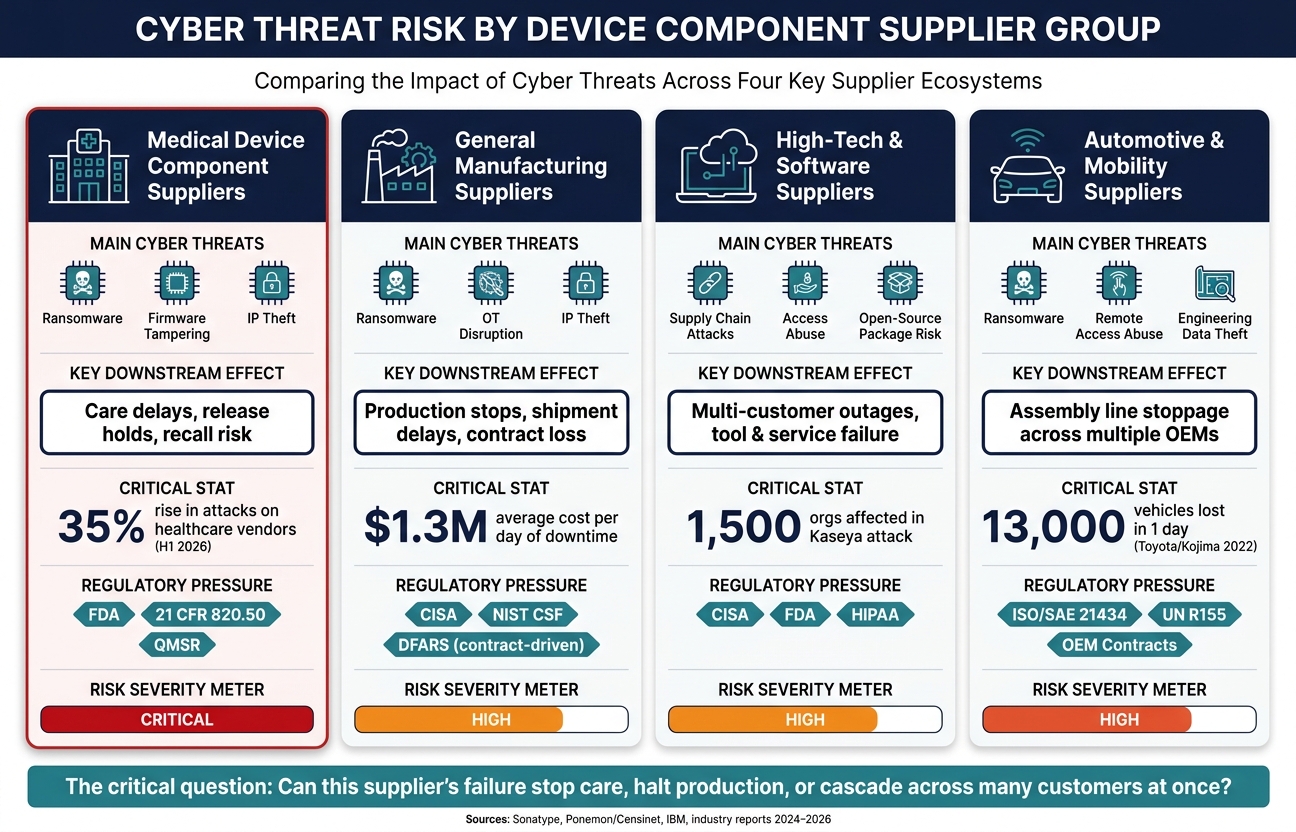
Cyber Threat Comparison: 4 Device Component Supplier Groups
Stryker Cyberattack Disrupts Surgeries And Medical Supply Chains Across US | WION Podcast
sbb-itb-535baee
Quick Comparison
| Supplier group | Main risk | Downstream effect | Pressure source |
|---|---|---|---|
| Medical device component | Ransomware, firmware tampering, IP theft | Care delays, release holds, recall risk | FDA, quality system rules, buyer oversight |
| General manufacturing | Ransomware, OT disruption, IP theft | Production stops, shipment delays, contract loss | Customer contracts, sector guidance |
| High-tech / software | Update-channel compromise, access abuse, open-source package risk | Multi-customer outages, tool and service failure | Customer demands, healthcare data and device rules |
| Automotive / mobility | Ransomware, remote access abuse, engineering data theft | Assembly line stoppage across OEMs | ISO/SAE 21434, UN R155, OEM contract terms |
Bottom line: if you want to judge supplier cyber risk well, you need to look past breach counts and ask a simpler question: Can this supplier’s failure stop care, stop production, or spread through many customers at once?
Medical Device Component Suppliers
Threat Exposure
Medical device component suppliers sit in a tougher spot than most manufacturing suppliers. When they go down, the damage doesn't stop at missed output targets. Surgeries can be delayed, maintenance can stall, and device shipments can get stuck.
That makes these suppliers prime targets from several angles.
Ransomware groups see them as pressure points. If a component line stops, the push to pay fast gets much stronger. Nation-state actors and competitors want something different: design files, firmware, and materials specs tied to high-risk parts like implantables and precision electronics.
Their digital connections add even more risk. Many suppliers connect with hospitals, medical device OEMs, and logistics partners through EDI, portals, file transfer, and shared cloud tools. Every one of those links adds another way in. And if one of those paths is compromised, the result may not just be data theft. It can shut down production and stop release workflows.
The trend backs this up. Attacks on healthcare vendors, including medical device suppliers, rose 35% in the first half of 2026, compared with 14% growth in ransomware incidents aimed at hospitals directly.[2] That spread points to a shift: attackers are going after the supply chain more often than the end facility. That's a big difference from general manufacturing, where disruption hurts, but usually doesn't carry the same direct clinical fallout.
Operational Impact
If ransomware locks up MES or QMS data, batch records and device history files may disappear from reach. When that happens, component release can stop, finished-device assembly can slow or halt, and care downstream can be affected.
A Tier 2 or Tier 3 supplier outage can also spread fast across several OEMs at the same time. This isn't a one-company problem.
There's another problem too: corrupted traceability data. If a cyber event damages that data, suppliers may have to quarantine components or deal with recalls. That piles on cost, slows operations, and can delay patient access to devices they need. That's why this group faces tighter review on both quality and cyber controls.
Regulatory Pressure
FDA supplier controls now reach upstream. Under 21 CFR 820.50, manufacturers must manage supplier risk, which means component-supplier security can affect finished-device compliance.[4] QMSR links cybersecurity to design, risk management, and post-market surveillance.[10]
Most component suppliers don't fall under HIPAA. But that can change fast. If PHI shows up in analytics, remote support, or connected-device portals, a supplier may become a business associate.[7][8][9]
Risk Management Maturity
These rules draw a sharp line between suppliers that do the bare minimum and suppliers that can keep production and traceability standing during an attack.
Smaller suppliers often lean on basic tools like firewalls and antivirus, and many have limited visibility into OT. Bigger suppliers that work closely with major OEMs usually start from a stronger base. They tend to have formal risk assessments, identity and access management programs, and incident response plans built around production and quality impact, not just office IT.
The main divide is simple: is cybersecurity treated as a quality and patient safety issue, or just an IT task?
Suppliers with stronger programs build security into the work that already governs product quality, including design controls, supplier quality management, and change control. Structured assessments give HDOs and OEMs a way to compare supplier security, gather proof, and follow remediation work over time.
Weak controls do more than look bad on paper. They shake OEM confidence because they put traceability, release integrity, and auditability at risk. A Ponemon Institute study sponsored by Censinet found that 54% of healthcare vendors had experienced at least one PHI breach tied to the providers they serve, and 41% of those had six or more breaches in just two years.[3] That's a strong signal that reactive security isn't working.
General Manufacturing Suppliers
Threat Exposure
General manufacturing suppliers face a lot of exposure. Manufacturing has made up about 25% to 26% of incidents across top industries for several years in a row, which puts it among the most targeted sectors in the world.[11][13][14]
Compared with medical device component suppliers, the big difference isn't data sensitivity. It's the scale of operational fallout.
Ransomware leads the way here. It accounts for 17% to 30% of malware deployments in the sector.[11][12][13] The usual goal is extortion and disruption. IP theft often comes after that: design files, process specs, and manufacturing know-how, especially for suppliers tied to aerospace or defense work.
Weak separation between IT and OT adds even more risk. Many plants still rely on legacy PLCs and HMIs, so one phishing email can end up touching production equipment when IT/OT segmentation is weak.
That gives this group a broader threat profile than plain downtime alone, even if it doesn't carry the same clinical sensitivity as the medical device supplier category.
Operational Impact
When ransomware hits a general manufacturing supplier, the damage shows up fast. Production halts. Shipments fall behind. Just-in-time commitments break. On average, a single day of downtime costs nearly $1.3 million.[18]
The recovery side isn't much better. Average ransom payments rose 88% to nearly $2.4 million, and average recovery costs climbed to almost $1.7 million - up 55% from 2022.[19] And paying doesn't solve the root problem. Among manufacturers that paid a ransom, 78% were breached again,[17] which suggests the same weak spots often stay in place.
For OEMs, the knock-on effect can be brutal. One supplier outage can stop an entire assembly line.
Unlike the medical device supply chain, the main downstream cost here is usually contractual and financial, not direct risks to patient care.
Regulatory Pressure
The gap between this group and medical device suppliers comes down more to regulatory depth than cyber risk. Manufacturing doesn't face HIPAA-style or FDA-style controls. Guidance from CISA's Critical Manufacturing Sector and the NIST Cybersecurity Framework Manufacturing Profile lays out clear expectations, including a formal cybersecurity supply chain risk management (C-SCRM) program, but compliance is mostly voluntary.[15][20][22]
The pressure tends to arrive through contracts instead.
- Suppliers working with defense customers face DFARS and NIST SP 800-171 requirements.
- Suppliers serving automotive or aerospace OEMs are seeing more customer-led security audits and contract terms with real penalties for non-compliance.
So while regulation may be lighter, the business risk is moving up fast.
Risk Management Maturity
Maturity across this group is uneven. Larger manufacturers, and firms that serve regulated industries, usually have more structured programs in place: formal risk assessments, incident response plans, and use of common frameworks.
Smaller and mid-sized manufacturers are often in a weaker spot. They report the lowest cyber readiness, especially in OT settings where asset inventories are incomplete and monitoring is limited.[16][21][23] That's a problem, because you can't protect systems you can't fully see.
Without clear visibility into OT assets and tested response playbooks for ransomware or ICS disruptions, these suppliers stay exposed. And not just to direct attacks. They can also be used as a stepping stone into larger OEM networks.
That uneven maturity gets harder to manage when suppliers move beyond factory systems and into software-driven products and services.
High-Tech and Software Suppliers
Threat Exposure
High-tech and software suppliers - including SaaS vendors, MSPs, EHR platforms, and medtech firms - carry a large blast radius. If one gets hit, that damage can move fast across downstream customers. And compared with hardware suppliers, these firms can affect many customers at the same time through a single update channel or access path.
The biggest issue here is the software supply chain attack. Attackers can break into build and release systems, tamper with build steps, or steal code-signing certificates to ship malicious updates that look legitimate to end users. The Kaseya VSA incident showed just how far that kind of attack can spread: one compromised platform affected about 1,500 downstream organizations and led to a $70 million ransom demand.[35][36][40][41]
Open-source dependencies add another risk layer. Sonatype's 10th Annual State of the Software Supply Chain report found 704,102 malicious open-source packages, a 156% year-over-year increase. That shows how often risk comes in through the components vendors use to build software.[42][43][44]
Because these vendors sit directly in update and access paths, a compromise often turns into a downstream service outage, not just a security problem.
Operational Impact
This is where a technical breach turns into a business-wide mess. When a high-tech or software supplier goes down, the damage usually doesn't stay in one place. One compromised vendor can disrupt device update channels, billing systems, and patient engagement tools across dozens of healthcare organizations.[24][28][29] A failed shipment might slow one site. A compromised software vendor can spread failure across many hospitals and OEMs almost at once.
Care can be delayed even if the hospital itself was never directly targeted. That's a big part of how attackers work now: they move through a trusted vendor access point instead of going straight at the healthcare organization.[1][29][30][31]
That downstream reach explains why regulators and customers now treat software-supplier controls as part of clinical risk management.
Regulatory Pressure
After SolarWinds, Log4j, and Kaseya, CISA and the FBI pushed software suppliers to tighten secure development, patching, and incident coordination.[32][33][34][38][39] For suppliers that handle healthcare data or connected devices, FDA expectations around third-party software and HIPAA duties add more pressure. Smaller SaaS vendors and MSPs still often lack formal incident response and supply chain security programs.[35][36][37][38]
The main issue now isn't writing more rules. It's whether suppliers can carry them out in practice.
Risk Management Maturity
There is a clear split in maturity. Larger vendors often have secure SDLC practices, continuous monitoring, and hardened cloud and SaaS configurations, including identity governance, least privilege, and configuration baselines.[25][27][35][36][37][38] Smaller vendors often don't have the staff or tools to keep up.
That gap matters because many critical applications and medical devices depend on the same cloud sub-supplier or software platform. If one weak link fails, the result can be cascading outages across the ecosystem.[25][26] For these suppliers, the main risk isn't plant downtime. It's trusted access, update integrity, and dependence on shared platforms.
Automotive and Mobility Component Suppliers
Like the rest of manufacturing, this sector can get hit by production downtime. But there’s an extra problem here: tiered sourcing and just-in-time assembly mean one supplier issue can spread fast across multiple OEMs.
Threat Exposure
Automotive and mobility component suppliers deal with ransomware, industrial espionage, and supply-chain compromise. Compared with medical device component suppliers, the main danger here is production cascade, not patient-safety exposure. Risk is heaviest at the top of the chain: Tier 1 suppliers account for more than three times as many victim organizations as any other automotive subsector.[46]
A common weak spot is exposed remote access. In one case, multiple ransomware groups exploited the same exposed RDP service on a management server.[47] That kind of access can move from remote compromise to line stoppage in a hurry.
Ransomware isn’t the only concern. Engineering platforms are also in play. CAD files, PLM systems, and similar engineering environments store sensitive design data that carries high value for industrial espionage.[46]
Operational Impact
In February 2022, ransomware at Kojima Industries shut down all 14 Toyota factories and 28 production lines in Japan, cutting output by about 13,000 vehicles in one day.[45] The attack struck a supplier’s file server and then rippled through Toyota’s just-in-time production model.
That gets to the heart of the sector’s operational risk. A brief disruption at one Tier 2 supplier can trigger missed delivery windows, parts shortages, and halted assembly lines across multiple OEMs.
Because the fallout is so direct, OEMs now push security demands into procurement and supplier contracts.
Regulatory Pressure
Automotive suppliers now face layered compliance demands. ISO/SAE 21434:2021 sets formal cybersecurity engineering requirements for vehicle electrical and electronic (E/E) systems and their components. That includes Threat Analysis and Risk Assessment (TARA), continuous monitoring, and incident response.[49][50][51] UN Regulation No. 155 adds another layer, especially for suppliers serving European markets.
OEMs are using procurement power to press these standards downstream. Tier 1 suppliers are expected to provide TARA outputs, cybersecurity cases, and validation evidence in RFQ responses and ongoing reporting. To manage this burden, vendors are increasingly using automated questionnaire tools to streamline responses. Tier 2 and Tier 3 suppliers need to show controlled risk through specific security controls, patch SLAs, and assurance evidence.[48] If a supplier can’t show its security posture, contracts may be at risk.
The result is a clear gap between large Tier 1 firms and smaller downstream vendors.
Risk Management Maturity
Large Tier 1 suppliers usually have dedicated security teams and formal incident response plans. Smaller Tier 2 and niche vendors often depend on basic endpoint security, limited visibility, weak IT/OT segmentation, and uneven patching.
That difference isn’t hard to explain. Tier 1s face heavier OEM scrutiny, so they tend to be further along. Tier 2 and niche vendors often lag because the pressure is lower and the budget is tighter.
The supply chain itself adds another layer of difficulty. A typical Tier 1 supplier integrates software from dozens of sub-suppliers, and each one brings its own vulnerabilities.[52] That makes oversight hard, especially when those sub-suppliers lack the staff or budget to meet the same standards OEMs demand.
Response Strategies: Strengths and Weaknesses by Supplier Group
The same threat can play out in VERY different ways depending on how a supplier operates. A hospital-facing device maker, for example, doesn't recover the same way a factory supplier or a software vendor does. The pressure points change, and so do the limits on response. The table below shows where each group tends to do well and where things start to strain.
| Supplier Group | Strengths | Weaknesses |
|---|---|---|
| Medical Device Component | Regulatory-aligned patching; structured cybersecurity defect management; safety-aware release validation; postmarket surveillance [57][5] | Slow patch deployment due to validation cycles; legacy operating systems and constrained devices; complex coordination with hospital IT and clinical engineering [57][5] |
| General Manufacturing | Robust backup and recovery practices, including the 3-2-1 backup rule; OT-aware network segmentation; dedicated OT security teams where adopted [53][54][56] | Inconsistent OT patching; fragmented security tooling; vendor remote access often inadequately controlled [53][54][58][59] |
| High-Tech / Software | Rapid patch cycles; continuous monitoring via SOC/SIEM/EDR; automated vulnerability management and threat intelligence integration [53][54][55] | Patch fatigue in regulated environments; rapid releases can collide with customer validation requirements; incident response guidance can be generic and hard to apply [57][5] |
| Automotive / Mobility | Safety-integrated validation processes; growing OT cyber maturity; formal supplier interface agreements with patch SLAs [60][61][62] | OTA update complexity; long product lifecycles complicate patching; coordinated response across IT, OT, and connected vehicle systems is challenging [54][56][59] |
Medical device suppliers usually have the closest link between safety and security. That helps control risk, but it also slows remediation. FDA guidance says routine cybersecurity patches generally do not require premarket review [5][6]. Even so, manufacturers still have to validate each change before release. So while the path is clear on paper, the clock often tells a different story: critical fixes may need weeks, not days.
Manufacturing suppliers face a different problem. OT downtime costs money fast, so patching often moves slowly. High-tech suppliers sit at the other end of the spectrum. They can patch fast, but that speed can run straight into customer validation demands. In plain terms, one side struggles to move fast enough, and the other can move faster than customers are ready to accept.
Recovery is where these gaps stand out most. Manufacturing suppliers tend to handle ransomware better when recovery tests are already in place and OT is segmented. Automotive suppliers get more consistency from safety-security processes, but those same checks can slow coordinated remediation across IT, OT, and connected systems.
The control mix has to match the main bottleneck: validation delay, OT downtime, release speed, or multi-tier coordination.
Conclusion
Across the four supplier groups, medical device component suppliers carry the highest clinical stakes. Compared with general manufacturing, high-tech/software, and automotive suppliers, they face a two-layer risk: operational risk and patient-safety risk. In this group, a cyber failure can halt production and disrupt patient care at the same time.
The difference is straightforward. For general manufacturing, software, or automotive suppliers, cyber issues may lead to delays, downtime, or cost. For medical device component suppliers, those same issues can reach much further. They connect straight to patient safety and device compliance. FDA rules also push cyber risk upstream, which means component suppliers now sit inside the compliance and vulnerability-management chain.
That leaves four practical priorities for manufacturers and healthcare buyers:
- Supplier governance: Put cyber requirements into contracts and sourcing.
- SBOM transparency: Require machine-readable SBOMs and tie them to vulnerability workflows.
- Firmware integrity controls: Require secure boot, code signing, and protected update channels.
- Continuous third-party monitoring: Monitor supplier posture continuously, not just at assessment time.
Censinet RiskOps™ can help connect third-party risk, SBOM tracking, and continuous monitoring in one healthcare workflow.
This risk will stay hard to manage. The right response is continuous supplier governance, not periodic review.
FAQs
Why are medical device component suppliers considered the highest-risk group?
Medical device component suppliers are seen as high risk for a simple reason: they often don't have the same cybersecurity defenses as large healthcare organizations. That makes them appealing targets for attacks that move through connected systems.
There's another issue too. Many of these suppliers are single-source partners, and their sub-tier dependencies aren't always easy to spot. That can include legacy software and unpatched vulnerabilities sitting deeper in the chain.
And because their components end up inside safety-critical or life-sustaining devices, the stakes are high. If one of these suppliers is compromised, the fallout can disrupt operations, affect device performance, and put patient safety at risk.
What supplier controls matter most for patient safety?
The most important supplier controls go beyond basic product performance.
They should include a machine-readable SBOM so you can see what components are inside, plus an SPDF that lines up with ISO 13485 purchasing controls. Contracts should also require fast vulnerability notices and clear proof that the supplier follows secure development practices.
On top of that, teams need continuous vulnerability monitoring, validated patch management, and periodic audits. Those checks help spot, assess, and reduce third-party risk before it reaches patient care.
How should buyers monitor deep-tier supplier cyber risk?
Buyers need to move past one-time reviews and get to continuous, automated visibility.
Start with the full BOM. Map it end to end so you can spot Tier 2 and Tier 3 dependencies, not just the parts you see on the surface. Then require machine-readable SBOMs during procurement and across the full device lifecycle.
Use Censinet RiskOps to bring this data into one place, check components against vulnerability feeds, rank safety-critical components first, and monitor disclosure response and remediation when issues come up.
