
Most healthcare teams are not missing controls. They’re missing proof. If audit evidence only starts when a notice arrives, gaps show up fast. A better model is simple: map each control to an artifact, owner, review cycle, and retention rule, then run that process all year.
Here’s the short version:
- Audits ask for proof over time, not just policies
- HIPAA often means at least 6 years of records
- 39% of teams in one benchmark said they felt fully prepared for a HIPAA or OCR audit
- 74% of healthcare groups said a third-party breach hit them in the last 24 months
- The fix is a single evidence system with:
- control-to-evidence mapping
- set review cycles
- clear owners and backups
- version and retention rules
- vendor records in one place
- dashboards for completeness, age, and open issues
What I take from this article is straightforward: audit prep should not be a scramble. If you want to stay ready, you need a repeatable process for collecting, checking, storing, and retiring evidence across internal teams and vendors.
A few points stand out:
- Every control needs three things: a policy, a procedure, and proof the control was used
- Every artifact needs context: control ID, source, owner, reviewer, dates, status, and data class
- Every workflow needs the same path: request, submit, check, approve, store, renew, fix issues, retire
- Every vendor record should match risk level: higher-risk vendors need more records and more frequent review
- Every system should track readiness: completeness, file age, overdue tasks, and vendor coverage
Bottom line: if your evidence lives in inboxes, spreadsheets, and shared drives, audit risk goes up. If it lives in one tracked system with set rules, audit prep gets a lot less painful.
Below, I’ll walk through the article’s main ideas in plain English without repeating it line by line.
Build the evidence model: controls, artifacts, owners, and retention
Turn that rule into a control-to-evidence register. In plain English, that means taking each control and linking it to the proof that shows it exists and works.
Map each control to required evidence and review cadence
A control-to-evidence register links every in-scope control to its artifacts, source systems, owners, review schedule, and supporting metadata. Each entry should include the control ID, framework mapping (HIPAA, HITRUST, SOC 2, or internal), control type (administrative, technical, or vendor), required evidence types, evidence source, control owner, evidence preparer, reviewer or approver, review cadence, retention rule, storage location, and last refresh date. [11][14][19]
A good evidence model uses three documentation types per control:
- a written policy
- a documented procedure
- operating evidence that shows the control in use, such as log exports, access review reports, or signed approvals
That setup lets you show both design and operating effectiveness in one place. [18]
Example control-to-evidence entries:
| Control ID | Control Description | Type | Evidence Types | Evidence Source | Owner | Reviewer | Review Cadence | Retention Rule | Storage Location |
|---|---|---|---|---|---|---|---|---|---|
| AC-01 | User access to EHR is role-based and reviewed quarterly | Technical | Access review report, IAM config export, audit log | IAM platform, EHR | IT Security Manager | Compliance Officer | Quarterly | 7 years for access logs | GRC: /Controls/AC-01/Evidence |
| TR-02 | Workforce receives annual security training | Administrative | Training policy, LMS completion report | LMS, HRIS | HR Director | CISO | Annually | 6 years for training records | SharePoint: /Compliance/Training/TR-02 |
| VR-05 | Critical vendors have current SOC 2 or HITRUST reports | Vendor | SOC 2 report, HITRUST certificate, BAA | Vendor portal, VMS | Vendor Risk Lead | Legal Counsel | Annually | 3–5 years for vendor docs | Vendor Repo: /Tier1/VR-05 |
These retention windows match common healthcare practice, with HIPAA’s six-year baseline and the document retention periods often used for SOC 2 support files. [2][3][6][8][9][10]
Review cadence should follow risk. Privileged access reviews for high-impact systems like EHRs should run quarterly. Security awareness training evidence is gathered annually. Penetration test results are refreshed annually. [13][15][16][20] Vendor SOC 2 and HITRUST reports should be reviewed at least once a year, often using healthcare third-party risk assessment questions, with event-driven reviews triggered by major incidents or contract changes. Put that cadence in the register itself - not in someone’s head.
You should also tag one artifact to every framework it supports. That cuts duplicate collection and keeps the file set lean. [14][17][20][26]
Set retention and version standards that preserve record integrity
Once the register is in place, define how long each artifact stays valid and where the final version lives.
Use retention and version rules that protect evidence integrity. In U.S. healthcare, retention rules are anchored in 45 CFR 164.316 and 164.530, which require covered entities to keep policies, procedures, risk assessments, audit logs, and related documentation for at least six years from the date of creation or the date last in effect, whichever is later. [2][4][5] Many organizations keep records longer when state law, litigation holds, or contract terms require it, especially for high-risk systems like EHRs. [3][6][7]
| Evidence Category | Recommended Retention | Notes |
|---|---|---|
| Policies and procedures | 6+ years | Retain older versions to show change history |
| System and access logs | 6–7 years | Align with HIPAA; PHI-related logs often kept longer |
| Tickets and approvals | 3–7 years | Covers SOC 2 periods and internal audit cycles |
| Vendor files (BAAs, questionnaires, SOC 2/HITRUST reports) | 6 years for BAAs; 3–5 years for reports | Preserve across multiple cycles to show continuous oversight |
| Audit packages | 6+ years | Supports re-performance, regulatory inquiries, and litigation |
Final evidence should be stored in a fixed format and in a location that does not drift over time. Many healthcare organizations use date-stamped filenames in a set pattern, such as 2026-09-15_AC-01_AccessReview_v2.pdf, along with version numbers tied to change logs that show what changed, who approved it, and when. Evidence is then grouped by control and reporting period in controlled folders like /Controls/AC-01/2026-Q3/, so an auditor can pull the exact file set for a given window without guesswork. [11][21][24]
Final evidence should use immutable storage such as WORM or object lock so that, once an artifact is marked final, it cannot be changed without creating a new version and a full audit trail. [12][18][22][23][24][25] That matters during HIPAA investigations, where regulators look at whether documentation and logs are reliable and complete. It also matters for SOC 2, where weak evidence governance can lead to exceptions in the auditor’s report.
Once the model is defined, the next step is building a workflow that collects, checks, and refreshes each artifact on schedule.
sbb-itb-535baee
Design repeatable workflows for collecting, validating, and refreshing evidence
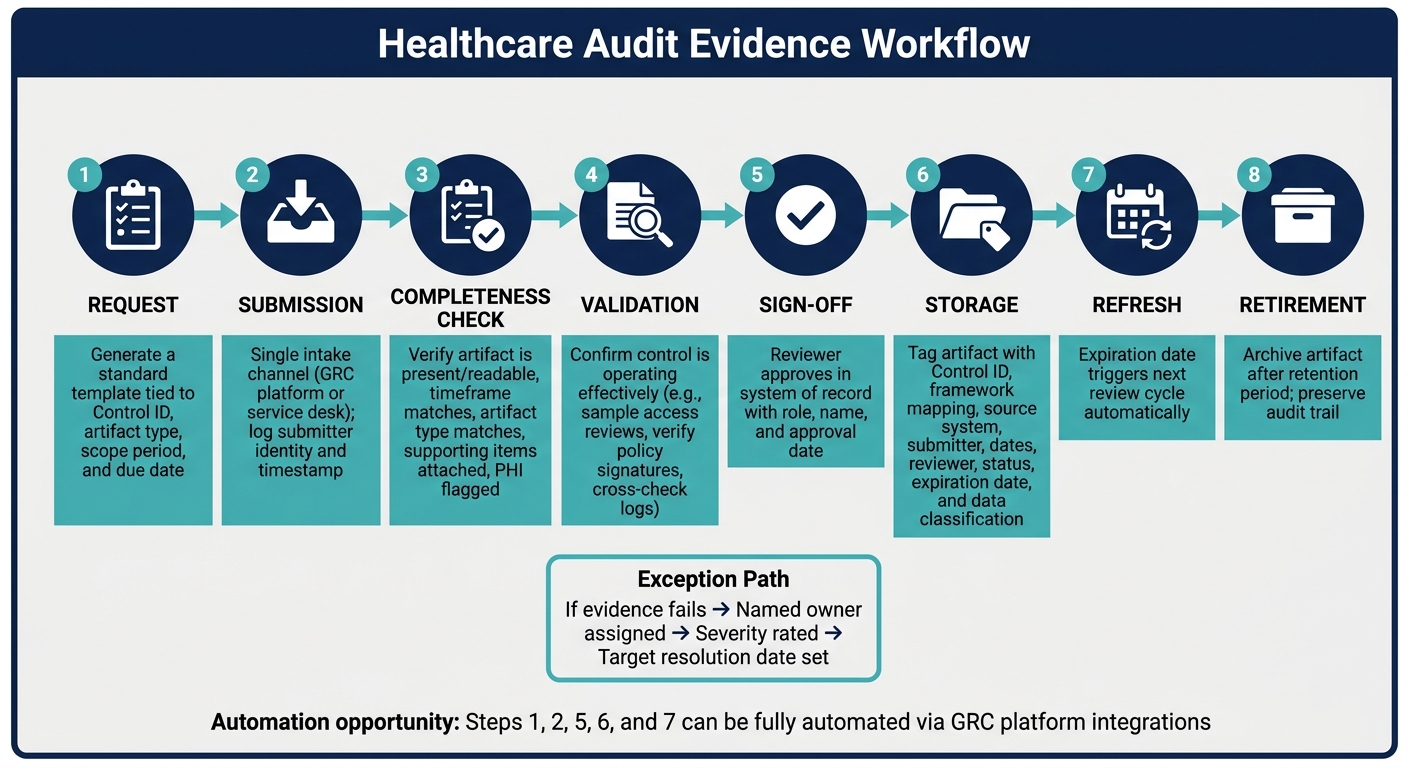
Healthcare Audit Evidence Workflow: 8-Step Repeatable Process
A control-to-evidence register tells you what to collect. A repeatable workflow tells you how to collect it, check it, and refresh it without the whole process falling apart when people leave or roles shift, a common challenge in the future of GRC in healthcare. The control register should stay the source of truth for every request.
Build a workflow from request through approval and retirement
Every evidence item should move through the same path: request, submission, validation, signoff, storage, refresh, exception handling, and retirement. When teams skip a step or handle it off the books, that's usually when audit chaos begins.
The request stage starts with a standard template tied to the control ID, required artifact type, scope period, and due date. Reuse that same template each cycle - quarterly for access reviews, annually for policy documents - so no one has to build requests from scratch every time. Submission should happen through one intake channel, whether that's a dedicated ticket type in your service desk or an evidence collection form in your GRC platform. As soon as a submission comes in, log the submitter's identity and a timestamp.
Before anyone reviews the file, run a completeness check. Confirm that the artifact is present and readable, that the timeframe matches the request window, that the artifact type matches the request - say, a configuration export instead of a screenshot - and that any supporting items, such as change tickets, approval emails, or vendor attestations, are attached. If the material includes PHI, flag it and send it to approved storage.
Validation answers the big question: does this evidence show that the control actually works? That can mean sampling user accounts in access review outputs to confirm deactivated users were removed, checking that a policy document has the right approval signature and was updated within the defined cycle, or comparing identity provider logs with EHR access logs to make sure they line up. After validation, the reviewer signs off in the system of record with their role, name, and approval date.
Tag each approved artifact with:
- Control ID
- Framework mapping
- Source system
- Submitter
- Submission date
- Reviewer
- Approval date
- Status
- Expiration date
- Data classification
Use expiration dates to kick off the next review cycle. Refresh scheduling should tie recurrence directly to that expiration date. If evidence fails review or comes in incomplete, send it through an exception workflow with a named owner, severity rating, and target resolution date. Retirement closes the loop by archiving artifacts after the retention period while keeping the audit trail intact.
Where automation reduces manual effort and missed evidence
Once the manual path is set, automate the repeatable parts. Rules-based steps are the best place to start because they help stop missed evidence across recurring review cycles and larger programs.
GRC platforms can generate evidence requests automatically when a control's scheduled test date arrives. That request can come pre-filled with metadata, so owners get a clear ask instead of a fuzzy email that sparks three follow-ups. Automated reminders and escalation paths also cut down the back-and-forth that eats up compliance team time. Notices go out as due dates get closer, and overdue tasks move to managers without someone chasing them by hand. Status fields can update on their own as users complete steps or as expiration dates pass, which keeps dashboards current without a spreadsheet babysitter.
Evidence ingestion integrations push this even further. Identity providers can send access review exports straight into the evidence repository. Cloud platforms can deliver configuration baselines on a set schedule. Ticketing systems can surface change management records as linked evidence without anyone attaching files one by one. For some control types, that removes manual data entry from the workflow altogether.
The table below shows where automation has the clearest payoff compared with manual collection:
| Workflow Step | Manual Approach | Automated Approach | Improvement |
|---|---|---|---|
| Evidence request creation | Compliance analyst drafts email or spreadsheet row | GRC platform generates request from control schedule, pre-filled with metadata | Consistent format; no drafting time |
| Reminders and follow-up | Analyst tracks due dates and sends individual follow-ups | System sends scheduled alerts and escalates overdue items | Fewer missed deadlines |
| Status tracking | Analyst updates shared tracker manually | Status changes automatically as steps are completed or dates pass | Real-time visibility |
| Evidence ingestion | Owner exports file, attaches to email or folder | Integration pulls export from source system on schedule | Faster collection; no manual attachment errors |
| Expiration alerts | Analyst reviews calendar or spreadsheet | System flags expiring evidence and spawns new requests | Proactive refresh |
| Audit traceability | Relies on email threads and manual logs | System logs every action | Complete chain of custody |
Validation and exception decisions should still stay with people. That next layer comes down to who owns what across internal teams and vendors.
Govern evidence at scale across internal teams and third parties
Once collection and validation are standardized, governance answers two plain but big questions: Who owns each artifact? And what happens if that person doesn’t respond?
Automation helps move work along. Governance is what keeps accountability in place across internal teams and outside vendors.
Assign ownership that survives turnover and organizational change
The biggest weak spot is person-based ownership. It falls apart when people leave, switch roles, or get pulled into other work.
A role-based model fixes that. Assign roles, not names. Compliance owns audit readiness. Security owns technical evidence. IT owns operational evidence. Procurement owns vendor inventory and contract records. Legal owns BAAs, DPAs, and breach terms. Business owners own the vendors and systems they sponsor.
Store role fields for owner, submitter, reviewer, and approver right in the control-to-evidence register, next to the artifact, cadence, and retention fields. When someone leaves, you can update the role-to-person mapping in one place and keep the governance model in shape.
It also helps to pair each primary owner with a backup. If a task misses its SLA, escalate from the primary owner to the backup, then to the manager. During heavy audit periods, temporary delegation should be allowed, with full action logging so nothing gets fuzzy later.
Run scheduled readiness reviews that cover:
- evidence freshness
- open exceptions
- upcoming audits
- ownership changes
That rhythm matters. When these reviews become part of normal operations, the program stays ready instead of scrambling at the last minute.
Use this same role-based model for third-party evidence too.
Tier vendor evidence by risk and centralize supporting records
Third-party evidence should sit in the same model as control evidence. Start by assigning every vendor a risk tier based on PHI access, system criticality, and connection to clinical operations. That tier should set the required artifacts, refresh cadence, and responsible owners, using the same risk-based approach applied to control evidence.
High-risk vendors need the largest artifact set and the most frequent refresh cycle. Medium-risk vendors need a smaller but still structured set. Low-risk vendors need basic documentation and standard contract terms.
| Risk Tier | Required Artifacts | Refresh Cadence | Business Owner Role | Legal Owner Role | Security/Risk Owner Role | Storage Location |
|---|---|---|---|---|---|---|
| High | BAA, detailed security questionnaire, SOC 2 Type II or HITRUST certification, annual pen test summary, incident notification procedures, remediation evidence | Annual for attestations and questionnaires; as needed for incidents and remediation | Clinical or Operations Lead | Healthcare Counsel | Vendor Risk Lead | Centralized vendor record |
| Medium | BAA, standard security questionnaire, SOC 2 Type II or equivalent attestation, incident notification clause | 18–24 months for attestations; 12 months for questionnaires | Department or Program Manager | Contracts Counsel | Security Analyst | Centralized vendor record |
| Low | Standard contract terms, basic security questionnaire | Policy-defined review cycle | Procurement Manager | Contracts Counsel | Procurement Analyst | Centralized vendor record |
Each vendor record should include the metadata that people usually go hunting for later: artifact versions, effective and expiration dates, source, reviewer, and control mappings that connect vendor attestations to the exact HIPAA, HITRUST, or SOC 2 controls they support.
That mapping makes a big difference. It lets auditors pull a complete vendor packet without piecing it together by hand.
Centralized vendor records only do their job when they live in the same system of record as control evidence.
Use the right tool stack and operating metrics to stay audit-ready
Once ownership and retention are set, your system of record needs to back them up in day-to-day work.
Core tooling capabilities for a single evidence system of record
A healthcare evidence system of record should connect controls to artifacts, send work to the right people, and flag gaps before an auditor finds them. In plain English: the stack has to do four jobs well.
- Control-to-framework mapping: Every HIPAA, HITRUST, SOC 2, or internal control should link straight to its required evidence types, owners, and review cadence inside the GRC platform. That means no orphaned artifacts and no controls sitting there without a map.
- Workflow, ticketing, and automated monitoring: Evidence requests should create tickets on their own, route to the assigned owner, and close only after the evidence is attached, checked, and tagged to the right control. When possible, the system should pull evidence directly from connected tools - IAM platforms, vulnerability scanners, HR systems, and ticketing tools - instead of waiting on manual uploads. Automation can cut manual audit preparation time by 41%. [1] Overdue tasks should also escalate on their own, without someone having to chase people down by hand.
- Repository metadata, versioning, and retention fields: Evidence should live in a clear folder structure organized by domain, framework, system, and vendor. Each artifact should include standard metadata - control ID, framework mapping, owner, effective date, version, and source. It also needs access controls based on least privilege and immutable logs showing who viewed, changed, or downloaded each artifact. For PHI-adjacent evidence under HIPAA and HITRUST, this isn't optional.
- Dashboards and operating metrics: Readiness should be easy to see. Dashboards should track evidence completeness, evidence freshness, workflow SLA performance, exception rates, and vendor coverage. [27][28][29]
Healthcare teams also need a few extra capabilities. The system should track BAAs, support multi-framework mapping, and document HITRUST control inheritance without creating duplicate records.
Censinet RiskOps™ combines third-party risk workflows, evidence validation, and AI-assisted documentation in one system.
Track evidence completeness rate: the share of in-scope controls with current, validated artifacts ready for review.
Conclusion: The operating model for always-ready evidence
An always-ready evidence program doesn't come together in a last-minute sprint before an audit. It comes from steady operating habits: a defined evidence model, controls mapped to artifacts and owners, repeatable collection workflows, durable role-based ownership, enforced retention standards, centralized vendor records, and connected tooling that keeps everything current.
Each layer supports the next. The control-to-evidence register gives workflows something to run on. Workflows give ownership something to enforce. Ownership gives the tool stack something to route. And the tool stack gives leadership something to measure.
When those parts work together, audit readiness stops feeling like a special project and becomes the default way the team operates.
FAQs
How do we start building a control-to-evidence register?
Start with a master index in a spreadsheet or database that links each regulatory citation to the artifact that supports it. Include the evidence ID, document name, owner, source system, covered citation, related control, effective date, review schedule, and retention deadline.
Then use a unified control matrix to map overlap across HIPAA, SOC 2, and HITRUST. From there, standardize your folder structure and file names with the MM-DD-YYYY format.
What evidence should we retain for HIPAA audits?
Keep records that prove your controls are in place, used in day-to-day work, and checked over time. HIPAA says you must keep this documentation for at least six years from the date it was created or the date it was last in effect, whichever is later.
That proof can include risk analyses, policies and procedures, training records, BAAs, access reviews, audit log reviews, incident files, vulnerability scans, encryption settings, firewall rules, and tested contingency or disaster recovery plans.
How can we keep vendor evidence audit-ready?
Move away from reactive, manual collection and switch to a centralized, continuous model. Keep a complete inventory of every vendor that handles PHI, and make sure each one has a current, signed BAA plus a documented risk assessment.
Store your evidence in one centralized repository and map it to your controls and frameworks. Then use automated workflows and API integrations to keep that evidence current, version-controlled, and easy to access within required regulatory timelines.
