
One vendor incident can stall care, expose PHI, and slow cash flow across many health systems at once. That is the main point. I’d treat the vendor network like core infrastructure, not a procurement checklist.
Here’s the short version:
- Third-party risk now spreads through connected vendors and fourth parties
- Annual reviews and static questionnaires are too slow
- Teams need shared risk data across security, privacy, IT, clinical engineering, compliance, and AI oversight
- The main inputs are monitoring data, incident notices, threat feeds, security ratings, SBOMs, and dependency maps
- The goal is simple: spot concentration risk, rank vendors by care impact and PHI exposure, and cut response time when incidents hit
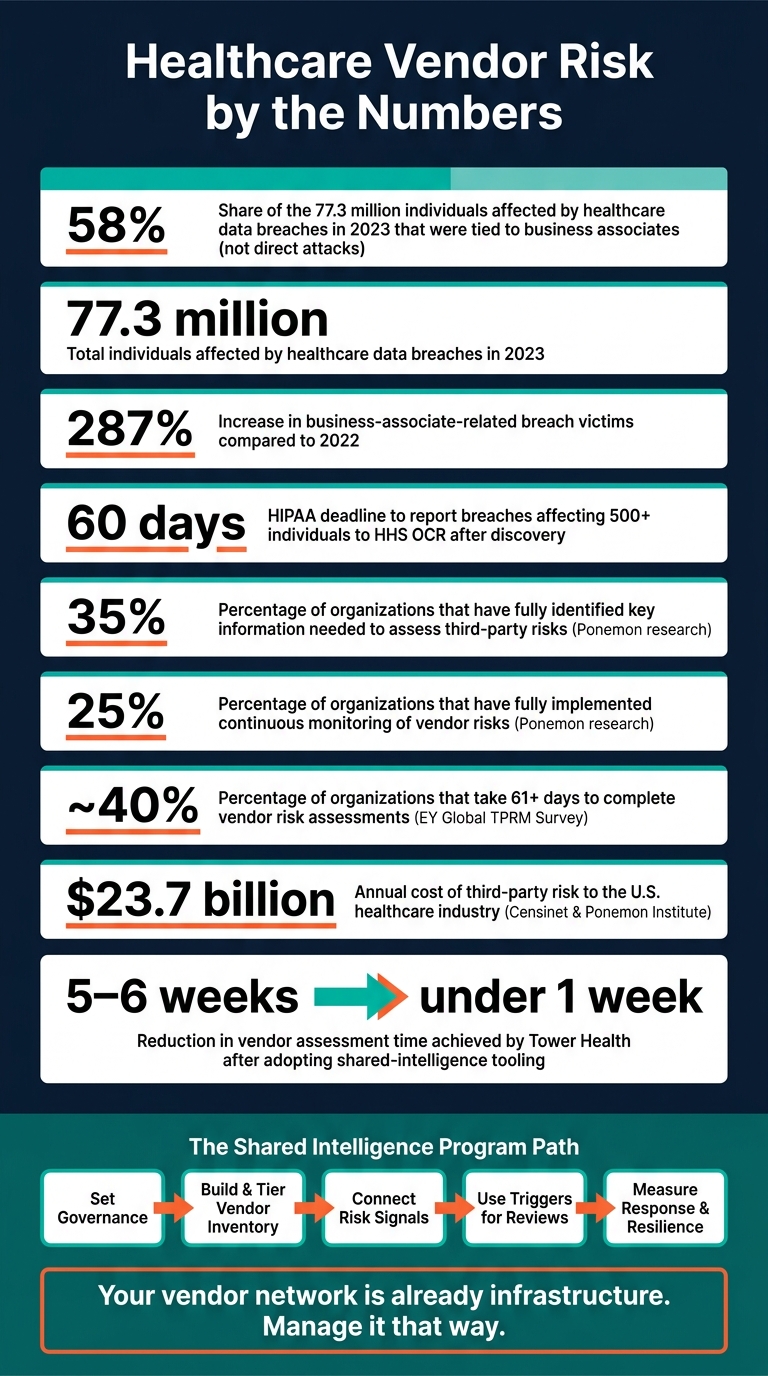
- HIPAA timelines matter: breaches affecting 500+ people must be reported to HHS OCR within 60 days of discovery
- The pressure is growing: in 2023, 58% of the 77.3 million people affected by healthcare breaches were tied to business associates
I’d boil the article down to this: if you can’t see shared vendors, hidden sub-processors, affected software components, and incident signals in one workflow, you’ll lose time when a ransomware event, outage, or data exposure starts moving through your vendor chain.
A few points stand out:
- A shared provider can disrupt claims, revenue, and clinical work at the same time
- SBOM data helps teams check exposure to flaws like Log4j or OpenSSL
- Vendor tiering should focus on clinical impact, PHI access, and dependency risk
- Good programs track assessment time, monitoring coverage, and incident routing time
- AI vendors need review too, especially for training data, model updates, and data-use controls
I also see a clear program path in the piece:
- Set governance
- Build and tier the vendor inventory
- Connect risk signals into one workflow
- Use triggers for targeted reviews
- Measure response time, coverage, and resilience
This is less about more paperwork and more about shared visibility and faster action.
If I were reading this for one takeaway, it would be this: your vendor network already affects uptime, patient care, privacy, and compliance every day, so it should be watched like infrastructure.
Healthcare Vendor Risk by the Numbers: Why Shared Intelligence Is Critical
Creating Cyber Resilience: Your Guide to Healthcare Vendor Risk Management [On-Demand Webinar]
sbb-itb-535baee
What Shared Intelligence Means in Healthcare Vendor Risk Management
Shared intelligence is a working practice. It means collecting, sharing, and using risk data on an ongoing basis across the vendor network. In healthcare, that network helps keep care delivery, compliance, and uptime steady as vendors connect to one another.
And vendor environments don’t sit still. Settings change, sub-processors shift, and patches sometimes get missed. What matters is turning those signals into faster triage and response.
The Core Signals: Monitoring, Incidents, Threat Feeds, Ratings, and SBOM Data
The main inputs are simple, but they carry a lot of weight. Each one answers a different risk question.
| Signal | What It Tells You |
|---|---|
| Continuous monitoring data | Current security posture - open ports, exposed services, misconfigurations, SSL/TLS issues |
| Breach indicators & incident reports | Whether a vendor is actively compromised and whether PHI may be exposed |
| Threat intelligence feeds | Which active campaigns target technologies your vendors use |
| Security ratings | Comparative risk across vendors; flags sudden drops that warrant a closer look |
| SBOM data | Exact software components inside vendor products, enabling faster vulnerability impact analysis |
| Fourth-party dependencies | Hidden reliance on shared cloud providers, identity services, or sub-processors |
SBOMs matter a lot in healthcare because FDA guidance requires machine-readable SBOMs for cyber devices, along with vulnerability and end-of-support information.[2][3] When a major vulnerability shows up - like Log4j or OpenSSL - a current SBOM helps you spot which vendor products may be affected, fast.
How Shared Signals Address Cyber, Compliance, and AI Risk
For ransomware readiness, threat feeds can show active campaigns aimed at specific VPN or remote desktop technologies. That gives your team a direct way to check which vendors use those tools and whether controls like MFA and patching are up to date. For PHI protection, incident notices from vendors let covered entities figure out HIPAA breach notification duties quickly - instead of finding out from a headline after the damage is done.
These continuous signals also support HIPAA-compliant vendor risk management and breach response in a direct way. Business-associate breaches now make up a much larger share of healthcare incidents, and they affect far more people than they did a decade ago.[1] HIPAA requires covered entities to include vendors in an organization-wide risk analysis, which makes continuous vendor monitoring a day-to-day need, not an optional extra.[4][5]
For AI governance, shared intelligence also covers model-training data, version logs, performance metrics, and output changes. If a vendor updates a clinical decision-support model, your governance team needs to hear about it right away - not stumble across it later. The key is figuring out how to use those signals to rank exposure and move faster.
What 'Shared' Actually Means Across the Vendor Network
"Shared" means the right people get the right signals at the right time. A CISO needs alerts and threat feeds. A privacy officer needs incident timelines and data-use documentation. Clinical engineering needs SBOM updates and patch status. AI governance needs model logs and performance data.
Each group sees what matters to them, but the work happens in one common flow instead of being scattered across inboxes and spreadsheets.
Vendors are part of that flow too. Rather than being reviewed in isolation, they provide standard evidence - SOC 2 reports, updated SBOMs, incident notifications, remediation confirmations - and get clear feedback on what needs to change. That two-way exchange turns vendor risk management into an active, documented process. The next step is using that visibility to spot concentration risk, rank vendors, and speed up response.
How Shared Intelligence Leads to Better Risk Decisions and Faster Response
Shared intelligence turns vendor data into faster triage, clearer priorities, and faster response. When vendor intelligence is current and structured, healthcare groups can move from reactive scrambling to deliberate, evidence-based action.
Identify Concentration Risk and Hidden Fourth-Party Dependencies
Many health systems don’t realize how concentrated their vendor exposure is until something breaks. A small set of dominant EHR, cloud, or remote-access providers can create system-level exposure that won’t show up in a single vendor review.
Shared intelligence connects inventory data with dependency maps and SBOMs. That gives teams a clear view of what’s tied together: which critical workflows use the same cloud provider, which clinical and back-office apps depend on the same open-source component, and which fourth-party sub-processors sit behind multiple vendors. So when a high-severity CVE appears - or a threat feed flags active exploitation of a given technology - you can answer how many of our vendors are affected right away instead of spending days chasing the answer.
Rank each dependency by clinical impact, PHI access, and technical reliance. That mix shows where one failure could ripple across facilities - and where failover plans or alternate vendors need attention first. Of course, visibility alone isn’t enough. It has to feed triage and remediation.
Prioritize Vendors and Validate Controls with Real-Time Evidence
Once exposure is mapped, the next job is deciding which vendors need action now. Changes in ratings, CVEs, and threat alerts can act as clear triggers for review.
A few practical trigger points include:
- A major drop in a vendor’s security score
- Discovery of an actively exploited component in the vendor’s product stack
- A confirmed incident
- A service change that increases PHI exposure
When one of those triggers hits, the response doesn’t need to be a full reassessment. In many cases, a focused review is enough. You might ask for updated MFA logs, a recent patching report, or confirmation of a specific mitigation. That kind of targeted check helps confirm whether controls are still working without slowing everything down.
This matters because, according to Ponemon research, only 35% of organizations have fully identified the key information needed to assess third-party risks, and only 25% have fully implemented continuous monitoring of vendor risks.[7]
Respond Faster to Ransomware, Data Exposure, and Service Disruption
Vendor incidents need immediate triage. A ransomware event at a billing vendor, an unauthorized access incident involving a cloud-hosted EHR integration, or a long outage at a medical imaging platform can affect patient care within hours. The teams that move fastest already share the same context in one workflow.
Standardized incident data is what makes that work. When a vendor reports an incident, structured fields like incident type, start time, affected systems, data types involved, and containment status help security, privacy, clinical operations, and legal teams line up on severity right away instead of wasting time gathering basic facts. That same structure also supports pre-built playbooks. Security can check logs for indicators of compromise, privacy can start PHI exposure analysis, and clinical operations can assess care delivery impact - all at the same time, not one after another.
Under HIPAA, covered entities must report breaches affecting 500 or more individuals to HHS OCR within 60 days of discovery.[6] That clock starts at discovery, not resolution. Shared intelligence - especially standardized incident notices from vendors and integrated threat feeds - shrinks the gap between something happened and we know what happened and who is affected. That’s the window that often decides whether an organization meets its notification duties or starts falling behind. That workflow sets up the program design that follows.
A Practical Blueprint for Building a Shared-Intelligence Program
If you want to move from plain visibility to action, keep the sequence simple: govern, connect, measure. In practice, that means building the program in three steps: governance, data integration, and measurement.
Start with Governance, Inventory, and Vendor Tiering
Begin with a formal third-party risk management (TPRM) charter approved by executive leadership or the risk committee. Put one person in charge of vendor risk - usually the CISO or Chief Risk Officer - and make it clear that vendor risk is part of core operations, not just a procurement task.
Next, set up a cross-functional governance team with representatives from security, compliance, privacy, procurement, clinical engineering, and AI governance. Each group has its own job. Clinical engineering looks at risks tied to networked medical devices and SBOM review. AI governance checks how vendors use PHI in models and whether those models line up with FDA and ONC guidance. Compliance tracks BAAs and regulatory attestations such as SOC 2 and HITRUST. A RACI matrix for onboarding, reassessment, incident handling, and offboarding helps keep work from piling up on one team - or slipping through the cracks.
Vendor tiering turns a plain inventory into a working risk picture. A useful model has three or four tiers based on PHI access volume, clinical criticality, and business impact. Tier 1 vendors - those whose failure would affect patient care within 72 hours or cannot be replaced at scale within 30 days - need continuous monitoring and semiannual contingency exercises.[11] Lower-tier vendors can follow lighter review cycles. Tier 1 vendors should go through full security and privacy reviews, SBOM analysis, penetration testing evidence review, and BAA review. Tier 3 and Tier 4 vendors may only need basic security attestations.
Connect the Right Data Sources into One Risk Workflow
Once governance and tiering are set, bring everything into one workflow so each team responds to the same signal in the same way. The goal is simple: turn each signal into a standard trigger for action.
| Signal Type | What It Detects | Primary Users | Trigger for Action |
|---|---|---|---|
| Continuous Security Rating | External security posture changes, exposed services, certificate issues | Security, Vendor Risk Team | Significant score drop for a Tier 1 or Tier 2 vendor triggers targeted control review |
| Threat Intelligence Feed | Active campaigns, ransomware IOCs, healthcare advisories | Security Operations, Vendor Risk Team | Named vendor or technology flagged in active exploitation triggers immediate triage |
| Vendor Incident Notification | Service disruptions, breaches, unauthorized access events | Security, Privacy, Clinical Operations, Legal | Any confirmed incident involving PHI or clinical systems triggers structured incident workflow |
| SBOM Vulnerability | Known exploitable components in vendor software or connected medical devices | Security, Clinical Engineering | New critical CVE on a Tier 1 clinical system or device triggers urgent patch verification and compensating controls review |
| Assessment Evidence & Attestations | Control maturity, SOC 2 status, HITRUST certification, BAA compliance | Compliance, Privacy, Procurement | Evidence older than 12 months or a major product change triggers reassessment request |
| AI Model Risk Assessment | PHI use in training data, model governance controls, bias and explainability posture | AI Governance, Privacy, Compliance | New AI feature using PHI or a regulatory change triggers model risk review |
Use a common risk schema that normalizes severity, likelihood, impact, vendor, and product so every signal is triaged the same way.[10]
Measure What Matters: Assessment Speed, Prioritization, and Resilience
Metrics give the program a feedback loop. The ones that matter most fit into three buckets: speed, coverage, and resilience.
For speed, track the median and 90th-percentile time to complete an initial risk assessment for Tier 1 vendors. Also track the average time from detection of a high-severity signal to a finished reassessment or targeted review. That gap tells you where the process slows down. EY's Global TPRM survey found that nearly 40% of organizations take 61 days or more to complete assessments.[8] Continuous monitoring can shrink that delay in a meaningful way. One hospital group cut the time from detecting a material vendor exposure to getting a remediation plan down to six days.[9]
For coverage, track the number and percentage of Tier 1 and Tier 2 vendors tied into continuous monitoring feeds. For resilience, track the percentage of critical suppliers with validated controls from the last 12 months, along with the average time it takes to route a vendor incident to the right internal stakeholders.
Taken together, these metrics show whether shared intelligence is cutting concentration risk, speeding up triage, and improving response when pressure hits. With that structure in place, teams can centralize execution in one vendor-risk workflow.
How Censinet Supports Shared Intelligence Across the Vendor Network
Once governance, tiering, and data flows are set, the next hurdle is scale. That’s where Censinet comes in. The platform pulls this work into one system, with the goal of treating the vendor network like infrastructure, not a pile of separate contracts.
Use Censinet RiskOps™, Censinet One™, and Censinet Connect™ to Centralize Vendor Risk
Censinet RiskOps™ brings assessments, evidence, scores, and incidents into one place. Risk teams get a single view of vendor posture by tier, data sensitivity, and criticality. RiskOps™ also maps each vendor product across critical healthcare functions, which makes concentration risk and single points of failure easier to spot before an incident puts them in the spotlight.[12]
RiskOps™ handles the internal workflow side. Censinet One™ helps improve the quality and timeliness of vendor-supplied evidence. It cuts friction in the shared-intelligence loop by removing duplicate questionnaires, stale evidence, and slow vendor replies. Vendors keep their control information in one place and share it across many customer assessments. That means your team gets current, validated data instead of waiting weeks for yet another spreadsheet to come back.
Centralized data doesn’t do much if the right people never see it. Censinet Connect™ pushes risk signals into procurement, EHR, GRC, and ticketing platforms. So when a Tier 1 vendor changes, security, privacy, procurement, and operations teams get notified in the tools they already use.
Censinet and Ponemon Institute research found that third-party risk costs the U.S. healthcare industry $23.7 billion per year.[14][15] Tower Health cut assessment time from 5–6 weeks down to under one week after adopting RiskOps™, redeploying three FTEs and tripling assessment productivity.[13]
Apply Censinet AI™ to Speed Reviews While Keeping Human Oversight
Censinet AI™ takes on the parts of vendor risk management that eat up time but don’t call for deep judgment. It helps vendors complete security questionnaires faster by suggesting responses based on prior assessments and known control configurations using Censinet Connect™ Copilot. It can also ingest SOC 2 reports, penetration test summaries, and policies, then flag gaps for analyst review.
For fourth-party exposure, Censinet AI™ reviews SBOMs and vendor architecture data to tag shared dependencies across the vendor portfolio. If a critical cloud provider or open-source component shows up across many Tier 1 vendors, risk teams can spot that concentration early and act before it turns into a crisis. This is critical as security threats in healthcare vendor relationships continue to evolve. AI also routes incoming assessments and incidents by flagging PHI exposure, ransomware-related findings, or AI model risk, then sending them to the right stakeholders automatically.
The human review model is there by design. Risk analysts review AI-generated summaries, approve or adjust risk ratings, and keep final authority over remediation requirements and risk acceptance. In healthcare, where decisions can affect patient safety and regulatory duties, automation supports expert judgment - it doesn’t replace it. Censinet AI™ helps extend those gains into the slowest parts of the review process.
Conclusion: Manage the Vendor Network Like the Infrastructure It Has Become
In 2023, 58% of the 77.3 million individuals affected by data breaches in healthcare were hit through attacks on business associates - a 287% increase compared to 2022.[16] That’s infrastructure risk, not just a procurement problem.
The fix starts with shared intelligence.
When monitoring, incident, rating, and SBOM signals come together in one response flow, teams can act from the same picture. That helps them spot concentration risk, check whether controls are working in live conditions, and move faster when something goes wrong. It also makes hidden fourth-party dependencies easier to catch before they turn into operational incidents.
Static questionnaires just can’t keep up with a connected vendor network. Continuous evidence can.
The vendor network is already infrastructure. Manage it that way.
FAQs
How do we identify shared vendor concentration risk?
Build a shared, continuously updated vendor inventory that also maps hidden shared dependencies, especially fourth-party upstream providers.
Then tier vendors based on:
- clinical criticality
- PHI exposure
- access level
- downtime tolerance
From there, use shared-intelligence signals - breach disclosures, Known Exploited Vulnerabilities, exploit activity, incident reports, and SBOM/dependency data - to spot where a single common provider outage or compromise could hit many hospitals at the same time.
Which vendors need continuous monitoring first?
Prioritize continuous monitoring for high-risk vendors first. Focus on the ones that handle large amounts of protected health information, connect to critical clinical systems, manage security tools, or have direct network access through VPNs or APIs.
Start with Tier 1 vendors like electronic health records, imaging systems, and connected medical devices. If these services go down, patient care or clinical operations can be affected within 72 hours.
What should we do when a vendor incident occurs?
Treat this as an operational event that could affect patient care and PHI. Start your incident response playbook right away. Alert security, third-party risk, privacy/legal, and clinical operations. If a high-risk alert - especially a Tier 1 alert - isn't acknowledged within 2 to 4 hours, escalate fast.
Use live vendor intelligence to verify what happened, what systems or data are affected, and how severe the issue is. From there, move to containment with approved actions. If needed, coordinate downtime procedures or manual workflows so care teams can keep moving.
Then push what you learn back into the process:
- risk tiering
- remediation tracking
- contract and SLA enforcement
This keeps the response grounded in facts, not guesswork, and helps teams act with the right level of urgency.
