
If you work in healthcare, a generic GRC tool may track risk, but it often won’t show how that risk hits patient care. That is the core point.
I’d sum up the article like this:
- Healthcare risk is different because it ties cyber events to PHI, medical devices, EHR downtime, vendors, and patient care.
- Censinet RiskOps™ is built for healthcare from the start, with native support for healthcare frameworks, device risk, clinical workflows, vendor risk, and breach context.
- LogicGate Risk Cloud gives you flexible workflows and framework mapping, but your team must build much of the healthcare context itself.
- ServiceNow GRC/IRM fits large enterprise programs, especially if you already use ServiceNow, but healthcare use usually needs heavy setup and custom modeling.
- The biggest gap in generic platforms shows up in clinical workflows, connected devices, vendor exposure, and healthcare-specific framework mapping.
- That matters because healthcare breach pressure is high: 663 large PHI breach reports were filed in 2024, affecting 242,908,056 people, and vendor-related incidents exposed more than 82 million records.
- In connected care settings, context matters even more: about 53% of connected medical and hospital IoT devices have a known critical vulnerability.
So if I were judging these platforms, I would focus less on a long feature list and more on four simple questions:
- Does it map HIPAA, HICP, HITRUST, NIST 800-66, and FDA device guidance without a lot of custom work?
- Does it show risk across clinical systems, IoMT, medical devices, and patient-safety workflows?
- Does it track healthcare supply chain security challenges in a healthcare setting?
- Does it support evidence-based assessments and breach visibility from day one?
The Future of GRC in Healthcare
sbb-itb-535baee
Quick Comparison
| Platform | Framework Mapping | Clinical Context | Third-Party/Supply Chain | Evidence & Breach Visibility | Best Fit |
|---|---|---|---|---|---|
| Censinet RiskOps™ | Native | Native | Native | Native | Healthcare groups that want sector-specific coverage from the start |
| LogicGate Risk Cloud | Configurable | Limited | Configurable | Configurable | Teams that want to design their own workflows |
| ServiceNow GRC/IRM | Configurable | Configurable | Limited | Configurable | Large health systems already using ServiceNow |
My takeaway: if your team has to spend months building healthcare logic into a general GRC platform, you are not buying healthcare fit. You are buying a base system plus a lot of setup work.
That’s the lens for the rest of the article.
1. Censinet RiskOps™
Censinet RiskOps™ maps risk to patient data, PHI, clinical apps, medical devices, and supply chains. That makes compliance work easier to put into day-to-day use. And in healthcare, that matters most when risk has to connect back to care delivery.
Censinet RiskOps™ uses the HSCC Sector Mapping and Risk Toolkit to map vendors to 17 sector-defined critical functions that support healthcare delivery.[3][5] That gives health systems a clearer view of which vendors support ICU monitoring, surgical scheduling, or revenue cycle operations, and where concentration risk can turn into a single point of failure.[3][5][6]
That same healthcare context extends into third-party oversight. Censinet Connect™ supports vendor risk assessments, while Censinet AI™ helps teams move through questionnaires faster, summarize evidence, capture integration details and fourth-party exposure, and generate risk reports.
A central command center gives teams one place to prioritize findings, track remediation, and coordinate response. That kind of context matters before healthcare organizations stack Censinet up against broader GRC tools.
2. LogicGate Risk Cloud
LogicGate stands out for workflow automation, but healthcare teams still need to build the clinical side on their own. Risk Cloud is a no-code, workflow-driven GRC platform used across healthcare, financial services, insurance, retail, and technology.[8] Its graph connects risks, controls, policies, assets, and incidents. On top of that, a visual workflow builder lets teams shape processes without writing code.[8][12] For U.S. healthcare groups, LogicGate offers a single-tenant healthcare environment for covered entities that need to store PHI, backed by a Business Associate Agreement (BAA).[9][16]
On the compliance front, Risk Cloud supports HIPAA, HICP, NIST CSF, SOC 2, and other frameworks through configurable control mappings and automated evidence collection.[8][14] Spark AI and agents can autofill forms, flag control gaps, and map records across frameworks, cutting down on manual spreadsheet work for compliance teams.[7][15] The platform also reports more than 200 native integrations, including cloud providers, security tools, and ticketing systems.[1]
Third-party risk management is built in. Teams can:
- run vendor intake workflows
- send questionnaires
- score responses
- track remediation in the same platform[8][11][13]
That setup helps with compliance operations. But it doesn't give healthcare teams out-of-the-box risk visibility for clinical settings.
Healthcare context comes from configuration, not native coverage. Risk Cloud can model risks tied to EHR downtime or revenue-cycle disruptions, but it does not come with prebuilt clinical workflow maps, medical device risk libraries, or native clinical metrics like patient harm and care delays.[10][12] It's a bit like getting a solid toolkit without the hospital-specific blueprint.
The same issue shows up in vendor and supply-chain oversight. LogicGate's vendor module handles cyber and compliance risk, but healthcare supply-chain intelligence, such as drug and device suppliers, care dependency chains, or how a vendor outage affects patient care, depends on how deeply the organization has modeled those relationships in the platform.[10][12]
3. ServiceNow GRC/IRM
ServiceNow GRC/IRM extends the Now Platform into governance, risk, and compliance. Many large U.S. health systems use it to centralize policies, controls, risk registers, and issues across hospitals and business units.[17][23] That’s a big plus for scale. But in healthcare, risk work still lives and dies on domain context.
For framework mapping, ServiceNow supports HIPAA, HITRUST CSF, and NIST CSF through its Policy and Compliance Management module and Unified Compliance Framework (UCF) plug-ins.[17][21][2] Teams use content packs to import control catalogs, map them to operational assets, and automate evidence collection such as training records, vulnerability scans, and policy attestations.[27][30] In plain English, that can take a lot of grunt work out of audit prep. It can also help with continuous monitoring. Even so, framework content needs steady upkeep as standards shift over time.[21][2]
The bigger challenge shows up in clinical and operational risk. ServiceNow can link risk records to configuration items in the CMDB, including EHR systems, clinical applications, and, with heavy modeling, biomedical devices.[23][25] But it does not come with built-in clinical risk semantics.[23][25] That matters. Scoring the cyber and operational risk of ICU ventilators is not the same as scoring a finance app. It takes major CMDB customization, added data integration, and domain know-how that the platform does not provide out of the box.[25] Healthcare teams often end up building custom models and integrations to support biomedical device and clinical service workflows. That’s the sticking point: generic platforms can do the job, but they often need deep tailoring before they fit healthcare risk work.
On the third-party risk side, ServiceNow’s Vendor Risk Management (VRM) module covers vendor tiering, standardized assessments, issue tracking, and compliance monitoring for HIPAA and HITRUST across business associates, cloud EHR providers, and medical equipment suppliers.[18][19][20][24] Through integrations like Interos, VRM can also extend into multi-tier supply chain intelligence, covering cyber, financial, geopolitical, and ESG risks.[28] Still, healthcare-specific questionnaire content, such as PHI handling and FDA medical device cybersecurity guidance, usually comes from custom development or consulting partners instead of built-in clinical content.[18][22]
ServiceNow is enterprise-priced, and healthcare TCO goes up with implementation, customization, and ongoing administration.[26][29] Those limits stand out most when healthcare risk has to connect directly to clinical workflows, devices, vendors, and patient-impact exposure.
Where Generic GRC Platforms Fall Short in Healthcare
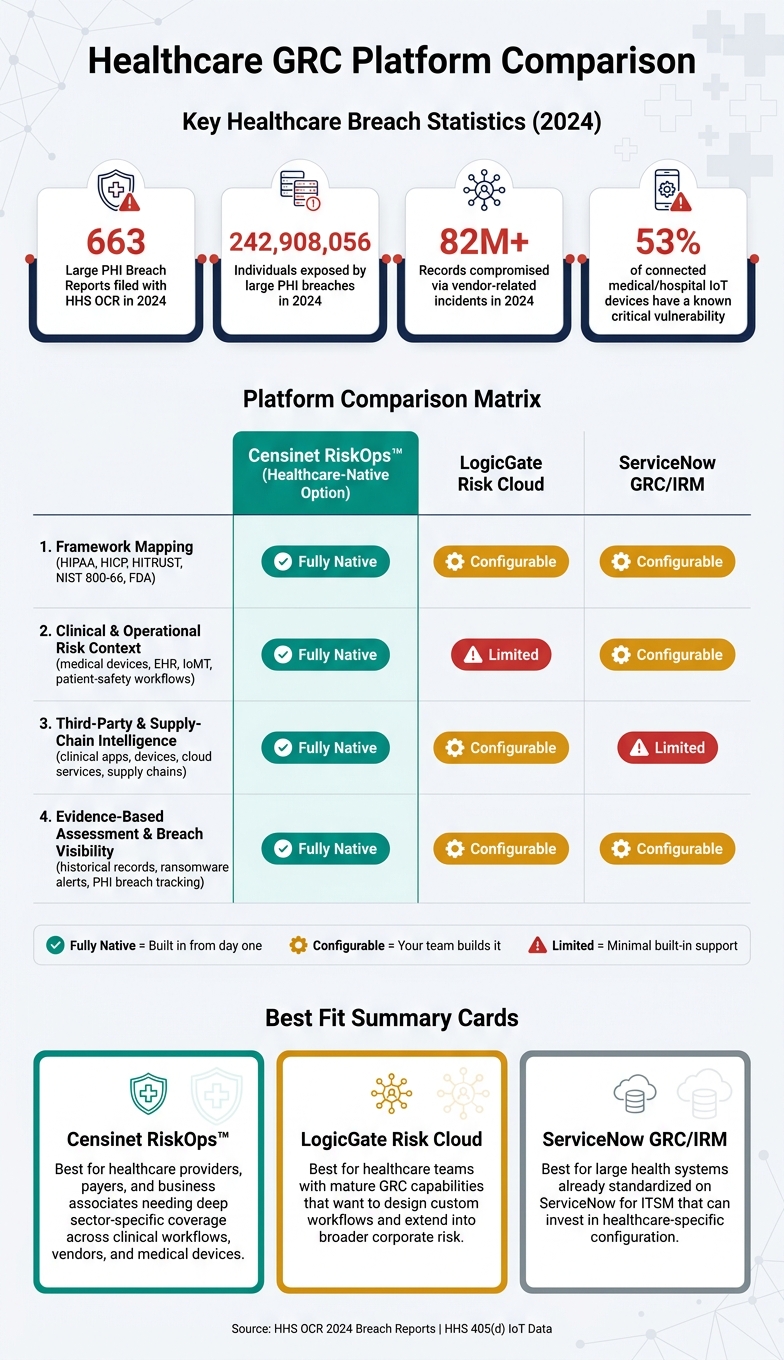
Healthcare GRC Platform Comparison: Censinet vs LogicGate vs ServiceNow
The weak spots tend to show up first in clinical operations and third-party oversight. If your team needs to assess a connected infusion-pump fleet, track how a vendor handled PHI after a ransomware event, or map controls to HICP (405(d)), the setup work lands on you.
And that gap isn't abstract. It shows up in breach numbers, device risk, and day-to-day care.
In 2024, HHS OCR received 663 notifications of large breaches involving unsecured PHI, exposing 242,908,056 individuals. On top of that, 81% of large breaches came from hacking and IT incidents.[31][34] Third-party vendors were also a major part of the problem, with vendor-related incidents compromising more than 82 million records that year alone.[32][33]
That's where many generic GRC tools start to strain. HIPAA, HICP (405(d)), HITRUST CSF, NIST 800-66, and FDA medical device cybersecurity guidance don't fit neatly into a one-size-fits-all control library. You can force the fit, sure. But then your team has to do the heavy lifting.
HHS 405(d) reports that about 53% of connected medical and other hospital IoT devices have a known critical vulnerability.[35] That's a big deal. If those devices get treated like ordinary IT assets, the risk picture gets warped. A device issue isn't just a patching issue. It can ripple into patient safety, EHR downtime, and care delays.
The differences below make that clear. Fully Native means it's built in. Configurable means your team has to set it up. Limited means there isn't much built-in support.
| Healthcare Requirement | Censinet RiskOps™ | LogicGate Risk Cloud | ServiceNow GRC/IRM |
|---|---|---|---|
| Framework mapping (HIPAA, HICP, HITRUST, NIST 800-66, FDA) | Fully Native | Configurable | Configurable |
| Clinical & operational risk context (medical devices, EHR, IoMT, patient-safety workflows) | Fully Native | Limited | Configurable |
| Third-party & supply-chain intelligence (clinical apps, medical devices, cloud services, and supply chains) | Fully Native | Configurable | Limited |
| Evidence-based assessment & breach visibility (historical records, ransomware alerts, PHI breach tracking) | Fully Native | Configurable | Configurable |
The practical tradeoff is pretty simple. Configurable sounds flexible, but in this case it means your team - or an outside consulting partner - has to build the healthcare context that a sector platform already includes. That usually means more time, more cost, and more room for the setup to drift as rules and threat patterns change.
Pros and Cons of Each Platform
The choice mostly comes down to one thing: how much of your healthcare risk content needs to be built in from day one, and how much your team is willing to create on its own.
Some platforms come with healthcare context already in place. Others give you a flexible system, but your team has to do more of the setup work. That tradeoff matters a lot when you're dealing with HIPAA, clinical workflows, medical devices, and vendor risk.
The table below shows where each platform helps most and where healthcare teams still need to close the gaps.
| Platform | Pros | Cons | Best Fit |
|---|---|---|---|
| Censinet RiskOps™ | Purpose-built for healthcare; native HIPAA/HICP mappings; prebuilt content for vendors, clinical workflows, medical devices, and supply chains, which can help healthcare teams get up and running faster[36] | More focused on healthcare than broad enterprise use; less suited for organizations managing broad, non-clinical corporate risk domains[36][4] | Healthcare providers, payers, and business associates that need deep sector-specific risk coverage across clinical workflows, vendors, and medical devices |
| LogicGate Risk Cloud | Highly configurable no-code workflow engine; flexible data model; strong evidence collection and cross-framework mapping; PHI-capable single-tenant option with a BAA available[8][9] | Healthcare content, including clinical workflows and device risk, must be modeled by your team; complex configurations can get harder to maintain over time[8][10] | Healthcare teams with mature GRC capabilities that want to design their own workflows and extend the platform into broader corporate risk areas |
| ServiceNow GRC/IRM | Deep integration with existing ServiceNow ITSM, ITOM, and CMDB environments; strong enterprise workflow automation across policy, risk, audit, and vendor risk[37][39] | Not healthcare-native; HIPAA/HICP mappings, clinical risk objects, and medical device context require substantial custom configuration; programs can end up focused more on IT controls than clinical risk[37][38][40] | Large health systems and academic medical centers already standardized on ServiceNow for ITSM that want to extend existing workflows into GRC and can invest in healthcare-specific configuration |
The main point isn't that generic platforms fail. It's that healthcare teams often have to build too much of the sector-specific context themselves.
Conclusion
This comparison comes down to more than feature depth. It comes down to healthcare fit.
Generic GRC platforms can do a lot. But healthcare teams often still have to build too much domain context from scratch. That takes time, adds work, and slows the path from setup to actual use.
Healthcare breach volume and vendor exposure are still high. So if a platform needs heavy customization just to track vendor breach exposure or medical device risk, it adds friction instead of cutting risk. That’s why the evaluation should center on native healthcare coverage, not a generic feature checklist.
Look at whether the platform natively maps HIPAA and HICP, shows clinical workflow and connected device risk, tracks vendor and supply-chain exposure, and supports evidence-based assessments without heavy customization. That matters because provider, payer, and partner environments are often managing cyber, compliance, third-party, and operational risk at the same time. They need tools that connect those pieces from day one.
A sector platform closes the gap between deployment and day-one usability. That fit should drive the choice.
FAQs
Why does healthcare need a sector GRC platform?
Healthcare needs a sector-specific GRC platform because generic tools often miss the day-to-day realities of care delivery. They often fall short when medical devices, clinical workflows, and tightly connected vendor networks enter the picture.
A healthcare-native platform brings that data together in one place, maps risk to HIPAA and HICP, and replaces manual, siloed work with automated, real-time visibility. That gives teams a clearer view of patient safety issues, third-party risk, and cyber threats so they can act faster when something goes wrong.
What should a healthcare GRC platform map natively?
A healthcare GRC platform should natively map organizational controls to healthcare-specific frameworks like HIPAA and HICP. That helps teams support compliance and makes risk assessments a lot less painful.
It should also connect vendors to the clinical workflows they support. And it should link controls across assets like electronic health records, connected medical devices, and clinical applications, so teams can see risk and compliance in one place.
How does healthcare-specific context improve risk decisions?
Healthcare-specific context improves risk decisions because it moves the conversation past generic compliance labels and toward actual clinical impact.
When teams map vendors and systems to clinical workflows - like electronic health records, medical devices, and patient care pathways - they can rank risk based on possible patient harm, not just financial loss or regulatory exposure.
That shift gives leaders a clearer way to make informed, defensible decisions. It also helps connect technical risk scores to clinical criticality, so time, budget, and staff attention go to the functions that matter most for patient care.
Related Blog Posts
- Integrated GRC Frameworks: Breaking Down Silos for Enhanced Organizational Resilience
- “Rebooting Risk: A New Operating System for Healthcare GRC”
- From $2.8M Fragmented Spending to $750K Unified Platform: The Economics of Intelligent GRC
- Why 92% of Healthcare Organizations Are Failing at GRC Integration - And How AI Changes Everything
