
Annual vendor reviews are too slow for healthcare. If you work with vendors that touch PHI, connect to clinical systems, or support care delivery, you need a program that watches for risk changes between reviews - not just once a year.
Here’s the core idea in plain English: tier vendors by impact, track risk signals all year, and route alerts through a fixed third-party vendor risk management process. That matters because healthcare systems often rely on 1,000+ vendors, and 90% of serious healthcare data breaches involve a third party. The 2024 Change Healthcare attack showed what can happen when one vendor failure hits claims, prescriptions, and cash flow at the same time.
If I had to boil the article down, it says to do four things:
- Know which vendors matter most by mapping PHI access, care impact, system connections, single-source dependency, and regulatory exposure
- Watch the right signals like breach notices, exposed assets, exploited flaws, expired SOC 2 or HITRUST coverage, BAA changes, outages, and ownership shifts
- Set fixed trigger points so teams know when to validate, escalate, remediate, or end a vendor relationship
- Assign ownership across teams like Security, Privacy, Legal, Procurement, and Clinical Operations, with records that can stand up to OCR review
A few points stand out:
- A questionnaire shows a vendor’s state on one day
- Vendor risk can shift fast through hosting changes, new subprocessors, weak MFA, financial trouble, or service instability
- For high-impact vendors, paperwork alone is not enough; you also need outside evidence, service context, and alert handling rules
- In healthcare, a vendor issue is not just a cyber problem. It can become a patient care problem
The article also makes one point that’s hard to ignore: the average cost of a vendor-related breach is $4.88 million. And in healthcare, the damage is not only financial. It can delay treatment, interrupt prescriptions, and slow claims payments.
So the message is simple: use annual reviews as a baseline, not the whole program. If you want fewer surprises, you need clear tiers, live signals, response deadlines, and one record of what you knew and what you did.
Creating Cyber Resilience: Your Guide to Healthcare Vendor Risk Management [On-Demand Webinar]
sbb-itb-535baee
Build a Tiered Monitoring Model Based on Patient, Data, and Operational Impact
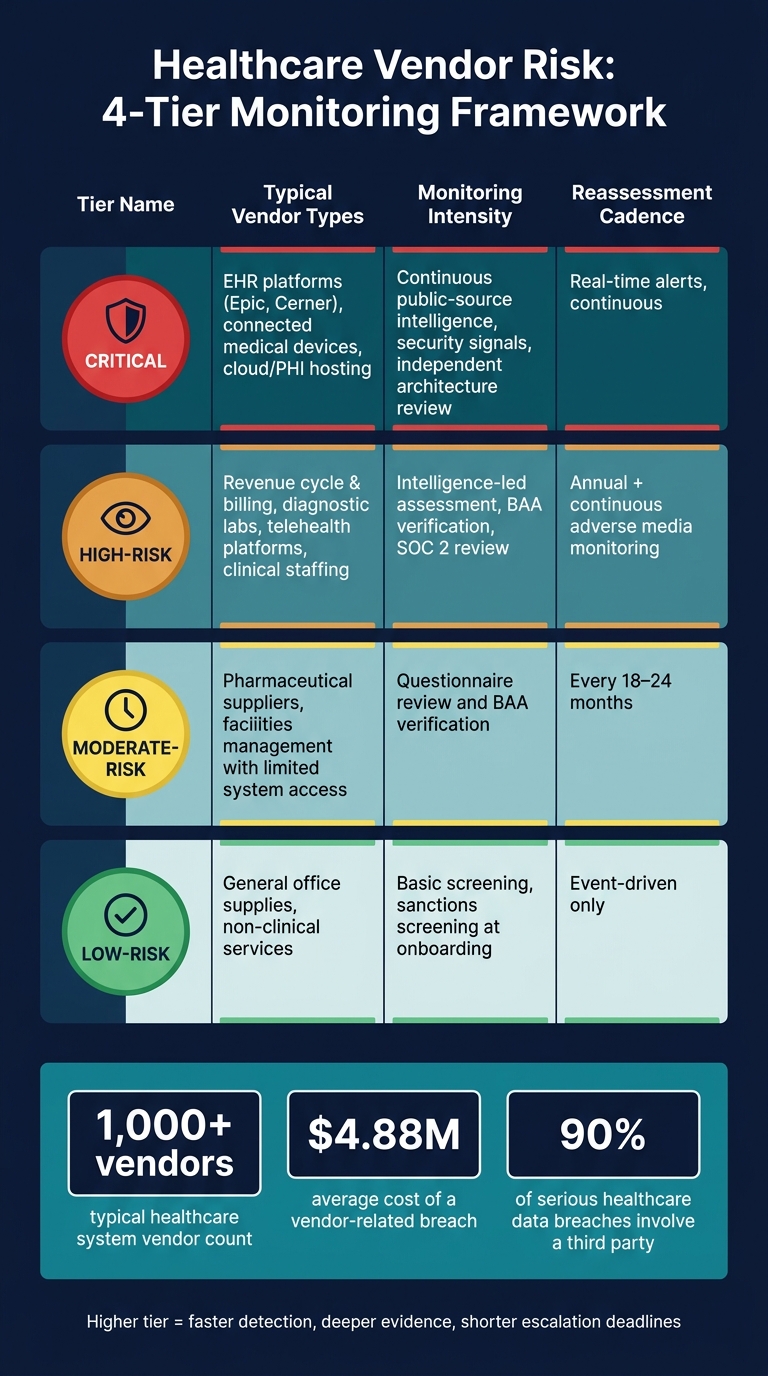
Healthcare Vendor Risk: 4-Tier Monitoring Framework
Use the inventory and risk register you already have to place each vendor into a tier based on patient, data, and operational impact. Not every vendor needs the same level of review. A company shipping office supplies presents one kind of risk. A vendor hosting your EHR in the cloud is in a completely different league.
The goal is simple: put the most attention on vendors that could harm patients, expose PHI at scale, or interrupt care.
Use Risk Factors to Classify Each Vendor
Score vendors by inherent risk, not contract value. A big contract doesn't always mean high risk, and a smaller one can still create major problems in a healthcare setting.
Five factors drive most of the risk in healthcare vendor relationships:
| Risk Factor | What to Assess |
|---|---|
| PHI Access | Does the vendor create, receive, maintain, or transmit PHI? This triggers BAA and HITECH obligations. |
| Clinical Impact | Could vendor failure delay care, such as chemotherapy or surgery? |
| System Integration | Does the vendor connect to your EHR, identity systems, or network? |
| Concentration Risk | Is this vendor the sole source for a critical function, such as claims processing or lab diagnostics? |
| Regulatory Exposure | Is the vendor subject to FDA 21 CFR Part 820/211, CMS Conditions of Participation, or other federal oversight? |
Mature programs look past those five factors too. They also account for subcontractor use, financial distress, adverse media, and beneficial ownership.
Define Tiers and Match Monitoring Intensity to Each
As vendor criticality goes up, monitoring should get deeper. You should also ask for more evidence and move faster when something goes wrong. After scoring vendors against the risk factors above, group them into four tiers:
| Vendor Tier | Typical Vendor Types | Monitoring Intensity | Reassessment Cadence |
|---|---|---|---|
| Critical | EHR platforms (e.g., Epic, Cerner), connected medical devices, cloud/PHI hosting | Continuous - public-source intelligence, security signals, independent architecture review | Continuous, real-time alerts |
| High-Risk | Revenue cycle and billing, diagnostic labs, telehealth platforms, clinical staffing | Intelligence-led assessment, BAA verification, SOC 2 review | Annual + continuous adverse media |
| Moderate-Risk | Pharmaceutical suppliers, facilities management with limited system access | Questionnaire review and BAA verification | Every 18–24 months |
| Low-Risk | General office supplies, non-clinical services | Basic screening, sanctions screening at onboarding | Event-driven only |
For Critical vendors, ask for a SOC 2 Type II report and an independent security architecture review. A self-completed questionnaire isn't enough here. Higher tier should mean faster detection and escalation, not just more paperwork.
Medical device vendors need added scrutiny. Request a Manufacturer Disclosure Statement for Medical Device Security (MDS2) and a Software Bill of Materials (SBOM) so you can review known vulnerabilities and sanctioned components [1].
This approach keeps your team's attention on Critical and High-Risk vendors. Once the tiers are in place, the next step is deciding which signals each tier should track on a continuous basis.
Set Up the Signals That Feed Continuous Monitoring
Once you've set vendor tiers and completed third-party risk assessment questions, the next job is watching for changes that push a vendor from low risk to high risk. That starts with one vendor profile that ties everything together: legal name, aliases, parent and subsidiary entities, domains, products, subprocessors, BAA status, data types, hosting locations, and internal IDs.
Without that single record, alerts get split across tools. And when that happens, your team can miss the full scope of a vendor's exposure.
Each signal should include a timestamp, source, confidence level, affected service or asset, and a status label: new, validated, remediating, or closed. That gives you an audit trail you can stand behind if a regulator or auditor asks what your organization knew and what it did.
The vendor's tier should also shape what gets watched all the time. Not every vendor needs the same level of attention.
Cybersecurity Changes That Can Become Incidents
Track signals that point to attack-surface changes or control drift. That includes breach disclosures, ransomware reports, drops in security ratings, newly exposed internet-facing assets, open admin ports, expired certificates, and weak email security settings, such as missing or weakened SPF, DKIM, or DMARC.
You should also watch for exploited vulnerabilities tied to the vendor's actual products or technology stack, dark-web signs like exposed credentials or leaked API keys, and material changes to MFA, remote access, or vulnerability-management practices.
External signals need validation before they trigger escalation. Let the vendor confirm scope or clear up false positives before your team treats an alert like a live incident.
Security alerts don't tell the whole story, though. Contracts, attestations, and assurance items can slip just as fast.
Compliance and Assurance Drift to Watch For
Certifications can expire. Just as important, they can drift out of scope while the vendor changes hosting, subprocessors, or data use.
Track SOC 2 reports and HITRUST certifications that are expiring, withdrawn, or no longer cover the specific service your organization uses. Adverse findings, overdue corrective actions, and missed deadlines matter too.
On the regulatory side, keep an eye on HIPAA enforcement actions and OCR breach-reporting activity. Under the HIPAA Breach Notification Rule, a business associate must notify the covered entity of a breach of unsecured PHI without unreasonable delay and no later than 60 days after discovery [2]. You should also monitor changes to BAAs, privacy notices, data locations, subprocessors, and stated processing purposes.
If a vendor rolls out new analytics or AI features that touch PHI, that should trigger BAA and privacy review.
A vendor may check the compliance box and still create problems for patient care. That's where operational signals come in.
Operational and Resilience Indicators That Affect Care Delivery
Operational signals matter when downtime gets in the way of clinical work. SLA breaches, recurring service degradation, and unresolved support backlogs can all point to a vendor that may struggle when pressure builds.
Pull data from more than one place. The vendor's status page helps, but so do your internal ticketing system, interface-engine logs, and reports from clinical or operational business owners.
Resilience signals matter just as much. Failed disaster-recovery tests and missed recovery-time objectives are strong warning signs that a continuity plan may exist on paper but hasn't been proven in practice.
Ownership changes, acquisitions, and subprocessor shifts, such as a move to a new cloud provider, can bring new jurisdictions, subcontractors, and security practices into the mix. Expired or reduced cyber insurance should also trigger review because it changes residual risk.
Each signal should map to a risk level and a required action. That way, alerts don't get handled differently from team to team.
| Signal | Risk Category | Evidence Source | Suggested Severity | Likely Response |
|---|---|---|---|---|
| Vendor breach or ransomware disclosure involving possible PHI | Cybersecurity and compliance | Vendor notice, HHS reporting information, incident-response records | Critical | Activate incident response; validate data and service impact; assess HIPAA notification obligations |
| Security rating drops sharply or stays below threshold | Cybersecurity | Independent security-rating service, internal validation | High | Request remediation plan; reassess vendor |
| New internet-facing asset, open admin port, or expired certificate | Cybersecurity | Attack-surface monitoring, DNS and certificate records | High | Validate ownership; request remediation; restrict connectivity if exposure affects the organization |
| Exploited vulnerability affecting a vendor product in use | Cybersecurity | CISA advisories, vendor advisory, vulnerability intelligence, asset inventory | Critical or High | Confirm exposure and patch status; escalate if remediation misses deadline |
| Exposed credential, API key, or dark-web indicator | Cybersecurity | Credential-intelligence or dark-web monitoring | Critical or High | Revoke and rotate; review access logs |
| SOC report or HITRUST certification expires, is withdrawn, or excludes the contracted service | Compliance and assurance | Auditor, certification body, vendor evidence portal | Medium or High | Request current evidence; document gap; reassess controls and contract risk |
| HIPAA enforcement action or material breach-reporting activity | Compliance and legal | HHS enforcement and breach-reporting sources | High | Review affected controls, data, and BAA obligations |
| BAA, privacy purpose, subprocessor, or data location changes | Privacy and compliance | Contract repository, vendor notice, privacy review | High | Conduct legal, privacy, and data-flow review; approve or reject the change |
| SLA breach, recurring outage, or clinical integration degradation | Operational resilience | Status page, internal monitoring, incident tickets, SLA reports | High | Open service review; require corrective action and continuity measures |
| Disaster-recovery test failure or recovery objective miss | Operational resilience | Test report, business-continuity evidence | High or Critical | Require retest and remediation; evaluate backup and downtime procedures |
| Cyber insurance expires or coverage is materially reduced | Financial and operational resilience | Certificate of insurance, contract records | Medium or High | Escalate to risk and procurement; assess residual-risk implications |
| Acquisition, ownership change, financial distress, or major fourth-party shift | Strategic and operational resilience | Corporate filings, vendor notice, financial intelligence | Medium or High | Trigger reassessment of continuity, data location, subprocessors, controls, and exit options |
Turn Alerts Into Consistent Action With Thresholds, Escalation, and Governance
Set Alert Thresholds and Reassessment Triggers
Once you’ve defined your signals, tie each one to a severity level and a response deadline. A signal without a response is just noise. Use four severity levels: Informational, Watch, High, and Critical.
In healthcare, Critical should reflect patient safety, not only data exposure. If a vendor failure delays care, that’s a clinical event.
That’s why critical vendors need shorter internal deadlines. Set internal alert thresholds so vendor outreach starts within 24 to 72 hours, well before the 60-day HIPAA breach-notification window [1].
After the thresholds are in place, lock down the path from validation to closure so teams aren’t making it up as they go.
Document the Workflow From Alert Validation to Closure
When an alert fires, every team member should follow the same path. Start by validating the alert and ruling out false positives. Automated signals still need human review before they turn into escalations.
Then classify the service by clinical dependency and PHI access, assign one owner and one due date, and contact the vendor through an approved channel.
From there, make a documented risk decision:
- Accept the risk
- Transfer the risk
- Mitigate the risk
- Terminate the risk
Document every alert, decision, and closure step, including evidence, approvals, vendor responses, and final disposition. Once remediation is verified, close the alert and update the vendor’s risk profile.
| Severity | Common Triggers | Required Action | Response Deadline |
|---|---|---|---|
| Critical | Confirmed breach, major outage, clinical disruption | Immediate escalation; 24–72-hour outreach; architecture review | 24–72 hours |
| High | Exploited vulnerability, regulatory finding such as an FDA 483, financial distress | 7-day validation; remediation task assignment | 7–14 days |
| Watch | Security rating decline, adverse media, ownership change | Validation; human review of automated findings | 30 days |
| Informational | Expired assurance evidence, minor policy update | Automated notification; document update | Next review cycle |
Once that workflow is fixed, governance is what keeps it steady across teams and vendors.
Govern and Scale the Program With Metrics, Ownership, and Reporting
Continuous monitoring falls apart fast if no one owns it or if the organization hasn’t agreed on what level of risk it will accept. In plain English: someone has to be in charge, and the rules can’t live only in people’s heads.
That means executive sponsorship, a documented risk appetite, and a cross-functional group that includes Security, Privacy, Legal, Procurement, and Clinical Operations. Each group handles escalation in its own lane. A PHI breach goes to Privacy and Legal. A clinical software failure goes to Clinical Operations because it’s a patient safety event, not just an IT ticket [1]. That’s exactly why Clinical Operations should be in the escalation path from day one.
The program also needs standard operating procedures, contract terms that require vendor cooperation, and regular response-plan testing. And yes, automated findings still need human review. False positives can drain trust from the program in a hurry, and the false-positive rate is worth tracking on its own.
Track metrics such as:
- Inventory coverage
- Critical-vendor monitoring coverage
- Validated alerts by severity
- Time to validate and remediate
- Overdue high-risk findings
- Reassessments triggered by alerts
- False-positive rate [1]
These numbers show leadership whether the program is producing decisions and follow-through, or simply generating activity.
Done well, this setup turns alerts into repeatable decisions with clear owners, deadlines, and escalation paths.
Conclusion: Detect Vendor Risk Before It Becomes an Incident
Once those controls are in place, the program moves from periodic review to ongoing detection. Annual reviews set the baseline. Continuous monitoring closes the gap between reviews.
Tiering tells you where to focus. Signals show when something changes. Thresholds tell teams when to act. Governance makes sure the program stays accountable.
That shift matters. The average cost of a vendor-related breach is $4.88 million [1][2]. In healthcare, the stakes go beyond money. Vendor failures can become patient safety events. A disrupted EHR or a compromised medical device supplier isn't just an IT issue. It's a clinical event, and your program should be built and staffed with that in mind.
The upside shows up in day-to-day work:
- Faster detection of security, financial, and regulatory change
- Clearer evidence trails for OCR investigations
- Lower concentration risk by spotting where multiple critical functions rely on one vendor or subcontractor
- Less supply chain disruption to care delivery
The goal isn't a perfect vendor portfolio. It's early detection, fast action, and a clear record of what your organization knew and what it did.
FAQs
How do we start continuous vendor monitoring with limited staff?
Start with risk-based prioritization and automation. Group vendors by inherent risk and operational criticality so your team can focus first on the relationships that matter most.
A centralized platform like Censinet RiskOps can take repetitive work off your plate by automating evidence collection, security questionnaires, follow-ups, and alerts. For smaller teams, that means more oversight without adding more manual work. It can also cut assessment time and free up staff for higher-value tasks.
Which vendors should be monitored continuously first?
Start with vendors in the highest risk tier. Put the first focus on the ones that could hit patient care and data security the hardest. That usually comes down to things like PHI exposure, ties to critical clinical systems, and how much a service outage could affect patient safety.
Focus first on critical vendors such as EHR systems, clinical applications, medical device manufacturers, and third parties that store or transmit large volumes of PHI.
What evidence should we require from critical vendors?
Require current, objective evidence that controls are working right now, not just static questionnaire answers.
- Technical proof: MFA coverage, EDR/XDR status, backup restore test logs, vulnerability aging, patch latency, and IAM anomaly logs
- Compliance proof: open exceptions, certifications, breach disclosures, regulatory findings, and current BAA status
- Access and dependency proof: PHI access logs, data flow maps, fourth-party dependencies, audit rights, and incident reports
A questionnaire can say the right things and still miss what’s happening on the ground. The gap is simple: policies describe intent, but evidence shows whether the control is active today.
Ask for proof that is time-bound and easy to verify. For example, don’t stop at “MFA is enabled.” Ask what percentage of users are covered, which accounts are excluded, and when that report was last pulled. The same goes for endpoint tools, backups, patching, and identity monitoring. If a vendor says the control is in place, there should be logs, dashboards, or test records to back it up.
On the compliance side, look past badges and certificates. A clean-looking attestation doesn’t tell you much if there are open exceptions, recent breach disclosures, or unresolved regulator issues. And if PHI is involved, current BAA status matters NOW, not at renewal time.
Access and dependency proof matters for a different reason: risk often hides in the connections. PHI access logs show who touched what. Data flow maps show where data moves. Fourth-party details show who your vendor relies on behind the scenes. Audit rights and incident reports tell you whether you’ll have visibility when something goes wrong.
The point isn’t to ask for more paperwork. It’s to ask for the kind of evidence that reflects present-day control health.
