
CMS quality performance now depends on cyber readiness. If your EHR, lab feeds, pharmacy systems, backups, or vendors fail, the problem doesn’t stay in IT. It can hit patient care, reporting, and payment at the same time.
Here’s the short version:
- CMS quality programs now rely on secure, available, accurate systems
- Promoting Interoperability already ties quality compliance to security risk analysis and SAFER Guides
- A cyber event can damage patient safety, measure data, and reimbursement all at once
- Third-party outages count too, as the Change Healthcare attack in February 2024 made clear
- The fix is one shared risk process across IT, compliance, quality, clinical teams, privacy, vendors, and finance
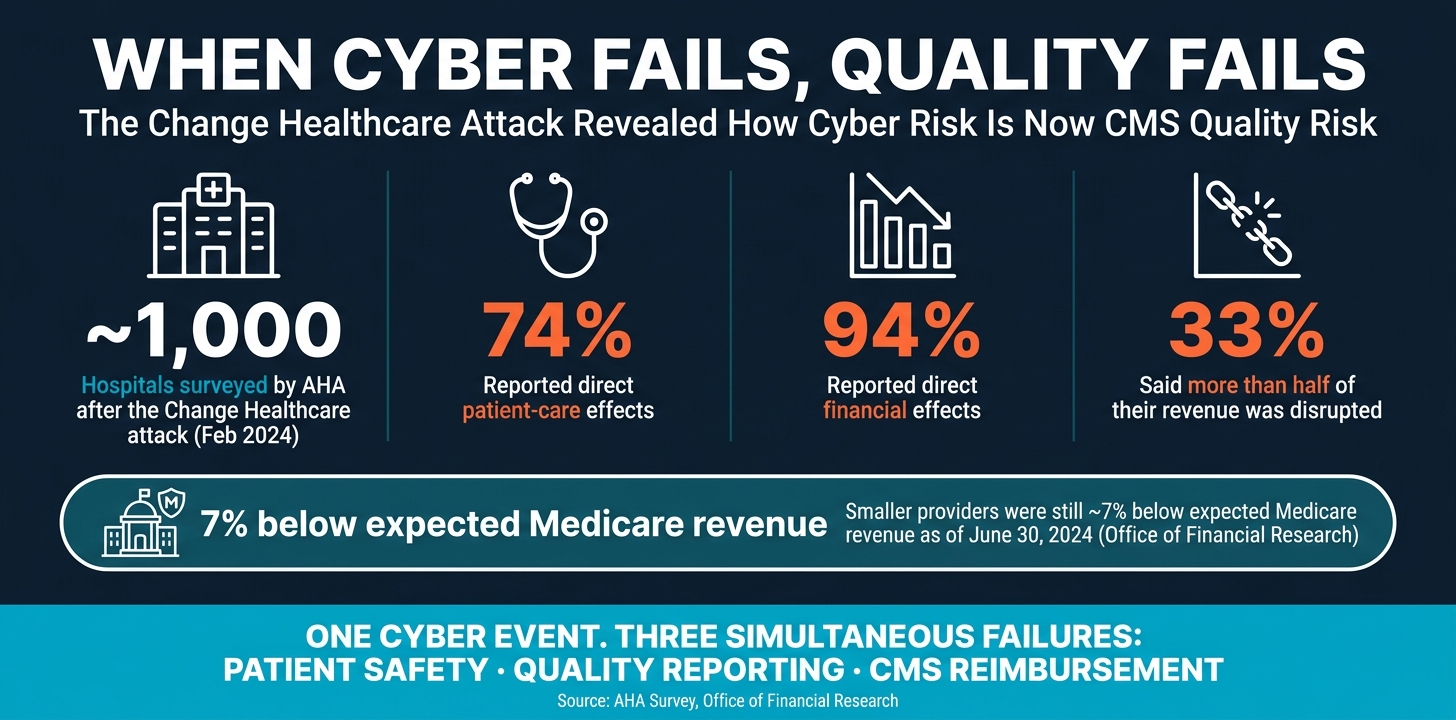
A few numbers make the point fast. After the Change Healthcare attack, an AHA survey of nearly 1,000 hospitals found that 74% reported direct patient-care effects, 94% reported financial effects, and 33% said more than half of revenue was disrupted. An Office of Financial Research review also found smaller providers were still about 7% below expected Medicare revenue by June 30, 2024.
What I take from that is simple: quality readiness and cyber readiness are now the same management job. If you want to protect CMS performance, you need to focus on system uptime, clean data, tested recovery, vendor oversight, and records that support every attestation.
The article boils down to this:
- Treat security risk analysis as more than a yearly form
- Use SAFER Guides to check downtime, recovery, and EHR use
- Rank cyber risk by clinical harm, reporting impact, and payment exposure
- Keep proof that controls were not just reviewed, but tested and fixed
- Put vendors, cloud services, medical device security risks, and fourth parties in the same risk view
If I had to say it in one line: CMS quality programs are turning into cyber-dependent performance programs, whether hospitals plan for that or not.
Change Healthcare Cyberattack: The Real Cost to Hospitals & Patient Care
Where CMS Requirements Already Function Like Cyber Requirements
Promoting Interoperability, Security Risk Analysis, and SAFER Guides
CMS's Promoting Interoperability Program already works a lot like a cybersecurity framework. Eligible hospitals and Critical Access Hospitals have to conduct or review a Security Risk Analysis of their certified EHR technology (CEHRT). That review must address the confidentiality, integrity, and availability of ePHI, along with encryption, needed security updates, and any deficiencies that were found.[6][7]
Put plainly, that's risk assessment, patch management, and remediation tracking. So this isn't just a paperwork exercise. It's a day-to-day check on whether the organization can keep systems running when something goes wrong.
CMS also requires organizations to analyze ePHI in storage, on portable media, and in transmission - not just inside the EHR.[6] The review happens every year and must be repeated after a system installation or upgrade.[6][7]
The SAFER Guides add another layer. They test whether EHR workflows, configurations, contingency plans, and recovery practices support safe use of the system.[2][5] If a SAFER review flags downtime procedures or recovery testing, that isn't only a patient-safety issue. It's also a cyber-resilience issue. Since CY 2024, a "no" response or missed completion fails the measure.[3]
Compliance Evidence Versus Real Operating Capability
The harder test isn't whether the paperwork exists. It's whether the organization can keep operating through a disruption.
The table below links each CMS requirement to the day-to-day dependency behind it, the control used to handle it, and the evidence leaders should keep. The point isn't only to pass an audit. It's to show the controls work when they're needed.
| CMS requirement | Operational dependency | Control | Evidence to retain |
|---|---|---|---|
| Security Risk Analysis lifecycle (annual, and after installation or upgrade) | Complete and current view of CEHRT and ePHI risks across the reporting period and after system changes | Enterprise risk assessment covering confidentiality, integrity, and availability; change management, security testing, interface validation, and post-change monitoring | Approved assessment, asset scope, findings, risk acceptance records, change tickets, test results, and production validation records |
| Encryption and data security | Protection of clinical data across systems and media | Encryption standards, key management, secure transmission, backup protection, and access controls | Encryption standards, key-management records, exception logs, and remediation tickets |
| Security updates and deficiency correction | Timely reduction of exploitable weaknesses | Vulnerability management, patch prioritization, compensating controls, and closure verification | Scan results, patch records, risk-based deadlines, exceptions, and retest results |
| Annual SAFER Guides self-assessment | Safe EHR use and clinical continuity | Downtime planning, recovery testing, configuration review, and workflow safeguards | Completed nine-guide assessment, action plan, drill results, leadership review |
| Attestation support file and source-record validation | The organization can substantiate each attested response with current, traceable records | Evidence governance and cross-functional accountability | Responsible-owner sign-off, source records, and retention schedule |
Attestations and policies still matter. But they're the floor, not the ceiling. When these controls are weak, quality reporting, clinical continuity, and reimbursement tend to slip at the same time.
sbb-itb-535baee
Healthcare Third-Party Risk Management: Compliance & Cybersecurity
How Cyber Weaknesses Affect Quality Scores and Reimbursement
Those CMS controls matter for a simple reason: when cyber systems fail, the damage doesn’t stay in IT. It spills into patient care, reporting, and payment.
Patient Safety and Clinical Continuity During Outages
Cyber incidents affecting hospitals have led to delayed procedures, patient diversion, and interrupted care.[9] When an EHR goes down, clinicians can lose medication histories, allergy lists, recent lab results, and care plans at the same time. That’s not just a tech problem. It’s a patient-safety event with a direct effect on quality. And when clinical workflows stall, quality measures stop showing what care teams are actually doing.
A pharmacy-system outage can stop staff from confirming medication histories or dispensing high-risk medications. A lab outage can delay time-sensitive results. An imaging-platform failure can push back urgent diagnostic decisions. From there, the problems pile up: omitted orders, transcription mistakes, and missing documentation.
Recovery priorities must be set by clinical consequence, not technical convenience. Emergency, ICU, OR, labor and delivery, pharmacy, lab, radiology, blood bank, and care-transition workflows should come first. Those priorities also need to be tested in downtime drills.
The same kind of disruption can also damage the data CMS uses to score performance.
Data Integrity, Reporting Accuracy, and Auditability
CMS quality reporting depends on source data that is accurate, complete, and traceable to source records. Ransomware puts all three at risk. Encryption can make source records and measure data unavailable. But unauthorized alteration can be even harder to spot - and just as harmful. Changed timestamps, edited diagnoses, or corrupted interface data can skew quality results even when systems seem to be working normally.
Failed data extracts and incomplete interfaces create a quieter version of the same issue. You get missing records, duplicated encounters, or holes in reporting data that may not show up until a submission fails validation or an auditor asks for source documentation. Role-based access, multifactor authentication, privileged-access reviews, protected backups, audit logging, and post-restoration validation help protect data and support defensible CMS attestations. After restoring from backup, organizations should reconcile record counts, timestamps, measure denominators and numerators, and a sample of patient-level data before resuming any reporting activity.[4][8]
The risk gets worse when the workflow depends on outside parties the hospital doesn’t control.
Vendor, Cloud, Medical Device, and Fourth-Party Dependence
Quality-critical workflows often rely on vendors, cloud services, and connected devices. Providers across the country have faced disrupted claims, delayed authorizations, and broken data flows they could not directly fix. Vendor risk should be judged by what the vendor supports, not only by what data they touch.
The table below links common cyber weaknesses to quality and reimbursement effects.
| Cyber weakness | Patient-safety effect | Quality-reporting effect | Operational-continuity effect | Reimbursement or compliance exposure |
|---|---|---|---|---|
| EHR unavailability | Delayed decisions; missing allergies, medication history, results, or care plans | Missing or late clinical data | Manual documentation; diversion or service reductions | Missed reporting requirements, lower performance, survey or corrective-action exposure |
| Ransomware encryption | Treatment delays and unsafe workarounds | Unavailable or incomplete source data; failed extracts | Prolonged downtime and recovery backlog | Reporting failure, audit inability, breach response, and financial loss |
| Unauthorized data alteration | Incorrect clinical decisions or patient matching | Measures calculated from corrupted or manipulated data | Rework and investigation | False or unsupported reporting; privacy, security, and compliance exposure |
| Laboratory or imaging outage | Delayed diagnosis, treatment, and escalation | Missing test results and incomplete numerator or denominator data | Manual result entry and reconciliation | Incomplete quality data and possible measure failure |
| Cloud or hosted-service outage | Loss of access to critical applications | Extracts, dashboards, or patient-access measures unavailable | Dependence on vendor restoration timeline | Contractual, reporting, and program-compliance exposure |
| Unmanaged medical-device vulnerability | Device malfunction, unsafe readings, or unavailable therapy | Missing device-generated observations or documentation | Replacement, isolation, or clinical workaround required | Patient-safety investigation and compliance consequences |
Each control has to do three jobs at once: protect safe care, protect reliable data, and protect the evidence tied to reimbursement.
The Solution: Build One CMS-Aligned Cyber Risk Management Process
The same cyber weakness can hit patient care, quality reporting, privacy, reimbursement, and continuity at the same time. If each team reviews risk on its own schedule, that overlap gets missed. The fix is one coordinated process that brings the right teams and core dependencies into a single workflow. From there, the next move is clear: build one risk inventory tied to business impact.
Build One Risk Inventory and Score Risk by Business Consequence
Your inventory should cover EHRs, clinical systems, lab and pharmacy platforms, medical devices, HIEs, reporting tools, patient portals, backups, cloud services, managed service providers, business associates, and critical fourth parties. For each item, document the system owner, data handled, interfaces, authentication, hosting location, recovery requirements, contract dependencies, reporting obligations, and the clinical workflows that would be hit by a failure.[1]
Risk scoring should reflect impact on care delivery and CMS obligations, not just technical severity. A moderate-severity flaw in a medication-dispensing system may deserve more attention than a severe finding in a nonclinical app if it could delay medication administration or disrupt documentation. Use likelihood, exploitability, and four impact tiers: critical, high, moderate, and low. And when a business-critical issue is prioritized or accepted, write down why. A vendor severity score by itself isn't enough.
Risk scoring only means something when it leads to owned remediation and board-level oversight.
Turn Findings Into Accountable Remediation and Governance
Findings without owners are just paperwork. Every finding needs:
- A named owner
- A target date
- A remediation plan
- An interim safeguard
- A verification method
- An escalation route
Governance should sit with an executive-sponsored risk committee that spans security, compliance, quality, clinical operations, privacy, legal, supply chain, continuity, and finance. That group approves risk criteria, settles ownership disputes, and reports material exposure to the board.
If a vendor can't support a required control right away, document the compensating controls, approval of residual risk, and the replacement timeline.[1][10] The retained evidence should show the full lifecycle: the risk was identified, evaluated, assigned, mitigated or accepted, tested, and reviewed on a set basis. A dashboard should also separate assessment completed from control operating. A signed questionnaire does not prove that a safeguard was put in place or tested.
Use Centralized Workflows to Scale Third-Party and Enterprise Risk Management
Managing dozens of vendors and hundreds of clinical systems in spreadsheets falls apart fast. Centralized workflows cut manual tracking across systems, vendors, and business units. They also improve ownership, traceability, and attestation support for CMS obligations. Just as important, they show which vendors support which quality programs and where unresolved risks are sitting in the remediation queue.
AI can help draft questionnaires, summarize evidence, and flag fourth-party exposure, but human review must stay mandatory. Information security teams need to validate technical evidence. Clinicians need to judge patient-safety and downtime effects. Executives need to approve residual risk and funding decisions. AI-generated summaries should be traceable to source evidence and clearly marked as requiring human approval before use in CMS attestations or risk acceptance decisions.
Once risk sits in one place, leaders can rank the controls that do the most to protect quality performance and recovery. A single risk workflow also makes it easier to fund the controls that matter most for quality performance and resilience.
What to Fund First and How to Prove Readiness
Priority Controls That Protect Quality Performance and Resilience
When money is tight, fund the controls that protect CMS quality performance first. Start with the ones tied most closely to care continuity and CMS reporting.
Use the shared risk inventory to decide where dollars go first. The main goal is simple: back the controls that have the biggest effect on care continuity, reporting accuracy, and reimbursement.
| Implementation Priority | Control Objective | Accountable Stakeholders | Evidence of Effectiveness | CMS or Operational Consequence |
|---|---|---|---|---|
| 1 | EHR downtime resilience | CIO, CMIO, nursing, emergency management | Completed downtime exercise, documented recovery times, clinician sign-off, corrective-action log | Delayed care, medication errors, disrupted quality workflows |
| 2 | Annual security risk analysis | CISO, privacy officer, compliance, EHR owner | Dated analysis, defined scope, identified deficiencies, remediation tracking, executive sign-off | Cannot support required attestation [4] |
| 3 | SAFER self-assessments and remediation | CMIO, health information management, clinical ops, IT | Completed assessments, risk-ranked findings, owners and due dates, closure evidence | Unresolved EHR safety risks; failure to meet the relevant Promoting Interoperability requirement [3] |
| 4 | Protect and restore data | Infrastructure, security, HIM, quality | Protected backup records, restoration-test results, reconciliation reports | Prolonged outage, lost documentation, inaccurate quality reporting |
| 5 | Validate quality data after restoration or change | Quality, HIM, data analytics, application owners | Source-to-restored-record comparison, timestamp and status verification, exception resolution records | Incorrect submissions, audit findings, payment or performance consequences |
| 6 | Control privileged access | CISO, IAM team, HR, application owners | Access reviews, privileged-account inventories, termination records, privileged-session logs, documented exceptions | Unauthorized changes to clinical or reporting data |
| 7 | Manage critical vendors and fourth parties | Supply chain, legal, security, clinical owners | Risk-tiered assessments, contract requirements, incident contacts, continuity evidence | Service interruption, delayed incident response |
When you rank investments, look at clinical criticality, reporting dependence, recovery time, and substitutability together. Think about it this way: a laboratory interface with no manual workaround should get more attention than a low-impact administrative tool.
Governance Evidence That Shows Controls Actually Work
Funding a control is only half the job. Leaders also need proof that the control works when operations get messy.
Keep one central evidence repository that tracks each risk from identification through closure, acceptance, or carry-forward, with a named owner and due date. That evidence should include current asset and vendor inventories, completed security risk analyses, SAFER self-assessment records, risk-register entries with named owners and due dates, downtime exercise results, vendor assessments, contract security obligations, access reviews tied to completed remediation, backup and restoration test results, and quality-data validation after major changes or recovery. It should also log incident decisions, approvals, rationale, and corrective actions for downtime, diversion, escalation, restoration, reporting pauses, and resubmission.
What separates strong evidence from a stack of documents? Version control and exception tracking. A signed access review that shows no removals is weaker than one tied to closed remediation tickets. A backup completion report without a restoration test doesn't show that the data can actually be recovered.
A tested failure with corrective action is stronger evidence than an untested pass.
Conclusion: Treat Quality Readiness and Cyber Readiness as One Discipline
The goal is not to buy more tools. The goal is to cut quality and reimbursement risk through one operating model.
CMS quality and reimbursement outcomes now depend on technology being secure, available, and resilient. A ransomware event, a failed vendor, or an untested recovery process doesn't only create a security issue. It also creates a patient-safety issue, a reporting issue, and a reimbursement issue.
The organizations in the best position to protect both patients and performance scores have stopped treating cybersecurity as a separate IT silo. They manage cyber risk in terms of care continuity, reporting integrity, vendor dependence, and clinical safety. Then they tie governance, controls, evidence, and remediation into one continuous operating model. For organizations participating in CMS quality programs, that alignment is no longer optional.
FAQs
Why does CMS quality performance now depend on cybersecurity?
Because regulators now treat cyberattacks as patient safety events, not just IT problems. That shift matters a lot. Under CMS Conditions of Participation, hospitals must follow all-hazards emergency preparedness rules. In plain English, surveyors want to see whether a hospital can keep patients safe when systems are down for an extended period.
Cyber incidents can slow clinical care, trigger ambulance diversions, and leave documentation gaps. So CMS and The Joint Commission also look closely at downtime workflows and the governance behind continuity of care.
Which cyber controls matter most for CMS reporting and payment?
For CMS reporting and payment, the controls that matter most are the ones that keep care moving and the organization steady under pressure.
Put the focus on identity and access management with multifactor authentication, network segmentation, immutable tested backups, downtime and reconciliation procedures, continuous risk assessment, third-party governance, workforce training, and cross-functional governance. These controls help support compliance, recovery, and stable operations.
How should hospitals manage vendor outages that affect quality programs?
Hospitals should treat vendor outages that hit quality programs as operational resilience issues, not just IT problems.
Why? Because the damage rarely stays inside the IT team. A vendor outage can disrupt clinical work, reporting, and payment flow at the same time. That’s why hospitals need to map core clinical and revenue workflows, spot single points of failure, and set a clear outage tolerance for each one.
It also helps to have backup paths ready before something goes wrong. That can include:
- secondary clearinghouse readiness
- manual fallback procedures
Incident response shouldn’t sit with IT alone. It should bring in revenue cycle and clinical leaders too, so decisions match what’s happening on the ground. On top of that, hospitals need continuous monitoring of vendor dependencies, SLA performance, and fourth-party risk.
