
Here’s the short answer: no single team should handle medical device risk alone, but one named executive must own each final risk decision.
I’d sum the article up like this: if your hospital lets clinical engineering, IT, security, supply chain, compliance, and clinical leaders each manage only their own piece, gaps show up fast. A connected pump, scanner, or monitor can affect patient care, privacy, uptime, medical device security risks, and rule-related exposure at the same time. And when no one has final sign-off, problems stay open.
What matters most:
- Clinical engineering handles device function, maintenance, testing, and safety impact
- IT and security handle network access, segmentation, monitoring, and containment
- Supply chain handles vendor terms, support status, and replacement timing
- Compliance and legal handle policy, HIPAA, FDA, and reporting duties
- Executive leadership must own funding, exceptions, and residual risk decisions
The core rule is simple: doing the work is not the same as owning the risk.
So if a device patch is delayed because the maker has not cleared it, someone still has to decide what happens next. That means:
- assign one accountable owner for each risk decision
- keep a device risk register with owners, due dates, and evidence
- set clear escalation triggers for high-risk cases
- review unsupported devices, vendor access, and open vulnerabilities on a set schedule
A few device examples make this plain:
- Infusion pumps: pharmacy, nursing, clinical engineering, IT, and supply chain all have a role, but one executive must approve any leftover risk
- Imaging systems: radiology, security, and vendor teams share work, especially when legacy systems cannot support current login controls
- Patient monitors: alarm integrity, wireless setup, and central visibility need named owners because a failed monitor can affect patient care fast
In other words: shared execution works only when accountability is explicit, documented, and tied to day-to-day approvals.
| Area | Main team doing the work | Final owner |
|---|---|---|
| Device safety and use | Clinical engineering and clinical teams | Clinical engineering or clinical operations leader |
| Cyber and network controls | IT and security | CISO or device security lead |
| Vendor and lifecycle issues | Supply chain, legal, IT, clinical engineering | Supply chain or IT executive |
| Leftover enterprise risk | Leadership, risk, compliance, legal | Named senior executive |
If I were putting this into one sentence, it would be: medical device risk in 2026 is a governance issue first, and a technical issue second.
Why medical device risk has no natural owner
Connected medical device risk cuts across clinical engineering, IT, supply chain, compliance, and executive leadership. So, no single department owns it by default. You can see the split more clearly when each team’s authority runs right up to its own line - and stops there.
The table below shows where each function begins, where it ends, and what can go wrong when it works in isolation.
| Function | Primary accountability | Key decisions | Risk created when operating alone |
|---|---|---|---|
| Clinical engineering | Safe operation and maintenance | Configuration, patch validation, service status, replacement recommendation | May miss enterprise attack paths or network exposure |
| IT/security | Cyber controls and connectivity | Segmentation, access, monitoring, vulnerability treatment, incident containment | May disrupt care, alarms, or medication workflows |
| Supply chain/procurement | Vendor, contract, and lifecycle controls | Supplier selection, support terms, security clauses, replacement funding | May procure devices that are difficult to secure or unsupported |
| Compliance/privacy/legal | Regulatory, policy, and reporting alignment | Required evidence, exceptions, reporting, privacy obligations | May document obligations without ensuring controls work in practice |
| Executive leadership | Enterprise risk acceptance and resource allocation | Accept, mitigate, transfer, defer, or escalate residual risk | Unfunded remediation and unowned residual risk |
Federal guidance backs up this split, but it does not name one hospital owner. It points to shared responsibility, while still leaving the hospital to decide who is finally accountable for residual risk.[4][1][6][7][5][8][9]
That’s the core issue: fragmented authority and partial visibility. Doing the work does not automatically make a team the risk owner. IT can segment a device, but that doesn’t mean IT has the authority to accept the leftover clinical risk. Clinical engineering can validate a patch, yet still lack visibility into whether the device is under active attack. If no one is named to make the final call, the risk doesn’t disappear. It just sits there.
What FDA and HHS guidance say about shared responsibility
FDA places clear duties on manufacturers: identify device-related cybersecurity risks, keep processes in place for vulnerability monitoring, provide postmarket patches and updates, support coordinated vulnerability disclosure, and - for applicable cyber devices - provide a software bill of materials.[6][7] FDA’s cybersecurity management-plan framework also calls for named responsible personnel, defined monitoring methods, patch-development timelines, and remediation communications.[5]
But manufacturer responsibility doesn’t erase provider responsibility. HHS guidance treats connected medical devices much like other enterprise endpoints for several controls, including network segmentation, routine patching, password management, authentication, and remote-access control.[8] Healthcare organizations are also expected to keep accurate device inventories, control vendor and clinical access, apply patches - or use compensating controls when patches can’t be applied - and build security requirements into procurement contracts.[9] Even when a device is well supported, the hospital still has to manage the local risk.
The next step is a shared-ownership model with one accountable decision-maker.
sbb-itb-535baee
A shared-ownership model with one accountable decision-maker
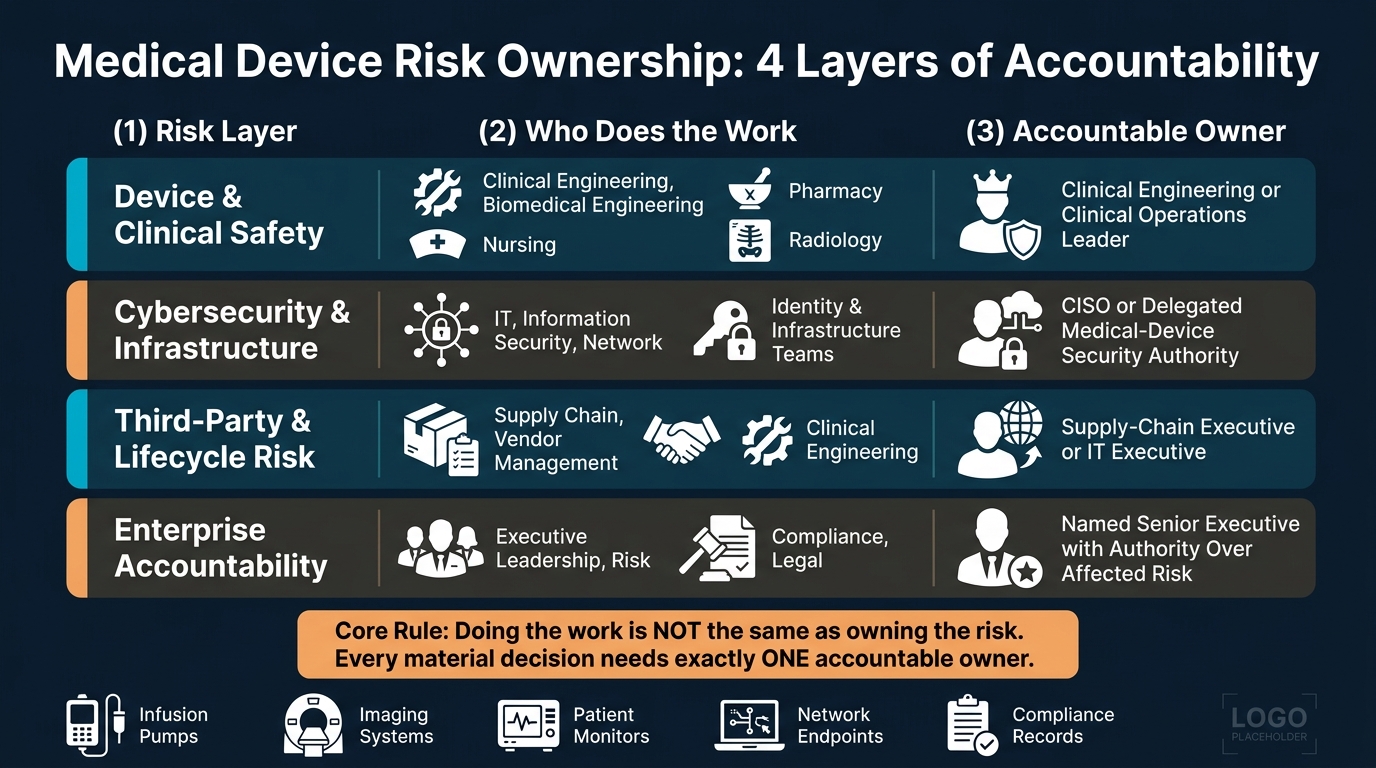
Medical Device Risk Ownership: Who Does the Work vs. Who Owns the Decision
Shared execution only works when one person owns each material decision. That’s the core idea here. The people doing the work and the person making the final call are not always the same, and that split needs to be clear.
The four layers of device risk ownership
Connected medical-device risk is easiest to manage when you treat it as four separate layers. Each layer has its own team doing the work and its own owner making the decision.
| Risk layer | Who does the work | What decisions belong here | Accountable owner |
|---|---|---|---|
| Device and clinical safety | Clinical engineering, biomedical engineering, nursing, pharmacy, radiology, and other clinical users | Clinical criticality, safe configuration, maintenance status, downtime procedures, validation after changes, and patient-safety impact | Clinical engineering or clinical operations leader |
| Cybersecurity and infrastructure | IT, information security, network, identity, and infrastructure teams | Segmentation, authentication, monitoring, access controls, logging, containment, and secure connectivity | CISO or delegated medical-device security authority |
| Third-party and lifecycle risk | Supply chain, vendor management, procurement, legal, and clinical engineering | Support status, vulnerability alerts, contract obligations, remote access, replacement timing, and end-of-life exposure | Supply-chain executive or IT executive, depending on the decision |
| Enterprise accountability | Executive leadership, risk, compliance, and legal | Funding, risk tolerance, material exceptions, major downtime risk, residual-risk acceptance, and retirement decisions | Named senior executive with authority over the affected risk |
The executive layer is there for decisions that can change patient-harm exposure, regulatory exposure, clinical operations, financial impact, or enterprise resilience. In plain English: when the stakes are high, someone with clear authority has to own the call.
These layers only work in practice when each decision maps to one accountable role.
RACI for device risk decisions
Every activity needs exactly one accountable role. If a decision seems to belong to two owners, split it into separate approvals. That may sound strict, but it avoids the kind of gray area where everyone is involved and no one is on the hook.
| Device-risk activity | Accountable | Responsible | Consulted | Informed |
|---|---|---|---|---|
| Inventory and classification | Clinical engineering director | Biomedical engineering and asset-management teams | Clinical operations, IT, security | Compliance, supply chain |
| Safety and security assessments | Designated device-risk owner | Clinical engineering and cybersecurity | Manufacturer, privacy, clinical users | Executive risk committee |
| Network connection approval | CISO or delegated medical-device security authority | Network and security engineering | Clinical engineering, device owner, vendor | Compliance, operations |
| Manufacturer vulnerability-alert review | Medical-device risk manager | Clinical engineering and cybersecurity | Manufacturer, supply chain, privacy | Executive risk owner |
| Patching or firmware updates | Clinical engineering director | Biomedical engineering, IT, vendor | Clinical users, pharmacy or radiology when relevant | Operations and compliance |
| Compensating controls | CISO | Security operations, IT, biomedical engineering | Clinical engineering, vendor, privacy | Operations and compliance |
| Vendor remote access | CISO or infrastructure security leader | IAM, network, and biomedical engineering teams | Vendor, clinical owner, privacy, compliance | Executive risk owner |
| Incident response | Incident commander or CISO, according to incident policy | Security operations, clinical engineering, IT, and clinical operations | Vendor, privacy, legal, communications | Executive leadership |
| Residual-risk acceptance | Executive risk owner for material risk | Named device or service owner prepares the decision | Clinical engineering, CISO, compliance, finance | Audit and affected operations |
| Retirement of unsupported devices | Named executive owner for the device or service | Clinical engineering, supply chain, IT, and clinical operations | CISO, finance, compliance, manufacturer | Executive risk committee |
Each row in this table should connect to:
- an approval record
- a due date
- evidence requirements
- a clear escalation threshold
A RACI that lives only in a slide deck doesn’t enforce anything. It has to show up in day-to-day work, approvals, and follow-up.
How this model works in Censinet workflows
Censinet RiskOps takes this model out of a policy document and puts it into an operating process. When a device or vendor record is created, the platform links it to the asset, location, owner, clinical use, and risk tier. Connectivity details are tracked in that same record.
Censinet Connect then routes safety, security, privacy, supply-chain, and compliance tasks to the named stakeholders in your RACI. That means the right people get the right work instead of chasing emails or sorting through spreadsheets.
Censinet AI can help move the work along by helping vendors complete security questionnaires faster, summarizing documentation, and flagging missing evidence before a review is due. That said, the final call still belongs to a qualified reviewer. Automation can draft the analysis, but it should not approve the final rating, mitigation, or residual-risk decision.
Every decision should leave behind an audit record that shows who acted, who approved, what risk was accepted, and when the next review is due. That’s what turns shared execution into clear, defensible accountability.
The next step is assigning these roles to specific devices and use cases - infusion pumps, imaging systems, and patient monitors.
How to assign ownership at the device level
That framework starts to matter when you tie it to a specific device and a specific decision.
At the device level, apply the model in a simple way: identify the asset, define the clinical impact, assess cyber exposure, assign controls and owners, document residual risk, and escalate issues that stay unresolved. The point is not to split ownership evenly across teams. It’s to connect each device decision to one accountable owner.
The asset record should include the manufacturer, model, serial number, location, firmware version, network connections, vendor relationships, clinical department, and lifecycle status.
Infusion pumps: safety, connectivity, and medication workflow
An infusion pump sits right where medication safety, wireless networking, and bedside workflow meet.
Ownership usually breaks down like this:
- Pharmacy owns the drug library
- Nursing owns programming workflow and bedside authentication
- Clinical engineering owns maintenance, configuration verification, alarm verification, and patch feasibility without voiding validation or support
- IT and security own segmentation, access restrictions, and vendor remote access
- Supply chain owns support status, security clauses, and replacement timing
- The executive risk owner accepts residual risk when patching or replacement is delayed
Before closing out pump risk, check a few things. Can unauthorized users change settings or the drug library? Is wireless traffic isolated from other clinical and enterprise systems? Are vendor sessions time-limited and logged? If the library server fails, is there a clinical fallback?
FDA treats unresolved compromise of device functionality, data integrity, availability, or connected systems as a patient-safety risk that warrants formal escalation.[1][10]
Imaging systems and patient monitors: uptime, access, and continuity
The same ownership model shifts a bit for imaging and monitoring, where uptime and alarm integrity matter more than medication workflow.
For imaging, the asset scope should cover the full setup: the modality itself - CT, MRI, ultrasound, or radiography - along with acquisition workstations, modality servers, authentication services, interfaces, PACS, storage, and vendor gateways. Ownership should follow the clinical risk. For pumps, that means medication safety. For imaging, diagnostic continuity. For monitors, alarm reliability.
Radiology owns downtime impact. Clinical engineering and IT own remediation. Security owns vulnerability assessment, remote access, and incident response. Supply chain owns support terms and end-of-life planning.
Vendor remote access needs its own decision row. Document each remote-access path by vendor, account, protocol, and purpose. Use named accounts, multifactor authentication, session logging, and time-limited approval windows.
If a legacy imaging system can’t support modern authentication, document compensating controls with a named owner and a remediation deadline. That can include:
- A jump server
- Network isolation
- Allowlisted connections
- Independent session review
HHS Cybersecurity Performance Goals specifically call for identifying, assessing, and mitigating risks from third-party products and services.[2]
Patient monitors introduce a different kind of failure mode: alarm integrity and continuous availability. Clinical engineering verifies alarm operation, firmware, and interoperability. Nursing and clinical leadership define alarm priorities, escalation expectations, and the patient-care consequences of delayed or suppressed alarms. IT and security own wireless design, segmentation, and centralized monitoring visibility.
A recent FDA safety communication shows how this can play out:
on January 30, 2025, FDA issued a safety communication about cybersecurity vulnerabilities in certain Contec CMS8000 and Epsimed MN-120 patient monitors, reporting that the vulnerabilities could allow unauthorized access or control, and recommending that healthcare providers assess affected devices and consider local monitoring or disabling network connectivity until remediation was available.[3][11]
For delayed patching or replacement, assign a named owner, set a review date, and document the escalation trigger.
Governance tools that make ownership last
Ownership only sticks when it’s documented, checked on a set schedule, and tied to a clear escalation path. Without that structure, accountability slips right back to the person who happens to answer when something fails.
The device risk register and escalation path
The risk register is the base layer. Every device record should include the device or device class, manufacturer and model, serial number or asset ID, location and clinical owner, clinical function, connected systems, network segment, operating system and software versions, data handled, vendor support status, and lifecycle stage.
Each entry should also spell out the risk scenario, affected patients or workflows, safety, security, operational, privacy, and compliance impacts, likelihood and severity, inherent and residual risk, current controls, planned treatment, accountable decision-maker, control owners, due dates, dependencies, exception status, evidence links, and last review date.
Escalation needs to start from clear conditions, not from whether a team feels okay closing the item. Mandatory escalation triggers include:
- A vulnerability that could directly affect patient care or device operation
- Evidence of exploitation, compromise, or unauthorized access
- Unsupported software without validated compensating controls
- A missed remediation deadline
- A vendor’s inability to provide an acceptable patch or mitigation
- A control failure affecting a high-risk clinical workflow
- Residual risk above the organization’s approved tolerance
When any of those conditions show up, the issue moves to the named executive risk owner. It does not go back to the working team for another round of debate.
Review cadence and control evidence
A tiered review cadence keeps the program moving without burying one team in work. Inventory and ownership data should be checked through day-to-day operational changes and formally reconciled at least monthly for high-risk devices and quarterly for the broader fleet. New purchases, major upgrades, and new network connections should be reviewed before implementation. Critical open vulnerabilities need weekly review until they’re contained. Exceptions should carry an expiration date and get reviewed at least quarterly. Downtime procedures for critical device-dependent workflows should be tested at least annually and after any material system or device change.
Evidence matters just as much as the schedule. A task marked complete is not the same thing as a risk that’s actually closed.
Acceptable evidence includes reconciled inventory exports, signed pre-procurement security assessments, completed risk assessments, approved network diagrams, vulnerability scans or validated vendor advisories, patch-test results, change tickets, configuration or segmentation records, access-review reports, vendor remote-session logs, incident-response exercises, downtime-test results, meeting minutes that record a risk decision, and approved exceptions with compensating controls and an expiration date.
For an infusion pump, that means linking the validated firmware version, medication-library integrity test results, wireless-security configuration, restricted vendor access, and a documented downtime workflow.
The table below shows who is answerable for each governance control, what proof shows the work is done, how often it should be reviewed, and what forces escalation.
| Governance control | Accountable function | Evidence of completion | Review frequency | Escalation trigger |
|---|---|---|---|---|
| Maintain authoritative device inventory and ownership | Clinical engineering, with IT/security support | Reconciled asset record with device, connectivity, owner, and lifecycle fields | Monthly for high-risk devices; quarterly for all devices | Unknown owner, missing connectivity data, or unmanaged device |
| Pre-procurement risk review | Supply chain and clinical engineering | Approved security and clinical-risk assessment; contract requirements | Before purchase, renewal, or major upgrade | Device cannot meet minimum security, support, or downtime requirements |
| Monitor and remediate vulnerabilities | IT/security and clinical engineering | Advisory, scan result, risk decision, test record, patch or mitigation ticket | Continuous monitoring; weekly review for critical items | Exploitation, direct patient-care impact, missed deadline, or unsupported software |
| Control vendor and privileged access | IT/security and device owner | Access approval, MFA record, least-privilege review, remote-session log | Quarterly and after vendor or system changes | Unapproved access, inactive account, absent logging, or failed MFA |
| Validate downtime and continuity procedures | Clinical operations and clinical engineering | Exercise plan, results, corrective actions, retest record | At least annually and after material changes | Failed test, unavailable backup workflow, or unresolved corrective action |
| Review exceptions and residual risk | Executive risk owner with compliance and affected functions | Approved exception, compensating controls, expiration date, decision minutes | Quarterly or sooner when conditions change | Expired exception, degraded control, or risk above tolerance |
| Report unresolved high-risk items | Enterprise risk or executive leadership | Decision brief with affected device population and clinical service, risk scenario, patient-safety and operational impact, exploit or vulnerability status, current controls, residual risk, remediation options, estimated cost in U.S. dollars, staffing or downtime requirements, vendor commitments, deadline, consequences of inaction, and the specific decision requested | Monthly; immediately for critical events | No decision by deadline or inability to contain risk |
The accountable function in each row is the party answerable for the result, even if another team handles parts of the work. That line matters. Otherwise, a technical step, like applying a patch, can get mistaken for acceptance of the clinical or operational risk that still remains.
Conclusion: Shared execution, explicit accountability
No single department owns medical device risk. Clinical engineering, IT and security, supply chain, compliance, clinical operations, and executive leadership each own part of it. Shared ownership is not the problem. The problem starts when shared ownership turns into nobody owns it because no one is explicitly named to make the final call.
This model spreads execution across teams while making decision-level accountability plain. Each function owns its controls. One named decision-maker owns the outcome when those controls fall short. FDA guidance treats cybersecurity as a lifecycle responsibility, and HHS guidance calls for organization-wide safeguards that cover inventory, access control, vendor management, segmentation, and incident preparedness. Both point in the same direction: governance needs to live inside normal workflows, not get added after an incident.
Executive leadership must own the decisions that no technical team can make alone - funding remediation, approving exceptions, accepting residual risk, and making patient-safety tradeoffs when a device cannot be patched, replaced, or taken offline without causing other problems. That is an enterprise risk question, and it needs an enterprise answer.
FAQs
How do we choose the final risk owner for each device decision?
Choose the final risk owner through a cross-functional governance model, not one department acting alone. Keep a shared risk register and use a RACI matrix to assign a named owner to each device decision.
If conflict comes up, such as a patch deferral, escalate it to a designated senior leader or committee. Clinical leadership should keep veto power for decisions that affect patient safety.
What should a medical device risk register include?
A medical device risk register should serve as the main, auditable record that ties technical findings to clinical and day-to-day decisions.
Each entry should include:
- A unique asset identifier
- A clear risk description
- A severity score
- Mapped security controls
- A designated owner
- A remediation timeline
It should also record the chosen action - remediate, mitigate, accept, or replace - along with the reason behind that choice. Then review each entry again after a new vulnerability disclosure, a software update, a network change, or a device relocation.
When should unresolved device risk be escalated to an executive?
Escalate any unresolved medical device risk to executive leadership and the patient safety officer right away when a cybersecurity event involves a medical device.
Executive notice is also needed when patches for devices with critical exposure or high clinical criticality are delayed, or when containment actions are delayed and the risk to operations or patient safety goes up.
To keep ownership clear, define and document these escalation paths in a RACI matrix.
