
If EMS cybersecurity fails, patient care can slow down fast. My takeaway is simple: if I run or support an EMS agency, I need to know where ePHI lives, lock down mobile and shared devices, control who can access data, plan for ransomware and lost devices, and check vendors before they touch PHI.
Here’s the short version:
- EMS is different from office healthcare because crews move between ambulances, scenes, hospitals, and stations.
- ePHI shows up almost everywhere: CAD, ePCR tablets, smartphones, station PCs, hospital links, billing systems, and radio or dispatch workflows.
- HIPAA Security Rule duties apply when an EMS agency handles and sends health data in standard electronic transactions.
- Core safeguards include risk analysis, staff training, access removal after termination, encryption, audit logs, auto logoff, and device controls.
- Shared logins are a problem because they weaken accountability and logging.
- Mobile risk is high because tablets and phones can be lost, stolen, left unattended, or used on weak networks.
- Vendor review matters because ePCR, billing, cloud, CAD, and IT partners may all handle PHI.
- Documentation matters because OCR looks for proof, not just policy.
A few facts stand out. One OCR settlement reached $400,000 after a phishing event tied to a missing risk analysis. Another case ended in $202,400 after a former worker kept using shared credentials. Research cited here also found hospital volume fell 17% to 26% during ransomware attack weeks, while in-hospital mortality for already admitted patients rose 35% to 41%.
What I’d treat as the baseline:
- Inventory every system and device that creates, receives, stores, or sends ePHI
- Use named accounts for each worker
- Encrypt field devices and data in transit
- Use MDM for app control, patching, and remote wipe
- Set short inactivity timeouts on shared devices
- Create downtime and ransomware playbooks
- Sign BAAs before sharing data with vendors
- Keep records of training, incidents, reviews, and fixes for at least six years
This article boils down to one idea: EMS compliance is not just policy work. It’s day-to-day control of devices, access, incidents, and vendors in fast-moving field settings.
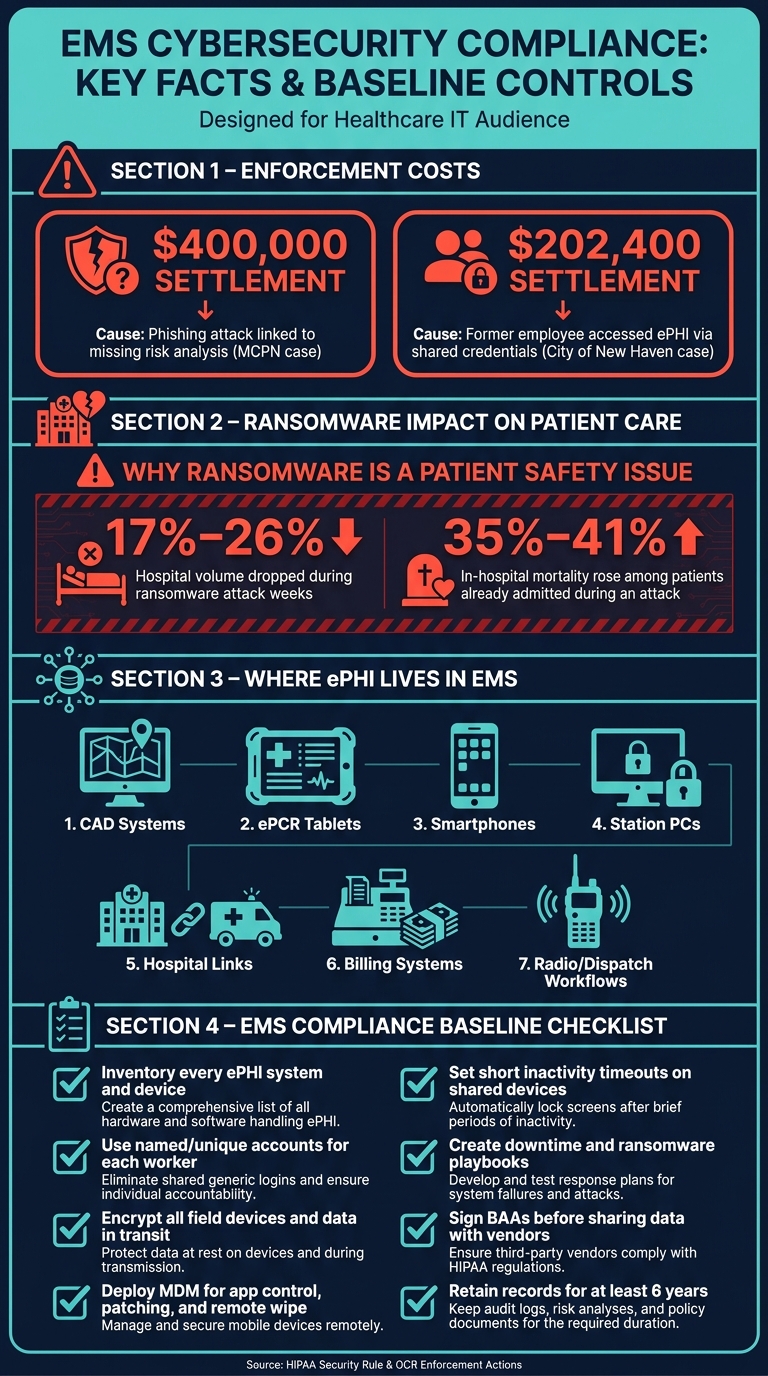
EMS Cybersecurity: Key Stats, Risks & Compliance Baseline
Road to HIPAA Compliance: Using the NIST Cybersecurity Framework to Protecting PHI
sbb-itb-535baee
HIPAA Security Rule requirements EMS leaders must act on
EMS leaders need to turn those rules into controls crews can use in the field.
Administrative safeguards: risk analysis, policies, training, and response
Start with a documented risk analysis that shows where ePHI is created, stored, accessed, and transmitted. For EMS, that includes ePCR tablets, radio traffic, and cloud-based dispatch systems. Once you map that out, use it to set written procedures for access termination, crew training, and incident response.
Training needs to match how EMS work actually happens. That means showing crews the risks they face every day, like talking about patient details over unencrypted radio channels or leaving a tablet unattended in an ER hallway. The risk analysis should then shape the device, access, and response controls that follow.
Two enforcement cases show the cost of missing these basics. MCPN paid $400,000 to settle OCR charges after a phishing attack exposed ePHI because the organization had never conducted a comprehensive risk analysis. [1] The City of New Haven, Connecticut, agreed to pay $202,400 after a former employee accessed ePHI using shared credentials after termination, exposing failures in unique user identification and access termination procedures. [1]
Physical and technical safeguards for field and station environments
For EMS, physical safeguards cover more than the station. They also apply in ambulances, ER drop-off areas, and any place crews handle devices. That includes workstation security in ambulances and stations, device and media controls for tablets and cardiac monitors, and proper sanitization before a device is decommissioned or sent out for repair.
A solid starting point looks like this:
- A live device inventory tied to each vehicle or station
- Locking docking stations inside ambulances so tablets stay secure when crews are on scene
On the technical side, full-disk encryption (FDE) on all field devices is a must. HIPAA treats encryption as addressable, but for mobile EMS equipment, it should be turned on across the board. Add unique user IDs for each crew member, automatic logoff for unattended ePCR sessions, and encrypted transmission such as a VPN for 12-lead ECGs and patient data sent over cellular or Wi-Fi.
Audit controls are also required. In plain terms, those are logs that show who accessed a patient record and when. Break-glass access procedures let clinicians get to patient data during a life-threatening emergency if standard authentication fails, and those procedures need to be documented ahead of time. These are the baseline controls for mobile devices, shared logins, and unattended equipment.
Key EMS controls for mobile, field, and shared-use workflows
Mobile device and ePCR protections that reduce field exposure
Once the baseline safeguards are in place, EMS agencies need tighter controls for mobile devices and shared-use work. Field devices deal with rough conditions, shared logins, and spotty connections. That means protection has to hold up when a tablet goes missing, the signal drops, or a crew member is focused on patient care.
A layered setup works best.
- Device security: Full-disk encryption and remote wipe lower breach risk if a tablet is lost or stolen.
- Network security: An always-on VPN or other encrypted tunnel keeps PHI protected while it moves from the scene to the ePCR server or billing system.
- App control: MDM enforcement stops crews from adding unapproved apps that could expose PHI or bring in malware.
- Update control: Centralized patch management through MDM keeps devices current before they go back into service.
MDM is the backbone of this setup. When it’s configured well, it handles app restrictions, patching, remote wipe, and limits on personal cloud backups or copying PHI into nonwork apps. Those gaps are easy to miss when the same tablet gets used for patient care and off-duty downtime.
Access management for crews, supervisors, dispatch, and billing staff
Every user should have a unique login and role-based access. If a tablet is signed in under a unit name, or a dispatch console uses one station-wide password, there’s no clear audit trail showing who opened a patient record.
EMTs and paramedics should see only care data. Supervisors, dispatch, and billing staff should get only the access tied to their jobs. That role-based access control model helps enforce HIPAA’s minimum-necessary standard.
Shared workstations at stations and dispatch consoles need short inactivity timeouts and automatic logoff. Those are not optional. At the same time, reauthentication should be fast enough that it doesn’t slow down operations. Badge tap, PIN, or biometric sign-in can help the next user confirm identity without a hassle.
Written policy matters too, especially in busy field settings where shortcuts can slip in. Agencies should spell out rules for texting, image capture, and radio use in plain language:
- Do not send PHI by SMS.
- Use approved secure messaging.
- Limit image capture to authorized clinical use.
- Use run numbers, not patient names, in radio traffic.
Physical security for ambulances, stations, and unattended equipment
Access controls fall apart when devices, paper records, or media are left out in the open. A tablet in an ER hallway, a report sitting on a counter, or a device visible through an ambulance window can all turn into a breach.
Locking mounts inside ambulances help keep tablets secured while crews are on scene. They also help stop devices from becoming projectiles during transport. At the station level, access should be badge-controlled. Visitors should sign in, and anyone who isn’t agency staff should follow escort rules. Charging and docking areas should sit inside secured rooms, not out in open common spaces.
Printed run reports need the same care as digital records. After use, they should go straight into locked, access-controlled storage. When it’s time to dispose of them, they should be shredded - not left in vehicles, taken home, or tossed in open trash.
Removable media, like USB drives, should be restricted or disabled on field devices. If there’s a documented operational reason to use portable storage, it needs to be encrypted and inventoried. And before any device is retired or reassigned, the data has to be wiped or the device destroyed, with verification.
These controls should be documented in the risk analysis and the incident response plan.
Risk analysis, incident response, and third-party oversight
Once devices, access, and physical security are under control, EMS agencies still need something just as important: proof. That means a written risk analysis, tested response playbooks, and a clear way to review vendors.
How to document risk analysis and risk management plans
A HIPAA-compliant risk analysis starts with a full inventory of every system that creates, receives, maintains, or transmits ePHI. That includes ePCR platforms, CAD interfaces, mobile devices, billing tools, cloud storage, and station workstations. From there, rate each threat based on likelihood and impact.
This work has to reflect how EMS runs in the field. Think shared devices, weak connectivity, vehicle-based access, staff turnover, and after-hours use. An office-only risk analysis will miss the problems that show up on the road.
The analysis also can't sit on a shelf. Update it after any material change, like:
- a new vendor
- a device rollout
- a ransomware event
- a workflow shift
OCR enforcement actions show that failing to conduct or update risk assessments is a common reason for HIPAA settlements. That includes one case tied to a ransomware incident that exposed the ePHI of 585,621 individuals.[2]
The risk management plan that follows should name an owner for each remediation item, set a target date, and track corrective actions through completion. Track patching, MFA, MDM enrollment, account termination, policy acknowledgments, remediation actions, and exception approvals. If high-risk items stay open, leadership should accept the remaining risk in writing. That's the paper trail auditors want to see.
Incident response for ransomware, lost devices, and unauthorized access
Once the inventory and remediation plan are in place, the next step is simple: what happens when a device, account, or vendor fails?
Start with the situations EMS teams are most likely to face. An ambulance tablet gets stolen. A dispatch account is taken over. A ransomware attack locks the ePCR system. A cloud outage cuts off chart completion in the middle of a shift. Each playbook should spell out first notice, isolation authority, vendor and counsel contacts, and breach decision authority.
One point matters here: containment and breach classification are not the same thing. Stop the damage first. Then sort through the facts to decide whether notification or reporting is required.
Downtime procedures should cover paper charting, ePCR reconciliation, and backup communication paths. And they need to be tested from time to time, not just filed away. The stakes aren't abstract. Research on large-scale ransomware events found that hospital volume dropped 17–26% during attack weeks, and in-hospital mortality increased by 35–41% among patients already admitted when an attack began.[3]
Every incident should be documented with the date, time, location, what happened, affected systems, individuals involved, data accessed, immediate containment steps, longer-term corrective actions, and any regulatory notifications or breach determinations. Those records should be kept for at least six years.[4]
Business associate oversight and vendor risk review
The same control model applies to vendors that store, move, or support EMS ePHI.
Any vendor with access to ePHI or agency systems needs a signed Business Associate Agreement before data is shared or system access is granted. That includes ePCR providers, billing and revenue cycle management partners, CAD vendors, cloud hosts, managed service providers, and connected medical device manufacturers whose equipment sends data across the network.
Before onboarding, due diligence should confirm how PHI is stored and transmitted, whether the vendor supports encryption, MFA, and logging, how access is removed at contract end, what subcontractors are involved, and what the data retention, deletion, uptime, disaster recovery, and breach notification terms look like. Set a 24–72-hour contractual notice window, which is shorter than HIPAA's 60-day maximum. Keep evidence such as SOC 2 Type II reports, completed security questionnaires, and penetration test results.
For agencies with small teams, the goal is not a big security department. It's a repeatable process. A standard checklist scored by data sensitivity, system access, and how tightly the vendor connects to agency systems helps keep reviews consistent. Platforms like Censinet RiskOps™ are built for this kind of work, helping streamline third-party and enterprise risk assessments, benchmarking, and shared risk management across healthcare organizations.
High-risk vendors, especially those with deep access to PHI or major operational impact if compromised, should be reviewed each year or whenever their service changes in a material way. A central vendor register with renewal dates, contract owners, and open remediation items helps keep that work from slipping through the cracks.
Conclusion: A practical compliance baseline for EMS agencies
With the controls above in place, compliance shifts into a daily habit instead of a one-time push. For EMS agencies, cybersecurity compliance is part of day-to-day operations: know where ePHI lives, protect it with documented controls, train crews for what happens in the field, and review risk on a set schedule.
Applying the HIPAA Security Rule well means matching mobile devices, access control, incident response, and vendor oversight to the day-to-day realities of field work. If a compliance program ignores those conditions, it turns into paper compliance.
Policies only matter when there’s proof behind them. That means keeping clear records of:
- training
- incident logs
- vendor reviews
- corrective actions with assigned owners and due dates
That paper trail is what shows regulators the program is working when they come in to review it.
The bar for what counts as "reasonable" is getting higher. Baseline expectations now include faster restoration targets and stronger annual checks of technical safeguards.
The practical path forward is simple: inventory ePHI, assess risk, put reasonable safeguards in place, train staff, plan for incidents, and review vendors on a fixed schedule. That repeatable cycle is EMS compliance.
FAQs
Does HIPAA apply to every EMS agency?
Yes. HIPAA applies to EMS agencies that act as covered entities or business associates. If an agency handles, stores, or transmits electronic protected health information (ePHI), it must follow the HIPAA Privacy and Security Rules.
As of 2026, that means putting administrative, physical, and technical safeguards in place. That includes steps like encryption and multi-factor authentication. And there are no exceptions for emergency care scenarios.
What should an EMS risk analysis include?
An effective EMS risk analysis needs to be thorough and continuous. It should cover the full picture, not just a few high-risk tools or vendors.
That usually includes:
- a complete inventory of vendors and systems, with dependency mapping for critical services
- security and compliance reviews of vendors and internal systems, including PHI flows, encryption, and access controls
- risk tiering based on data sensitivity, service importance, and impact on patient safety or operations
- incident response planning and continuous monitoring
If you skip any of these areas, blind spots can pile up fast. One missing vendor record or one unclear PHI flow might not look like a big deal at first, but in EMS, small gaps can turn into major problems.
How can EMS secure shared mobile devices?
EMS can protect shared mobile devices with a layered setup that keeps patient data safe without getting in the way of day-to-day work. Start with full-disk encryption on every portable device, and manage those devices through MDM.
Then add a few key controls:
- Require PIN-plus-biometric logins
- Turn on remote wipe for lost or stolen devices
- Limit hospital access to secure VPNs or zero-trust tunnels
- Use MDM to keep devices locked to approved clinical apps and block unauthorized software
That way, crews can move fast in the field without leaving sensitive data exposed.
