
X Close Search

How can we assist?

Demo Request

FDA AI/ML Guidance and Vendor Risk: What Healthcare Organizations Need to Know

Post Summary

How does the FDA regulate AI and ML tools in healthcare and what clearance pathways apply?

The FDA regulates AI and ML tools that impact diagnoses, treatment decisions, or patient safety as medical devices under existing device regulatory frameworks. The three primary clearance pathways are the 510(k) pathway for devices that demonstrate substantial equivalence to a legally marketed predicate device, the De Novo pathway for novel low-to-moderate risk devices without a predicate, and the Premarket Approval pathway for high-risk devices requiring the most rigorous evidence of safety and effectiveness. Software as a Medical Device — software intended to be used for one or more medical purposes — is classified under these frameworks when it meets the functional criteria for device classification. By mid-2025 over 878 AI and ML-enabled medical devices had been FDA-cleared, and the FDA's August 2025 final guidance on Predetermined Change Control Plans formalized the regulatory framework for managing AI algorithm updates within authorized device changes without requiring new premarket submissions for each modification.

What is Good Machine Learning Practice and what does it require of AI vendors serving healthcare organizations?

Good Machine Learning Practice is a set of principles developed jointly by the FDA, Health Canada, and the UK MHRA spanning ten guiding areas for developing and deploying AI and ML medical devices responsibly. The core GMLP principles address data quality and representativeness — requiring that training datasets be diverse, accurate, and free of systematic biases that could produce differential performance across patient populations; algorithm transparency — requiring that vendors provide plain-language explanations of their software's purpose, input data, and decision-making logic rather than relying on opaque black box outputs; bias identification and reduction — requiring ongoing assessment of model performance across demographic groups with documentation of known limitations; and human-AI team performance — ensuring that the AI system is designed to perform within the clinical context in which it will be used rather than in isolation from the human clinician who must act on its outputs.

What are Predetermined Change Control Plans and why do they matter for AI vendor risk management?

Predetermined Change Control Plans are a regulatory tool established by the FDA that allows AI and ML medical device manufacturers to describe planned future algorithm modifications in their initial marketing submission — enabling those changes to be implemented without new premarket submissions if they remain within the authorized scope and follow the defined change protocol. A PCCP submitted as part of a 510(k), De Novo, or PMA application is reviewed by the FDA alongside the device itself, and if authorized, becomes part of the device description with any covered updates implementable without additional submissions. For healthcare organizations, verifying that AI vendors have authorized PCCPs is critical because vendors without PCCPs must submit new marketing applications for significant algorithm modifications — a process that can take months and during which the AI system may be operating on outdated algorithm versions. PCCP authorization does not eliminate vendor oversight obligations; it requires that changes be implemented exactly as specified in the authorized plan, and changes outside the plan's scope still trigger new submission requirements.

What is the Total Product Lifecycle approach and how does it shape ongoing AI vendor compliance obligations?

The Total Product Lifecycle approach is the FDA's framework for AI and ML device oversight that treats compliance as a continuous obligation extending from initial design through deployment, post-market monitoring, and eventual device retirement — rather than a one-time review at the point of initial clearance or approval. Under the TPLC approach, vendors must continuously monitor real-world device performance, track and report adverse events and near-misses, address emerging cybersecurity vulnerabilities, and update algorithm documentation when performance characteristics change in clinical deployment. For healthcare organizations, the TPLC approach means that confirming a vendor's initial FDA clearance is necessary but insufficient — post-market surveillance practices, adverse event reporting processes, and change management procedures must all be verified and monitored on an ongoing basis. The 6.3% recall rate among FDA-cleared AI and ML medical devices by mid-2025 demonstrates that initial clearance does not guarantee ongoing safety without the post-market surveillance discipline the TPLC framework requires.

What must healthcare organizations verify when assessing AI and ML vendor compliance under FDA guidance?

AI vendor assessments under FDA guidance must verify FDA clearance or approval status for the specific use case in which the organization intends to deploy the tool — clearance for one clinical application does not authorize use for a different application. Assessments should confirm whether the vendor has an authorized PCCP and what its scope covers, because the PCCP determines how future algorithm updates will be managed and what new submission requirements may arise from changes outside its scope. GMLP compliance should be evaluated through documentation review of training data diversity and quality, validation study methodology across demographic groups, algorithm performance benchmarks in clinical deployment contexts, and bias assessment results. Post-market surveillance capabilities must be confirmed — vendors must demonstrate systematic processes for tracking real-world performance, adverse event reporting, and vulnerability management. For vendors handling PHI, HIPAA compliance including current BAAs and specific safeguards against AI-specific risks including data poisoning, adversarial attacks, and model drift must be verified alongside FDA compliance obligations.

How can technology platforms help healthcare organizations manage FDA AI and ML vendor compliance continuously?

The volume and technical complexity of FDA AI and ML vendor compliance obligations — spanning clearance verification, PCCP scope monitoring, GMLP practice verification, post-market surveillance tracking, and cybersecurity requirements — exceeds what manual assessment processes can sustain across the growing AI vendor portfolios that healthcare organizations are building. Platforms like Censinet RiskOps™ centralize AI vendor risk management by automating vendor evaluations that address FDA clearance, GMLP compliance, PCCP status, and security requirements in a structured assessment framework. The platform enables continuous monitoring of vendor compliance and security posture rather than point-in-time evaluations that may not reflect current PCCP implementation status or post-market surveillance performance. Censinet AI™ accelerates the evidence review process by summarizing vendor documentation, identifying fourth-party AI supply chain risks, and generating risk reports that help compliance teams prioritize vendor oversight resources across large AI vendor portfolios.

AI tools in healthcare are under stricter FDA regulation, and your organization is responsible for ensuring vendor compliance. Here's what you need to know:

Use a structured framework to evaluate AI/ML vendors: Confirm FDA compliance, ensure strong security measures, and demand clear update management processes. Tools like Censinet RiskOps™ can help centralize and simplify vendor risk management.

Bottom line: Thorough vendor evaluations and continuous oversight are essential to protect patients and stay compliant. AI in healthcare is powerful but requires careful management.

FDA Requirements for AI/ML Technologies

FDA

The FDA has established critical guidelines for AI/ML technologies to ensure they meet safety and effectiveness standards while supporting innovation. These requirements are pivotal for assessing vendor compliance, which directly affects your organization’s risk management. They serve as the groundwork for evaluating vendors and set the stage for a deeper dive into specific assessment criteria.

Good Machine Learning Practice (GMLP)
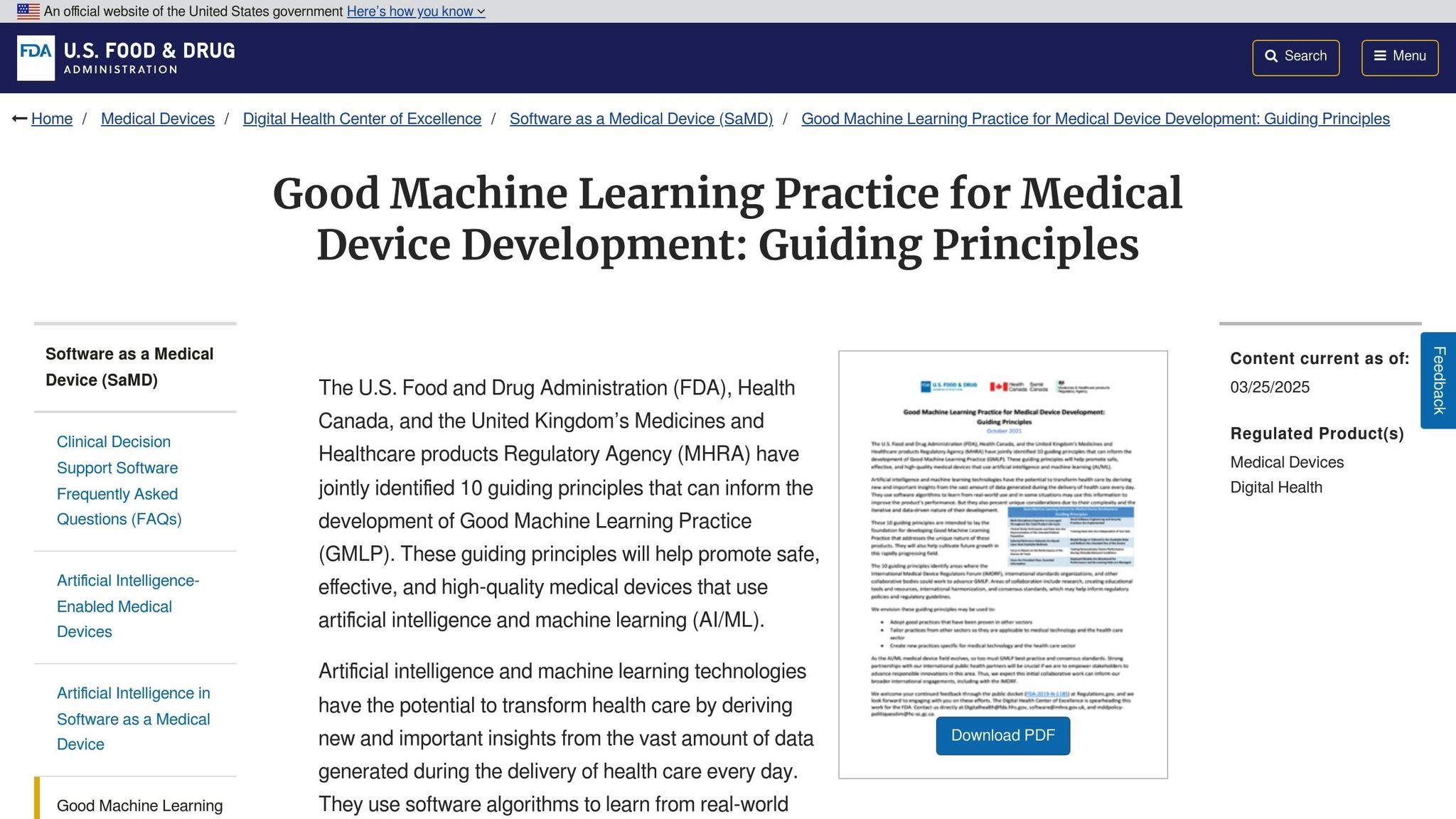
Good Machine Learning Practice

Good Machine Learning Practice (GMLP) consists of 10 guiding principles developed by leading regulatory authorities[6][3]. This framework is designed to promote the creation of AI/ML technologies that are safe, effective, and of high quality. When evaluating vendors, healthcare organizations should focus on several key areas:

Ask vendors for detailed documentation that illustrates how they’ve implemented these principles. Look for evidence such as diverse expertise in development, use of independent validation datasets, and clearly defined testing protocols. This level of transparency helps gauge a vendor’s commitment to quality. Additionally, it’s essential to understand how vendors handle dynamic changes in AI/ML systems, as these technologies evolve over time.

Predetermined Change Control Plans (PCCPs)

Predetermined Change Control Plans (PCCPs) are structured outlines detailing how manufacturers will modify their AI/ML devices over time without requiring new FDA submissions for every change[3][7]. These plans typically include:

PCCPs offer a roadmap for how AI systems will adapt and evolve. Unlike static devices, AI/ML tools can update algorithms as new data becomes available. When assessing vendors, review their PCCP documentation to understand their approach to managing these updates. A well-thought-out PCCP demonstrates that the vendor has considered the entire lifecycle of their product and has measures in place to maintain safety and effectiveness as the technology evolves[3].

Post-Market Performance Monitoring

Initial compliance is just the beginning - ongoing monitoring is equally critical to address emerging risks. The FDA mandates continuous surveillance and performance tracking for AI/ML tools after deployment. This approach combines premarket evaluations with post-market oversight to ensure these tools remain safe and effective in real-world environments[3].

For healthcare organizations, maintaining a relationship with vendors that prioritize post-market monitoring is essential. During vendor evaluations, investigate their surveillance programs, the frequency of performance reviews, and their criteria for updates. Vendors should have clear processes for tracking system performance in production and addressing any issues that arise. A lack of robust monitoring practices can lead to undetected performance problems, posing significant compliance risks.

Creating a Vendor Risk Framework for FDA AI/ML Compliance

Three-Step Framework for Evaluating FDA AI/ML Vendor Compliance in Healthcare

       
       Three-Step Framework for Evaluating FDA AI/ML Vendor Compliance in Healthcare

Building on the FDA's guidelines, this framework helps you thoroughly evaluate vendor compliance. Developing a vendor risk framework that addresses regulatory compliance, security, and change management is crucial to avoid potential pitfalls like product recalls, liability issues, penalties, or harm to your reputation[1]. With more than 950 FDA-approved AI/ML medical devices currently available[1], having a systematic approach to assess these tools is essential.

Your framework should focus on three main areas: confirming regulatory compliance, evaluating security measures, and understanding how vendors manage updates. Each of these areas should include clear documentation requirements and consistent evaluation criteria, ensuring patient safety and adherence to FDA standards.

Checking Vendor Regulatory Status

The first step is to ensure the vendor complies with FDA standards before integrating their tools into your workflows. Determine if the AI/ML tool requires FDA authorization. The FDA regulates AI as Software as a Medical Device (SaMD) when it's used for diagnosis, treatment, or disease prevention[1]. Ask vendors to provide documentation of FDA clearance or a legal explanation if the tool is classified as exempt[5].

Make sure the vendor's regulatory pathway aligns with the tool's complexity and associated risks. Review the device classification and its controls, and verify that the approved indications for use match your intended application of the tool. Any deviation from the approved use case could lead to non-compliance, even if the vendor meets regulatory requirements. Once regulatory compliance is confirmed, the next focus is on security and data protection.

Reviewing Security and Data Protection

This step ensures compliance with HIPAA regulations and addresses AI-specific security risks. Vendors handling Protected Health Information (PHI) must have a valid Business Associate Agreement (BAA) that outlines access restrictions, security safeguards, breach notification protocols, and audit rights[1]. Without a properly executed BAA, sharing PHI with the vendor is not legally permissible.

Examine the vendor's adherence to the HIPAA Security Rule, which includes administrative, physical, and technical safeguards[1]. For AI/ML systems, pay close attention to protections against threats like data poisoning, model evasion, and performance drift[4]. Request detailed documentation of their vulnerability management processes, secure development practices, and controls to prevent data leakage. Since AI systems introduce unique risks that traditional software evaluations might overlook, your assessment criteria should address these specific challenges. With regulatory and security checks completed, the final step is to manage the ongoing evolution of AI/ML systems.

Managing AI/ML Updates and Changes

AI/ML systems are dynamic, requiring careful oversight as they evolve. Evaluate how vendors handle model drift, particularly in deep learning models[8][4]. Request documentation of their drift monitoring processes, thresholds for corrective actions, and response timelines. As of December 2024, only 1.5% of FDA-authorized AI/ML devices included a Predetermined Change Control Plan (PCCP) in their approval summaries. Of these, 73.3% were added after the PCCP guidelines were introduced in April 2023[8]. This indicates that many vendors may not yet have formalized processes for managing changes.

Ask vendors to provide evidence of their version control practices, testing methodologies for updates, and risk analysis procedures[1][8][4]. They should also supply structured reporting tools like Model Cards, which detail algorithm specifications, training data sources, and planned update pathways[1][8][4]. These measures ensure that your organization stays compliant and prepared for the complexities of AI/ML system updates.

sbb-itb-535baee

Managing AI/ML Vendor Risk with Censinet

Censinet RiskOps™ brings a practical solution to the table for healthcare organizations aiming to manage vendor risks tied to FDA regulations. It tackles key challenges like regulatory compliance, cybersecurity, and change control, all while simplifying vendor oversight. By centralizing and standardizing compliance with FDA guidelines, this platform helps streamline the often complex process of managing AI/ML vendor risks.

Automating Vendor Reviews

Censinet RiskOps™ takes the hassle out of vendor reviews by automating the collection and organization of essential compliance and security documents. It integrates structured workflows with automated processes, ensuring reviews are efficient while still allowing for human oversight during critical risk assessments.

Coordinating Across Teams

Effective AI/ML oversight requires input from multiple departments, including risk management, compliance, clinical, and IT teams. RiskOps™ ensures seamless collaboration by centralizing vendor risk data, enabling unified evaluations across teams. This shared access to accurate and relevant data ensures that compliance and cybersecurity standards are consistently upheld throughout the organization.

Tracking AI/ML Risks in One Place

With a centralized dashboard, Censinet RiskOps™ simplifies the task of monitoring AI policies, vendor compliance, and risk assessments. This tool helps organizations pinpoint compliance gaps, prioritize remediation efforts, and stay on top of key risk indicators. By doing so, it equips healthcare organizations to confidently handle internal reviews and regulatory audits with greater efficiency and preparedness.

Conclusion

Effectively managing AI and machine learning (ML) vendor risk is crucial to safeguarding patient safety and ensuring regulatory compliance. The numbers speak volumes: the FDA has approved over 1,000 AI technologies as medical devices[9], and between 2015 and 2020, there was an 83% increase in AI-enabled devices[2]. With potential penalties under HIPAA reaching $1.5 million annually per category[1], and software defects responsible for 20% of medical device recalls[5], the stakes couldn't be higher.

To address these risks, organizations need a structured framework. This begins with adhering to key FDA requirements, such as Good Machine Learning Practice (GMLP), Predetermined Change Control Plans (PCCPs), and rigorous post-market performance monitoring. Healthcare providers should confirm vendor regulatory compliance, verify FDA clearance for specific use cases, and establish strong security protocols. Adopting a Total Product Lifecycle (TPLC) approach ensures compliance doesn't stop at initial approval but continues through ongoing monitoring and updates[3][4].

AI/ML compliance should be treated as a core engineering principle, given its direct link to patient safety[1]. This involves setting up clear processes for reviewing vendor documentation, fostering collaboration across risk management, compliance, clinical, and IT teams, and maintaining oversight of updates and changes to AI/ML systems. Tools like Censinet RiskOps™ help by centralizing vendor risk data, automating compliance reviews, and providing a unified dashboard to monitor AI policies and risks. Such solutions enable healthcare organizations to meet FDA requirements while maintaining the vigilance needed to protect patients.

As the healthcare AI landscape evolves, the basics remain unchanged: thorough vendor evaluations, continuous monitoring, and strong cross-functional collaboration are non-negotiable. By committing to these principles, healthcare organizations can ensure that AI/ML technologies deliver on their promise of innovation while staying safe and compliant. This ongoing commitment to evaluation and oversight is what keeps cutting-edge AI solutions both effective and trustworthy.

FAQs

What are the FDA's main requirements for AI/ML tools in healthcare?

The FDA has established strict requirements for AI and machine learning tools in healthcare to ensure they are both safe and effective. These standards include clear labeling that identifies the use of AI, along with a straightforward explanation of how the tool achieves its intended purpose. Additionally, these tools must comply with premarket review processes such as 510(k), De Novo, or PMA, depending on the product's classification.

For tools that use adaptive algorithms, the FDA emphasizes the importance of ongoing performance monitoring throughout the product's lifecycle. This ensures that the tool consistently meets regulatory and safety standards over time. These guidelines provide healthcare organizations with the confidence to adopt AI/ML technologies while staying compliant and reducing potential risks.

How can healthcare organizations confirm that vendors comply with FDA AI/ML guidelines?

Healthcare organizations aiming to ensure vendor compliance with FDA AI/ML guidelines need a well-structured evaluation process. Start by examining whether the vendor meets FDA premarket requirements, follows cybersecurity standards, and adheres to lifecycle management protocols. Vendors should supply detailed documentation covering model development, validation, risk assessments, and change control strategies, including Predetermined Change Control Plans (PCCPs).

Ongoing audits and performance monitoring play a key role in maintaining compliance. Organizations should also insist that vendors align with FDA’s Quality System Regulation (QSR) and include these compliance expectations in their contracts. Leveraging risk assessment tools and checklists that align with FDA recommendations can simplify the process and help address potential risks more effectively.

What risks do healthcare organizations face when using AI/ML tools that don’t comply with FDA standards?

Using AI and machine learning tools that don't align with FDA compliance standards can have serious repercussions for healthcare organizations. These issues can range from regulatory rejections and product recalls to legal troubles - each capable of disrupting operations and tarnishing your organization's reputation.

On top of that, non-compliant tools often come with elevated cybersecurity risks, making them more susceptible to data breaches or malicious attacks. Such vulnerabilities can expose sensitive patient information, endanger patient safety, and weaken the trust between healthcare providers and their patients. Compliance isn't just about adhering to regulations - it's about safeguarding your organization and the individuals who depend on it.

Related Blog Posts

{"@context":"https://schema.org","@type":"FAQPage","mainEntity":[{"@type":"Question","name":"What are the FDA's main requirements for AI/ML tools in healthcare?","acceptedAnswer":{"@type":"Answer","text":"<p>The FDA has established strict requirements for AI and machine learning tools in healthcare to ensure they are both safe and effective. These standards include <strong>clear labeling</strong> that identifies the use of AI, along with a <strong>straightforward explanation</strong> of how the tool achieves its intended purpose. Additionally, these tools must comply with premarket review processes such as <strong>510(k), De Novo, or PMA</strong>, depending on the product's classification.</p> <p>For tools that use adaptive algorithms, the FDA emphasizes the importance of <strong>ongoing performance monitoring</strong> throughout the product's lifecycle. This ensures that the tool consistently meets regulatory and safety standards over time. These guidelines provide healthcare organizations with the confidence to adopt AI/ML technologies while staying compliant and reducing potential risks.</p>"}},{"@type":"Question","name":"How can healthcare organizations confirm that vendors comply with FDA AI/ML guidelines?","acceptedAnswer":{"@type":"Answer","text":"<p>Healthcare organizations aiming to ensure vendor compliance with FDA AI/ML guidelines need a well-structured evaluation process. Start by examining whether the vendor meets FDA premarket requirements, follows cybersecurity standards, and adheres to lifecycle management protocols. Vendors should supply detailed documentation covering model development, validation, risk assessments, and change control strategies, including <strong>Predetermined Change Control Plans (PCCPs)</strong>.</p> <p>Ongoing audits and performance monitoring play a key role in maintaining compliance. Organizations should also insist that vendors align with FDA’s <strong>Quality System Regulation (QSR)</strong> and include these compliance expectations in their contracts. Leveraging risk assessment tools and checklists that align with FDA recommendations can simplify the process and help address potential risks more effectively.</p>"}},{"@type":"Question","name":"What risks do healthcare organizations face when using AI/ML tools that don’t comply with FDA standards?","acceptedAnswer":{"@type":"Answer","text":"<p>Using AI and machine learning tools that don't align with <strong>FDA compliance standards</strong> can have serious repercussions for healthcare organizations. These issues can range from regulatory rejections and product recalls to legal troubles - each capable of disrupting operations and tarnishing your organization's reputation.</p> <p>On top of that, non-compliant tools often come with elevated <strong>cybersecurity risks</strong>, making them more susceptible to <a href=\"https://censinet.com/blog/taking-the-risk-out-of-healthcare-june-2023\">data breaches</a> or malicious attacks. Such vulnerabilities can expose sensitive patient information, endanger patient safety, and weaken the trust between healthcare providers and their patients. Compliance isn't just about adhering to regulations - it's about safeguarding your organization and the individuals who depend on it.</p>"}}]}

Key Points:

How does the FDA's regulatory framework for AI and ML tools apply to healthcare vendor relationships and what accountability do healthcare organizations carry?

  • The FDA regulates AI and ML tools impacting diagnoses, treatment decisions, or patient safety as medical devices — Software as a Medical Device intended for one or more medical purposes is subject to 510(k), De Novo, or PMA clearance and approval requirements, and healthcare organizations that deploy non-cleared tools for regulated purposes face patient safety risk and legal exposure regardless of whether the compliance failure originated with the vendor.
  • Healthcare organizations are responsible for verifying vendor FDA compliance rather than relying on vendor self-representation — a vendor's claim of FDA clearance does not confirm clearance for the specific use case in which the organization intends to deploy the tool, and misuse of cleared AI tools outside their authorized indications is a compliance failure attributed to the deploying organization.
  • By mid-2025 over 878 AI and ML-enabled medical devices had received FDA clearance — a volume that reflects the rapid expansion of AI tools across diagnostic, monitoring, and clinical decision support applications, and that creates a complex and rapidly evolving vendor landscape in which organizations must continuously track the clearance status and compliance posture of multiple AI vendors simultaneously.
  • The 6.3% recall rate among FDA-cleared AI and ML medical devices by mid-2025 demonstrates that initial clearance is insufficient protection — recalls due to algorithmic flaws confirm that post-market surveillance obligations are not administrative requirements but patient safety functions that detect real performance failures in clinical deployment.
  • A study of 130 FDA-approved AI medical devices from 2015 to 2020 revealed that 97% relied on retrospective data for training — a data quality limitation that GMLP principles specifically address and that healthcare organizations must evaluate when assessing whether a vendor's training methodology meets the representativeness standards that FDA guidance expects.
  • AI-related issues accounted for 13% of healthcare incidents in analyzed breach data from 2009 to 2023 — demonstrating that AI vendor failures create patient safety and data integrity consequences in clinical deployment at a scale that makes FDA compliance verification a patient protection obligation rather than a regulatory formality.

What does Good Machine Learning Practice require and how should healthcare organizations evaluate vendor GMLP compliance?

  • GMLP's data quality and representativeness principles require that training datasets be diverse, accurate, and free of systematic biases — training data that underrepresents specific demographic groups, clinical presentations, or geographic populations produces AI models with differential performance across those populations, creating patient safety risks for the groups the data inadequately represents.
  • Algorithm transparency requirements mean that vendors must provide clear, plain-language explanations of software purpose, input data, and decision-making logic — rather than characterizing AI outputs as emerging from opaque black box systems that clinicians cannot interrogate, GMLP compliance requires that the rationale behind AI recommendations be understandable to the clinicians who must act on them.
  • Bias identification and ongoing assessment across demographic groups are required GMLP practices — vendors must conduct and document validation studies that specifically evaluate model performance across age, race, sex, and other clinically relevant demographic dimensions, with known performance differentials disclosed rather than averaged into aggregate accuracy metrics that may obscure disparate performance.
  • Human-AI team performance evaluation requires that the AI system be designed for the specific clinical context in which it will be used — not just optimized for algorithmic performance in isolation, but validated in deployment with the human clinician workflow, decision authority, and clinical environment that will characterize real-world use.
  • Post-deployment performance monitoring is a GMLP requirement, not an optional best practice — vendors must establish systematic processes for tracking real-world model performance against the benchmarks established during clinical validation, identifying performance drift as clinical environments, patient populations, or data quality evolve.
  • GMLP compliance assessment should be evidence-based rather than accepting vendor self-attestation — requesting validation study documentation, training data diversity statistics, bias assessment methodology, performance benchmarks across demographic groups, and adverse event reporting processes provides the substantive compliance evidence that FDA guidance expects organizations to verify before deploying AI tools in clinical settings.

What are Predetermined Change Control Plans, what must they contain, and why do they matter for healthcare AI vendor management?

  • PCCPs allow AI medical device manufacturers to preauthorize future algorithm modifications in their initial marketing submission — eliminating the requirement for separate regulatory submissions for covered changes that remain within the authorized PCCP scope and follow the plan's specified change management procedures, enabling AI systems to evolve more rapidly than the traditional submission-by-submission regulatory model would allow.
  • FDA's August 2025 final guidance formalized the PCCP framework and detailed what a PCCP must include — descriptions of the specific changes the manufacturer intends to implement, the data collection and testing methodology that will validate each change, the acceptance criteria the change must meet, the labeling updates that will accompany changes, and the quality system procedures that will govern implementation.
  • A PCCP is submitted with the 510(k), De Novo, or PMA application and reviewed by the FDA alongside the device — when authorized, the PCCP becomes part of the device description and changes within its scope may be implemented without new submissions, while changes outside the plan's scope or that cannot meet its specified methods still trigger new premarket application requirements.
  • For healthcare organizations, verifying PCCP authorization and scope is a required AI vendor assessment element — vendors without authorized PCCPs must submit new marketing applications for significant algorithm modifications, meaning organizations using those vendors may be deploying AI tools operating on outdated algorithms during the months-long submission review period for each update.
  • PCCP implementation must be exact — changes must be executed precisely as specified in the authorized plan — deviations from the PCCP's documented change management procedures eliminate the submission waiver benefit and create compliance exposure, making the vendor's change management discipline a compliance risk factor that requires ongoing monitoring rather than one-time verification.
  • PCCP principles require that plans be focused and bounded, risk-based, evidence-based, and transparent — a PCCP that describes changes broadly without specific testing requirements, lacks risk-based prioritization of different change types, or provides insufficient detail about validation methodology does not meet FDA's quality expectations for authorized change management.

What does the Total Product Lifecycle approach require for ongoing AI vendor compliance and why is initial clearance insufficient?

  • The TPLC approach treats AI medical device compliance as a continuous obligation spanning design, development, deployment, post-market monitoring, and device retirement — rather than a one-time review completed at the point of initial clearance or approval, the TPLC framework requires that oversight continue throughout the device's operational life in the same clinical environments where patient safety is at stake.
  • Post-market surveillance under the TPLC framework requires vendors to continuously monitor real-world performance against the benchmarks established during clinical validation — detecting performance drift that can occur as patient populations, clinical workflows, data quality, and clinical practice evolve in ways that were not anticipated during the pre-market validation studies that supported initial clearance.
  • Adverse event reporting is a TPLC compliance obligation that vendors must fulfill systematically — tracking and reporting adverse events, near-misses, and device malfunctions to the FDA in the required timeframes with appropriate detail is an ongoing post-market obligation that healthcare organizations should verify vendors have the infrastructure to meet before deployment.
  • Cybersecurity vulnerability management under the TPLC framework requires continuous monitoring — for AI medical devices that also qualify as cyber devices under Section 524B, vulnerability disclosure and patch management obligations continue throughout the device lifecycle, making vendor cybersecurity practices a TPLC compliance element as well as a security risk factor.
  • The 6.3% recall rate among FDA-cleared AI and ML medical devices demonstrates that initial clearance does not guarantee sustained safety — recalls due to algorithmic flaws that emerge in clinical deployment confirm that the post-market surveillance discipline the TPLC framework requires is detecting real safety failures that pre-market validation did not fully anticipate.
  • Healthcare organizations must establish ongoing monitoring of AI vendor TPLC compliance rather than treating initial vendor clearance verification as a completed compliance activity — because TPLC obligations continue throughout the device lifecycle, the vendor compliance posture relevant to an organization's patient safety and regulatory standing changes continuously as vendors update algorithms, report adverse events, and manage cybersecurity vulnerabilities.

What must healthcare AI vendor assessments cover and how should organizations structure their evaluation framework?

  • FDA clearance verification must confirm authorization for the specific use case in question, not just general clearance status — a vendor cleared for one diagnostic application is not authorized to use that clearance for a different clinical indication, making use-case-specific clearance verification a required assessment element rather than a general regulatory compliance check.
  • PCCP status and scope must be confirmed as part of AI vendor assessment — identifying whether the vendor has an authorized PCCP, what changes it covers, what acceptance criteria govern covered changes, and what new submission requirements would apply to algorithm modifications outside the PCCP's scope provides the regulatory change management picture that organizations need to assess ongoing compliance risk.
  • GMLP compliance documentation must be evaluated across data quality, bias assessment, transparency, and post-market monitoring dimensions — requesting validation study documentation, training data diversity statistics, performance benchmarks across demographic groups, adverse event reporting processes, and algorithm transparency materials provides the substantive evidence basis that FDA guidance expects organizations to verify.
  • PHI security requirements including HIPAA compliance and AI-specific threat protections must be verified alongside FDA compliance — AI systems that process PHI must comply with HIPAA's technical, administrative, and physical safeguards, and must specifically address AI-specific security risks including data poisoning, adversarial attacks, and model drift that conventional security frameworks do not fully address.
  • Post-market surveillance capabilities must be confirmed through evidence of systematic processes — verifying that vendors have structured adverse event tracking, real-world performance monitoring against validated benchmarks, and vulnerability management processes that operate continuously rather than periodically provides the assurance that ongoing TPLC compliance is achievable.
  • AI/ML compliance should be treated as a core engineering principle in vendor assessment — rather than evaluating regulatory compliance as an administrative layer applied to an AI system designed without compliance in mind, GMLP-aligned assessment looks for compliance embedded in the AI development methodology, training data governance, validation framework, and deployment monitoring infrastructure from the outset.

How can technology platforms support continuous FDA AI and ML vendor compliance oversight at scale?

  • The growing AI vendor portfolio that most healthcare organizations are building creates a compliance oversight scale problem that manual processes cannot solve — evaluating GMLP compliance, confirming PCCP status and scope, tracking post-market surveillance performance, and monitoring cybersecurity vulnerability management for multiple AI vendors simultaneously requires systematic automation rather than case-by-case assessment.
  • Censinet RiskOps™ centralizes AI vendor risk management in a structured assessment framework that addresses FDA clearance, GMLP compliance, PCCP status, and security requirements — enabling organizations to evaluate and monitor their AI vendor portfolios against the full scope of FDA AI and ML guidance requirements in a unified platform rather than through fragmented assessment processes.
  • Continuous monitoring replaces point-in-time assessment snapshots that may not reflect current PCCP implementation status or post-market surveillance performance — because TPLC compliance changes continuously as vendors update algorithms, report adverse events, and manage vulnerabilities, ongoing monitoring is required to maintain an accurate picture of AI vendor compliance posture between scheduled assessment cycles.
  • Censinet AI™ accelerates AI vendor evidence review by summarizing documentation, identifying fourth-party supply chain risks, and generating risk reports — AI systems frequently depend on third-party AI components, model hosting infrastructure, and data pipeline vendors whose own compliance posture creates fourth-party risk for the healthcare organization, and identifying these dependencies is a required element of comprehensive AI vendor risk management.
  • The platform enables collaboration across risk management, compliance, clinical, and IT functions — AI vendor compliance requires cross-functional input that siloed assessment processes cannot efficiently coordinate, and platforms that route findings to appropriate stakeholders through automated workflows ensure that FDA compliance findings reach the technical and clinical teams who must act on them.
  • Healthcare organizations using automated AI vendor risk management report significant improvements in assessment efficiency and compliance gap identification — the operational discipline that systematic automated AI vendor oversight creates across growing AI portfolios produces measurable improvements in both the regulatory compliance and patient safety dimensions of AI vendor risk management simultaneously.
Censinet Risk Assessment Request Graphic

Censinet RiskOps™ Demo Request

Do you want to revolutionize the way your healthcare organization manages third-party and enterprise risk while also saving time, money, and increasing data security? It’s time for RiskOps.

Schedule Demo

Sign-up for the Censinet Newsletter!

Hear from the Censinet team on industry news, events, content, and 
engage with our thought leaders every month.

Terms of Use | Privacy Policy | Security Statement | Crafted on the Narrow Land