
KRIs help healthcare teams turn scattered security data into a short list of risk signals that leaders can act on before care is hit. That matters because in 2024, hacking and IT incidents drove 81% of healthcare data breaches, and more than 276 million Americans had PHI exposed.
If I had to boil the article down, it’s this:
- KRIs show where risk is building
- They are not the same as KPIs, tool metrics, or incident counts
- They cut guesswork by using fixed formulas, time periods, and thresholds
- The most useful healthcare KRIs track patching, MFA, vendor risk, device risk, detection time, response time, and downtime
- They fit into HIPAA, NIST CSF, and ERM reporting
- They work best when definitions, ownership, and data sources are documented
- Benchmarks make reports easier to use, because leaders can see if a metric is off target and needs action
A few numbers make the case plain. Research cited in the article says 44.4% of ransomware attacks on U.S. hospitals disrupted care delivery, 41.7% caused electronic system downtime, and 4.3% led to ambulance diversion. The point is simple: measuring what matters for cybersecurity is not just about IT status updates. It helps leaders track risks tied to patient care, PHI, and downtime.
Here’s the short version of what matters most:
| Area | What KRIs add |
|---|---|
| Reporting | Fewer vague ratings, more measurable risk signals |
| Governance | Clear thresholds for escalation |
| Compliance | A more repeatable way to support HIPAA risk review |
| Patient care | Earlier warning signs before outages and delays spread |
| Leadership decisions | Cleaner trend data for staffing, tools, and control gaps |
I’d describe the main takeaway this way: good healthcare cyber reporting does not need more dashboards. It needs better indicators. KRIs do that by linking raw data to risk scenarios, setting clear trigger points, and giving boards and risk teams a steady way to track movement over time.
KRI Explained in Detail | Key Risk Indicators for Risk Management, IT Audit & Cybersecurity
sbb-itb-535baee
What KRIs Are and How They Improve Reporting Accuracy
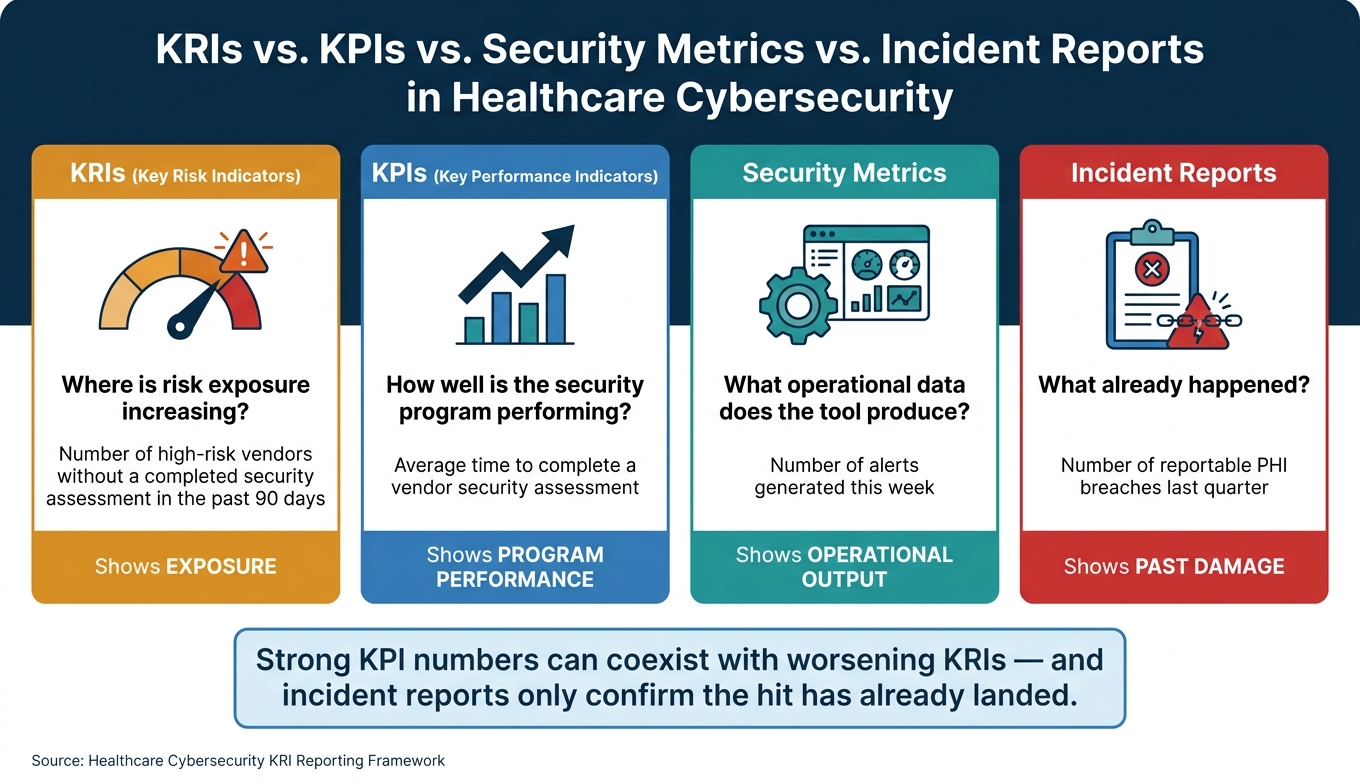
KRIs vs. KPIs vs. Security Metrics vs. Incident Reports in Healthcare Cybersecurity
A KRI is a risk measure tied to a specific risk scenario, not just raw output from a tool. In healthcare, “percentage of clinical apps without MFA” is something a team can act on. A weekly MFA event count isn’t. That difference matters.
KRI-based reporting is built for accuracy, comparability, and action. It’s not about dumping more data into a dashboard. It’s about showing risk in a way leaders can understand and use.
KRIs vs. KPIs, Security Metrics, and Incident Reports
Once KRIs are defined, they need to be kept separate from the other measures leaders see. In healthcare reporting, these categories often get lumped together. That creates confusion for boards and risk committees, because each measure answers a different question:
- KRIs answer: Where is risk exposure increasing? Example: “Number of high-risk vendors without a completed security assessment in the past 90 days.”
- KPIs answer: How well is the security program performing? Example: “Average time to complete a vendor security assessment.”
- Security metrics answer: What operational data does the tool produce? Example: “Number of alerts generated this week.”
- Incident reports answer: What already happened? Example: “Number of reportable PHI breaches last quarter.”
Put simply, KRIs show exposure, KPIs show program performance, and incident reports show damage that has already happened. A team can have strong KPI numbers and still watch KRIs drift in the wrong direction. And incident reports only tell you the hit has already landed.
That’s why separating these categories in dashboards matters. It helps executives avoid a common mistake: assuming that a lot of security activity means risk is low.[3][4]
Leading and Lagging Indicators in Healthcare Environments
KRIs work best when they include both exposure signals and outcome signals. In practice, they fall into two groups.
Leading indicators point to higher exposure before an incident occurs. In healthcare, that can include patch latency on EHR servers, privileged access anomalies found by identity or SIEM tools, and the percentage of medical devices without current security configurations. If patch times start slipping or unusual logins jump, risk managers still have time to step in.[7][9]
Lagging indicators confirm what already happened. In healthcare, these include total hours of EHR downtime from ransomware per quarter, the number of reportable PHI breaches per year, and regulatory findings that cite poor safeguards. Sophos found that only 22% of healthcare ransomware victims fully recovered within a week or less in 2024, while 37% took more than a month to recover.[5]
Lagging indicators help validate whether controls are getting better. But they can’t stop the next event. A mature KRI program uses both types: leading indicators for day-to-day risk management, and lagging indicators to confirm trends and support investment decisions with portfolio risk management and governance groups.
How KRIs Reduce Subjectivity in Cyber Risk Reports
A lot of healthcare risk reporting still leans on narrative language like “legacy systems pose high risk” or red-yellow-green ratings that depend too much on who wrote the report. That’s where problems start. Two analysts can review the same environment and come back with different ratings, which makes it hard for boards to track progress or compare risk from one period to the next.[6]
KRI-based reporting brings structure to that process. It uses a defined calculation, a fixed measurement period, and clear threshold bands tied to the organization’s risk appetite. For example, “percentage of PHI systems on unsupported operating systems” might be green at 0–5%, yellow at 5–10%, and red above 10%. That gives boards a number they can work with.
The shift is easy to see in day-to-day reporting. Here’s how the two approaches compare across four governance needs.[6][7]
| Dimension | Traditional Qualitative Reporting | KRI-Based Reporting |
|---|---|---|
| Consistency | Varies by analyst and period; relies on individual judgment | Same formula, same scope, same thresholds applied every reporting cycle |
| Precision | Broad terms like "low", "medium", or "high" risk | Numeric values with trend lines, e.g., "12% of clinical workstations missing patches >30 days" |
| Audit trail | Hard to trace back to primary data sources | Documented data sources, calculation steps, and version-controlled definitions reviewable by internal audit or regulators |
| Actionability | Difficult to prioritize investments from vague descriptions | Measurable thresholds let leadership set targets and track progress quarter over quarter |
The KRIs Most Relevant to Healthcare Cybersecurity Reporting
Once KRI definitions are standardized, the next move is picking the small set that matters most for healthcare reporting. Not every indicator belongs in a board packet. In healthcare, four KRI groups tend to matter most: technical exposure, identity, third-party risk, and medical devices. Each one points to a different kind of risk. Put them together, and leadership gets a much clearer view of where trouble may be building.
Technical and Operational KRIs
A few technical KRIs do a lot of work in healthcare reporting. Percentage of unpatched critical assets, unsupported operating systems in use, encryption coverage across PHI-bearing systems, and endpoint detection and response (EDR) coverage are all easy to measure, easy to trend, and closely tied to reducing exposure. MTTD and MTTR add another layer by showing how fast the team can detect and contain risk.
HHS’s Health Industry Cybersecurity Practices (HICP) technical guidance gives a plain example: track monthly DMZ vulnerabilities by CVSS severity and work to bring the total down over time. That same guidance also recommends measuring the number of unmitigated new vulnerabilities introduced weekly as a leading sign of risk exposure[10].
Identity, Third-Party, and Medical Device KRIs
MFA coverage is the main identity KRI. It shows, in one number, how much of the organization is protected against credential theft. Alongside that, failed login spikes and unusual privileged access can act like early smoke alarms. They may point to brute-force attempts, compromised accounts, or misuse of admin access before an incident turns into something serious.
For third-party risk, percentage of critical vendors assessed, aging of open high-risk findings, and time since last reassessment for high-risk suppliers say a lot about governance quality, not just whether a checklist was completed. Aging findings, especially, often signal governance gaps rather than one-off technical flaws[11].
Medical device cybersecurity also belongs in executive reporting because it is, at its core, a governance issue. The most useful device KRIs are inventory completeness, percentage of devices with known exploited vulnerabilities, percentage of devices past supported firmware or patch levels, and devices lacking validated network segmentation. HICP guidance also recommends tracking the number of medical devices not segmented on wired or wireless networks monthly as a direct measure of clinical exposure[10].
How to Present KRIs in Executive Dashboards
After the core KRIs are chosen, the format matters just as much as the metric. Executives should be able to scan the dashboard in seconds. Each KRI should answer three plain questions: what is the current value, how has it moved over time, and when does it call for action? Percentages, counts, and days work well because both technical and non-technical audiences can read them without extra translation.
Keep the units simple, the data sources consistent, and the risk domains clear. That way, each KRI looks and reads the same way in every reporting cycle. The table below maps each KRI to its unit, likely data source, and healthcare risk domain.
| KRI | Unit | Likely Data Source | Healthcare Risk Domain |
|---|---|---|---|
| Critical assets unpatched >30 days | % | Vulnerability scanner + asset inventory | PHI systems, clinical infrastructure |
| EDR/endpoint protection coverage | % | Endpoint management platform | Clinical workstations, servers |
| Mean time to detect (MTTD) | Days | SIEM / detection platform | Operational continuity |
| Mean time to respond (MTTR) | Days | Incident tracking system | Operational continuity |
| MFA coverage across clinical systems | % | Identity platform (IAM) | PHI, privileged access |
| Failed login spikes | Count | IAM / SIEM logs | Identity and access control |
| Percentage of critical vendors assessed | % | Vendor risk assessment records | Third-party / supply chain |
| Aging of open high-risk vendor findings | Days | Vendor risk management system | Third-party / supply chain |
| Medical devices with known exploited vulnerabilities | Count | Medical device inventory + vulnerability feeds | Clinical safety, PHI |
| Medical devices not segmented on wired or wireless networks | Count (monthly) | Network segmentation tools + device inventory | Clinical safety, operational continuity |
Trend lines show direction, not just a snapshot.
How KRIs Fit into Healthcare Risk Management Frameworks
KRIs matter only when they shape governance decisions. That’s where they stop being dashboard filler and start doing real work. The next step is to map those measures to HIPAA, NIST CSF, and ERM.
Mapping KRIs to HIPAA, NIST CSF, and Enterprise Risk Management
HIPAA requires an accurate, thorough ePHI risk assessment, but it doesn’t tell you which metrics to use or how often to review them.[2] KRIs help turn that broad requirement into measurable, repeatable reporting signals.[1][14]
NIST CSF 2.0 goes a step further. It includes KRI review in the Govern function, which makes it part of governance, not just an IT status update.[18][16] In practice, that means using KRIs to track exposure across Identify, Protect, Detect, Respond, and Recover.[13][15]
HIPAA and NIST aren’t the whole picture, though. Healthcare organizations also need KRIs that cover broader enterprise risk areas like privacy, patient safety, operational continuity, workforce security, and third-party risk. A 2025 benchmarking study found that Govern and Identify had the lowest coverage among healthcare organizations. It also pointed to supply chain and asset management gaps, where vendor assessment and inventory KRIs can add the most value.[8] Once KRIs are tied to frameworks, the next job is clear: assign ownership and set thresholds.
Steps for Building a Usable KRI Program
You don’t need to build a KRI program from zero. The most workable path is pretty direct: start with risk scenarios. That could mean ransomware causing EHR downtime, a third-party PHI breach, or misconfigured access leading to unauthorized disclosure. Then map each scenario to the matching HIPAA safeguards and NIST CSF categories.[2][12]
From there, choose only KRIs that are measurable and actionable. If a metric won’t trigger a decision or change behavior, it probably doesn’t belong in the program.
Ownership matters just as much as metric selection. CISOs usually own technical control KRIs. Compliance officers own HIPAA process indicators. Operations leaders own downtime and patient safety metrics.[12][15] After that, document the data source for each KRI, set how often it will be reported, and define green-yellow-red thresholds that match risk appetite and escalation steps.
For example, MFA coverage on remote access might be:
- Green: 100%
- Yellow: 95%–99%
- Red: below 95%
If that metric hits red, it can trigger automatic escalation to the CIO and move remediation work up the queue.[1][13]
Why Data Quality and Standard Definitions Matter
A KRI is only as good as the data behind it. If one team defines a critical asset one way and another team defines it differently, the metric won’t hold up from one reporting cycle to the next. Sector guidance recommends a master definition table that links each KRI to a specific data source, calculation method, HIPAA citation, NIST CSF subcategory, and review frequency.[14][15] That kind of documentation keeps reporting steady even when teams change or frameworks shift.
Common problems tend to look familiar: siloed data, too much dependence on manual spreadsheets, and KRIs with no clear tie to controls or risk domains. Automating data collection where possible - from GRC tools, security platforms, ticketing systems, audit logs, and training records - cuts manual errors and speeds up reporting. The table below shows how risk domains and example KRIs fit together in a structured program.
| Risk Domain | Example KRI |
|---|---|
| Privacy / HIPAA compliance | HIPAA risk analysis aging (months); % of identified risks with documented remediation; breach notification timeliness |
| Access control | MFA coverage on remote access (%) |
| Data security | ePHI encryption coverage at rest and in transit (%) |
| Detection capability | Logging coverage on critical systems (%); time to detect high-severity incidents |
| Operational continuity | Average downtime of critical clinical systems; time to restore EHR services after an incident (hours) |
| Patient safety / clinical quality | Sentinel event count; clinical downtime impacting high-risk procedures |
| Third-party / supply chain risk | % of high-risk vendors with current assessments; third-party risk assessments completed on schedule |
| Workforce security | HIPAA training completion rate (%); sanctions timeliness |
Definitions also need regular upkeep as frameworks change. When those definitions stay stable, benchmarking becomes more useful, and platform-based reporting gets a lot easier.
Benchmarking and Platform Support for Efficient KRI Reporting
How Benchmarking Makes KRI Reporting More Useful
Benchmarking shows where an organization stands against its targets and its peers. That sounds simple, but it changes how people read a report. If a board sees that mean time to detect (MTTD) is 187 minutes when the target is under 100 minutes, or that mean time to contain (MTTC) is 14 hours against a 7-hour target, the gap is hard to ignore.[20][7] At that point, the report stops being a status update and starts pointing to action.
The most useful benchmarks usually track a few core areas:
- Control coverage, such as MFA deployment, vulnerability scan coverage, patch SLA attainment, and IoMT inventory completeness
- Response capability, such as MTTD, MTTC, and breach notification timeliness
- Program maturity against internal targets and peer groups
Executive reporting guidance also recommends normalizing some metrics so the comparison is fair across organizations of different sizes. One example is tracking HIPAA incident counts per 10,000 patient encounters.[17][19]
For benchmarking to matter, each benchmark needs a direct link to an escalation or remediation step. If a metric slips into the red, it should trigger a set response, not just another meeting. That matters even more in healthcare, which has been the costliest industry for breaches for 13 straight years. Average breach costs reached about $6.64 million in 2026, or about $408 per record.[22][23]
Once those benchmarks are in place, the next step is a repeatable workflow that collects and reports the same KRIs every cycle.
How Censinet Supports Structured Healthcare Cyber Risk Reporting
Centralized workflow is what turns benchmarking into day-to-day practice. Consistent KRI reporting needs a setup that connects data sources, assessment workflows, and reporting outputs. Censinet RiskOps™ supports third-party and enterprise risk assessments, cybersecurity benchmarking, and collaborative risk management across PHI, clinical applications, medical devices, and supply chains.
For healthcare delivery organizations (HDOs), the platform helps pull vendor assessments, device inventories, and enterprise risk workflows into structured reporting. Censinet AI™ can automate questionnaires, summarize evidence, and draft risk reports. In a busy healthcare setting, that can cut down the manual work and move assessments along faster.
Conclusion: What the Research Shows About KRIs
With benchmarking and platform support, KRIs are easier to report in a consistent way. They make healthcare cyber risk more measurable, more comparable, and more timely. They also cut subjectivity, support escalation decisions, and give boards a steady set of signals tied to patient safety, ePHI protection, and operational resilience. When KRIs are mapped to HIPAA, NIST CSF, and enterprise risk management - and backed by benchmarking and centralized platforms - they improve healthcare cyber reporting by making risk measurable, comparable, and easier to act on.[17][21][24]
FAQs
How many KRIs should a healthcare organization track?
Healthcare organizations should focus on quality over quantity when choosing Key Risk Indicators (KRIs). The goal isn’t to track every possible signal. It’s to use a small set of metrics that connect directly to risk tolerance and business goals.
A lean KRI set is usually the better move. It keeps reporting easier to follow, helps teams stay focused, and makes it simpler to spot risk changes that need attention.
Industry guidance often points to 8 to 12 core metrics to measure cybersecurity and risk management performance across the enterprise.
What makes a good healthcare cybersecurity KRI?
A good healthcare cybersecurity KRI is forward-looking, risk-based, and tied to the organization’s risk appetite, with clear escalation actions.
It should be specific, measurable, and linked to healthcare-critical outcomes like patient safety, PHI protection, and clinical continuity. It also needs reliable data, clear ownership, regular review cycles, and updates as risks and systems change.
How often should KRIs be reviewed and reported?
KRI review and reporting should line up with two things: how critical the system is and how fast risk can show up.
For patient-safety-critical tools, that often means near-real-time or hourly monitoring. For administrative systems, a weekly or monthly review may be enough.
A cross-functional governance committee should review KRI performance every quarter. After major system changes, re-baseline KRIs for 30 to 90 days. It also helps to review alert quality every 3 to 6 months so teams can spot noisy alerts, missed signals, and thresholds that need tuning.
