
If you run connected medical devices, FDA-aligned monitoring comes down to three things: know what you have, track new risks, and act through one shared workflow.
I’d boil the article down like this: device cybersecurity is no longer a one-time vendor task. Hospitals need a clear way to track devices, review FDA/CISA/vendor alerts, rank risk by patient care impact, and move fixes through IT, HTM, and clinical teams. That matters even more when 23% of medical devices had at least one known exploited vulnerability, 99% of healthcare organizations had known exploited vulnerabilities somewhere in their environment, and more than 460 ransomware incidents hit the U.S. healthcare sector in 2023.
Here’s the simple version:
- Build one device inventory that includes model, location, owner, OS, firmware, and clinical use
- Tie SBOM data to each device and map software components to CVEs and KEVs on a set schedule
- Send all alerts into one intake queue from FDA, CISA, NVD, vendors, and internal teams
- Rank risk by exploit status, exposure, and patient care impact, not CVSS alone
- Connect device visibility to the SIEM/SOC so unusual traffic and device behavior trigger alerts
- Use one response playbook for detection, containment, recovery, and reporting
- Assign roles in advance across IT security, HTM, clinical leaders, vendors, and compliance as part of a comprehensive third-party vendor risk management strategy
- Test the process with exercises and feed lessons back into inventories, rules, and CAPA records
What I take from the article is simple: weak programs usually fail at visibility, intake, and ownership. The fix is not more scattered tools. It’s one clear process that turns alerts into action without slowing care.
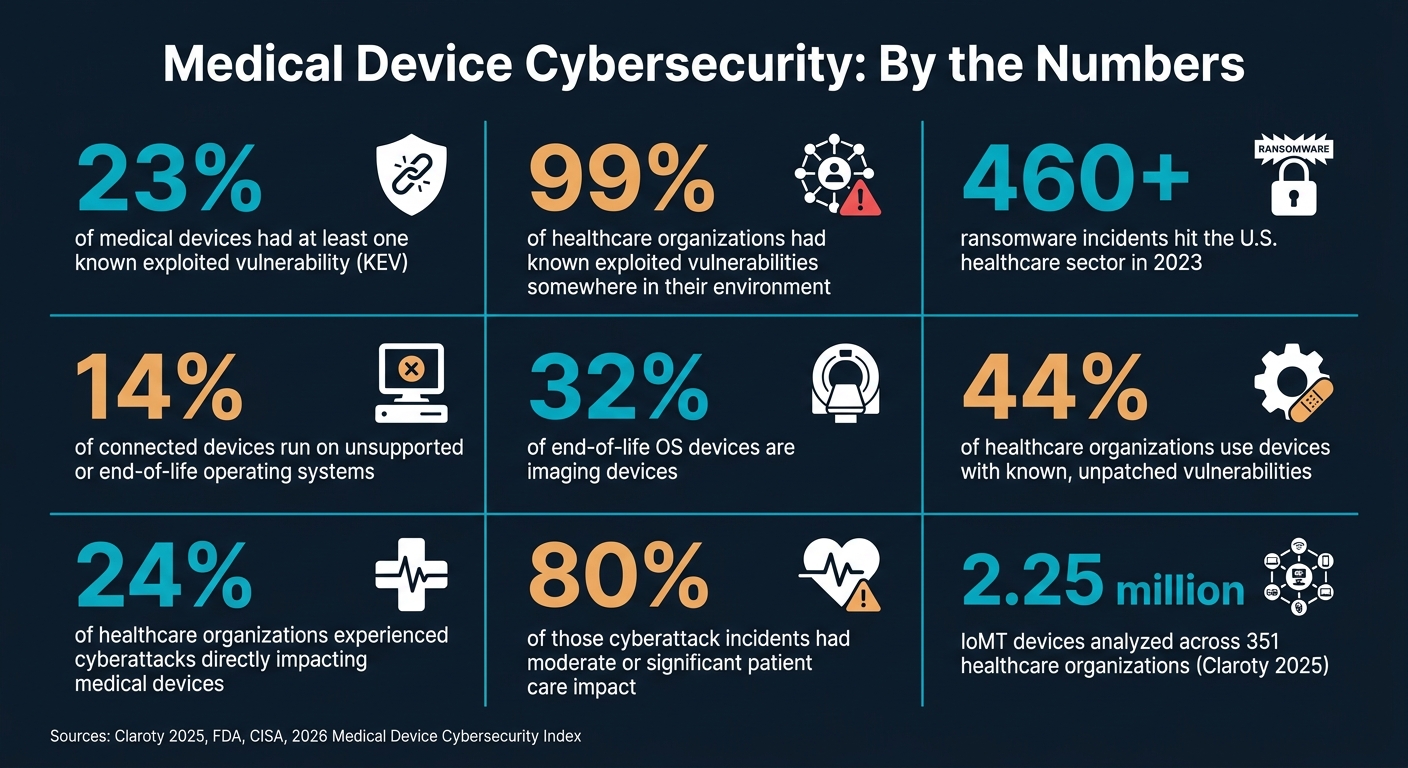
Medical Device Cybersecurity Threat Landscape: Key Statistics
Where Medical Device Threat Monitoring Programs Break Down
Gaps in Asset, Software, and SBOM Visibility
Monitoring falls apart when teams don’t have a dependable inventory of what they’re supposed to protect. Many hospitals still keep device records in separate CMMS platforms, IT asset tools, and local spreadsheets or tracking systems. The problem is simple: there’s no single view that connects a device to its location, owner, OS version, firmware, and clinical role.
That missing context matters. An ICU ventilator and an outpatient imaging unit don’t carry the same clinical or operational risk. If teams can’t see that, triage turns into guesswork. And once the inventory is incomplete, threat intake and prioritization start to slip almost immediately.
The software side is messy too. 14% of connected devices run on unsupported or end-of-life operating systems, with imaging devices making up 32% of that group and surgical devices accounting for 7%.[14] Many of these devices can’t run endpoint agents, don’t produce standard logs, and may never get another patch or security update. Even so, hospitals still rely on them every day.
SBOMs can help, but only if teams can actually use them. An SBOM shows components. It does not show which components are vulnerable. In many hospitals, SBOMs arrive only for newer devices, show up in non-standard formats, or never arrive at all. On top of that, many teams don’t have the tools to ingest machine-readable SBOMs and map them to active CVEs or Known Exploited Vulnerabilities (KEVs) on a recurring basis. Inventory by itself won’t carry the load. Teams need a repeatable intake process that turns advisories into action.
Fragmented Threat Intelligence and Vulnerability Intake
Even when devices are inventoried, monitoring programs can still break down if advisory sources are split across teams. Security, HTM, and compliance often track NVD, FDA, CISA, and vendor notices on their own, with no single owner and no fixed review schedule. That’s where FDA-aligned monitoring starts to drift. Instead of one documented intake workflow, teams end up with ad hoc review.
The numbers show the cost of that drift. Claroty's 2025 analysis of more than 2.25 million IoMT devices across 351 healthcare organizations found that 99% of organizations had confirmed known exploited vulnerabilities somewhere in their environment.[12][15] Claroty also reported that 23% of medical devices had at least one KEV.[10] A separate survey found 44% of healthcare organizations use devices with known, unpatched vulnerabilities.[13] That’s what happens when advisory intake depends on who happens to see what, and when.
The table below shows where common HDO practice parts ways with what FDA guidance and security frameworks call for:
| Area | Typical Gaps in HDOs | FDA/Standards Expectations |
|---|---|---|
| Asset visibility | Separate CMMS and IT inventories; no unified view of OS, firmware, or clinical criticality | Integrated inventory with device configurations and software components, supported by SBOMs with NTIA minimum elements |
| Threat intel intake | Manual, ad hoc review of FDA Safety Communications, manufacturer notices, and CISA advisories; no single owner or schedule | Defined postmarket monitoring plan with documented sources (FDA, CISA, NVD, vendors) and assigned roles |
| Vulnerability prioritization | Prioritization driven by alert volume or vendor pressure; limited use of KEV data or clinical context | Risk-based process incorporating exploit status, device criticality, patient safety impact, and available mitigations |
| Anomaly detection | Limited sensor coverage on medical networks; logs not centralized; legacy devices without monitoring agents | Enterprise monitoring encompassing medical devices, network segmentation, and logging sufficient to detect cyber events |
Siloed Workflows Between Security, HTM, and Clinical Operations
Even with a solid inventory and steady threat intake, programs stall when nobody agrees on who owns what. Security sees the vulnerability. HTM sees the device. Clinical teams see the downtime risk. But the full decision often sits in the gap between them.
Without a shared workflow, those discussions happen in separate channels, late in the process, or sometimes not at all.
The result is slow and uneven action. A recent survey found 24% of healthcare organizations experienced cyberattacks that directly impacted medical devices, and 80% of those incidents had a moderate or significant patient impact.[13] When 23% of devices already carry at least one KEV,[10] delayed patching, uneven controls, and late clinical input can hit hard. These breakdowns make one thing clear: discovery, intake, and response need one workflow, not three. That starts with centralized discovery, unified threat intake, and clear ownership.
sbb-itb-535baee
How to Build an FDA-Aligned Monitoring Program
Standardize Device Discovery, Inventory, and Software Component Tracking
The fix is operational: build one inventory, one intake queue, and one monitoring path.
An FDA-aligned program starts with a simple idea: you need to know exactly which devices are in your environment. And not just once. This calls for continuous, agentless network discovery across clinical network segments, not a one-and-done inventory exercise. Passive traffic inspection can profile devices without touching them, which matters a lot for devices that can't support endpoint agents.[19][20]
For each device, your inventory should record the basics that teams keep needing later:
- Device type and model
- Unique device identifier
- Clinical function
- Physical location
- OS and firmware version
- Network interfaces
- Communication protocols
- Support status
- Responsible owner
It also helps to link each record to FDA product codes or UDIs. That makes it much easier to match FDA safety communications and CISA advisories against what you actually have installed.[18][11][22]
On the software side, vendors should provide machine-readable SBOMs in SPDX or CycloneDX format for every software release, including commercial, open-source, and third-party components.[8][9][17] But an SBOM can't just sit in a folder. Treat it like a living record. Update it when firmware changes, map components to NVD and KEV on a set schedule, and tie those records back to the device model and serial number.[6][16][5] An SBOM that never gets mapped to CVEs doesn't do much.
Build a Repeatable Threat Intelligence and Risk Prioritization Workflow
Threat intelligence needs a clear path. Feed FDA notices, manufacturer bulletins, CISA alerts, NVD feeds, and internal findings into one central queue, whether that's a ticketing system or a unified risk operations platform. Use the same metadata fields each time, such as affected product, CVE ID, exploit status, and recommended mitigations.[3][6][7][5] Then assign a cross-functional review team, give it a fixed weekly cadence, and set plain escalation rules for critical issues.
This is where many programs either hold together or start slipping: prioritization.
Don't lean on CVSS scores alone. A better approach is to combine exploitability, device exposure, and patient-care impact, in line with NIST CSF and AAMI TIR57 risk management principles.[3][6][7] A flaw on an isolated, non-networked device is not the same as one affecting a widely deployed, highly exposed infusion pump. The point isn't just to label severity. It's to write down why one issue moved to the top of the pile and another didn't.
Connect Medical Devices to Enterprise Monitoring and Risk Operations
Once devices and vulnerabilities live in one system, the next step is to feed that data into enterprise monitoring.
For devices that can't run agents, agentless network visibility tools can send device traffic to your SIEM or SOC platform, where teams set behavioral baselines and use anomalies to trigger alerts.[3][6][7] If an imaging system suddenly starts making outbound connections to an unfamiliar IP, or an infusion pump begins communicating on an unexpected port, that should fire an alert. That's the kind of early warning that gives teams time to step in before device behavior starts affecting care delivery.
Syslog integrations, API connections to HTM platforms, and vendor gateway telemetry can also feed central logging with events like authentication failures, configuration changes, and error states.[3][6] That turns device telemetry into security alerts people can act on instead of noise that gets ignored.
The table below shows how this programmatic approach differs from the manual monitoring that many HDOs are trying to leave behind:
| Dimension | Manual Monitoring | Programmatic, FDA-Aligned Monitoring |
|---|---|---|
| Visibility | Sporadic vendor emails, isolated SOC alerts, no structured SBOM use | Defined sources: FDA notices, CISA alerts, NVD CVE feeds, manufacturer bulletins, internal findings |
| Intake | Reactive; issues addressed after incidents or staff escalations | Structured intake queue, weekly review cadence, documented escalation criteria |
| Ownership | Unclear; security, HTM, and clinical act independently | Defined roles: IT security leads intake, HTM validates devices, clinical leaders assess patient impact |
| Response output | Informal notes, inconsistent remediation, minimal documentation | Ranked remediation actions, documented risk rationale, audit-ready records |
Medical Device Security: What Must Be Decided Early
How to Strengthen Incident Response for Medical Device Cyber Events
Monitoring only helps if it leads to a fast, safe response. FDA expects a defined process for containment, recovery, and reporting, not improvised decisions in the middle of an event. And the same inventory and ownership gaps that weaken monitoring tend to slow incident response too.
A 2026 Medical Device Cybersecurity Index found that 24% of healthcare organizations experienced a cyberattack affecting a medical device, with 80% of those reporting moderate or significant impact on patient care.[26][27] This isn't just an IT problem. It can hit clinical workflows, patient safety, and reporting duties at the same time.
Build Playbooks for Detection, Containment, Recovery, and Reporting
Use the playbook to cut out guesswork before an incident starts.
A device-specific playbook helps teams act under pressure without stopping to debate every step. The simplest way to do that is to walk through four phases with short, parallel actions:
- Detect and triage: Define what a suspicious device event looks like. That may include unexpected reboots, abnormal network traffic, unauthorized configuration changes, or anomalous clinical outputs. Then assess whether essential clinical performance could be impaired.[7]
- Contain: Set containment options ahead of time. If a device can't go offline, document compensating controls such as increased clinical monitoring, redundant devices, or manual output verification.[25]
- Recover: State who validates patches or firmware before the device goes back into service. In many cases, that means a joint sign-off from HTM and IT security.[25]
- Report: Make the reporting rules plain. Routine patches follow one path. Actions taken to reduce a risk to health - corrections or removals under 21 CFR Part 806 - follow another, with records that feed into CAPA and risk management processes.[3][24]
Map the playbook to NIST CSF or ICS so it fits into hospital emergency structures.
Define Roles Across IT, HTM, Clinical Leaders, and Vendors
Once the playbook spells out the actions, assign an owner to each one.
Unclear ownership slows an FDA-aligned response. If a device alert fires at 2:00 a.m., people need to know exactly what's theirs to do.
A practical split looks like this: IT security watches enterprise networks, connects device-level indicators to bigger attack patterns, and leads technical containment decisions. HTM/clinical engineering brings device-level expertise. That includes advising on which controls can be used without violating device specifications, putting compensating controls in place, and validating functionality after recovery.[25] Clinical leaders judge patient safety impact and approve workflow changes when devices are isolated or limited. Manufacturers and vendors clarify whether a given containment action counts as a reportable correction or removal under 21 CFR Part 806.[1][3][24] Compliance and legal interpret reporting thresholds across FDA MDR/806, HIPAA, and CISA, and make sure documentation meets internal governance rules.[24]
This is the day-to-day fix for fragmented workflows between security, HTM, and clinical operations. Put these duties into a RACI matrix tied straight to the playbook. For example, IT security is responsible for technical containment, clinical leadership is accountable for patient safety decisions, HTM is responsible for device-level implementation, and vendors are consulted before safety-impacting changes are finalized.[1][2][7] FDA also maintains a dedicated contact point - CyberMed@fda.hhs.gov - for medical device cybersecurity incidents. That makes the expectation pretty plain: communication channels should be set up before an event, not during one.[21][8]
Use Exercises and Post-Incident Reviews to Improve Over Time
Test the playbook under realistic conditions, then update it based on what breaks.
An untested playbook is just a document. Tabletop exercises and clinical simulations turn written steps into habit.
The best scenarios are specific, not generic. Run an exercise around ransomware affecting networked infusion pumps across multiple units and forcing a fast shift to manual dosing protocols. Simulate a compromise of imaging systems that delays or corrupts diagnostic results. Test what happens if a vendor's remote access channel becomes the point of entry. The FDA/MITRE Medical Device Cybersecurity Regional Incident Preparedness and Response Playbook is explicitly designed to support this kind of regional readiness work.[23][28][29] After each exercise, feed lessons learned back into monitoring rules, device inventories, risk assessments, and CAPA processes.
Conclusion: Next Steps for Healthcare IT Teams
For healthcare IT teams, the next move is simple: execute. Use one inventory, one intake path, and one response workflow. The practical fix is turning those requirements into a repeatable way of working.
In 2024, 23% of medical devices had at least one known exploited vulnerability, and advisories keep climbing.[30] The threat surface is still getting bigger. That puts visibility and triage at the top of the list.
These steps address the same gaps that derail most programs. Start with a central inventory. Then map SBOMs to each device and triage advisories based on device risk and patient impact. After that, route findings to HTM and clinical leaders through a standard workflow.[23][21][6][4][3]
Keeping this workflow in place means having one central place to track risk, owners, and remediation. Censinet RiskOps™ centralizes device risk, vendor risk, and benchmarking, making it easier to track remediation timelines, show consistent practice, and spot systemic gaps before they turn into incidents.
Strong programs have clear ownership, tested playbooks, and connected workflows in place before incidents happen.
FAQs
What does FDA-aligned device threat monitoring require?
It calls for a lifecycle-based approach that builds continuous vulnerability management into your Quality Management System instead of relying on periodic manual reviews.
Key expectations include real-time scanning, a machine-readable SBOM, a formal Cybersecurity Management Plan, Coordinated Vulnerability Disclosure, and timely patching - usually within 30 days for critical vulnerabilities. If patching isn’t feasible, document and apply compensating controls such as network segmentation.
How should hospitals prioritize medical device vulnerabilities?
Hospitals should use a risk-based triage process that ties exploitability directly to patient safety.
Start by sorting vulnerabilities into two groups:
- Uncontrolled: unacceptable risk
- Controlled: acceptable residual risk
Handle uncontrolled issues first. If a patch isn't ready yet, put interim mitigations in place right away while the fix is being developed.
Then use device inventory and SBOM mapping to find the affected assets. From there, prioritize based on:
- Clinical impact
- Likelihood of exploitation
- Exposure
- Available compensating controls
This keeps the focus where it belongs: the issues most likely to affect care and put patients at risk.
What teams should be involved in medical device cyber response?
Medical device cyber response needs a team effort. In a healthcare delivery organization, that usually means bringing together clinical engineering or biomed, information security, IT operations, supply chain or vendor management, and clinical leadership.
Each group plays a different role, and that matters. Security issues with medical devices aren't just an IT problem. They can affect care at the bedside.
These teams work side by side to triage risk, look at possible patient safety effects, and decide what to do next. That can include putting compensating controls in place, switching to alternative devices, or taking equipment out of service.
