
If I had to sum this up in one line: a 2027-ready health system risk program must track vendor, cyber, device, and AI risk all the time, not just once a year.
Here’s the short version:
- Annual reviews are too slow. A vendor can change controls, add subcontractors, or suffer an attack long before the next review.
- Third-party risk is now front and center. The 2024 Change Healthcare attack showed how one vendor issue can disrupt claims, prescriptions, revenue, and care across the U.S.
- A signed BAA is only the floor. It does not prove encryption, MFA, downtime planning, or subcontractor oversight.
- Medical devices and AI need closer review. That includes SBOMs, patch status, model drift checks, bias review, and rollback plans.
- Leaders need plain-language metrics. Think: Which workflows stop? How long is downtime? How many high-risk issues are past SLA?
- Risk ownership can’t sit with IT alone. Security, compliance, legal, procurement, clinical engineering, and care teams all need a role.
- Vendor contracts need harder terms. That includes 24–72 hour breach notice, audit rights, subcontractor flow-down, and downtime coordination.
- The goal is one program. Cyber risk, vendor risk, AI governance, data protection, and incident response should work together.
A few numbers make the case fast: 90% of serious healthcare data breaches involve a third party, and the average economic impact of a healthcare vendor-related breach is $4.88 million. But the bigger issue is care disruption, not just cost.
| Area | Old model | 2027 model |
|---|---|---|
| Risk reviews | Annual or periodic | Continuous tracking and alerts |
| Vendor oversight | Questionnaires and BAAs | Evidence review, monitoring, contract controls |
| Medical device review | Limited point-in-time checks | SBOM tracking and patch follow-up |
| AI governance | Approval at intake | Post-deployment checks for drift, bias, and changes |
| Reporting | Compliance-focused | Patient-care and downtime-focused |
| Ownership | Mostly IT | Shared across business and clinical teams |
My takeaway: if your program still depends on yearly reviews, self-attestation, and scattered ownership, it is built for a health system that no longer exists.
Below, I’d frame the article around one simple shift: move from static review to live risk management tied to patient care.
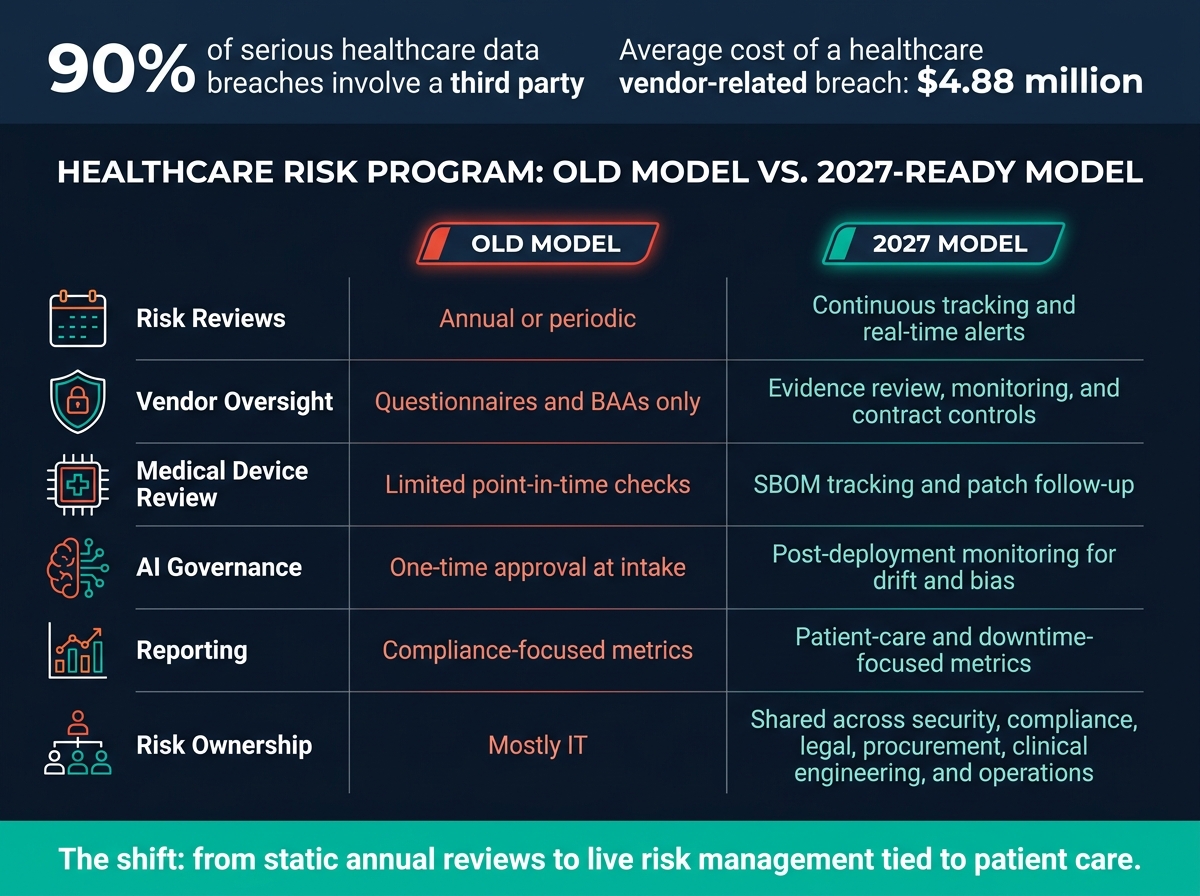
Healthcare Risk Program: Old Model vs. 2027-Ready Model
Healthcare Third-Party Risk Management: Compliance & Cybersecurity
sbb-itb-535baee
Problem: Static Cyber Risk Assessments Leave Health Systems Exposed
Static assessments break down for a simple reason: risk doesn’t sit still.
By the time an annual review is done, the risk picture may already look different. And the issue isn’t just timing. It’s what those fixed reviews never see in the first place. Configuration drift, hidden fourth-party dependencies, and warnings researchers flag months before public disclosure can all slip past an annual process. Software vulnerabilities in connected medical devices can surface the same way and stay unnoticed. So this isn’t only a volume problem. It’s the gap between reviews.
What Continuous Risk Assessment Looks Like in a Health System
Continuous risk assessment isn’t one product you buy. It’s a change in how the program works day to day.
Instead of checking vendors and systems on a set calendar, the program keeps ongoing visibility across every asset that touches ePHI. In practice, that means:
- dynamic risk scoring that changes when conditions change
- automated alerts when a vendor’s security posture shifts
- independent control validation instead of self-attestation
For connected medical devices, that also means tracking Software Bills of Materials (SBOMs) and watching patch status over time. Under HIPAA's Security Rule at §164.308(a)(1)(ii)(A), health systems are expected to conduct an organization-wide risk analysis that covers all systems and vendors with access to ePHI[2]. Continuous assessment is what keeps risk management tied to live clinical operations.
The same idea carries over to how leaders rank vendor exposure.
How to Measure Cyber Risk in Terms Leaders and Clinicians Understand
Risk reports packed with technical jargon rarely drive action in the boardroom or the clinical suite. What lands better are metrics tied straight to care delivery: How long would it take to restore this system after an outage? Which clinical workflows stop if this vendor goes down? How many critical vulnerabilities are past their remediation SLA? The average cost of a healthcare vendor-related breach is $4.88 million[1], but the operational hit is what makes the exposure feel concrete.
That becomes even clearer when leaders need to make a call. The table below shows the difference between the two models.
| Dimension | Periodic Assessment Program | Continuous Risk Assessment Program |
|---|---|---|
| Visibility | Point-in-time snapshots | Ongoing visibility across assets and systems |
| Speed | Slow to detect changes or new risks | Rapid detection of configuration drift and new vulnerabilities |
| Compliance Support | Meets minimum HIPAA review requirements | Supports ongoing HIPAA Security Rule risk analysis |
| Patient-Safety Impact | Gaps may go undetected between review cycles | Faster identification of risks that could disrupt care delivery |
Problem: Vendor and Supply Chain Dependence Creates Concentrated Risk
Continuous assessment only works if it reaches the vendor chain.
Claims processing, prescription routing, imaging, and care coordination all rely on outside vendors. EHR platforms, labs, SaaS tools, telehealth services, and connected device manufacturers all help keep clinical work moving. So when one of those vendors goes down, the fallout isn't just technical. It hits operations and patient care.
The February 2024 Change Healthcare ransomware attack made that painfully clear: one vendor failure stopped claims and prescriptions across the country. The takeaway is blunt: questionnaires alone don't cut it for critical vendors.
Fourth-party risk makes the picture even messier. HITECH says safeguards have to extend to subcontractors, but many health systems never check whether that actually happened. And when those downstream controls aren't there, recovery drags out and exposure grows. In that setting, 90% of serious healthcare data breaches involve a third party[1]. That's why annual reviews fall short. For critical vendors, continuous monitoring is the only model that holds up.
How to Build a Vendor Risk Program Around Clinical Criticality
A vendor risk program built for 2027 starts with a full inventory: every vendor with ePHI access, network connectivity, or a role in patient care. Then comes tiering based on clinical criticality, not just vendor type. An EHR platform or connected medical device manufacturer belongs in a very different risk tier than a lower-impact vendor, even if both touch data.
Higher-tier vendors need tighter controls and stronger proof. That means going far beyond a signed Business Associate Agreement.
A BAA is the legal minimum. It doesn't show whether a vendor encrypts data at rest, trains staff, or could make it through a ransomware event[2]. For critical vendors, contracts should spell out breach notification windows of 24–72 hours, right-to-audit terms, downtime coordination, and clear subcontractor flow-down requirements[1][2]. Evidence reviews should also cover:
- SOC 2 reports
- Penetration testing summaries
- For connected medical devices, a Manufacturer Disclosure Statement for Medical Device Security (MDS2) and a Software Bill of Materials (SBOM)[1]
The SBOM matters because it helps teams see whether a device's embedded software includes known vulnerabilities. A questionnaire by itself won't show that[1].
How Continuous Vendor Monitoring Cuts Reassessment Bottlenecks
Onboarding reviews are a starting point, not the finish line. A vendor's security posture, financial condition, or subcontractor setup can shift a lot between annual reviews. Monitoring has to keep up with those changes. That means tracking movement in security posture, adverse media, and new vulnerabilities without waiting for the next scheduled reassessment[1][2].
AI-assisted workflows can help by summarizing evidence, flagging fourth-party exposure, and drafting reviewer-ready summaries, with human approval still in the loop.
The shift is straightforward: tier vendors by clinical impact, then continuously monitor the relationships that carry the most risk.
| Dimension | One-Time Vendor Review | Modern Vendor Risk Program |
|---|---|---|
| Inventory Completeness | Often incomplete or manually maintained | Full vendor inventory with tiering by clinical criticality and ePHI access |
| Monitoring Frequency | One-time onboarding review | Continuous monitoring with periodic evidence updates |
| Continuity Planning | Rarely tied to vendor contracts | Downtime coordination and subcontractor flow-down built into BAAs and contracts |
| Assessment Turnaround Time | Weeks-long review cycles | Accelerated with AI-assisted evidence review and risk summary drafting |
Problem: AI Adoption, Data Protection, and Compliance Are Moving Faster Than Governance
AI is pushing third-party risk into both clinical and administrative workflows, and most governance programs haven’t caught up. The issue isn’t AI adoption itself. The issue is speed. Governance is lagging behind.
That gap matters because any AI tool or third-party app that touches ePHI belongs in the organization’s risk analysis. If a system can access patient data, it can’t sit outside review just because it feels new or sits in a gray area.
AI due diligence also has to go past the usual vendor checklist. It needs to cover data lineage, bias, transparency, explainability, and upstream dependencies [3]. Put simply: AI governance isn’t a one-and-done approval step. It’s a monitoring job.
What AI Governance Must Include by 2027
Start with patient-safety classification. This helps in managing threats to patient care by aligning security reviews with clinical outcomes. Every AI use case should be rated low, medium, high, or critical so the organization can match the level of review and oversight to the level of risk [3].
From there, governance needs to cut across teams. Security, clinical leadership, data science, and legal should each have clear roles and decision rights. That way, high-impact use cases get reviewed before deployment instead of after a problem lands on someone’s desk.
Just approving a tool up front isn’t enough. Programs built for 2027 need continuous post-deployment monitoring. AI models can drift or degrade after vendor updates or system changes, so governance should track model accuracy, bias, and performance. It also needs a tested rollback and revalidation plan for when something goes wrong [3].
Contracts matter too. AI agreements should restrict training use, require approval for model changes, define performance obligations, and require secure data destruction at end of life [3].
Which Controls Protect PHI and Support Compliance in Connected Care
AI-related PHI should be protected with encryption, IAM, least privilege, and data minimization. In connected care, those controls also need clear human oversight for high-impact decisions.
That’s where governance either becomes real or stays theoretical. If it doesn’t turn into production controls, it won’t protect PHI when people are using the system day to day.
| Risk Domain | Governance Owner | Technical Controls | Compliance Implications |
|---|---|---|---|
| PHI used to train or run AI models | Security, Compliance, Legal | Data minimization, encryption, access controls | HIPAA Privacy and Security Rule requirements |
| Model accuracy and clinical decision support | Clinical Leadership, Data Science | Model documentation, human oversight, re-validation | HIPAA and FDA requirements |
| Third-party AI tools and integrations | Security, Procurement | third-party vendor risk assessment for AI, contract controls, model change approval | BAA requirements, HIPAA Security Rule |
| AI workflow errors and accountability gaps | Clinical Ops, Compliance | Escalation paths, incident response procedures, rollback and revalidation | OCR accountability and state health data privacy laws |
AI in healthcare must meet HIPAA and FDA requirements together.
What a 2027-Ready Risk Program Looks Like in Practice
The last step is getting these controls to work as one program, addressing the security threats in healthcare’s third-party vendor relationships rather than managing a pile of separate workstreams. A 2027-ready model treats cyber risk, vendor risk, AI governance, and data protection as parts of the same operating system. That only works if ownership, incident response, and reporting all run through the same process.
Governance, Incident Readiness, and Executive Reporting as a Unified Model
By 2027, security, compliance, legal, procurement, clinical engineering, and operations need to share risk ownership.
That setup also needs to carry into incident readiness. Strong programs use multidisciplinary playbooks, run tabletop exercises with critical vendors, and keep tested outage plans for disruptions that last more than 72 hours. Why does that matter? Because when a critical vendor goes down or care is disrupted, making it up on the fly won't cut it. The Change Healthcare attack showed how missing vendor-tested contingency plans can stop care and operations at scale.
Executive reporting has to follow that same model. If security metrics sit apart from care-continuity data, leaders don't get the full picture. And without that, they can't make smart investment calls. Boards and executives need reporting that connects vendor risk posture, remediation progress, and incident response readiness to patient safety outcomes, not just compliance checkboxes.
Key Steps to Close the Gap Before 2027
The move from today's model to a 2027-ready program looks like this:
| Today | By 2027 |
|---|---|
| Annual vendor questionnaires | Continuous monitoring with real-time alerts |
| IT-owned risk program | Cross-functional ownership across security, compliance, legal, procurement, clinical engineering, and operations |
| BAA as primary vendor control | Evidence-based assessments verifying actual safeguards |
| AI tools reviewed at onboarding only | Ongoing post-deployment monitoring for drift and bias |
| Incident response tested internally | Tabletop exercises conducted with critical vendors |
Start by inventorying every vendor with PHI or clinical access. Then tier those vendors by clinical continuity impact. From there, merge vendor, audit, and AI findings into one risk-ranked remediation list.
FAQs
How do we start moving from annual reviews to continuous risk monitoring?
Move away from static, point-in-time questionnaires and toward automated, real-time oversight. A good place to start is a risk-tiered cycle: monitor critical vendors continuously for adverse media, security incidents, and financial distress, while reviewing standard vendors on a regular schedule.
Use a GRC platform to pull technical and operational signals into dynamic dashboards. Then set clear escalation paths so automated alerts lead to prompt human action before risks affect patient care.
Which vendors and systems should a health system prioritize first?
Put vendors at the top of the list based on how much they affect patient safety and day-to-day clinical work - not just the compliance box they fall into. Start with Tier 1 vendors: EHRs, connected medical devices, clinical systems, and shared infrastructure.
Then sort them by what matters on the floor:
- How critical they are to patient care
- How likely they are to cause downstream delays
- Whether staff can switch to a manual workaround
Give the highest priority to systems where downtime would interrupt life-critical care in the ICU, OR, ED, oncology, or NICU.
What metrics should leaders track to connect risk with patient care?
Leaders should track metrics that connect cyber and vendor risk to clinical and operational impact, not just IT severity.
That means looking past technical alert scores and focusing on what happens on the floor when systems fail or slow down. Key metrics include downtime hours, canceled procedures, patient diversions, and diagnostic or treatment delays.
It also helps to watch for clinical warning signs that can signal trouble before a disruption turns into a bigger mess. These include:
- Order-to-administration timing
- Medication near-misses
- Device alarm frequencies
- Clinical system uptime
- Time to detect, contain, and recover from incidents that affect critical workflows
Those numbers give leaders a clearer view of how cyber and vendor issues affect patient care, staff workload, and day-to-day hospital operations.
