
Healthcare cyber risk breaks down when setup, daily work, and leadership review live in separate places. My take is simple: the SMART Bundle groups that work into three parts so teams can move from intake to action to board reporting without losing context.
Here’s the short version:
-
Activate sets up the program:
- vendor intake
- asset and product visibility
- tiering by risk and business use
- one place for questionnaires, evidence, and scores
-
Operate runs the day-to-day work:
- assessments
- remediation tracking
- vendor follow-up
- device and breach workflows
- SLA-based task routing
-
Lead turns that data into leadership action:
- dashboards
- risk thresholds
- committee reporting
- board updates
- AI and vendor oversight
A few numbers explain why this matters. 67% of healthcare groups reported ransomware hits in 2024, and the mean recovery cost reached $2.57 million. HHS OCR also received 732 breach notices in 2023, up 17% from 2022. When risk reviews sit in email, spreadsheets, and side processes, delays pile up fast.
What I see in this model is a clear sequence:
- Set up the system
- Run repeatable workflows
- Use the results for decisions
That sequence applies across:
- third-party vendors
- clinical apps
- medical device security risks
- supply chain
- research
- enterprise IT
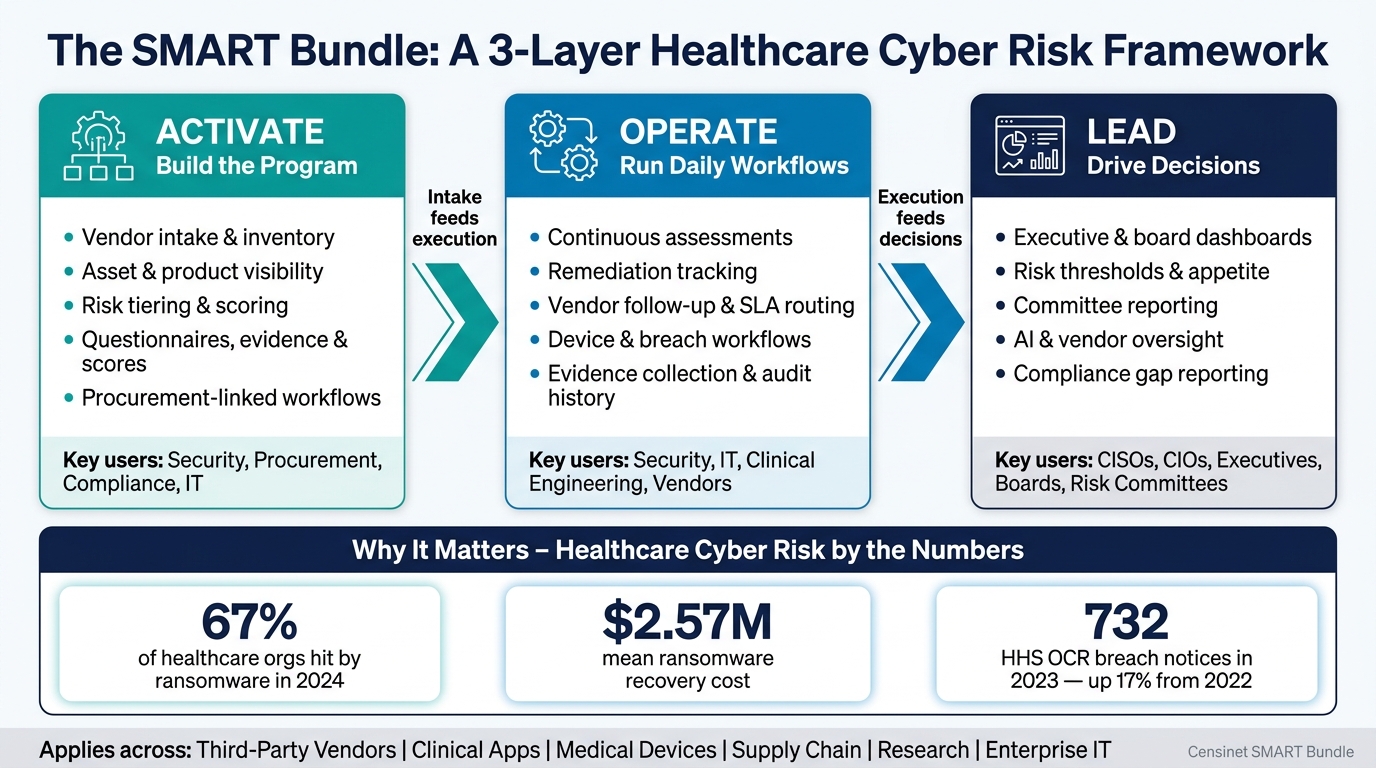
SMART Bundle: Activate, Operate, Lead – Healthcare Cyber Risk Framework
Healthcare Third-Party Risk Management: Compliance & Cybersecurity
sbb-itb-535baee
Quick Comparison
| Part | Main job | What teams use it for | Main users |
|---|---|---|---|
| Activate | Program setup | Intake, scoring, inventory, tiering | Security, procurement, compliance, IT |
| Operate | Daily execution | Assessments, evidence review, remediation, incident workflow | Security, IT, clinical engineering, vendors |
| Lead | Oversight and decisions | Dashboards, risk review, board reporting, AI governance | CISOs, CIOs, executives, boards, risk committees |
In short, I’d describe the SMART Bundle as a build-run-govern model for healthcare third-party risk management. It does not remove the hard parts, but it gives teams a direct way to connect intake, review, remediation, and leadership reporting in one flow.
Activate: Build the Foundation for Risk Management
Most healthcare organizations don’t have a complete cyber risk program. Vendor reviews live in email threads, risk data ends up in spreadsheets, and assessments begin on the fly. Activate changes that by standardizing intake, scoring, and ownership from day one.
What Is Included in Activate
Activate puts the core building blocks in place for a repeatable risk program: standardized questionnaires, a vendor criticality model, a standardized intake risk score, an enterprise risk register, and intake workflows tied directly to procurement.
Those questionnaires cover five core risk areas: Financial, Legal and Regulatory, Information Security, Availability, and Resiliency. They’re also mapped to NIST CSF functions - Identify, Protect, Detect, Respond, and Recover - along with HITRUST control categories and HHS/HSCC cybersecurity practices.[4] That means teams can produce framework-aligned reports for auditors and leadership without redoing the same analysis every time.
Censinet RiskOps™ brings all of this into one system: assessment responses, evidence, scores, and risk decisions. Censinet One™ standardizes vendor profiles, and Censinet Connect™ gives vendors a way to respond once and reuse validated controls across health systems.
Inputs, Stakeholders, and AI Support for Activate
Activate needs a small set of core inputs to get started:
- A vendor inventory
- An asset catalog
- Existing security and privacy policies
- Current risk registers or audit findings
Pulling that information together usually takes coordination across supply chain, IT, finance, and clinical departments. And that process often exposes gaps. For example, a cloud-based scheduling system may appear on IT’s application list but never show up in the vendor inventory. That kind of mismatch is more common than many teams expect, often contributing to the economic impact of third-party risk across the organization.
Activate also depends on shared ownership across security, IT, compliance, privacy, legal, clinical engineering, and supply chain. A RACI matrix sets approval levels and escalation paths so teams know who decides what. A Tier 1 designation - used for mission-critical clinical systems such as major EHR vendors - triggers deeper assessments, shorter review timelines, and higher approval levels than a Tier 4 ancillary service. When those roles are formalized, risk decisions are less likely to stall because of unclear signoff authority.
Censinet AI™ helps speed up some of the most time-consuming setup work. It can help vendors interpret questionnaire items and draft answers from prior responses. It can review SOC 2 reports and penetration test results to pull out relevant control statements. It can also draft initial versions of internal policies and suggest remediation actions for identified gaps. Risk professionals still review the output and make the final call.
Table: Program Maturity Before and After Activate
| Dimension | Before Activate | After Activate |
|---|---|---|
| Vendor Intake | Manual, email-driven, and inconsistent | Standardized, procurement-linked, and automated |
| Risk Scoring | Subjective or applied only after assessment completion | Consistent initial risk score at intake |
| Data Management | Fragmented across spreadsheets and SharePoint | Centralized in Censinet RiskOps™ with normalized fields |
| Review Consistency | Ad hoc, triggered by perceived importance | Policy-driven, tiered by vendor criticality |
| Visibility | Systemic and concentration risks largely invisible | Interactive workflows mapping dependencies and chokepoints |
| Reporting | Reactive, limited, and manually assembled | Structured dashboards aligned to NIST CSF and HITRUST |
The payoff shows up in both speed and workload. Tower Health reduced assessment time from 5–6 weeks to under 1 week, while Intermountain Health cut third-party risk assessment time by 65%.[1][3]
With that foundation in place, Operate turns intake into repeatable day-to-day workflows.
Operate: Run Daily Cyber Risk Workflows at Scale
Operate is the execution layer of the SMART Bundle. It takes the intake and scoring work from Activate and turns it into day-to-day risk workflows across vendors, medical devices, and incident response. This approach helps in managing threats to patient care by ensuring that security gaps don't impact clinical operations. In plain English, it’s the day engine for third-party oversight, device risk, and follow-through after an issue shows up.
What Is Included in Operate
Operate handles continuous reassessments, automated evidence collection, remediation tracking, and dashboards that highlight missing controls against internal policy, HIPAA, and NIST CSF. Evidence collection includes SOC 2 reports, BAAs, penetration test summaries, and SBOMs. The result is simple: risk data doesn’t just sit in a file. It moves into action across the full vendor lifecycle.
Censinet RiskOps™ is the workflow engine behind this process. It routes work, tracks actions, and keeps audit history in one place. Censinet Connect™ brings outside vendors straight into those workflows, so a medical device manufacturer can upload updated vulnerability disclosures or SBOMs directly into the health system’s risk records instead of relying on email follow-up. The Digital Risk Catalog adds continuously updated vendor profiles, risk ratings, and sector-wide intelligence, which helps teams decide how often to reassess vendors and what remediation timelines are realistic.
Operate also ties risk workflows to incident response. If a vendor breach or an unpatched medical device vulnerability is found, predefined RiskOps™ workflows trigger notifications, containment actions, and follow-up tasks. That gives teams a structured response instead of a scramble. Command center dashboards show vendor status, open findings, remediation progress, SLA health, and trend data.
Task Ownership, SLAs, and AI-Enabled Execution in Operate
Operate works best when ownership is clear. Otherwise, it slips back into ad hoc work. Security owns triage. IT and clinical engineering own remediation. Procurement owns vendor alignment. Business owners accept residual risk. When RiskOps™ flags a critical finding, it routes the work automatically: first to security for triage, then to IT operations for remediation planning, and then back to procurement before a contract is signed or renewed.
SLAs give those handoffs some force. Common targets include 10–15 business days for standard assessments and 30-day remediation windows for high-severity findings tied to PHI or clinical safety. HHS Cybersecurity Performance Goals specifically recommend risk-based patching SLAs and 24/7 alert triage for continuous monitoring [5], and those map directly to what Operate puts into day-to-day practice.
Censinet AI™ speeds up execution across the workflow. It can auto-route tasks based on vendor type and risk tier, draft remediation plans for common control gaps, flag inconsistencies in vendor responses, and reuse validated evidence from the Digital Risk Catalog to shorten assessment cycles. Risk professionals still review the output and make the final call.
With execution in place, the next move is to use that operating data for governance and leadership decisions.
Table: Manual Workflows vs. Automated Workflows in Censinet RiskOps™
| Dimension | Manual Workflows | Automated Workflows in Censinet RiskOps™ |
|---|---|---|
| Assessment Speed | Weeks of back-and-forth emails and manual data entry | Shortened cycles via standardized questionnaires, automated reminders, and AI-assisted review |
| Risk Prioritization | Driven by project timelines or internal politics | Intelligence-driven triage using inherent risk scores (300–850 scale) |
| Data Accuracy | Static spreadsheets that go stale quickly | Continuously updated records from a network of 200+ organizations |
| Systemic Visibility | Vendor dependencies largely invisible | Visual workflow maps showing concentration risks and chokepoints across 17 critical functions |
| Remediation Tracking | Status tracked in separate files with no escalation logic | Closed-loop task routing with due dates, ownership, and escalation paths built in |
| Audit Readiness | Fragmented email chains and disparate records | Centralized, auditable histories of assessments, decisions, and remediation actions |
Manual coordination carries a lot of hidden cost and delay. Those time savings matter most when they flow into governance, reporting, and board-level decision-making.
Lead: Strengthen Governance, Reporting, and Decision-Making
Lead picks up where Operate leaves off. It takes workflow data and turns it into decisions leaders can act on. In practice, that means using cyber risk data to guide choices about patient safety, compliance, financial resilience, and digital strategy.
What Is Included in Lead
Lead covers executive and board reporting, risk appetite and tolerance setting, policy governance, AI oversight, and cyber investment prioritization. Censinet dashboards give leaders a standard way to view portfolio risk management, concentration risk, and open exposure over time. That matters because leadership doesn’t need more raw data. It needs clear thresholds and a plain next step.
A good board view usually sticks to 5 to 8 steady metrics, then rotates supporting topics each quarter. A practical set might include:
- overall risk score movement
- critical finding density
- ransomware readiness
- compliance coverage
Metrics show the shape of the portfolio. Risk appetite tells you when to act. That’s a big part of Lead too. In healthcare, thresholds should match what’s at stake: patient care continuity, regulatory exposure, and enterprise resilience. Risks tied to clinical systems, medical devices, or high-impact vendors should face tighter tolerance than administrative applications. If a finding crosses the threshold, it should trigger escalation right away.
Governance Structures for Cyber and AI Risk
Lead works best when governance is designed on purpose before there’s a problem. That means setting a reporting cadence in advance: monthly committee reviews, quarterly board updates, and one annual cyber posture review aligned to NIST CSF. [7][9][13][10] It also means writing committee charters that make accountability plain - who accepts risk, who manages third-party risk and escalates vendor issues, and who approves funding for remediation.
NIST CSF 2.0 made this direction more explicit by adding Govern (GV) as a sixth core function, alongside Identify, Protect, Detect, Respond, and Recover. [8][10] That change puts cybersecurity governance on the same level as the rest of the framework. Several large healthcare systems, including HCA Healthcare and Tenet Healthcare, already place cybersecurity oversight with board audit or risk committees and point to NIST CSF in their governance disclosures. [6][11][12]
That same model now needs to cover AI use inside third-party products. As AI gets built into vendor tools, leadership needs a clear way to track AI-related findings, keep an AI inventory, and send new AI use cases through policy review and security assessment before deployment. Censinet RiskOps™ tracks AI policies, risks, and approvals in one place, then routes findings to the right stakeholders for review. Decision rights for AI risk sit with the same committees that handle vendor oversight and funding approval.
Table: Reactive Governance vs. Data-Driven Governance
| Dimension | Reactive Governance | Data-Driven Governance with Lead |
|---|---|---|
| Decision Basis | Incident-driven updates and internal pressure | Dashboards, trends, and defined risk thresholds |
| Visibility | Limited to individual vendor assessments | Portfolio-wide view across critical business functions |
| Risk Metric | Qualitative or subjective assessments | Standardized 300–850 inherent risk scores |
| Reporting Cadence | Ad hoc, after incidents or audits | Monthly committee reviews, quarterly board sessions |
| AI Oversight | Ad hoc or nonexistent | Centralized AI inventory with automated routing and tracking |
| Resource Allocation | Queue-based or reactive | Prioritized by exposure and business function impact |
| Reporting Format | Manual spreadsheets and technical jargon | Board-ready dashboards in plain language |
Applying the SMART Bundle Across Healthcare Risk Domains
The SMART Bundle brings governance into the risk areas healthcare leaders deal with every day. Across each domain, Activate standardizes inputs, Operate keeps work moving, and Lead turns risk data into decisions.
Third-Party Risk, Vendor Oversight, and Supply Chain
Business associates accounted for 37% of reported healthcare breaches in 2025[15]. That puts pressure on teams to use a structured process from contract intake to renewal.
Activate standardizes vendor intake, PHI-based tiering, and minimum controls before contract signoff.
Operate schedules reassessments by tier and routes remediation to the right owner on a defined SLA.
Lead shows concentration risk and renewal blockers early, so leaders can step in before renewal.
That same three-layer model also works for systems that touch patient care more directly.
Clinical Applications, Medical Devices, and Enterprise Risk
For clinical applications, Activate sets one risk framework that maps each system by clinical criticality, PHI exposure, and integration complexity. It also sets baseline controls before go-live or major upgrades. Operate then handles ongoing vulnerability tracking, change approvals, and user access reviews through RiskOps™ workflows, with Censinet AI™ ranking findings by patient-safety impact. An unpatched EHR interface sits above a non-clinical system because the downstream impact - care disruption and regulatory exposure - is more severe.
For medical devices, Activate starts with a risk-based inventory that includes model, version, connectivity, and clinical criticality. Devices are then tiered by criticality, so ICU bedside monitors face tighter standards than lower-risk devices. Operate coordinates maintenance windows with clinical teams, tracks vulnerabilities, and records approvals when security changes could affect clinical workflows. Lead rolls device risk up across service lines - radiology, cardiology, surgery, and intensive care - to guide capital planning, network segmentation projects, and investment in biomedical security capabilities[2].
Across enterprise IT and research environments, the main issue is consistency. Different departments often work in semi-independent ways. That can leave research environments storing PHI on unapproved platforms or using uneven data governance. Activate sets common risk taxonomies across clinical, enterprise, and research domains. Operate centralizes assessments for new research studies involving PHI and manages data use agreements. Lead gives executives one view of exposure across hospitals, clinics, and research units[2][14].
Table: Healthcare Risk Domains Mapped to Activate, Operate, and Lead
The matrix below shows how the SMART Bundle applies across healthcare risk domains.
| Healthcare Risk Domain | Activate (Foundation) | Operate (Daily Workflows) | Lead (Governance & Decisions) |
|---|---|---|---|
| Third-Party & Vendors | Vendor intake, PHI-based tiering, minimum controls | Tiered reassessments, SLA-enforced remediation | Concentration risk views, renewal decisions |
| Clinical Applications | Risk classification by criticality, PHI exposure, integration | Vulnerability tracking, change approvals, patient-safety prioritization | Cross-application risk visibility, EHR investment decisions |
| Medical Devices | Risk-based inventory, criticality tiering, baseline standards | Patch coordination, compensating controls, change approvals | Capital planning, segmentation projects, regulatory readiness |
| Supply Chain & Procurement | Critical provider identification, intake guardrails, SBOM requirements | Monitoring for single points of failure, automated triage | Supply chain resilience reporting, bottleneck visibility |
| Research & Innovation | Common risk taxonomy, data governance standards, AI inventory | PHI handling reviews, data use agreement management, AI task routing | Unified dashboards across research units, AI governance oversight |
| Enterprise IT | System classification by data sensitivity and regulatory scope | Identity and access reviews, network change tracking, risk normalization | Aggregate risk views, compliance gap reporting, investment alignment |
Conclusion: Using the SMART Bundle as a Cyber Risk Transformation Roadmap
Across third-party, clinical, device, and enterprise use cases, one thing stands out: the SMART Bundle is not a one-and-done project. It works as a sequence. Activate lays the groundwork, Operate keeps that work moving through day-to-day processes, and Lead turns risk data into decisions that help teams move faster and make better calls.
That setup matters because healthcare risk never sits still. Fragmented programs run through spreadsheets and disconnected tools just can’t keep up. A structured three-layer model can.
Key Takeaways for Security, IT, and Risk Leaders
For leaders, the SMART Bundle works best as a phased roadmap. A practical path looks like this:
- Complete a baseline inventory in Activate by month 3
- Automate vendor workflows in Operate by month 6
- Deliver executive dashboards from Lead by month 12
Those early wins matter. Faster assessments, cleaner dashboards, and fewer overdue remediation tasks can build the internal support needed to keep the program going over time.
For security leaders, it swaps ad hoc firefighting for a standard workflow. For IT leaders, it makes ownership clearer and cuts down on unvetted technology risk. For risk and compliance leaders, it creates auditable evidence for HIPAA, OCR, and insurer reviews.
Unify risk findings, corrective actions, and governance workflows in one system of record[16]. When leadership can see vendor exposure, clinical system risk, remediation status, and trend data in one place, decisions move faster, ownership becomes clearer, and governance is easier to manage.
FAQs
How do I know which SMART Bundle phase to start with?
Start by mapping your critical clinical and business services, not your vendor list. Put the focus on the functions that would disrupt patient care or cash flow within 72 hours if they went down. That usually includes EHR access, pharmacy transactions, claims processing, and diagnostic imaging.
From there, connect each service to the vendors, platforms, and subcontractors that support it. Then tier those third parties based on their impact on patient safety and day-to-day operations.
Can the SMART Bundle work with our existing risk workflows?
Yes. The SMART Bundle is built to fit the risk and governance workflows your organization already uses, so you don’t need to rebuild everything from scratch.
Censinet RiskOps helps make that possible by mapping current vendor products to critical healthcare functions. You can also edit and annotate workflows so they match how your organization works day to day.
What metrics should leaders track in the Lead phase?
In the Lead phase, leaders need to watch metrics that tie security work to business results, day-to-day operations, and patient safety. That means looking beyond raw security data and focusing on what it could cost the organization if a third party goes down, where the current security profile falls short of the target state, and how remediation is trending over time.
It also helps to track vendor-level metrics that show where risk is building up or starting to come down. Common examples include:
- The percentage of critical vendors that have been assessed
- Open high-risk findings and how long they’ve remained unresolved
- Average time to remediate issues
- Identified single points of failure
Executive dashboards make this easier to act on. They give leaders a clearer view of risk, support board reporting, and help guide decisions without forcing anyone to dig through raw data.
