
AI risk in healthcare often starts before procurement starts. If I set the wrong use case, assume data can be used without review, or leave ownership unclear, I can create patient-safety, privacy, and third-party AI risk long before any vendor demo happens.
Here’s the short version: Phase 0 is the point where I decide what problem I’m solving, whether AI should be used at all, what data is involved, how much safety risk exists, who owns decisions, and what must be true before the project moves forward. If those choices are weak, later reviews, contracts, and controls may not fix the problem.
What this article says, in plain English:
- Define the use case early. Vague goals like “improve efficiency” are not enough.
- Check whether AI fits the job. Not every workflow needs a model.
- Rate safety impact. The article points to four levels: low, medium, high, and critical.
- Review data before vendor talks. That includes PHI status, data source, sharing rules, and model-tuning limits.
- Name owners from day one. Clinical, privacy, legal, security, IT, and compliance all need clear roles.
- Set go/no-go rules. If the scope, data approval, monitoring plan, or ownership is missing, the project should pause or stop.
- Use one workflow. The article argues that scattered email, docs, and spreadsheets make review harder to track and defend.
One fact stands out: the article cites the HSCC Cybersecurity Working Group, which represents more than 480 healthcare organizations. Its message is simple: cyber safety is patient safety. That is why Phase 0 should be treated as a formal gate, not casual planning.
If I had to boil the article down to one point, it would be this: the lowest-cost time to cut AI risk is before vendor review, when the rules, data, scope, and owners are still being set.
From Deployment to Oversight: Strengthening AI Risk Management and Patient Safety in Health Care
sbb-itb-535baee
Phase 0 failures that create downstream cyber, compliance, and patient-safety risk
Early decisions in Phase 0 can lock in cyber, compliance, and patient-safety risk before procurement or implementation even begins. In most cases, the trouble starts in three places: unclear scope, shaky data assumptions, and weak ownership.
Unclear clinical use cases and undefined decision boundaries
If a team says its AI goal is to “improve clinical efficiency” or “support the care team,” that’s too broad. It doesn’t give anyone enough to validate the system, set human-in-the-loop rules, or assign clear accountability.
The problem is simple: if the use case is fuzzy, everything that follows gets fuzzy too. Validation becomes hard to define. Human oversight gets vague. Baseline controls are harder to set. Drift monitoring turns into guesswork.
As the HSCC notes, "AI incidents are uniquely gradual and difficult to detect, requiring specialized forensics and vendor expertise." [1]
A weak problem statement also makes vendor review harder. If the task and decision boundary aren’t clear, how can a team judge whether a model fits the job or understand its safety impact?
Unapproved data-sharing assumptions and missing data classification
Another common Phase 0 mistake is assuming that if data exists, it can be used for AI right away. That shortcut causes problems fast.
Teams need to confirm whether the data is PHI or de-identified. They also need to set training restrictions before vendor review starts. Without that step, an organization can miss supply-chain risks such as training data leakage, synthetic data misuse, and adversarial inference.
Early data-flow mapping helps show where exposure can happen, especially around:
- PHI movement
- Third-party tools
- Model tuning
That kind of mapping gives teams a plain view of supply-chain risk before contracts are signed.
No named governance owners and weak success criteria
An AI effort needs named owners across clinical, cybersecurity, compliance, legal, and operations. A Phase 0 RACI makes that ownership clear. Without it, teams can end up with untracked AI use, slow incident response, and no clear authority to stop a model when something goes wrong.
Weak success criteria create a similar blind spot. If success isn’t defined at the start, teams may miss whether the tool fits the clinical workflow, how bias should be checked, what incident thresholds matter, and whether patient outcomes are moving in the right direction.
These failure patterns are exactly what a Phase 0 go/no-go screen should catch before procurement starts. The next step is to turn them into intake criteria, data checks, and go/no-go thresholds.
A Phase 0 intake and go/no-go screen for healthcare AI use cases
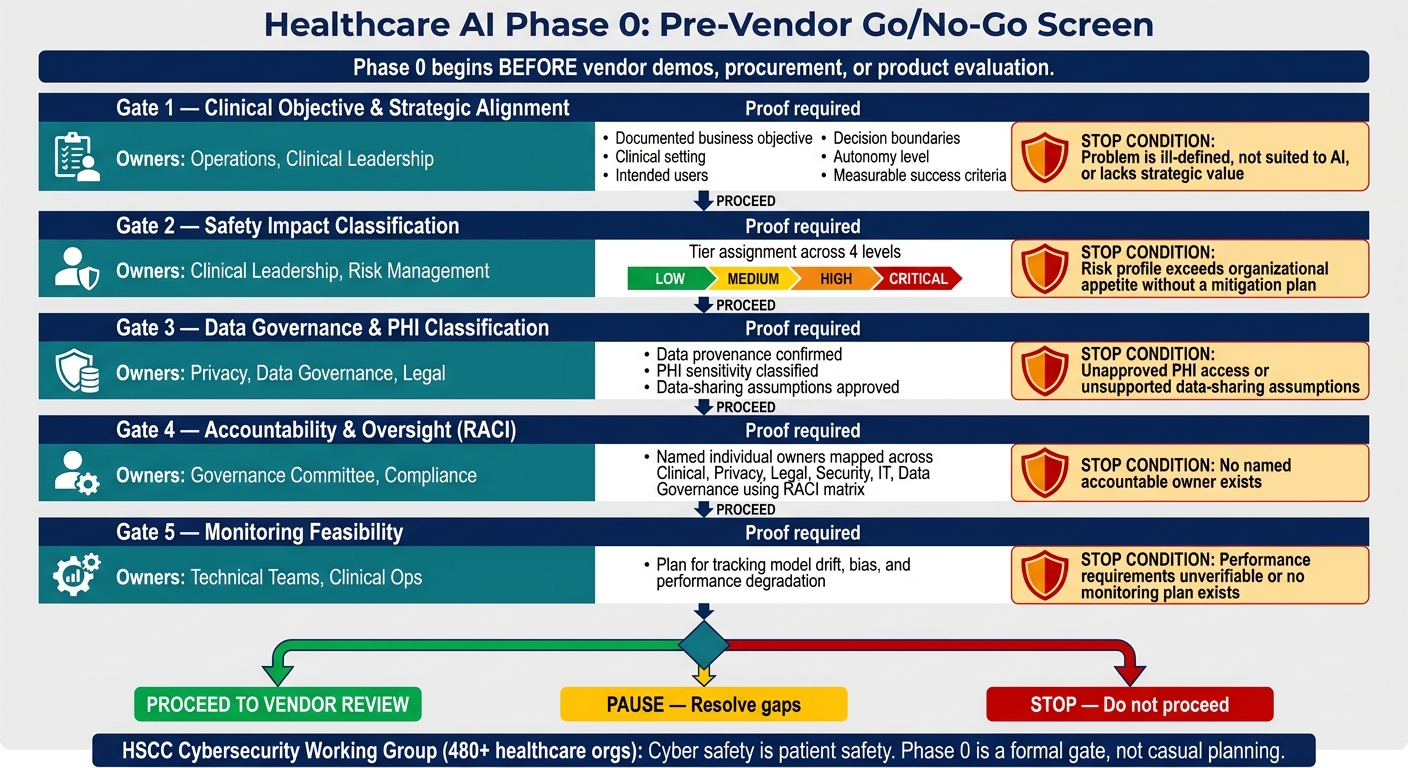
Healthcare AI Phase 0 Go/No-Go Framework: Pre-Vendor Risk Gate
Phase 0 takes the common early failures and turns them into a clear intake screen. It lines up with NIST AI RMF Govern and Map: Govern assigns accountability, while Map rates safety impact.[2] In plain terms, this screen turns three common Phase 0 problems - an unclear use case, unapproved data, and no clear owner - into a process teams can run the same way every time.
Use-case intake criteria that establish clarity early
Before anyone reaches out to a vendor, each proposed AI use case should pass a documented intake checklist. That write-up needs to answer a few basic but tough questions: What, exactly, is the business goal? What clinical setting is involved? Which patient group could be affected? Who will use the system? Where are the decision boundaries? How much autonomy is expected? What data is needed? How will success be measured? And just as important: is AI even the right tool for the job?
The Health Sector Coordinating Council (HSCC) puts it this way:
"Phase 0 - AI use case justification and strategic assessment. Define the problem, confirm AI suitability, classify the use case by safety impact (low, medium, high or critical)."[1]
That classification determines how deep the review needs to go.
Data classification and stakeholder ownership checks
Next comes data classification. Teams need to confirm whether the data includes PHI, how that data is classified, where it comes from, and whether the planned use is already allowed under current policy or consent rules. If any of those points are vague, disputed, or not approved, the project should not move ahead.
Data checks alone aren't enough. A stakeholder ownership map also needs to exist from the start. That means named people, not just departments or job titles, across clinical, compliance, privacy, legal, security, IT, and data governance. The HSCC recommends using a RACI matrix to spell this out: who is Responsible, who is Accountable, who is Consulted, and who is Informed.[2] Without that level of clarity, accountability stays fuzzy, and reviews tend to stall right when decisions matter most.
Go or no-go criteria before procurement begins
A Phase 0 screen also needs hard stop conditions. These are the thresholds that pause or reject a use case before procurement starts. The same risk tier should guide those go/no-go calls.
The screen should force a plain decision: proceed, pause, or stop.
| Intake Criterion | Owners | Proof | Stop Condition |
|---|---|---|---|
| Clinical objective, decision boundaries, and strategic alignment | Operations, Clinical Leadership | Documented business objective, clinical setting, intended users, decision boundaries, expected level of autonomy, and measurable success criteria | No-Go: The problem is ill-defined, not suited to AI, or lacks clear strategic value |
| Safety impact classification | Clinical Leadership, Risk Management | Tier assignment: Low, Medium, High, or Critical | No-Go: Risk profile exceeds organizational appetite without a mitigation plan |
| Data governance and PHI classification | Privacy, Data Governance, Legal | Data provenance and PHI sensitivity classification | No-Go: Unapproved PHI access or unsupported data-sharing assumptions |
| Accountability and oversight | Governance Committee, Compliance | Named owner in a RACI matrix | No-Go: No named owner is accountable |
| Monitoring feasibility | Technical Teams, Clinical Ops | Plan for tracking model drift, bias, and performance degradation | No-Go: Performance requirements are unverifiable or there is no monitoring plan |
The next step is making this screen repeatable inside the governance workflow.
How Censinet helps make Phase 0 AI governance repeatable
The intake screen only does its job if every AI use case moves through the same process. If teams handle one request in a spreadsheet, another in email, and a third in a shared doc, the gate starts to fall apart. The next step is to make that gate repeatable inside one workflow.
Using Censinet RiskOps™ to standardize pre-vendor AI risk review
Censinet RiskOps™ gives healthcare teams one place to run Phase 0 before any vendor review starts. A central intake portal collects the required fields, sends the case to the right reviewers, and records the decision.
That early classification then determines how deep the review needs to go. PHI exposure and data lineage live in that same workflow instead of being tracked in separate places. A dashboard shows every use case and its review status in one view. That's the intake-stage gap RiskOps™ is built to close.
Once intake is done, the workflow can send the case to the right reviewers.
Using Censinet AI™ to scale human-guided review
After a use case passes the Phase 0 screen, Censinet AI™ helps move the next stages along without taking people out of the loop.
It can:
- validate evidence
- draft policy language
- summarize risk findings
- route tasks to the right stakeholders based on the RACI structure set during intake
The point is simple: automation helps the workflow, but accountable reviewers still make the call.
Manual Phase 0 workflows versus a centralized RiskOps model
The gap between a manual Phase 0 process and a central model isn't just speed. It's also about consistency, auditability, and whether a go/no-go decision can stand up when someone looks closely at it.
| Phase 0 Activity | Manual challenge | Censinet capability |
|---|---|---|
| Use Case Intake | Scattered spreadsheets and inconsistent justification | Centralized intake with standard fields |
| Risk Classification | Ad hoc safety assessments that miss hidden risks | Structured tier classification across four safety impact levels [2] |
| Stakeholder Routing | Email-based approvals with missing owners and bottlenecks | Automated routing based on a RACI matrix |
| Evidence Collection | Missing documentation on data lineage and PHI sensitivity | Centralized repository for pre-vendor evidence and data classification |
| Auditability | No permanent record of approval or rejection decisions | Full audit trail of the go/no-go process and stakeholder sign-offs |
A central model makes Phase 0 repeatable across use cases and care settings. That repeatability makes Phase 0 the lowest-cost place to reduce AI risk.
Conclusion: Phase 0 is the lowest-cost point to reduce AI risk
Phase 0 is where healthcare AI risk is either created or kept in check. It happens before vendor review, procurement, or product evaluation. That’s why the practical move is a formal Phase 0 gate: problem definition, safety classification, governance ownership, and go/no-go review should be required steps, not casual early planning.
If those checks aren’t there, the project can carry risk before procurement even starts. A weak problem definition or no clear governance owner can leave data-sharing and security issues out of sight until much later. HSCC’s guidance lands in the same place: it puts Phase 0 first in the AI risk lifecycle.[1] In plain terms, this stage needs the same discipline as any later governance gate.
Phase 0 is the lowest-cost point to cut avoidable AI risk, rework, and delay. It’s the control point that shapes whether later vendor work begins on a safe, defensible base, with the right tool for the problem and clear ownership from day one.
FAQs
What counts as Phase 0 in healthcare AI?
In healthcare AI, Phase 0 happens before procurement and before any vendor demo. It’s the first gate. The goal is simple: define the exact problem or opportunity, then check whether AI is even the right fit.
This phase also sorts the use case by patient safety impact and data sensitivity. On top of that, it names the people accountable for the work, flags governance needs, and sets clear markers for success, expected benefits, risks, costs, and the organization’s readiness to move ahead.
How do we know if AI is the right tool?
Run a Phase 0 solution assessment first. Define the exact problem in plain terms, check whether AI is even the right tool, and sort the planned use by safety impact and data sensitivity.
Don’t skip the basic gut check here. Some problems look like AI problems but are better solved with rules, workflows, search, or standard software. If a non-AI option can do the job with less risk, less cost, and less review overhead, use that instead.
Then require proof that the AI use makes sense. That proof should cover:
- Model provenance: where the model came from, who built it, what version is in use, and what it was trained or tuned for
- PHI handling limits: what protected health information can enter the system, what cannot, where data goes, how long it stays there, and whether it is used for training or logging
- Human oversight: who reviews outputs, when review is required, and what happens if the model gives bad advice or low-confidence results
- Clear success criteria: the exact metrics, thresholds, and failure conditions that determine whether the system is safe and useful
Be strict about documentation. Stop the review if any of the following are missing:
- a model card
- AI-BOM details
- proof of privacy testing
- proof of safety testing
No exceptions. If the team can’t show what the model is, how data is handled, and what testing was done, the project is not ready to move forward.
Who should own Phase 0 decisions?
Phase 0 should sit with named, cross-functional stakeholders who are tied to the use case from day one.
That usually includes:
- Clinical leadership for safety sign-off and clinical value
- Privacy and compliance for HIPAA/BAA review and risk limits
- The CISO or security lead for security controls and incident-response readiness
- Procurement for supplier follow-up and escalation paths
- The governance committee or business owners for accountability, safety-based risk classification, and documented success criteria before any vendor demo
This matters because Phase 0 isn't just early planning. It's where teams set the guardrails. If ownership is fuzzy at this stage, vendor reviews can drift, safety checks can get delayed, and success can turn into a moving target.
