
If a vendor uses AI, I can’t treat it like a normal software review. Models change, data sources shift, and hidden suppliers can affect risk without any visible product change.
Here’s the short version: the HSCC guide gives me a simple way to check third-party AI risk in healthcare before purchase, lock those checks into contracts, and keep watching after go-live. It centers on a few direct asks: what the AI does, what data shaped it, what parts and suppliers it depends on, how updates are handled, and whether outputs can be traced.
What I should do right away:
- Ask vendors to state intended use, limits, and banned use cases
- Request model documentation, data lineage, testing results, and an AIBOM
- Check for red flags like missing data sources, hidden subcontractors, and no change process
- Put disclosure, audit, incident, and update terms into the contract
- Keep a live inventory of AI vendors by risk tier: low, medium, high, or critical
- Review changes such as retraining, drift, new dependencies, and harmful outputs
- Keep records for at least 6 years
A key point from the article is that AI risk does not stop at onboarding. A vendor can change a model after signing, add fourth parties, or retrain on new data. That means my review needs to move from a one-time check to a repeatable workflow.
One fact stands out: the HSCC framework uses 4 safety impact tiers, and the article says review depth should match that tier. Another hard rule: keep governance records for 6 years. Those two numbers alone shape how I set review cycles and evidence tracking.
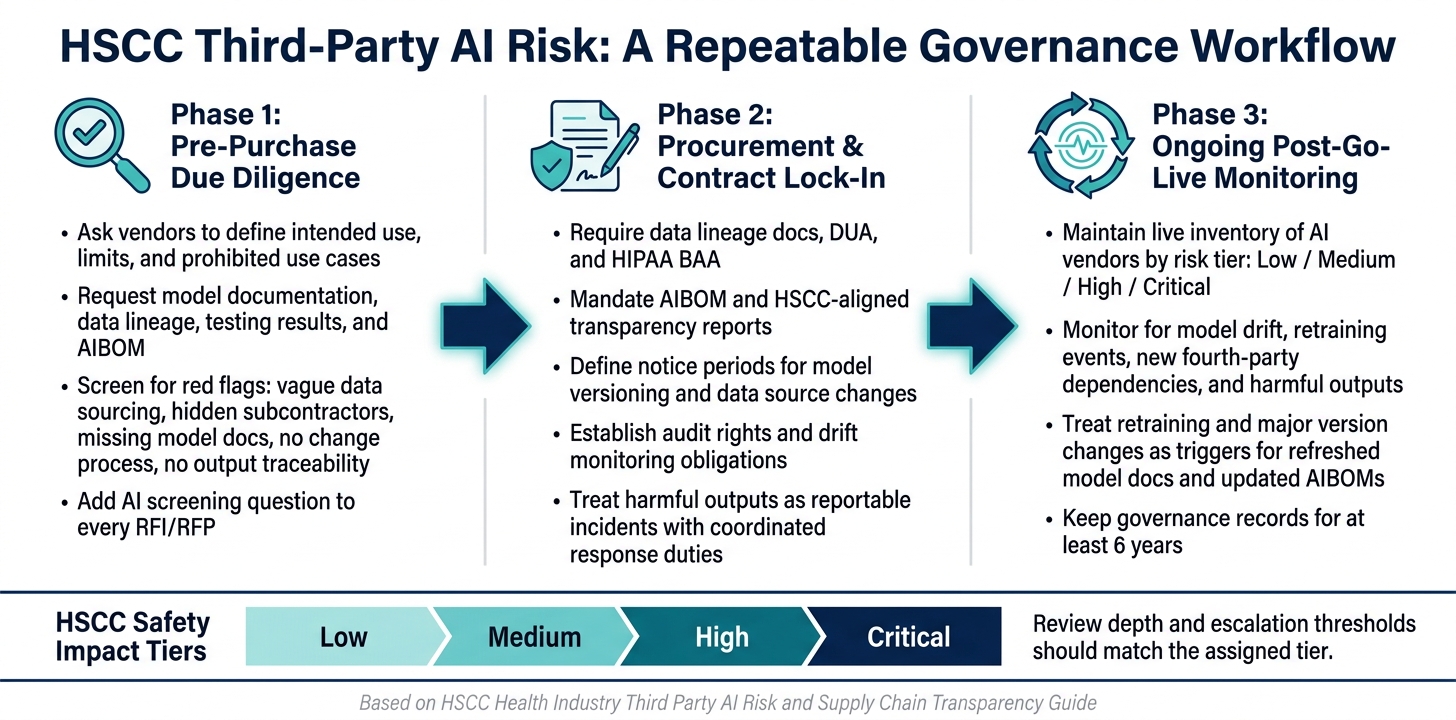
HSCC AI Vendor Risk Review: 3-Phase Governance Workflow
Clarence Chio on how AI Transforms Vendor Risk Into Continuous Evidence
sbb-itb-535baee
Quick comparison
| Area | Basic vendor review | HSCC-style AI review |
|---|---|---|
| Product scope | General product summary | Intended use, limits, banned use cases |
| Data | General claims | Named training/testing sources and lineage |
| Model info | High-level overview | Model docs, test results, model-level controls |
| Dependencies | Direct vendor only | Subcontractors, offshore teams, open-source, fourth parties |
| Changes | Limited change review | Logged model updates and changed assumptions |
| Outputs | Little traceability | Audit trail and output traceability |
Bottom line: if I want a simple way to review third-party AI, this article says to turn HSCC into a checklist, contract terms, and review cycle that I can run the same way every time.
Translate HSCC Requirements Into a Vendor Due Diligence Checklist
Many vendor reviews do a decent job on general security. But they often miss AI risks that sit just below the surface: model integrity, hidden dependencies, and failure chains that don't show up in a standard security questionnaire. HSCC closes that gap by pushing vendors to share specific details. That makes it a solid base for a due diligence checklist.
| Review Area | Minimal Vendor Transparency | HSCC-Aligned Transparency |
|---|---|---|
| Purpose | General product description | Specific intended use and prohibited use cases |
| Data Provenance | Vague reference to "proprietary data" | Named training and testing data sources with provenance details |
| Model Documentation | Marketing materials or high-level overview | Model cards or technical documentation, bias/performance testing and model-level security and privacy controls |
| Third-Party Dependencies | Single-vendor view only | Full map of subcontractors, offshore development, open-source assets, and fourth-party services |
| Update Practices | No documented change process | Documented process for model updates and changed assumptions |
| Output Traceability | No audit trail | Traceable outputs and audit trail |
Ask Vendors to Define Intended Use, Limits, and Prohibited Use Cases
Start with scope. Get clear on what the AI is built to do, what it is not built to do, and which use cases are flat-out off-limits. That sounds simple, but it's where a lot of reviews go sideways.
If the tool touches clinical workflows, even in an indirect way, dig deeper. For any workflow that could affect clinical judgment or operational decisions, ask whether the system supports human judgment or stands in for it. Also ask what level of clinician review is expected before anyone acts on the output.
Safety guardrails matter here too. If a vendor can't explain how the system handles edge cases, that's a warning sign. It usually means deployment risk hasn't been thought through all the way.
Request Core Artifacts: Model Documentation, Data Lineage, and AIBOM
Once the scope is clear, move from claims to proof. The HSCC guide points to a core set of artifacts vendors should be ready to provide: model cards or technical documentation, training and testing data sources, bias and performance testing results, and security and privacy controls tied to the model itself.
Then look at the full supply chain, not just the product demo. Ask for an AI Bill of Materials (AIBOM), which is a structured list of every component in the AI system, including external APIs and fourth-party services. Ask for the full inventory because layered supply chains can hide subcontractors, offshore development, open-source assets, and fourth-party services. That's often where risk slips in.
Identify High-Risk Indicators Before Approval
Some responses should trigger follow-up right away before a vendor moves any further.
- Vague data sourcing: If the vendor can't identify training and testing data sources, provenance is unclear.
- Hidden dependencies: If subcontractors, offshore development, open-source assets, or fourth-party services aren't disclosed, supply-chain risk may be missing from the review.
- Missing model documentation: No model cards, technical notes, or bias and performance testing results.
- No change-management process: No documented process for model updates or changed assumptions.
- No output traceability: If the vendor can't show traceability for AI outputs, escalate.
None of these issues automatically knocks a vendor out. But each one needs a direct answer before approval.
Apply HSCC in Procurement and Contract Review
Once due diligence is done, the next step is to bake HSCC requirements into procurement before you pick a vendor, and then lock them into the contract. That means turning what you found during review into required disclosures, review checkpoints, and contract terms.
Add HSCC Requirements to RFI and RFP Workflows
It helps to flag AI as early as possible in intake. A simple screening question in every RFI can do a lot of work:
Does this product or service include any AI or machine learning components, including those from subcontractors, offshore development, or open-source assets?
That single question can bring hidden dependencies to the surface before they slip through review.
HSCC notes that layered supply chains can obscure AI components that come through subcontractors, offshore development, and open-source assets. If a vendor says AI is part of the product or service, route the request to clinical, legal, and AI governance reviewers. The depth of review should fit the risk. A low-risk operational tool may need a lighter check. Clinical decision support calls for a much closer look.
Use HSCC glossary terms in the RFP so there is less confusion about what the vendor needs to provide.[1] For example, if your RFP uses HSCC definitions for "model documentation" and "AIBOM," vendors have less room to misunderstand the request.
Convert Transparency Expectations Into Contract Clauses
Collecting transparency artifacts during procurement is only part of the job. You also need to make sure vendors stay on the hook after the agreement is signed. After intake and review, carry those same requirements into the contract.
Use contract terms like these to make disclosure duties and change obligations enforceable:
| Contract Risk Area | HSCC-Recommended Controls | What to Request from Vendors |
|---|---|---|
| Data Rights | Define permitted data use for model training; establish PHI and HIPAA constraints; prohibit unauthorized use or disclosure of training data or PHI. | Data lineage documentation; Data Use Agreement (DUA); HIPAA Business Associate Agreement (BAA). |
| Transparency Artifacts | Mandate disclosure of model components and supply chain dependencies, including subcontractors and open-source assets. | AI Bill of Materials (AIBOM); model cards; HSCC-aligned transparency reports. |
| Updates & Changes | Require defined notice periods for model versioning, data source changes, or major performance drift. | Change management logs; updated model documentation upon each version release. |
| Monitoring & Audit | Establish rights to audit model integrity and performance; require regular performance and drift reporting. | Performance dashboards; third-party audit reports; drift monitoring logs. |
| Incident Response | Treat harmful outputs as reportable incidents; establish coordinated response duties for AI-related incidents. | AI incident response plan; root cause analysis (RCA) for harmful outputs or adversarial attacks. |
The HSCC guide's appendices include sample contract language, vendor assessment questionnaires, and RACI matrices that you can adapt directly.[2] That gives teams a practical way to standardize contract language, review questions, and escalation paths.
Build an Ongoing Monitoring Program for AI Vendors
After the contract is signed, HSCC disclosure requirements shouldn't just sit in a file. They need to move into day-to-day monitoring.
Why? Because AI vendors can retrain models, ship updates, and add new dependencies after onboarding. In plain terms, the risk picture can shift even when the contract stays the same. Once the terms are set, turn them into recurring oversight.
Maintain an Inventory of AI Use Cases, Vendors, and Key Dependencies
Start with a clear inventory. For each AI vendor, track the business function it supports, its risk tier, and key dependencies, including subcontractors and fourth-party components.
The HSCC framework places each AI solution into one of four safety impact tiers: low, medium, high, or critical.[1] That tier should drive how often you review the vendor and how deep those reviews go. It should also help set escalation thresholds, so teams know when an issue needs extra attention.
Monitor for Updates, Drift, Incidents, and Changed Model Assumptions
Once the tool is live, the focus shifts to change. That includes vendor updates, retraining events, data source changes, new fourth-party components in the supply chain, and any drift or odd outputs that show up in clinical workflows.
Treat retraining and major version changes as clear triggers for refreshed model documentation and updated AIBOMs.
Use the controls below to assign ownership and define what evidence to request.
| Monitoring Control | Key Evidence to Collect | Primary Owner | Supporting Roles |
|---|---|---|---|
| Model Drift & Performance | Retraining logs, validation reports, performance metrics | IT / Clinical Leadership | Security, Data Science |
| Supply Chain Transparency | Updated AIBOM, subprocessor lists, fourth-party disclosures | Procurement / IT | Security, Legal |
| Data Governance | Data lineage updates, PHI exposure disclosures | Compliance | Legal, Security |
| Security Posture & Incidents | Incident reports, vulnerability scans, audit logs | Security | IT, Vendor Management |
| Contractual Compliance | BAA attestations | Legal / Procurement | Compliance |
| Clinical Impact & Patient Safety | Output anomaly reports, workflow impact reviews | Clinical Leadership | Compliance, Risk Management |
Keep risk analyses, remediation plans, and review records for at least six years.[1] Every governance decision and escalation should be logged with that requirement in mind.
At scale, this work needs one clear workflow for review and escalation. Otherwise, evidence gets scattered, follow-up slows down, and issues can slip between teams.
Use Censinet to Manage Evidence Reviews and Escalations
Censinet RiskOps™ brings AI vendor records, assessment artifacts, contract obligations, and evidence reviews into one place for audits and recurring reviews. Censinet AI™ helps teams move through evidence work faster by helping complete vendor questionnaires, summarize documentation, and flag fourth-party risk exposures.
From there, key findings can be routed to the right stakeholders - security, compliance, clinical leadership, or the AI governance committee - with human approval.
Conclusion: Turn HSCC Transparency Into a Repeatable AI Governance Workflow
HSCC is most useful when you treat it as a repeatable governance workflow, not a one-time vendor check. The HSCC Health Industry Third Party AI Risk and Supply Chain Transparency Guide gives healthcare security, compliance, and procurement teams a practical, sector-specific baseline for managing AI-related risk [1]. At its core, the ask is straightforward: know what the AI does, how it was built, what it relies on, and what happens when those assumptions shift.
The day-to-day workflow is also straightforward. Collect the disclosures, pressure-test them during procurement, and keep checking them after go-live. Ask for intended use, model and data documentation, AIBOM details, and traceability records. Then build those requirements into procurement, contracts, and ongoing monitoring.
That visibility gap is exactly what the standard aims to close. Organizations can use the full framework or focus on the sections that map to their highest-risk gaps. The point is to set clear accountability and performance expectations across the AI supply chain.
To make the process repeatable, keep the evidence and review trail in one place. A centralized workflow such as Censinet RiskOps™ can help teams manage vendor records, assessment artifacts, and evidence reviews together, so findings are easier to track and escalate. With a steady process in place, transparency requirements become safer, more compliant, and more resilient AI decisions.
FAQs
How do I assign an AI vendor to the right risk tier?
Assign the vendor’s risk tier based on clinical impact, PHI access, and EHR integration.
- Tier 1: No PHI, no clinical impact, and no write-back
- Tier 2: PHI access, decision support, or limited read-only integration
- Tier 3: Direct clinical influence, autonomous actions, or read-write EHR integration
Before procurement, document the intended use, workflow impact, and data types so you can set the preliminary tier.
What should I do if a vendor will not share full model or data details?
Treat this as a serious transparency gap, not a small paperwork problem. Put procurement or approval on hold until the vendor submits the proof you need.
If the vendor still can't verify its security posture, demonstrate model auditability, or provide an AI-BOM and model card, reject the vendor or restrict use to a pilot program.
How often should I review an AI vendor after go-live?
Conduct a full reassessment at set intervals, usually once a year or when the contract comes up for renewal.
You should also reassess after any material change. That includes model updates, retraining, or changes that affect intended use, performance, or safety.
For exceptions, review them quarterly. For high-risk vendors, review them more often when needed.
Use risk-based monitoring and incident triggers to decide when a deeper review makes sense.
