
If you can’t show who saw a device cyber issue, what was decided, and when, you have a gap. For U.S. healthcare delivery organizations, post-market transparency comes down to three things: track device security risks, rate patient risk in context, and keep one audit-ready record from intake to closure.
Here’s the short version:
- Watch the right sources: CVE/NVD, CISA KEV, ICS medical advisories, vendor bulletins, H-ISAC alerts, and researcher reports
- Route issues fast: send high-risk cases to security, biomed, clinical teams, and compliance within set SLAs
- Score risk with patient impact in mind: CVSS alone is not enough
- Record every decision: mitigation, patch delays, workarounds, approvals, notices, and closure
- Know when FDA rules may apply: especially if harm, care delays, or a correction/removal is involved
- Review the process every quarter: source coverage, open exceptions, patch status, and record quality
A few numbers make the point clear:
- 53% of connected medical and IoT devices in hospitals have a known critical vulnerability
- In 2023, 993 medical device vulnerabilities were reported
- Of FDA cybersecurity safety communications reviewed, 94% involved high-risk vulnerabilities
- After ransomware events, 53% of hospitals reported increased mortality, and 37% reported worse patient conditions tied to delays
I’d treat this checklist as a simple internal system:
- Monitor and log
- Triage and score
- Mitigate and notify
- Document and retain
That’s the core of the article: make post-market device cybersecurity visible, repeatable, and easy to trace when an audit, incident, or legal review happens.
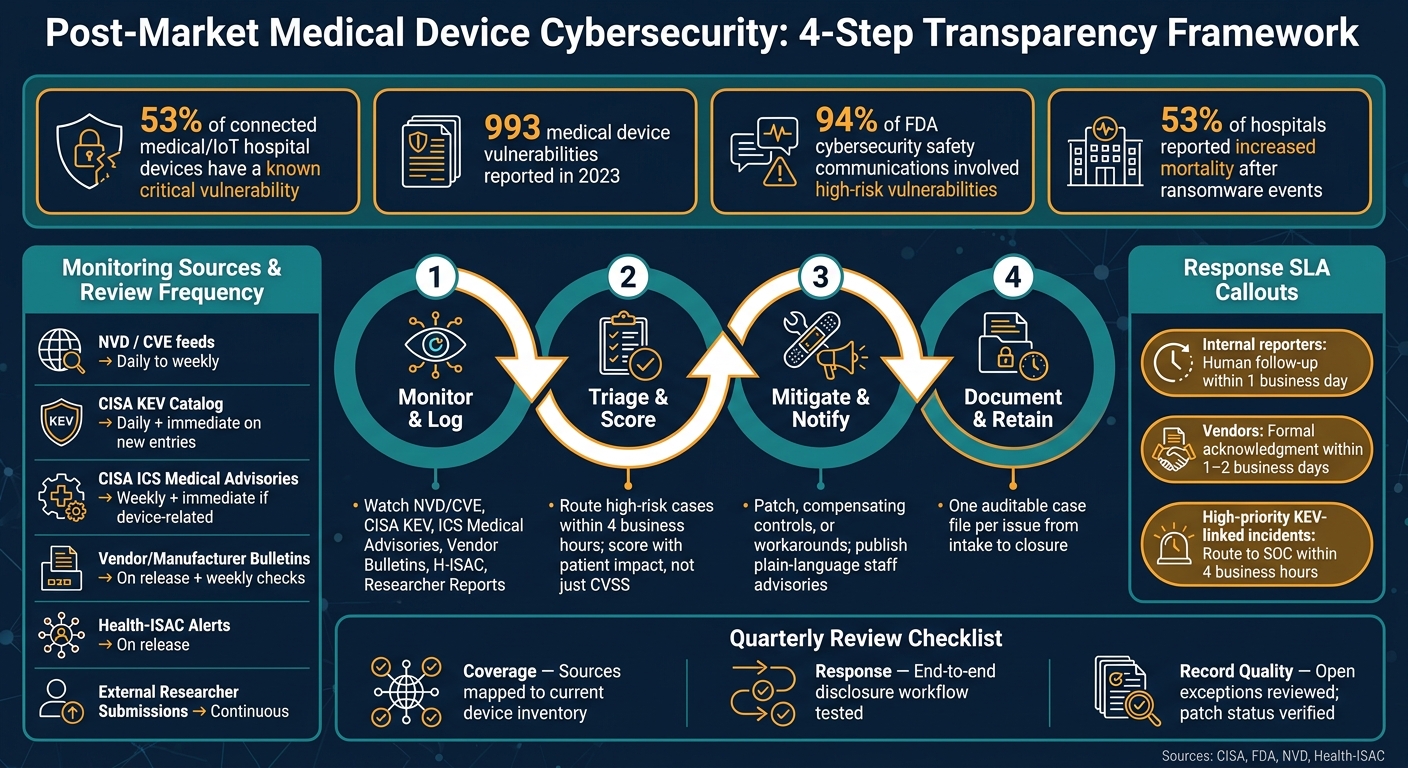
Post-Market Medical Device Cybersecurity: 4-Step Transparency Framework
Connected Medical Devices Under Threat: Why Cybersecurity Is Now Mandatory
sbb-itb-535baee
Checklist 1: Build a monitoring and vulnerability intake process
Use monitoring and intake to spot vulnerabilities early, log them once, and send them to the right owner fast before patient care is affected. The goal is simple: one workflow for external advisories, internal reports, and vendor notices. That gives every issue a clear owner, one record, and a timestamped chain of custody from intake through handoff.
Track the right post-market monitoring sources
A practical monitoring program should cover the main sources below, with a named owner and a set review schedule:
| Source | Review Frequency | Recommended Owner |
|---|---|---|
| NVD / CVE feeds | Daily to weekly | Security Operations (SOC) |
| CISA Known Exploited Vulnerabilities (KEV) catalog | Daily; immediate cross-check on new entries | SOC / Device Security team |
| CISA ICS Medical Advisories | Weekly; immediate review when device-related advisories are issued | SOC + Clinical Engineering |
| Vendor and manufacturer security bulletins | On release; weekly portal checks | Clinical Engineering |
| Health-ISAC alerts | On release | Risk Management / Compliance |
| External researcher submissions | Continuous | IT Security Governance |
Medical device vulnerabilities went up in 2023: 993 were reported, including 160 weaponized issues and 43 remote code execution or privilege-escalation flaws.[8]
The CISA KEV catalog needs extra attention. Every entry points to confirmed active exploitation and includes direct remediation guidance, which makes it one of the most useful inputs for triage workflows.[5] If a new KEV entry matches a component in your device inventory, that match should open a triage record right away.
For complex devices, use SBOM matching to connect component versions to NVD, KEV, and vendor advisories.[6][5]
Define intake channels and triage handoffs
Each type of reporter should have a clear intake path. Internal staff should use a service desk category made for medical device cybersecurity, with required fields for device ID, location, observed behavior, and clinical impact. Clinical engineering teams need CMMS integration so vulnerabilities found during maintenance are linked automatically to the right assets. Vendors should have a dedicated email address and portal entry point. External researchers should see public reporting instructions, including the preferred contact method, expected acknowledgment timeframe, and a short note on how reports are handled.
Response timing matters here. Internal reporters should get an automated confirmation right away and a human follow-up within 1 business day. Vendors should receive a formal acknowledgment within 1–2 business days. External researchers should see a public commitment, usually acknowledgment within 3 business days and a status update within 10–15 business days, in line with coordinated vulnerability disclosure norms.[7]
After a report comes in, triage routing should be automatic and time-bound. High-priority device incidents, especially those tied to KEV entries or active threat intelligence, should reach the SOC and device security team within 4 business hours. If patient care or procedure availability may be affected, route the issue at the same time to clinical engineering and the affected department. This ensures rapid response to risks to patient care caused by device downtime. If the event may trigger safety or regulatory reporting, flag it at once for quality and compliance.
Every handoff should be logged with a timestamp, assignee name, and decision in your ticketing or risk platform. That record shows end-to-end handling for each issue and gives you proof when someone asks, “What happened, who touched it, and when?”.[7]
Once intake is routed, score severity by patient impact and clinical context.
Checklist 2: Standardize risk assessment, mitigation, and communication
Once a vulnerability is routed and logged, use a set process to rate severity, pick mitigations, and communicate next steps.
Assess severity using patient safety and clinical context
CVSS on its own isn't enough. The same vulnerability may land at a different severity level in a networked vital signs monitor than in a non-critical lab workstation, because the chance of patient harm is far higher in one case than the other.
That’s why each severity rating needs a written rationale, not just a score. Put that reasoning in a formal SOP instead of leaving it to case-by-case judgment.
A practical way to handle this is to map CVSS to clinical risk tiers, then require interim mitigation and fast patch planning for high-scoring issues on patient-facing devices.
Scoring also needs cross-functional review. Security and IT look at technical exploitability. Clinical engineering checks patch fit with installed configurations. Clinical leadership weighs workflow disruption and patient harm scenarios. Quality and risk management handle documentation and make sure decisions fit the organization’s risk appetite. Regulatory and compliance decide whether the event crosses FDA reporting thresholds. Spell out roles, approval thresholds, and escalation paths in a written RACI.
Centralized workflows can make this far easier. They help standardize scoring, residual risk tracking, and audit trails.
From there, use the tier to decide whether to patch now, apply compensating controls, or monitor the issue under a set deadline.
Document mitigation, patching, and compensating controls
Not every vulnerability can be patched right away. So the mitigation record needs to cover every response option and its timing, with decision records that can be traced later.
For each issue, document the chosen path and why it was selected. That may mean applying a vendor patch, making configuration changes, adding network segmentation, tightening access controls, or using procedural safeguards as an interim control.
If immediate patching isn't possible, define the compensating controls in plain terms:
- What controls are being used
- Which devices they apply to
- Which units are affected
- What residual risk still remains
- The target date for permanent remediation
Patch plans should also spell out which device groups come first, which configurations have been validated, and what rollback steps to take if a patch creates clinical or operational problems.
Any device that still can't be patched should stay flagged as an open risk. Assign a named owner, set a milestone-based timeline, and require at least monthly status reviews until the issue is closed.
Then turn that response into a staff-facing update with clear actions and timing.
Communicate updates through coordinated disclosure and user guidance
Once the response is set, publish one plain-language message for affected teams.
Each user-facing advisory should name the affected device types and locations in plain language, explain the potential clinical impact without technical jargon, and tell staff exactly what to do now.
It should also include:
- Patch or remediation status
- Any labeling updates
- End-of-support dates, if they apply
- A transition plan, if one is needed
Internal updates should match manufacturer advisories while also reflecting your installed base and any HDO-specific compensating controls already in place.
Checklist 3: Meet reporting, documentation, and traceability requirements
Once mitigation is in place, document the full decision trail in one auditable case file. Good records make each call easier to defend during audits, legal review, and regulatory review. The goal here is simple: keep records clean, complete, and traceable from the moment an issue is found to the day it closes.
Separate FDA-reportable events from routine internal records
Not every vulnerability needs to be reported to FDA. The main question is whether the issue has caused - or could reasonably cause - patient harm, a serious adverse event, or death, or whether it calls for a correction or removal of a device from clinical use.
If a cybersecurity exploit leads to delayed therapy, incorrect dosing, loss of critical monitoring, or a device that can no longer be used safely as intended, that event will likely meet the threshold for a Medical Device Report (MDR). Under 21 CFR Part 806, if a manufacturer starts a correction or removal to reduce a risk to health, reporting to FDA is generally required within 10 working days.[1][3][10]
Routine issues - misconfigurations, software flaws that were not exploited, or low-risk library updates - usually stay in internal records, as long as they do not affect clinical safety or core performance. A simple decision tree in your intake workflow can help route each issue based on clinical impact, evidence of exploitation, and whether a field correction or labeling change is needed. Using real-time portfolio risk management can further streamline how these issues are prioritized across the enterprise. Keep external and internal records separate. That split matters, and the table below shows why.
Maintain end-to-end records for each issue
Every cybersecurity issue tied to a medical device should have one case file that follows it from intake through closure. Think of it as the paper trail you never want to build in a panic later.
Each case file should include:
- Intake metadata: unique issue ID, date/time of report (MM/DD/YYYY HH:MM AM/PM), reporter identity, and reporting channel
- Asset details: device type, model, manufacturer, software/firmware version, serial number, location, and connectivity profile
- Risk assessment: vulnerability description, exploitability, clinical impact, affected workflows, and severity rating with written rationale
- Mitigation decisions: chosen remediation path, implementation dates, responsible teams, and validation results
- Communication history: internal notifications, vendor coordination, any FDA communications, and customer-facing updates
- Approvals and governance: sign-offs from clinical leadership, information security, biomedical engineering, and legal or privacy if PHI exposure is involved
- Closure: closure date, residual risk rating, and any follow-up actions flagged for the next quarterly review
The 2025 FDA cybersecurity QMS guidance backs this up. It states that manufacturers should link vulnerability intake, SBOM or component data, risk assessment, testing evidence, and final disposition in one auditable record set.[11] Also, keep immutable access logs for each record.
Compare core transparency artifacts in a single view
Use these artifacts as the record set for each issue. Each document serves a different audience and purpose. When teams mix them up - or leave fields blank - gaps show up at the worst time.
| Artifact | Primary Purpose | Audience | Key Required Fields | Owner | Why It Matters |
|---|---|---|---|---|---|
| Intake record | Capture the original issue and source | Security, clinical engineering, compliance | Issue ID, date/time, reporter, device details, initial severity | Information security / IT service desk | Audit baseline; retain for multiple years or life of device plus a defined period |
| Public advisory | Inform broad external stakeholders about a vulnerability | Customers, users, sometimes the public | Issue description, affected devices, recommended actions, disclosure date | Communications / regulatory affairs | Disclosure timing evidence; long-term retention |
| Customer notice | Give actionable instructions to affected sites | Affected HDOs, IT, and biomed teams | Device locations, specific actions required, patch or control status, contact | Clinical communications / biomedical engineering | Targeted remediation record; retain with incident file |
| Labeling update | Modify manufacturer instructions, warnings, or limitations | Clinical staff, users, procurement | Changed language, effective date (MM/DD/YYYY), device identifiers, approval | Regulatory affairs / quality | Connects remediation to device use conditions; regulatory retention |
| Internal risk documentation | Record assessment, decisions, and governance | Compliance, legal, quality, leadership | Risk score, decision log, approvals, residual risk, closure date | Risk management / legal | Supports audits, regulatory review, and lessons learned |
A published analysis of FDA cybersecurity safety communications found that among communications issued from June 2013 to January 2025, 94% of identified vulnerabilities were classified as high-risk.[9] That volume makes consistent, well-structured documentation essential - not optional.
Preserve versioned copies so you can show what was communicated, when, to whom, and why.
Conclusion: Use the checklist to improve post-market transparency
Post-market cybersecurity transparency takes steady governance, not a one-time fix. These checklists help make that work repeatable: monitor, triage, mitigate, communicate, and document. If one part slips, the problem often shows up at the worst time - during an audit, a regulatory inquiry, or an active incident. A quarterly review helps keep controls current as devices, vendors, and threats shift.
Key actions to review every quarter
Each quarter, review three areas: coverage, response, and record quality. Make sure your monitoring sources - NVD, CISA's Known Exploited Vulnerabilities catalog, H-ISAC advisories, and vendor notifications - are actively mapped to your current device inventory.[2][4] Then test at least one end-to-end disclosure workflow, from alert intake through clinician notification, to check that contact lists, approval chains, and message templates still match how your team works today. Also review open risk exceptions that have been sitting too long, and confirm that patch and mitigation status for critical devices matches what’s in your risk register.
Process checks matter, but so do a few transparency performance indicators. Track the average time from an external alert to internal triage, the percentage of issues with complete traceability records, and the share of clinically significant alerts sent to the right owner within your defined SLA. Those numbers can tell you, pretty fast, whether transparency is getting better - or where handoffs between clinical engineering, information security, and vendors are starting to fail.
A quarterly review can also lean on a centralized risk platform to track open exceptions, patch timing, and documentation completeness. The point isn’t more reporting. It’s faster, clearer action.
FAQs
How should we prioritize device vulnerabilities that cannot be patched right away?
If you can’t patch right away, put temporary compensating controls in place to cut risk. That can mean network segmentation, tighter monitoring, more detailed logging, or changes to day-to-day workflows.
Write down each control, give it a clear remediation plan, and set a firm deadline for the permanent fix. It also helps to sort devices based on clinical criticality, connectivity, and how much downtime they can handle.
In plain terms, start with the devices that matter most for patient care, are most exposed to the network, and can’t be taken offline without causing problems.
When does a medical device cyber issue become FDA-reportable?
A cybersecurity issue becomes FDA-reportable when it involves a device-related death, a serious injury, or a malfunction that could lead to death or serious injury if it happens again.
There are also clear timing rules for reporting.
Under 21 CFR Part 806, manufacturers must report corrections or removals made to reduce a risk to health within 10 working days.
For Medical Device Reports (MDRs), the standard deadline is 30 calendar days. In expedited cases - when action is needed to prevent serious harm - the report is due within 5 working days.
What should an audit-ready record include for each device cyber issue?
Keep each case in one system of record with a unique case ID, a visible owner, and a clear next step.
At closure, include the original report or ticket, communications, root cause analysis, affected models and software versions, risk and clinical impact assessment, remediation actions and dates, validation test results, and a formal closure statement approved by cybersecurity and quality or regulatory leads.
