
If you treat every vendor the same, you waste time on low-risk tools and miss the vendors that can hurt patient care, PHI, or revenue the most.
I’d sum it up like this: vendor risk tiering is a simple way to sort vendors into Critical, High, Medium, or Low based on things like PHI access, EHR or network connections, clinical downtime risk, business reliance, and regulatory status. That score then decides how to conduct effective third-party risk assessments, what proof you ask for, how often you check them again, and when leadership needs to step in.
And this matters in healthcare. The article points to two clear warning signs: 56% of healthcare organizations said a third-party vendor was tied to a data breach in the prior two years, and business associates were involved in 37.5% of HIPAA breaches. That’s why a risk-based model matters.
Here’s the short version of what I’d want any healthcare team to know up front:
- Start with exposure first. Look at PHI/ePHI access, data volume, sensitive record types, and privileged access.
- Score clinical impact next. If a vendor outage can delay meds, lab results, imaging, or charting, the tier should be higher.
- Check connectivity. HL7, FHIR APIs, VPNs, remote admin access, and device links increase risk.
- Factor in business reliance. A vendor can be risky even with less PHI if it supports claims, scheduling, or a core workflow across many sites.
- Separate raw risk from post-control risk. First score the vendor based on what they touch. Then review reports, certifications, and controls to see what risk remains.
- Match the tier to the work. High-tier vendors need deeper review, more proof, tighter contract terms, and more frequent checks.
- Re-score when things change. New PHI access, new EHR integration, a breach, M&A activity, or a product update should trigger a fresh review.
- Keep records clean. Intake, approvals, tier changes, and review dates should all be logged for audit use.
A simple four-level model usually works best:
| Tier | What it usually means | Common examples |
|---|---|---|
| Critical | A failure could hit patient care, core systems, or large amounts of PHI | EHRs, tele-ICU tools, core clinical systems |
| High | Large data access or deep system reliance, but not quite at the top level | Billing vendors, PHI analytics, IAM providers |
| Medium | Limited access or narrower workflow impact | Reminder tools, smaller clinical apps |
| Low | Little to no PHI access and limited system connection | Basic service vendors with low exposure |
Bottom line: I’d use tiering to focus reviews on the vendors that can cause the most harm, not the vendors with the biggest contract or the loudest internal sponsor. The rest of the article explains how to score those vendors, what criteria to use, how to set review frequency, and how to keep the process consistent over time.
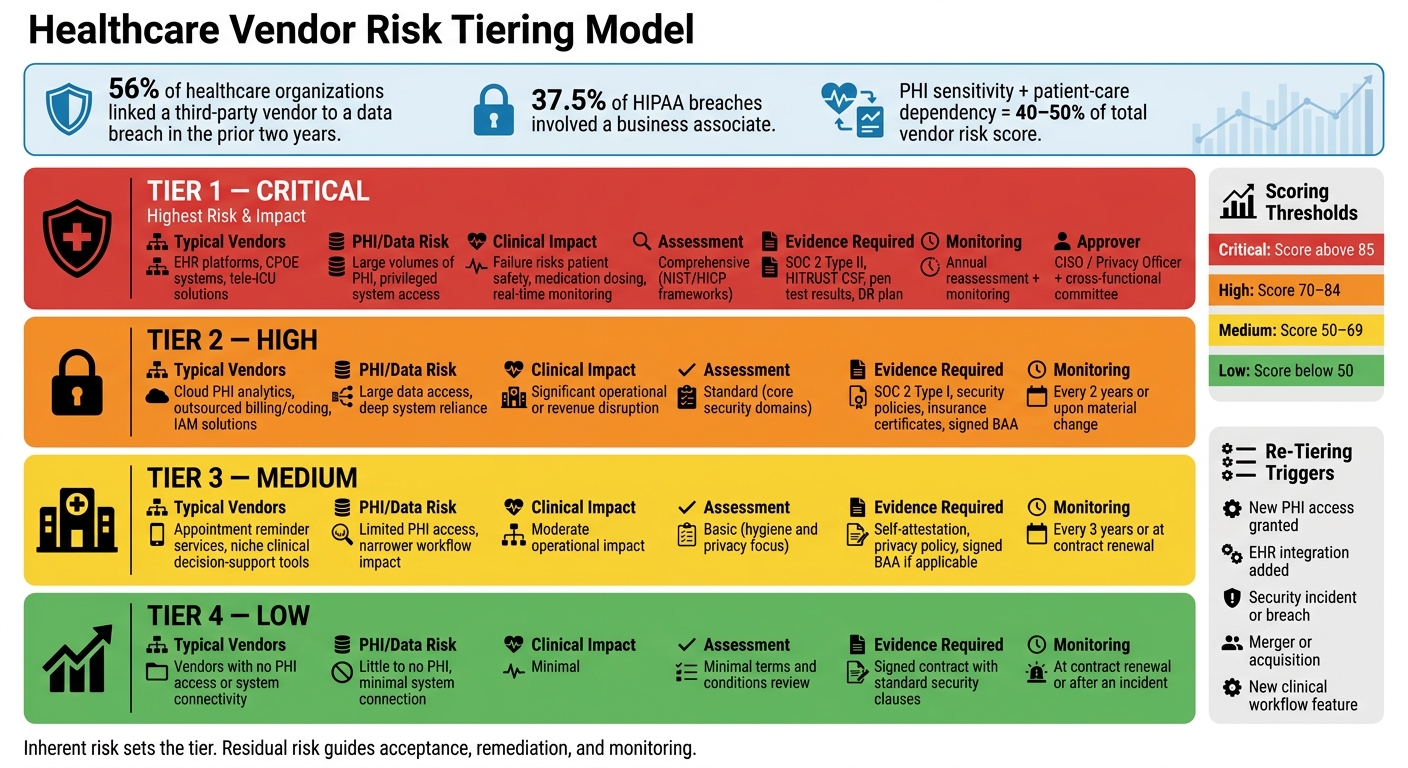
Healthcare Vendor Risk Tiering Model: 4-Tier Framework at a Glance
How to Categorize Third-Party Vendors by Risk- Tier 1, Tier 2, Tier 3 Explained with Examples
sbb-itb-535baee
How Vendor Risk Tiering Models Work
Vendor tiering gives each vendor a score based on set criteria, then maps that score to a preset tier. Put simply, it gives teams a repeatable way to decide how much oversight a vendor needs. That helps compliance, security, and privacy teams spend their time where it matters most: PHI, clinical systems, and regulated operations. The tier structure below shows how those scores turn into oversight.
Tier Structure and What Each Level Means
Most healthcare organizations use a four-tier structure: Critical, High, Medium, and Low. Each tier points to a different level of exposure and a different level of review.
| Tier | Typical Vendor Examples | Oversight Expectations |
|---|---|---|
| Critical | EHR platforms, CPOE systems, tele-ICU solutions | Comprehensive assessments, continuous monitoring, executive approval, audit rights |
| High | Cloud-based PHI analytics, outsourced billing and coding, IAM solutions | Annual reassessments, HIPAA/HITECH compliance review, breach reporting requirements |
| Medium | Appointment reminder services, niche clinical decision-support tools | Streamlined questionnaires, reassessment every 2–3 years, core privacy and security controls |
| Low | Vendors with no PHI access or system connectivity | Basic intake screening, contract-level assurances, minimal ongoing monitoring |
Only a small share of vendors end up in the Critical tier, but those vendors account for most cyber and operational risk.[2]
Tier assignment is just the first step. The next step is control review, which shows residual risk.
Inherent Risk vs. Residual Risk
Inherent risk sets the starting tier. Residual risk shows what remains after control review.
Inherent risk is the raw exposure a vendor brings before you review any safeguards. It comes from what the vendor does: how much PHI they handle, how deeply they connect to your systems, and how much clinical impact they could have if something goes wrong. This is what teams look at during intake to set a preliminary tier and decide how deep the assessment should go.
Residual risk is the risk left after you review the vendor’s safeguards. Strong controls can lower residual risk, but they do not wipe away high inherent exposure. That adjusted score helps teams decide whether the risk is acceptable, whether a corrective action plan is needed, or whether the vendor relationship needs another look.
Residual risk ratings also shape monitoring intensity and escalation. Higher residual risk calls for more frequent reassessment and escalation to governance committees or risk councils.
Scoring Logic, Weighting, and Tier Thresholds
Weighted scoring keeps tier assignment consistent across vendors and business units. Most scoring models use either a 1–5 ordinal scale or a 0–100 numeric scale. Each risk criterion - PHI volume, clinical criticality, network connectivity, and regulatory scope - gets a score. Those scores are then combined through weighted averages to produce an overall inherent risk rating.
In healthcare, PHI sensitivity and patient-care dependency usually carry more weight than financial impact or vendor size. Combined, they often make up 40–50% of the total score.[3] Threshold bands then convert the total score into a tier. For example:
- Critical: above 85
- High: 70–84
- Medium: 50–69
- Low: below 50
Automatic escalation rules can also override score-based tiers for especially sensitive use cases.[3][4]
Taken together, weighting and escalation rules turn a pile of vendor facts into a compliance priority list you can defend. The point isn’t just to sort vendors by size or contract value. It’s to rank them by clinical and regulatory exposure.[4]
Core Criteria for Tiering Healthcare Vendors
These criteria turn the weighted scoring model above into a tier you can defend. The goal is simple: use data exposure, clinical impact, and dependency risk to place vendors in the right tier. Score inherent risk first. Then review controls and adjust for residual risk.
PHI Exposure, Access Type, and Data Sensitivity
Start with the big question: does the vendor create, receive, maintain, or transmit PHI or ePHI?
That answer should drive a large part of the tier decision. One 2023 analysis found that a business associate was involved in 37.5% of all HIPAA breaches.[5] That helps explain why PHI exposure is often the first lens teams use.
From there, look at how much data the vendor handles and how sensitive that data is. A vendor storing millions of full medical records with longitudinal histories carries more inherent risk than one working from a small claims extract. Some data types should also push a vendor higher, including:
- behavioral health records
- HIV status
- substance use disorder information
- genetic data
Access type matters just as much. Read-only access to de-identified data may fit a lower tier. Write access to clinical or billing data raises risk because the vendor can affect patient safety and billing accuracy. And privileged access - such as domain admin, database root, or hypervisor-level control - belongs in the highest tier, since a compromise at that level can trigger a large breach or a major outage.
That picture of the data should shape the tier before any control review starts.
Clinical Criticality, Connectivity, and Regulatory Scope
Next, ask a plain question: what breaks if this vendor goes down?
If the answer includes medication dosing, real-time monitoring, imaging interpretation, or lab results, the clinical impact is high. If clinicians would have to fall back to paper workflows, or if downtime could create immediate risk of harm, the vendor should land in a high or Critical tier.
Connectivity adds another layer of risk. Vendors that connect through HL7 or FHIR APIs, keep site-to-site VPN links, or need remote admin access create attack paths that disconnected tools simply don't. The July 2024 CrowdStrike outage made that painfully clear. Because of broad enterprise connectivity, one failure spread into a major operational disruption: Mass General Brigham and other major health systems had to cancel non-urgent surgeries and clinical appointments.[1]
Regulatory scope matters too. A vendor that qualifies as a HIPAA Business Associate but does not have a signed BAA should be placed in a higher tier until that gap is fixed. Vendors that provide FDA-regulated devices or software as a medical device (SaMD) also need deeper review, since device classification, essential performance, and post-market surveillance all shape oversight.[6][7]
Financial Dependence, Concentration Risk, and Control Evidence
Not every high-tier vendor looks risky on the surface. Some may handle less PHI and have limited clinical connectivity, yet still deserve close review because the business depends on them.
A billing clearinghouse is a good example. Even with moderate data exposure, if it processes most of a health system's claims volume, a failure could hit revenue and operations hard. In plain terms, it's a single point of failure, and that means continuity planning needs a close look.
Concentration risk goes past any one contract. If one vendor supports multiple hospitals, departments, or core workflows at the same time, one outage can ripple across the organization. Risk teams should map each vendor to the facilities and service lines it touches, then use that footprint when setting the tier.
Control evidence comes last in this part of the process. It does not change inherent risk. It only lowers residual risk after review. Current SOC 2 Type II, ISO 27001, or HITRUST evidence can reduce the amount of residual-risk review needed. But stale reports, narrow-scope reviews, or adverse findings keep the vendor in a higher oversight tier.
Those findings then determine the depth of the assessment and how often the vendor should be monitored as part of third-party vendor risk management in the next step.
How to Put a Vendor Tiering Model Into Practice
Once your risk criteria are set, the next step is simple in theory but easy to mess up in practice: turn them into a repeatable third-party risk management intake and review process.
Vendor Intake, Inventory, and Inherent Risk Questionnaires
Send every vendor through one intake process, and stop procurement until intake and preliminary tiering are finished. The internal business owner asking for the vendor should fill out the form. They usually know the planned use, the day-to-day impact, and any clinical touchpoints better than anyone else.
Keep the intake questionnaire short: 10 to 15 questions focused on inherent risk only. You want the basics that shape risk from the start, not a long form that people rush through.
That means collecting details like:
- Whether the vendor will access PHI or ePHI
- How much data is involved
- How access happens
- Whether downtime would stop clinical care or affect revenue
- Which regulatory frameworks apply
Set clear record-volume thresholds that push a vendor into a higher-tier review. Without those cutoffs, teams tend to make case-by-case calls, and that gets messy fast. Use conditional logic too. If someone answers “yes” to remote network access, the form should open follow-up questions right away instead of leaving a gap.
Your centralized inventory should track the vendor name, the exact products or services in use, the data types involved, the access method, and the internal business owner. That level of detail helps keep tiering consistent over time.
Mapping Each Tier to Assessment Depth and Monitoring Cadence
The vendor’s score should decide how much review, evidence, and monitoring they get. Here’s how each tier maps to clear requirements:
| Tier | Assessment Depth | Evidence Required | Monitoring Schedule |
|---|---|---|---|
| Tier 1: Critical | Comprehensive assessment based on NIST/HICP frameworks | SOC 2 Type II, HITRUST CSF, penetration test results, disaster recovery plan | Annual reassessment + continuous monitoring |
| Tier 2: High | Standard assessment focusing on core security domains | SOC 2 Type I, security policies, insurance certificates, signed BAA | Every 2 years or upon material change |
| Tier 3: Medium | Basic assessment focusing on hygiene and privacy | Self-attestation, privacy policy, signed BAA if applicable | Every 3 years or at contract renewal |
| Tier 4: Low | Minimal terms and conditions review | Signed contract with standard security clauses | At contract renewal or after an incident |
For Critical-tier vendors, don’t rely only on self-reported answers. Ask for proof, such as a SOC 2 Type II report or HITRUST certification. Tier assignment should also affect contract language, including required security clauses and BAA terms.
Re-Tiering Triggers and Governance Reviews
Tiering isn’t a one-time exercise. The tier should reflect the vendor’s current access and impact.
A few events should trigger an immediate re-tiering review:
- The vendor gets new access to PHI
- A standalone tool becomes a deeper EHR integration
- A security incident or data breach occurs
- A merger or acquisition changes the vendor’s tech stack
- A new product feature starts touching clinical workflows
Contracts should spell out what counts as a material change and require the vendor to notify your organization when that happens.
For Critical-tier decisions, a cross-functional committee should approve the assignment. The CISO or Privacy Officer should be a named approver. Log every tier change with the date, rationale, and approver so the record is ready for an audit.
A workflow platform can help keep tier changes, approvals, and review dates up to date. See how organizations like Tower Health transformed their TPRM using these automated workflows.
Using Censinet RiskOps to Support Healthcare Vendor Tiering
Once the model is set, the next step is turning it into a governed workflow. After tiering rules are in place, Censinet RiskOps handles intake, scoring, approvals, and review timing for healthcare vendors. Censinet RiskOps™ is built for healthcare delivery organizations (HDOs), so tiering stays tied to PHI, clinical applications, medical devices, and supply chain dependencies.
Healthcare-Specific Scoring and Workflow Automation
Censinet RiskOps begins tiering at vendor intake. Standardized IRQs collect the factors that shape tier placement. The platform then weights those factors to generate an inherent risk score and assign a tier. High-risk vendors score higher on their own, while low-risk vendors score lower. Teams can also set hard floors. For example, any networked medical device can be held at a minimum Tier 2 due to FDA cybersecurity obligations.
After a tier is assigned, workflow automation steps in. The platform routes the right assessment based on that tier. Tier 1 vendors get full security, privacy, business continuity, and medical device security questionnaires. Tier 3 vendors get a lighter set. Vendors can also share existing verified assessments through the Collaborative Risk Exchange and Digital Risk Catalog™, which helps cut review delays. That means fewer handoffs, less manual follow-up, and shorter review cycles.
Portfolio Visibility, Corrective Actions, and Continuous Oversight
After scoring and routing, centralized views keep tier status, findings, and remediation in sync. Censinet RiskOps gives teams portfolio views that show tier, risk scores, assessment status, PHI exposure, and clinical role. CISOs, CIOs, and Chief Compliance Officers can filter by tier, spot concentration risk, and act on it. A simple example: if several Tier 1 vendors support the same care pathway, leaders can use that signal to focus resources and guide procurement decisions.
When assessments reveal gaps, the platform creates automated Corrective Action Plans (CAPs) tied to the vendor’s tier and the severity of the finding. Higher-tier vendors can be given stricter remediation requirements, including:
- Multi-factor authentication for remote access
- Encryption for PHI at rest and in transit
- Stronger incident response processes
Each action includes clear owners, due dates, and evidence requirements tracked inside the platform. Human reviewers still play a central role. They check the quality of remediation work and decide whether residual risk is acceptable before procurement or continued use moves forward. Approval gates, exception tracking, and audit trails keep accountability in place by showing who approved each risk decision and why.
Monitoring cadence is also set by tier. Tier 1 vendors can go through annual full reassessments. Tier 2 vendors can be reviewed every two years. Tier 3 vendors can move through lighter periodic reviews. Event-based re-tiering triggers can also start a new review when something changes, such as:
- A vendor starts storing PHI
- A security incident or breach occurs
- A product expands into new clinical workflows
- Cloud hosting or data residency changes
When one of those events happens, the platform can kick off reassessment, recalculate scores, and queue a governance review.
Conclusion: Build a Tiering Model That Reflects Clinical and Compliance Risk
Vendor tiering helps healthcare teams focus oversight where clinical and HIPAA-compliant vendor risk is highest.
In plain terms, a vendor's tier should reflect two things: the vendor's level of exposure and the clinical harm a failure could cause. Keep the model simple, and keep the criteria tight. A three- or four-tier scheme - Critical, High, Medium, Low - works well when it's backed by clear thresholds for PHI volume, EHR connectivity, and patient-safety impact.
Once the tier is set, the next step is figuring out what's left after controls are reviewed. Use inherent risk to set the tier. Use residual risk to guide acceptance, remediation, and monitoring.
After scoring and assignment, governance is what keeps the model steady over time. The model should stay auditable through documented tiers, standardized intake, approval workflows, and re-tiering triggers. Regulators expect a consistent, risk-based approach - not an arbitrary one.
For healthcare organizations building or refining their model, the starting point is simple: focus first on the highest-risk vendors by spend, PHI exposure, and clinical reliance. Test your draft tiering criteria against that group, look for places where the model gives inconsistent results, and adjust before scaling. Censinet RiskOps™ can automate intake, scoring, routing, and audit-ready documentation. A good model turns vendor review into a repeatable risk-priority process, not a one-time label.
FAQs
How do I choose the right tiering criteria?
Focus on how each vendor could affect patient safety, sensitive data, and day-to-day operations, not just the size of the contract.
Score vendors based on factors like:
- PHI access
- How critical they are to clinical care or revenue cycle work
- Their cybersecurity posture, including HIPAA or HITRUST compliance
Use the same scoring model across the board - such as 0 to 100 - so each tier lines up with your organization’s risk tolerance and regulatory requirements.
What should trigger a vendor re-tiering review?
A vendor re-tiering or out-of-cycle review should happen when there’s a major change in a vendor’s security posture or day-to-day risk profile.
Common triggers include:
- Security incidents
- Privacy violations
- Non-compliance findings
- Mergers or acquisitions
- New services
- Handling sensitive data
- Performance declines
- Regulatory changes or updated risk assessments that reveal new vulnerabilities
The idea is simple: if a vendor’s risk picture changes in a meaningful way, the review cadence should change too.
How often should each vendor tier be reassessed?
How often you reassess a vendor comes down to two things: the vendor’s risk tier and whether something big has changed.
High-risk or business-critical vendors usually need a full-scope assessment every year, along with quarterly checks or continuous monitoring.
Medium-risk vendors are often reassessed every 12 to 18 months. Low-risk vendors are usually reviewed every 24 to 36 months.
That schedule can change fast if a trigger event happens. No matter the tier, an off-cycle reassessment should happen after major events like:
- a data breach
- a change in regulations
- a contract renewal
- a major shift in the vendor’s security posture or services
