
Digital Evidence in Healthcare: Why Volatile Data Matters
Post Summary
When hospitals face cyberattacks, volatile data - temporary information stored in active memory like RAM - becomes a critical factor in understanding and mitigating breaches. This data disappears when systems lose power, making its timely collection crucial. Volatile data reveals key details like running processes, malware, encryption keys, and network connections, which are vital for forensic analysis and compliance, especially in healthcare settings where downtime isn't an option.
Key Takeaways:
- What It Is: Volatile data exists in RAM and CPU memory but vanishes when systems shut down.
- Why It Matters: It provides evidence of attacks, including fileless malware, encryption keys, and network activity.
- Healthcare Challenges: system downtime can risk patient safety, making live memory forensics necessary.
- Preservation Methods: Tools like WinPmem and Magnet RAM Capture help collect memory data without disrupting operations.
- Best Practices: Update incident response plans to prioritize memory collection before containment actions, and ensure evidence integrity with hash values and chain-of-custody logs.
Bottom Line: In healthcare cybersecurity, volatile data is often the only source of high-value evidence during breaches. Acting quickly and using the right tools ensures both patient safety and effective forensics.
How to Use Volatility in Memory Forensics | TryHackMe Critical

sbb-itb-535baee
How Volatile Data Works Within Healthcare Systems
Hospitals rely on intricate, interconnected systems to function efficiently. These include a mix of medical devices, cloud-based applications, and legacy servers, all of which generate volatile data in real time. Below, we break down where this data originates and the unique challenges healthcare systems face when attempting to preserve it.
Where Volatile Data Comes From in Healthcare
Volatile data in healthcare comes from several critical systems:
- EHR Servers: These systems produce transient data through audit trails, access logs, and emergency override events known as "break-glass" scenarios, where clinicians bypass standard access protocols in urgent situations.
- PACS and Imaging Platforms: These generate temporary data during imaging access and DICOM file transfers.
- Clinician Workstations and BYOD Devices: Devices like tablets and computers store active session tokens, cached login credentials, and running processes directly in memory.
- IoT Devices: Connected medical devices operating through HL7/FHIR interfaces create transient logs during data exchanges.
Each of these systems contributes to a constantly changing data landscape, making it difficult to capture and preserve information effectively.
Challenges in Preserving Volatile Data
Understanding where volatile data comes from is just one part of the equation. Preserving it presents a host of challenges, particularly in healthcare environments where system downtime isn't an option. Shutting down a compromised system can erase critical data, including evidence of in-memory malware, active command-and-control (C2) connections, or encryption keys.
"Power it off and you've destroyed your best evidence source." - Emma Chen, Cybersecurity Analyst [4]
Here’s a closer look at some of the key challenges:
| Challenge | Healthcare-Specific Impact | Forensic Consequence |
|---|---|---|
| Clinical Uptime | Systems tied to life-critical devices cannot be stopped or rebooted | Live data acquisition is required; traditional forensics methods are not feasible |
| Legacy Systems | Many IoT devices lack modern logging or endpoint detection capabilities | Creates blind spots, making it harder to track attacker activities |
| Log Rotation | Logs in EHR systems are often overwritten within hours | Crucial evidence may disappear before incident response teams can act |
| Data Diversity | Logs from EHR, PACS, and HL7/FHIR systems are often incompatible | Correlating data streams becomes time-intensive and complex |
| HIPAA Privacy Rules | Strict access limits apply, even during investigations | Legal restrictions can prevent access to key evidence [1] |
Capturing volatile data quickly is essential for both incident response and patient safety. For example, acquiring a 32GB memory dump typically takes 8 to 12 minutes on modern hardware [4]. This tight timeframe is critical because attackers may actively work to erase their tracks. As Emma Chen explains, "The window for high-fidelity evidence collection is measured in hours, not days." [4]
Research Findings: Volatile Data in Healthcare Cyber Incidents
Volatile data, with its fleeting existence, plays a pivotal role in healthcare incident investigations. Real-world scenarios and research demonstrate that capturing this data often determines whether an investigation succeeds or hits a dead end.
Case Studies: Volatile Data in Healthcare Breaches
Examining real-world cases shows how volatile data can be the key to unraveling complex cyber incidents.
In April 2026, investigators relied on memory capture to uncover suspicious process spawning, which pointed to a ransomware attacks against healthcare delivery organizations. The complete attack chain was identified in just four hours, thanks to this approach [8].
Another case from January 2026 highlights the importance of memory forensics in cloud environments. Responders investigating unusual compute spikes on an AWS EC2 instance found no evidence in disk snapshots. However, by remotely acquiring memory, they uncovered plaintext credentials and hidden code in RAM. This discovery revealed lateral movement into S3 buckets - something disk forensics alone would have missed [5].
"Disk alone rarely tells the whole story, especially in memory-resident attacks. To catch credential dumping, fileless malware, or lateral movement beacons, responders have to capture process memory." - Aditya Srikar Konduri, Guest Blogger, Paraben Corporation [5]
What Happens When Volatile Data Is Lost
The consequences of losing volatile data can be severe. For instance, in an April 2026 incident involving a LockBit affiliate, a server infected with ransomware was rebooted twice, and its Windows event logs were deleted to "save space." With no volatile memory or logs to analyze, investigators spent four weeks with little to show in terms of legally defensible evidence [4].
The absence of volatile data can derail investigations and lead to compliance issues, including potential HIPAA penalties and cyber risk. Without RAM evidence, organizations struggle to determine the scope of a PHI breach, leaving them vulnerable to legal liabilities and future attacks.
Key Research Findings on Volatile Data Preservation
Research underscores the critical role of memory forensics in cybersecurity. Tools like Volatility and Rekall achieve over 90% accuracy in identifying malicious processes [2]. Fileless malware, which operates entirely in RAM, is 10 times more effective at bypassing traditional detection methods compared to conventional malware [3]. In 2020, one security firm reported a staggering 900% increase in fileless malware attacks [3]. Memory imaging remains the only reliable method to document these threats.
The table below highlights key volatile artifacts and their forensic value:
| Artifact Type | Forensic Value |
|---|---|
| Active Processes | Identifies unauthorized software and unusual parent–child relationships |
| Network Connections | Reveals C2 communications and paths of lateral movement |
| Encryption Keys | Enables file decryption without paying a ransom |
| Clipboard Data | May expose passwords or other sensitive information |
| ARP Table | Shows recent local network interactions and potential spoofing |
"What you do in the first thirty minutes of an incident determines whether you'll have usable evidence." - Emma Chen, Cybersecurity Analyst, SSE [4]
These findings emphasize the importance of immediate and effective volatile data preservation during incident response.
Best Practices for Preserving Volatile Data in Healthcare
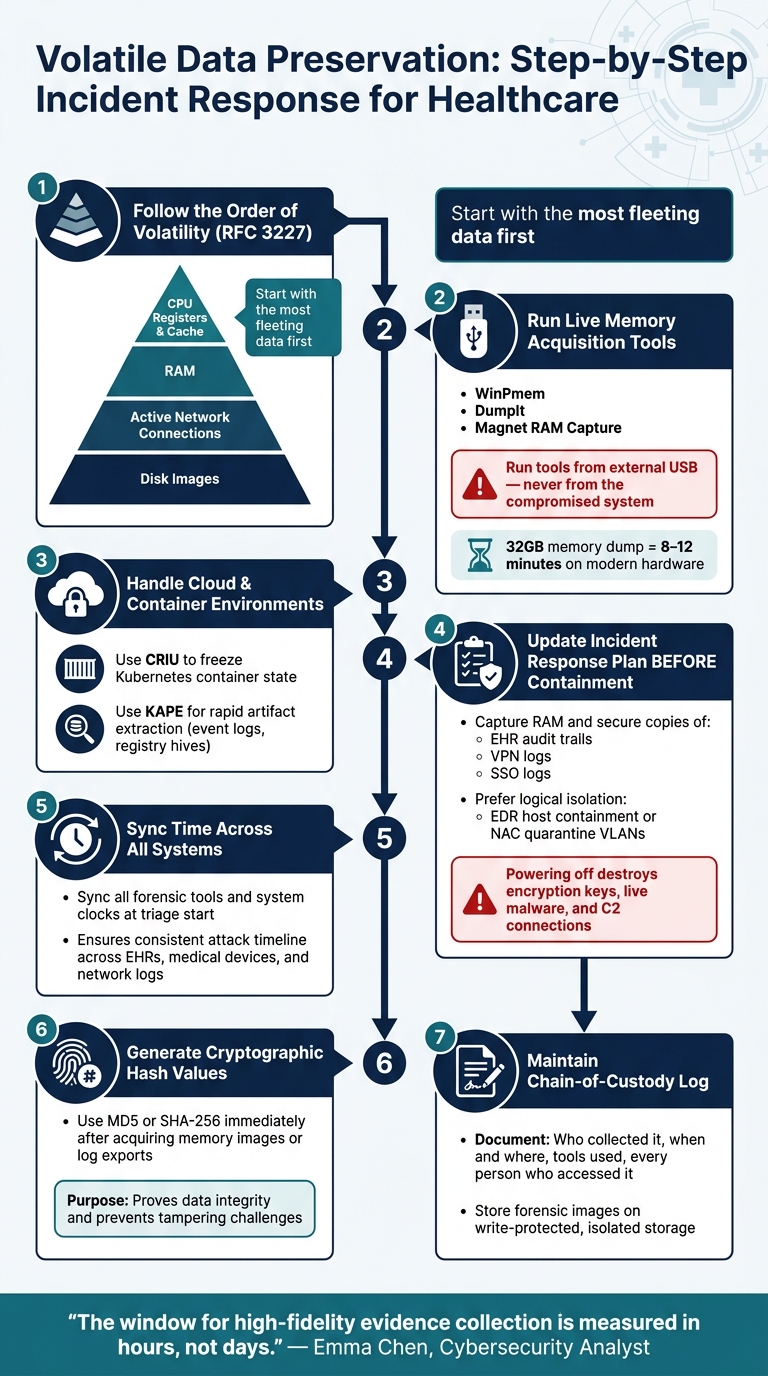
Volatile Data Preservation: Step-by-Step Incident Response for Healthcare
Methods for Collecting Volatile Data
When preserving volatile data, following the Order of Volatility outlined in RFC 3227 is key: start with the most fleeting data, like CPU registers and cache, then move to RAM, active network connections, and finally disk images [4][7]. Jumping straight to disk imaging while RAM is still accessible is a common misstep that can lead to significant data loss.
For live memory acquisition, tools such as WinPmem, DumpIt, and Magnet RAM Capture are widely used [4][6]. Modern hardware makes it possible to capture memory quickly enough to complete the process before containment actions begin. Always run these tools from external media, like a USB drive, to avoid overwriting critical data on the compromised system [6].
In cloud or containerized healthcare environments, the process adjusts slightly. For example, with Kubernetes containers, Checkpoint/Restore In Userspace (CRIU) can freeze a container's state, preserving ephemeral data that would otherwise disappear if the container is deleted or redeployed [5]. For high-pressure scenarios where patient care cannot be delayed, tools like KAPE (Kroll Artifact Parser and Extractor) allow for rapid extraction of specific artifacts, such as event logs or registry hives, without the time investment of a full disk image [4]. Together, these tools form a comprehensive strategy for volatile data collection, ensuring that evidence is preserved without interrupting critical healthcare operations.
These methods highlight the need to immediately update incident response plans to prioritize evidence collection.
Adding Volatile Data Preservation to Incident Response Plans
Capturing volatile data is just the first step - it’s crucial to integrate these practices into incident response plans. Many healthcare playbooks focus on containment first, which can unintentionally destroy key evidence. The solution? Update protocols to include memory capture and log preservation before containment or eradication begins [1][10].
For example, playbooks should specify capturing RAM and securing copies of EHR audit trails, VPN logs, and SSO logs before isolating a compromised system. Logical isolation methods, such as EDR host containment or NAC quarantine VLANs, are preferable to simply unplugging a machine. Powering off a system can destroy active encryption keys, live malware, and command-and-control connections - all of which may reside only in memory [4][1].
Time synchronization is another critical step. All forensic tools and system clocks should be synced at the start of triage to ensure a consistent attack timeline across EHRs, medical devices, and network logs [1]. Pre-staging forensic tools and coordinating isolation procedures with clinical leadership ahead of time can eliminate delays when every second counts [9][10].
Maintaining Forensic Integrity
Once data is collected and incident response plans are updated, the focus shifts to maintaining the integrity of the evidence. Proper handling is essential to ensure its admissibility in legal or regulatory investigations.
"Digital evidence carries the same legal weight as physical forensic evidence. But its admissibility depends on how it was collected. Evidence that cannot demonstrate a clean and documented chain of custody is vulnerable to challenge." - Zensec AE [7]
Two practices are critical here. First, generate cryptographic hash values - using algorithms like MD5 or SHA-256 - immediately after acquiring any memory image or log export [4][6]. These hashes act as digital fingerprints, proving the data hasn’t been altered. Second, maintain a detailed chain-of-custody log, documenting who collected the evidence, when and where it was collected, the tools used, and every person who accessed it afterward [11].
Investigators must also consider the "observer effect" - examining a live system inherently alters its state by updating logs, creating temporary files, and modifying timestamps. To address this, document every command and action taken to separate investigator activity from the attacker’s footprint [7]. Store all forensic images on write-protected, isolated storage to prevent accidental tampering [4].
These steps aren’t just procedural - they ensure the evidence remains viable when it’s needed most.
How Risk Management Platforms Support Volatile Data Preservation
Centralizing Cyber Risk Management with Censinet RiskOps™
Preserving volatile data is no small feat. It’s a challenge that requires both technical expertise and organizational readiness. Even with the most advanced tools, efforts can fall apart if teams don’t prioritize systems quickly or fail to keep playbooks up to date. That’s where centralized risk management platforms like Censinet RiskOps™ step in, streamlining evidence collection and improving coordination.
Built specifically for healthcare, Censinet RiskOps™ focuses on risks tied to critical areas like PHI, clinical applications, medical devices, and supply chains. These are the systems most likely to hold volatile evidence during an incident. With this platform, security teams can tag high-priority assets - such as EHR front-end servers, PACS systems, and remote access gateways - and map specific collection procedures to each.
One standout feature is the Cybersecurity Data Room™, which maintains a detailed record of evidence, remediation actions, and changes in risk posture over time. This audit trail simplifies incident verification and post-incident reviews. The platform also automates Corrective Action Plans (CAPs), assigning tasks like capturing a memory image within a specific timeframe to the right team members.
"Document all CAP and remediation activity for audits and security incidents." - Censinet[12]
Real-time alerts provide another layer of support, notifying teams immediately when a vendor breach occurs. This allows responders to act quickly, collecting volatile data before systems are altered. Considering that external actors are involved in 83% of breaches and 61% involve compromised credentials (2023 Verizon DBIR)[13], early warnings like these are essential for preserving critical evidence.
While centralizing data is a key step, effective incident response also hinges on strong teamwork, as explored in the next section.
Improving Team Collaboration on Cybersecurity Challenges
When it comes to preserving volatile data, teamwork isn’t optional - it’s essential. Miscommunication can lead to critical evidence being lost. For example, a premature system shutdown approved by clinical leadership or a vendor-managed device being reimaged without proper coordination can completely destroy volatile evidence.
Censinet RiskOps™ tackles these challenges head-on with role-based task assignments and shared dashboards. These features give IT, security, compliance, and clinical teams a single source of truth for incident status and evidence requirements. By moving away from fragmented communication methods like email threads, the platform ensures that delays are minimized during crucial moments.
The platform also facilitates vendor coordination by pre-storing engagement workflows and contact information. This becomes especially important when incidents involve cloud-hosted EHR systems or vendor-managed medical devices. With immediate access to vendor contacts and contractual obligations, teams can act swiftly to preserve volatile evidence without unnecessary delays.
Conclusion: Making Volatile Data a Priority in Healthcare Cybersecurity
Volatile data plays a critical role in strengthening healthcare cybersecurity. It captures elements that disk-based forensics simply cannot - like active processes, in-memory credentials, live network connections, and encryption keys that vanish when the system loses power.
Kevin Henry of AccountableHQ puts it succinctly:
"Digital forensics for healthcare breaches gives you a repeatable way to find what happened, prove it, and fix it without disrupting care." [1]
The absence of volatile data can create serious challenges during breach investigations. Without it, understanding the full scope of Protected Health Information (PHI) exposure becomes difficult, which can compromise breach notifications and increase legal exposure. This is particularly concerning given the economic impact of third-party breaches on healthcare providers. Additionally, it leaves gaps in root cause analysis, makes timelines incomplete, and opens the door for repeated exploitation of the same vulnerabilities.
Time is another critical factor. Fileless, memory-only malware is specifically designed to avoid leaving traces on disk [7]. This makes capturing volatile evidence quickly a necessity. Success here depends on having skilled responders, well-prepared incident response plans, and centralized tools that streamline evidence collection before an attack occurs.
Centralized platforms can significantly enhance this process. For example, tools like Censinet RiskOps™ help by consolidating asset risk data, automating response workflows, and improving collaboration among IT, security, compliance, and clinical teams. These platforms ensure efficient and consistent forensic practices - especially when time is of the essence.
Ultimately, treating volatile data preservation as a cornerstone of healthcare cybersecurity ensures organizations can confidently determine what happened during a breach, instead of being left in the dark.
FAQs
When should we capture RAM during a hospital cyber incident?
RAM needs to be captured right after a threat is detected and before shutting down, rebooting, or reimaging the system. Why? Because RAM is incredibly volatile. Once the power is cut, everything stored in it - like encryption keys, credentials, fileless malware, and active processes - disappears. Capturing memory early safeguards this crucial evidence, as it can't be retrieved from disk storage later. Tools like Censinet RiskOps help healthcare organizations stay ready to manage such incidents efficiently.
How can memory be collected without shutting down clinical systems?
Memory collection can now be performed without turning off clinical systems, thanks to live acquisition techniques. These methods allow data to be captured while the system remains operational. Investigators utilize memory collection tools to extract critical RAM data - such as active processes, network connections, and encryption keys - and transfer it to external storage. In cloud-based setups, native APIs make it possible to perform remote memory dumps with minimal interference. For containerized workloads, checkpointing tools are used to grab memory snapshots before the system is recycled or terminated.
What should we document to make volatile evidence legally defensible?
To handle volatile evidence in healthcare in a way that stands up legally, focus on proper preservation and meticulous documentation. Here’s what to keep in mind:
- Chain of custody: Keep a clear record of everyone who collects, transfers, or stores the evidence to maintain accountability.
- Integrity verification: Use cryptographic hash functions like SHA-256 to confirm the data hasn’t been altered.
- System state recording: Capture critical details such as screenshots, logged-in users, and any active applications at the time.
- Tool details: Document the specific tools and their versions used during the evidence collection process.
For cloud-based setups, make sure your Business Associate Agreement (BAA) explicitly addresses forensic responsibilities to avoid losing critical evidence.

