
HIPAA Compliance in Supply Chain Incidents
Post Summary
Healthcare organizations face serious risks when supply chain disruptions occur, especially regarding HIPAA compliance. If a vendor's systems are compromised - whether by ransomware, outages, or logistical failures - hospitals and clinics are still responsible for protecting patient data and maintaining operational continuity. Here's what you need to know:
- Supply chain security challenges are rising: Cybercriminals target vendors to disrupt healthcare operations, as seen in the March 2026 Stryker Corporation attack, which impacted 200,000 devices globally.
- HIPAA holds you accountable: Even if a vendor is breached, covered entities must notify affected individuals and regulators within 60 days.
- Common compliance gaps: Weak Business Associate Agreements (BAAs), poor visibility into data flows, and unclear responsibilities during incidents often lead to penalties.
- Costs of non-compliance: Recent breaches have resulted in fines exceeding $1 million, alongside operational disruptions and reputational damage.
To stay compliant, healthcare organizations must classify vendor risks, strengthen BAAs, and implement continuous monitoring. Automated tools like Censinet RiskOps™ can help streamline risk assessments and incident response.
Bottom line: Strong governance, clear vendor agreements, and proactive monitoring are essential to protect patient data and avoid regulatory penalties during supply chain disruptions.
Key HIPAA Risks in Supply Chain Disruptions
Where PHI Is at Risk Across the Supply Chain
Protected Health Information (PHI) moves through various hands in the healthcare supply chain - EHR providers, cloud services, device manufacturers, and logistics platforms - creating multiple points of exposure. Attackers are no longer sticking to traditional data theft methods. Instead, they’re exploiting vulnerabilities like compromised software updates, phishing targeted at vendors, weak authentication between systems, and outdated legacy technologies. A growing concern is the use of "Living off the Land" (LotL) tactics, where attackers leverage legitimate IT tools already in the system, making their activities harder to detect [1][3].
Adding to the complexity is fourth-party risk. When a vendor’s subcontractor has a security weakness, it can create a HIPAA compliance issue, even if there’s no direct relationship with the covered entity.
These vulnerabilities highlight significant regulatory challenges, often fueled by misunderstandings about vendor responsibilities.
Regulatory Missteps and Misconceptions
Many organizations mistakenly believe that having a signed Business Associate Agreement (BAA) ensures HIPAA compliance. While a BAA outlines expectations, it doesn’t enforce them. Covered entities need to actively monitor their vendors’ security measures rather than rely solely on documentation [1].
Another common error is misclassifying vendors as simple data transmitters. If a vendor interacts with PHI - whether storing, processing, or accessing it - they must be treated as a business associate. Additionally, certifications like SOC 2 or HITRUST, while valuable, don’t automatically meet HIPAA requirements. Organizations often fail to apply the "Minimum Necessary" standard during disruptions, assuming these frameworks cover all necessary safeguards when they don’t [2].
Consequences of Non-Compliance
The consequences of these regulatory oversights can be severe. Non-compliance in supply chain incidents often leads to hefty penalties. For example, in April 2026, the Office for Civil Rights (OCR) resolved four ransomware investigations, resulting in a combined $1,165,000 in fines - all linked to breaches involving unsecured electronic PHI (ePHI) [4]. One case involved Assured Imaging, where a ransomware attack affecting 244,813 individuals led to a $375,000 penalty. OCR has completed 19 investigations related to ransomware breaches alone [4].
Beyond fines, the operational fallout can be just as damaging. Disrupted surgeries, manual procurement processes, and liability for adverse patient outcomes can drive up costs. In one instance, Axia Women's Health (formerly Regional Women's Health Group) faced a $320,000 penalty and a two-year corrective action plan for failing to conduct a proper risk analysis years before a breach [4].
"Hacking and ransomware are the most frequent type of large breach reported to OCR. Proactively implementing the HIPAA Security Rule before a breach or an OCR investigation not only is the law but also is a regulated entity's best opportunity to prevent or mitigate the harmful effects of a successful cyberattack." - Paula M. Stannard, OCR Director, HHS [4]
State privacy laws can also amplify liabilities, adding layers of compliance challenges. Disputes over vendor responsibilities often stretch far beyond the initial breach, proving that non-compliance is rarely a cheap mistake [2].
sbb-itb-535baee
Building HIPAA-Compliant Supply Chain Governance
How to Classify Vendors and Assess Risk
Managing HIPAA risks during supply chain disruptions starts with categorizing vendors based on their access to Protected Health Information (PHI) and their operational importance. Here's a breakdown:
| Vendor Risk Category | Examples | PHI Access Level |
|---|---|---|
| High-Risk | Cloud providers, EHR systems, connected medical devices | Extensive access to core patient databases |
| Medium-Risk | Billing companies, transcription services, pharmacy benefit managers | Regular access to specific subsets of PHI |
| Lower-Risk | Legal services, consulting firms | Limited or incidental access to PHI |
Vendors in the high-risk category - like cloud providers and EHR systems - demand the most thorough evaluations, as they have significant access to patient data. Vendor assessments should include common healthcare third-party risk assessment questions focusing on five key areas:
- Data security controls: Check for encryption protocols and access management.
- Network security: Ensure firewalls and segmentation are in place.
- Incident response capabilities: Evaluate their ability to handle breaches.
- Compliance history: Review past adherence to HIPAA standards.
- Business continuity plans: Confirm they can maintain operations during disruptions.
Don't overlook fourth-party risks. Go beyond basic questionnaires by conducting penetration tests and vulnerability assessments to ensure vendors' security measures are effective.
Once vendors are classified, enforce these controls through robust Business Associate Agreements (BAAs).
Writing Effective Business Associate Agreements
A strong BAA is crucial for maintaining HIPAA compliance, especially during supply chain incidents. These agreements should clearly define breach terms, set incident response timelines, and outline coordination procedures [1]. Essential elements to include:
- Reporting requirements: Specify what incidents must be reported and how quickly.
- Subcontractor flow-down: Ensure business associates require their subcontractors to meet the same security standards.
- Audit rights: Grant the right to review vendor security controls.
- PHI disposal procedures: Include secure disposal methods, ideally with a certificate of destruction.
- Indemnification clauses: Clearly assign responsibility for breach-related costs.
Tailor BAAs to the vendor's risk level. High-risk vendors should face stricter Service Level Agreements (SLAs), mandatory encryption, and tight subcontractor approval processes. Medium-risk vendors can have slightly relaxed terms, but must still meet all HIPAA obligations. Avoid relying on generic security statements in place of a signed BAA, as these often fail to meet HIPAA's specific notification and flow-down requirements [6].
Strong BAAs provide a foundation for ongoing monitoring and risk management, ensuring compliance over time.
Setting Up Continuous Vendor Risk Management
Signing the BAA and completing the initial assessment is just the beginning. Effective vendor risk management requires continuous oversight, including scheduled reassessments and thorough evaluations after any incidents [1].
"Organizations must implement security measures that extend throughout their vendor relationships and supply chains." - HIPAA Partners [1]
To minimize risks, enforce measures like multi-factor authentication (MFA) and network segmentation to limit vendor access to only what is necessary. If a vendor is compromised, segmentation can help contain the issue. Use real-time monitoring tools, such as SIEM (Security Information and Event Management) and EDR (Endpoint Detection and Response), to catch suspicious activity early.
Maintain an up-to-date inventory of vendors and detailed PHI flow maps. These tools are invaluable for assessing breaches quickly and meeting HIPAA's 60-day reporting deadline [1].
Why Health Tech Still Fails HIPAA in 2026 (CISO Panel)
HIPAA Incident Response for Supply Chain Disruptions
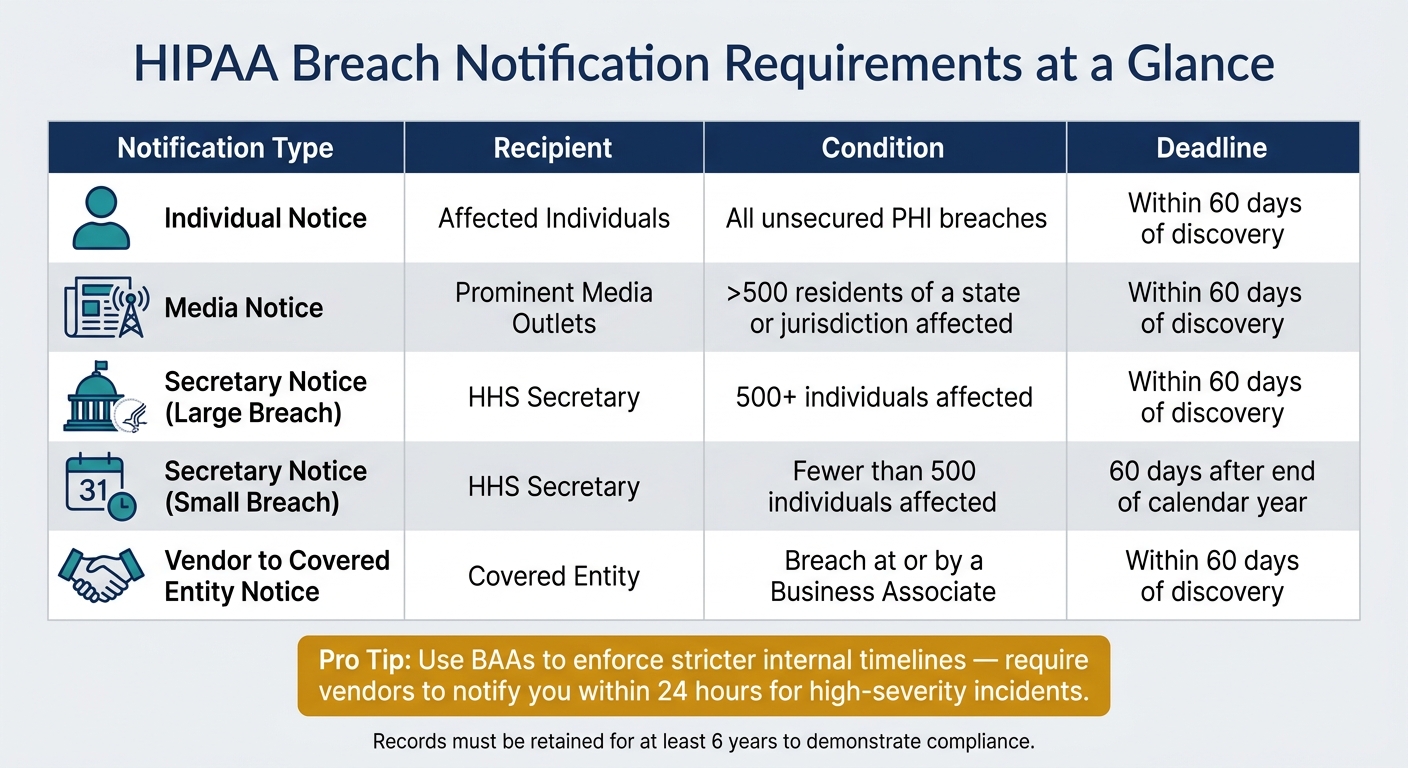
HIPAA Breach Notification Requirements: Deadlines & Conditions
Coordinating Detection and Containment with Vendors
Responding effectively to supply chain disruptions is critical for maintaining HIPAA compliance. The first 24 hours after an incident are crucial, so having established and tested communication channels with vendors is essential. Make sure every high-risk vendor relationship includes a designated 24/7 point of contact.
When an incident is detected, collaborate with the affected vendor to confirm indicators of compromise (IOCs) and identify which systems are impacted. If the vendor's systems are found to be compromised, immediately revoke their access by disabling integrations and rotating credentials. Automated access controls can speed up this process, minimizing the risks tied to manual delays [7].
It's essential to preserve all forensic evidence and maintain a documented chain of custody for compliance purposes [7]. Once containment is achieved, promptly start a PHI breach assessment to determine if the incident qualifies as a reportable breach.
Conducting a PHI Breach Assessment
Containing the incident is just the first step - accurately assessing whether it constitutes a HIPAA breach is equally important. Not every supply chain issue leads to a reportable breach. According to HHS:
"An impermissible use or disclosure of protected health information is presumed to be a breach unless the covered entity or business associate, as applicable, demonstrates that there is a low probability that the protected health information has been compromised based on a risk assessment." [5]
Start by determining whether the exposed data qualifies as "unsecured PHI." If the data was encrypted following HHS standards at the time of the incident, breach notification requirements may not apply [5]. If the data wasn't encrypted, a four-factor risk analysis is required:
| HIPAA Risk Assessment Factor | What to Evaluate |
|---|---|
| Nature of PHI | Assess the types of identifiers involved (e.g., SSN, DOB) and the risk of re-identification [5] |
| Unauthorized Recipient | Determine if the recipient had any legal or ethical duty to protect the data [5] |
| Actual Acquisition | Examine forensic evidence for data access or exfiltration [5] |
| Mitigation Extent | Evaluate the effectiveness of actions taken, such as remote wiping or confidentiality agreements [5] |
Engage both privacy and legal teams at the start of the forensic investigation. Running the breach analysis alongside containment efforts can save valuable time [7].
Meeting HIPAA Reporting and Documentation Requirements
The HIPAA Breach Notification Rule sets strict deadlines for reporting breaches. Business associates must inform covered entities without unreasonable delay and no later than 60 days after a breach is discovered [5]. Covered entities then have the same 60-day timeframe to notify affected individuals and the HHS Secretary. For breaches impacting over 500 residents in a single state or jurisdiction, local media outlets must also be notified within this window [5].
For breaches involving fewer than 500 individuals, covered entities can log the incidents internally and report them to the HHS Secretary annually - no later than 60 days after the end of the calendar year in which the breaches were identified [5]. Here’s a summary of the notification requirements:
| Notification Type | Recipient | Condition | Deadline |
|---|---|---|---|
| Individual Notice | Affected individuals | All unsecured PHI breaches | Within 60 days of discovery |
| Media Notice | Prominent media outlets | >500 residents of a state/jurisdiction | Within 60 days of discovery |
| Secretary Notice (Large) | HHS Secretary | 500+ individuals affected | Within 60 days of discovery |
| Secretary Notice (Small) | HHS Secretary | <500 individuals affected | 60 days after end of calendar year |
| Vendor to CE Notice | Covered entity | Breach at/by a business associate | Within 60 days of discovery |
To stay ahead of deadlines, use your Business Associate Agreements (BAAs) to enforce stricter internal notification timelines. For example, require vendors to alert you within 24 hours for high-severity incidents [7]. This extra time allows your team to assess, document, and respond effectively.
Keep detailed records of all incidents and responses for at least six years to demonstrate compliance [7].
Using Technology to Support HIPAA-Aligned Supply Chain Risk Management
Relying on manual processes and periodic audits is no longer sufficient for managing third-party vendor risk in healthcare supply chains. Digital tools that automate monitoring, streamline vendor assessments, and deliver real-time risk insights are now essential for maintaining HIPAA compliance, especially during disruptions. These technologies strengthen data protection and improve reporting capabilities while complementing existing governance and incident response frameworks.
Simplifying Risk Assessments and Vendor Collaboration with Censinet RiskOps™
One of the key challenges in vendor assessments is asking the right questions. Censinet RiskOps™ simplifies this with its built-in Recommendation Engine, which automatically selects the most relevant assessment questionnaires based on a supplier’s products or services. This ensures that critical HIPAA-related data is captured effectively [8]. Platforms like this address gaps in traditional methods by centralizing vendor collaboration and streamlining assessments, helping healthcare organizations uphold HIPAA standards, even during disruptions.
Censinet AI takes this further by speeding up risk assessments. It enables quick completion of security questionnaires, auto-summarizes vendor-provided evidence, and generates concise risk reports. In the event of a supply chain disruption, this efficiency is invaluable - validating a vendor’s security posture quickly allows for faster, more informed decisions on containment and reporting. Importantly, Censinet AI incorporates human oversight through configurable rules and review processes, ensuring that risk teams maintain the necessary control to meet HIPAA requirements.
Automating Compliance and Monitoring with Censinet AI
Censinet AI not only accelerates risk assessments but also automates key compliance and monitoring tasks. Its ability to summarize evidence and produce detailed risk reports in record time is particularly crucial during supply chain incidents. The faster healthcare organizations can verify a vendor’s security measures, the sooner they can take action to protect sensitive data. With built-in human oversight, the platform balances automation with the control needed to uphold HIPAA standards.
Using Benchmarking and Dashboards to Drive Compliance Improvements
Real-time dashboards in Censinet RiskOps™ provide continuous visibility into supplier performance and risk levels. This kind of oversight is invaluable during disruptions, offering immediate insights into affected vendors and potential exposure of protected health information (PHI) [10]. Beyond incident response, these dashboards support ongoing compliance improvements. By benchmarking performance over time, organizations can identify specific gaps, track compliance maturity, and uncover patterns of unreliability or internal inefficiencies [9][10]. This approach moves beyond self-reported data, providing a clearer, more actionable picture of vendor performance.
Conclusion: Maintaining HIPAA Compliance in a Complex Supply Chain
Staying on top of HIPAA compliance in a complex supply chain is no small task. It requires constant attention and a disciplined approach. Healthcare organizations that take this seriously are in a much better position to safeguard patient data, respond swiftly to incidents, and sidestep the heavy financial and reputational consequences of non-compliance.
The key lies in strong governance. This starts with well-structured Business Associate Agreements (BAAs), clear maps of how Protected Health Information (PHI) flows, and ongoing vendor monitoring. These tools are essential for assessing breaches quickly and issuing timely notifications during disruptions. As supply chains grow more intricate, relying on manual, occasional methods just isn't enough anymore.
"Traditional compliance methods - manual policy implementation and periodic audits - are increasingly inadequate." - Sabri Barbaria, Laboratory of Biophysics and Medical Technologies [11]
Technology steps in to fill the gaps. Tools like continuous monitoring, Zero-Trust access controls, and automated risk assessments allow organizations to move from being reactive to proactive. These measures help identify vulnerabilities before they escalate into breaches. Platforms such as Censinet RiskOps™ play a pivotal role by centralizing vendor risk data, automating assessments, and providing real-time insights into PHI exposure throughout the supply chain.
FAQs
When is a vendor considered a business associate under HIPAA?
A vendor qualifies as a business associate under HIPAA if they deal with Protected Health Information (PHI) or electronic PHI (ePHI) in any capacity - whether by handling, creating, receiving, maintaining, or transmitting it - on behalf of a covered entity. To comply with HIPAA regulations, they are required to sign a Business Associate Agreement (BAA). This agreement ensures they adhere to the necessary privacy and security standards.
What should we do in the first 24 hours of a vendor incident?
In the first 24 hours, it's crucial to act swiftly. Start by confirming the scope of the incident and evaluating whether any protected health information (PHI) might have been exposed. Immediately isolate any affected systems to prevent further damage. Reach out to the vendor for detailed incident information and document every notification thoroughly. Engage your incident response team without delay, ensuring they are fully briefed. Set up secure communication channels to manage sensitive discussions and ramp up system monitoring to detect and address any additional risks. These initial steps are key to containing the incident, safeguarding patient data, and maintaining compliance with HIPAA regulations.
How can we tell if a supply chain event is a reportable HIPAA breach?
A supply chain event must be reported under HIPAA if it includes the unauthorized use or disclosure of unsecured Protected Health Information (PHI) and there's more than a low likelihood of compromise. To determine this, organizations are required to conduct a documented risk assessment. This evaluation should take into account factors such as the type of data involved, who received it, and any steps taken to minimize harm. If the breach impacts 500 or more individuals, it must be reported to the Department of Health and Human Services (HHS) within 60 days, unless certain exceptions are applicable.

