
When it comes to protecting electronic Protected Health Information (ePHI), backup and recovery are two critical yet distinct processes. Here's the key difference:
- PHI Backup: A proactive process of creating secure, retrievable copies of ePHI to prevent data loss due to corruption, deletion, or attacks. It focuses on preserving data integrity and availability.
- PHI Recovery: A reactive process that restores access to data and systems after disruptions like cyberattacks, server failures, or natural disasters. It ensures continuity of healthcare operations.
Why it matters: Backups save your data; recovery ensures your organization can function during a crisis. Both are required by HIPAA, but they serve different purposes. Without backups, data is lost. Without recovery plans, operations grind to a halt.
Quick Overview:
- Backup: Stores exact copies of ePHI for safekeeping.
- Recovery: Restores systems and resumes services after incidents.
- HIPAA Compliance: Both are mandatory under the HIPAA Security Rule.
- Key Metrics: Backup focuses on Recovery Point Objective (RPO), while recovery prioritizes Recovery Time Objective (RTO).
Both processes are essential for safeguarding patient care and maintaining compliance. Let’s break this down further.
PHI Data Backup and Recovery
What is PHI Backup?
PHI backup involves creating exact, retrievable copies of electronic Protected Health Information (ePHI) to safeguard patient data in case of corruption, deletion, or ransomware attacks. These backups securely store patient records, lab results, clinical notes, and medical images, ensuring restoration is possible when needed, as outlined in the HIPAA Security Rule (45 CFR § 164.308(a)).
The primary focus is preserving data integrity. As Chase Higbee, Lead IT Strategist at Atlantic.Net, puts it:
The purpose of the data backup plan is to ensure that exact digital copies of Protected Health Information (PHI) are saved using a predefined backup schedule that can guarantee the integrity and recoverability of the data. [2]
PHI backups are not designed to maintain continuous operations during a crisis. Instead, they ensure that secure, intact copies of your data are available for restoration when needed.
Primary Functions of PHI Backup
PHI backups play a key role in protecting against data loss caused by hardware failures, accidental deletions, file corruption, or ransomware attacks. The emphasis is on preserving the data itself, not on keeping operations running during an incident. For example, if a server fails, the backup won't restore clinical workflows or keep your electronic health record (EHR) system online. However, it ensures that the data you recover is accurate, complete, and ready for use.
Modern backup systems incorporate features like immutability and versioning. These tools prevent unauthorized changes and allow you to roll back to a clean state before an attack - essential for combating ransomware that targets both primary data and backups [4].
HIPAA Backup Requirements
HIPAA doesn’t dictate how frequently backups must occur or what technology to use. Instead, these decisions depend on your organization's risk analysis and Recovery Point Objective (RPO) [4][7]. However, the regulation is clear about one thing: backups must be exact and retrievable copies of ePHI [5].
Key compliance requirements include:
| Feature | HIPAA Requirement / Best Practice |
|---|---|
| Copy Type | Must be an "exact" and "retrievable" copy of ePHI [4][5] |
| Encryption | AES-256 for data at rest; TLS for data in transit [4] |
| Storage Location | Must include offsite or geographically redundant storage [4][5] |
| Documentation Retention | 6 years (Federal requirement) [4][7] |
| Access Control | Unique user IDs and Multi-Factor Authentication (MFA) [2][6] |
| Integrity | Must protect against unauthorized alteration or destruction [7] |
Encryption is a must. Use NIST-approved methods like AES-256 for data at rest and TLS for data in transit [2][4]. This ensures that even if backup media is compromised, the ePHI remains unreadable.
Another best practice is the 3-2-1 Rule: keep 3 copies of your data on 2 different media types, with at least 1 copy stored offsite. This approach guards against localized disasters that could affect both primary systems and local backups [4].
If you rely on a third-party backup or cloud provider, ensure they sign a Business Associate Agreement (BAA) before handling any ePHI [4][6]. Without a BAA, your organization is not HIPAA-compliant, and violations can result in penalties of up to $1.5 million per year [5].
What is PHI Recovery?
PHI recovery is the process of restoring data and resuming operations after disruptions like system failures, cyberattacks, human errors, or natural disasters [3][8]. While PHI backup involves creating static copies of data, PHI recovery takes things further by activating those backups to restore full functionality. The goal is to get your organization back to normal operations as quickly as possible.
Beyond restoring data, recovery also rebuilds critical IT infrastructure, such as servers, applications, networks, and identity systems like Active Directory. For example, even if electronic health records (EHRs) are restored, clinical staff won’t be able to log in without functioning authentication systems [10]. Recovery is a key element of a HIPAA-mandated contingency plan, which also includes disaster recovery planning, emergency mode operations, and data criticality analysis [4][9]. This operational focus sets recovery apart from backup, paving the way for a deeper comparison.
Primary Functions of PHI Recovery
The primary goal of recovery is to restore essential systems to ensure patient care continues without interruption [3]. This involves prioritizing the restoration of servers, applications, and networks based on their importance to patient safety. For instance, identity services and EHR systems might need to be restored within 2–4 hours (Recovery Time Objective or RTO), while systems like medical imaging (PACS) may have an 8-hour RTO. Less critical systems, such as billing, might allow for up to 24 hours of downtime [10]. Recovery strategies hinge on two metrics: RTO (how quickly systems must be restored) and RPO (the maximum acceptable amount of data loss) [3][8].
Recovery also includes Emergency Mode Operations, which provide guidelines for maintaining critical functions and protecting electronic protected health information (ePHI) during outages. This might involve using alternative workflows, like paper charts or temporary hardware, to keep patient care running smoothly [3][4]. These measures ensure continuity even during prolonged system outages. Now, let’s explore how this reactive process contrasts with proactive backup strategies.
Disaster Recovery vs. Backup
The distinction between backup and recovery lies in their roles. Backup is a routine, proactive process of saving data copies, while recovery is the reactive response when something goes wrong - be it a ransomware attack, server failure, or natural disaster [4][9].
Recovery addresses the bigger picture of disaster response, covering everything from threat detection and containment to malware removal and operational restoration [9]. It’s not enough to simply have data backups; organizations need a well-documented, tested plan to use those backups effectively. In healthcare, where every minute of downtime can translate to thousands of dollars in lost productivity, a strong recovery plan is non-negotiable [10].
Consider this: since early 2016, healthcare organizations have faced an average of 4,000 ransomware attacks every day - a 300% increase from 2015 [9]. Without a solid recovery plan, backups are just files sitting idly on a server, offering little value when disaster strikes.
PHI Backup vs. Recovery: Side-by-Side Comparison
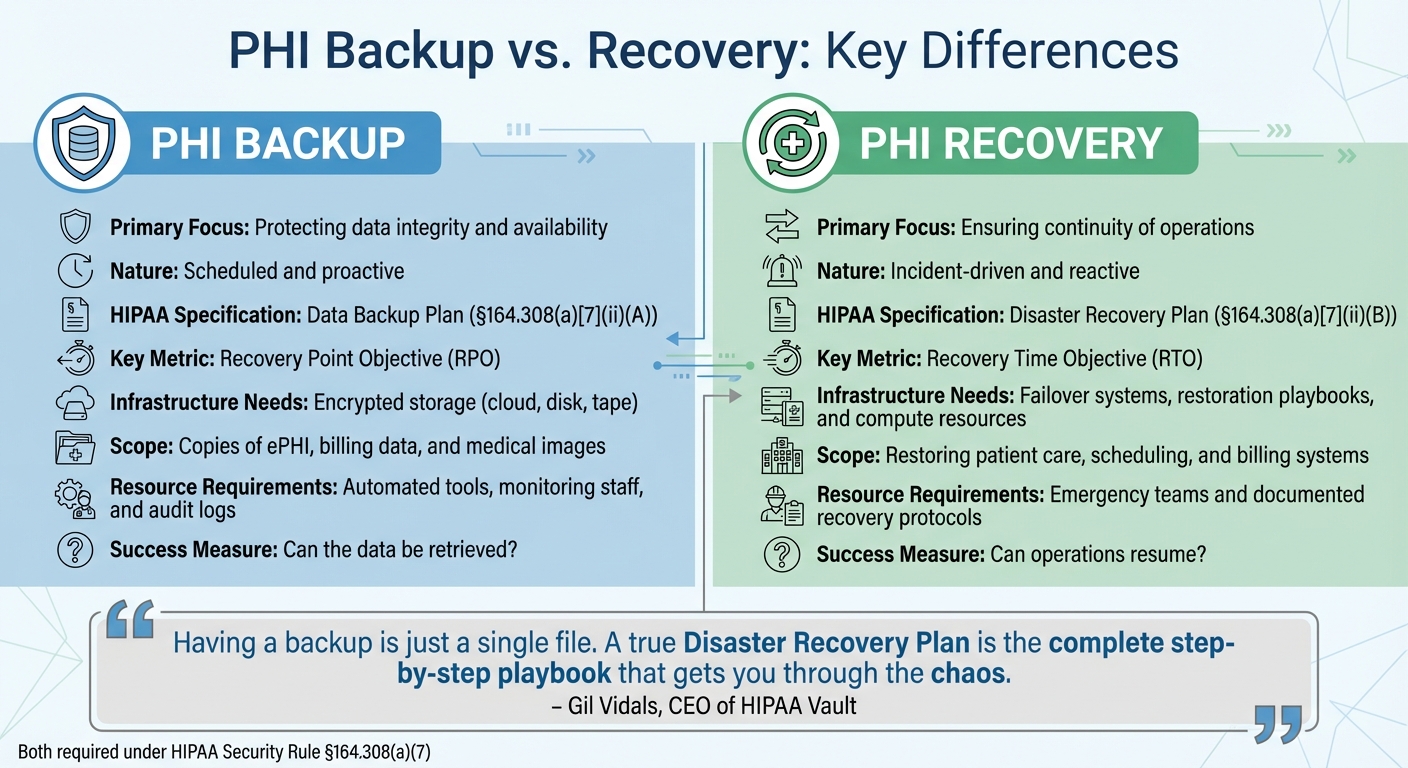
PHI Backup vs Recovery: Key Differences and HIPAA Requirements
This section dives into the key differences between PHI backup - focused on safeguarding data - and PHI recovery, which is all about getting operations back on track. While both are essential under HIPAA contingency plans, they serve distinct purposes: backup secures the data, and recovery ensures services can resume after an interruption.
Backup involves creating exact duplicates of electronic protected health information (ePHI), including billing records and medical images, to ensure the data itself is safe and intact. Recovery, on the other hand, prioritizes restoring the functionality of patient care systems, billing, and scheduling, allowing operations to continue even in the face of disruptions.
As Gil Vidals, CEO of HIPAA Vault, puts it:
"Having a backup is just a single file. A true Disaster Recovery Plan is the complete step-by-step playbook that gets you through the chaos." [4]
In essence, backup is a proactive process, while recovery is reactive, triggered by an incident. Think of backup as the safety net for your data and recovery as the roadmap to restoring full operations. The table below highlights their differences.
Comparison Table: Backup vs. Recovery
| Feature | PHI Backup | PHI Recovery |
|---|---|---|
| Primary Focus | Protecting data integrity and availability [12] | Ensuring continuity of operations [12] |
| Nature | Scheduled and proactive [12] | Incident-driven and reactive [12] |
| HIPAA Specification | Data Backup Plan (§164.308(a)7(A)) [4] | Disaster Recovery Plan (§164.308(a)7(B)) [4] |
| Key Metric | Recovery Point Objective (RPO) [11] | Recovery Time Objective (RTO) [11] |
| Infrastructure Needs | Encrypted storage (cloud, disk, tape) [1] | Failover systems, restoration playbooks, and compute resources [11][12] |
| Scope | Copies of ePHI, billing data, and medical images [11] | Restoring patient care, scheduling, and billing systems [11] |
| Resource Requirements | Automated tools, monitoring staff, and audit logs [3][2] | Emergency teams and documented recovery protocols [3][1][4] |
| Success Measure | Can the data be retrieved? | Can operations resume? |
Two critical metrics often guide these processes: Recovery Point Objective (RPO), which defines how much data loss is acceptable, and Recovery Time Objective (RTO), which determines how quickly systems need to be operational again. Together, they shape how organizations plan for both data protection and operational recovery.
sbb-itb-535baee
HIPAA Requirements for Backup and Recovery
HIPAA lays out clear expectations for both backup and recovery processes. According to 45 CFR § 164.308(a)(7), organizations must implement a Contingency Plan that includes a Data Backup Plan, Disaster Recovery Plan, and Emergency Mode Operation Plan. Additionally, it requires Testing and Revision Procedures and Application and Data Criticality Analysis, which are considered addressable elements [15].
Steve Alder, Editor-in-Chief of The HIPAA Journal, highlights the importance of treating contingency planning as an ongoing task:
"Contingency planning should not be considered a onetime checkbox item necessary for HIPAA compliance. It should be an ongoing process with plans regularly checked, updated, and tested to ensure any deficiencies are identified and addressed." [13]
HIPAA also enforces technical safeguards to protect electronic protected health information (ePHI). These include encryption (both at rest and in transit using AES-256 and TLS 1.2 or 1.3), unique user identification, and automatic logoff features [3]. Audit controls are essential to ensure ePHI integrity, tracking access and confirming that data remains unaltered [14]. Moreover, all related documentation - such as policies, procedures, and audit logs - must be retained for at least six years, although some states may impose longer retention periods for medical records [13].
Testing backup and recovery systems isn’t optional. HIPAA requires disaster recovery procedures to be tested annually to ensure they function as intended [3]. Chase Higbee, Lead IT Strategist at Atlantic.Net, stresses the importance of automation and monitoring:
"The data backup plan must be an automated task, monitored by support staff for incidents such as a failure or a missed backup with detailed reporting enabled." [2]
These requirements provide the foundation for a comprehensive HIPAA Contingency Plan, which is outlined below.
HIPAA Contingency Plan Standards
HIPAA’s contingency plan standards integrate backup and recovery into a broader framework designed to safeguard operations and data. The plan consists of five key components:
- Data Backup Plan: Ensures the creation of exact, retrievable copies of ePHI, covering everything from medical records to diagnostic images and billing data [30,33].
- Disaster Recovery Plan: Details procedures for restoring data following an emergency, such as a cyberattack or hardware failure [30,33].
- Emergency Mode Operation Plan: Focuses on maintaining critical business processes during disruptions, ensuring ePHI security during events like power outages or natural disasters [30,33].
- Testing and Revision Procedures: Involves periodic testing to identify and address issues, such as corrupted backups or slow recovery times, with updates as IT systems evolve [13].
- Application and Data Criticality Analysis: Helps prioritize which systems and data to restore first based on their importance to patient care and operations [30,32].
Physical safeguards are equally important. Backup media should be stored securely in offsite locations, far from the primary data center, to protect against regional disasters like hurricanes or wildfires. For cloud-based backups, organizations must sign a Business Associate Agreement (BAA) with their provider to ensure proper safeguards and incident reporting [3].
State-Specific Retention Periods
While HIPAA sets a federal baseline, state laws often impose stricter requirements for retaining medical records. HIPAA mandates a six-year retention period for compliance documentation, including policies and audit logs, but some states require longer retention for medical records [13].
For instance, Nevada only requires records to be kept for three years, while South Carolina mandates an 11-year retention period [2]. Pediatric records often have additional requirements, such as retaining them for a certain number of years after the patient reaches adulthood [3]. These state-specific rules influence both storage costs and recovery strategies, as organizations must ensure data is preserved for the longest applicable period. For healthcare providers operating across multiple states, compliance demands designing their backup and recovery systems to meet the most stringent requirements, avoiding potential violations even when federal standards are satisfied.
Common Gaps in Backup and Recovery Implementation
Even though HIPAA outlines clear requirements, healthcare organizations often face two major challenges: a disconnect between creating backups and executing recovery plans, and the steep costs associated with downtime when systems fail. Addressing these issues highlights the importance of a well-integrated and thoroughly tested strategy for protecting PHI.
The Backup-Recovery Gap
Many healthcare facilities focus on creating backups of their ePHI but neglect to establish or routinely test a recovery plan to restore that data when it’s needed most. As Atlantic.Net puts it:
While data backup focuses on the act of saving data, disaster recovery focuses on the process of restoring operations after a disruption [3].
The consequences of not testing recovery plans can be devastating. For instance, Wood Ranch Medical, a practice in California, had to shut down permanently after a ransomware attack because it lacked the recovery measures needed to restore encrypted patient records [16]. Similarly, Erie County Medical Center faced a $10 million expense to rebuild its IT infrastructure due to the absence of a viable recovery plan [16].
Without regular testing, organizations might find their backups corrupted, incomplete, or incompatible with current systems. DP Tech warns:
Failure to regularly test and update backup and disaster recovery plans leaves organizations unprepared to respond effectively to data breaches or system failures [16].
Other frequent issues include storing backups in the same location as primary data centers - leaving both vulnerable to local disasters - and maintaining outdated documentation that no longer aligns with current IT setups. Additionally, inadequate security during the restoration process can expose PHI to unauthorized access or tampering [3][16]. These gaps directly threaten operational continuity, which ties into the financial impact of downtime.
Cost of Downtime in Healthcare
The financial toll of ineffective backup and recovery systems on healthcare providers is staggering. On average, healthcare organizations lose $7,900 per minute during system outages, with medium-sized hospitals facing potential losses of up to $1.7 million per hour [17]. Additionally, healthcare breach costs averaged $9.77 million per incident in 2024, marking the highest average across industries for 14 consecutive years [17].
EHR outages don’t just hit the bottom line - they also put patient safety at risk. For example, when Cass Regional Medical Center in Missouri experienced a ransomware attack that encrypted its EHR system, the hospital had to rely on paper records for several days. This highlighted the dangers of delayed treatments and increased medication errors [16]. As Opti9 Tech noted:
A backup that can't be restored quickly or completely creates compliance exposure and operational risk [17].
How to Build a Complete PHI Protection Strategy
After identifying common gaps, the next step is crafting a solid strategy to protect PHI (Protected Health Information). This involves aligning technical safeguards with regulatory standards and operational priorities. Healthcare organizations must define clear recovery goals, use proven methods, and adopt specialized tools to tackle the complex risks tied to patient data.
Setting RPO and RTO Metrics
Recovery Point Objective (RPO) and Recovery Time Objective (RTO) are two critical metrics for effective recovery. RPO defines the maximum age of data that must be restored to resume normal operations, while RTO sets the acceptable time frame for restoring those operations after a disruption [19]. These metrics should be based on a Business Impact Analysis, which evaluates how downtime affects patient safety, finances, and compliance [18].
Start by conducting an Application and Data Criticality Analysis to pinpoint essential software and datasets for patient care during emergencies [13][15]. For example, if losing more than two hours of EHR (Electronic Health Record) data compromises patient safety, your RPO should be two hours, meaning backups must occur at least every two hours [18]. Similarly, if the emergency department can't function without patient records for more than 30 minutes, your RTO becomes 30 minutes, guiding the speed and capability of your recovery systems [19].
Test these metrics with tabletop exercises simulating real-world scenarios like ransomware attacks or power outages. Involving IT teams, clinical staff, and leadership in these drills helps identify whether your recovery process aligns with your objectives, highlighting any weaknesses before an actual crisis [18][15].
Backup and Recovery Best Practices
Following HIPAA's five contingency plan components is essential: Data Backup Plan, Disaster Recovery Plan, Emergency Mode Operation Plan, Testing and Revision Procedures, and Application and Data Criticality Analysis [13][4][15]. Strengthen your plan with key backup practices:
- Use multiple storage media and offsite storage.
- Apply robust end-to-end encryption [1][4].
- Implement immutable, versioned backups and automate failure detection [4][2].
Contingency planning isn't a one-time task - it requires regular updates, testing, and revisions to address any shortcomings [13].
Ensure Business Associate Agreements (BAAs) are in place with all third-party entities handling ePHI (electronic Protected Health Information) [4]. Enforce role-based access controls, multi-factor authentication, and unique user IDs to block unauthorized changes to backups [2][3]. Establish "break-glass" procedures for audited, time-limited access to PHI during emergencies when normal authentication may fail [15]. Finally, verify backup integrity with automated checksums and periodic restore tests to confirm data reliability [15].
Using Censinet for Risk Management

Coordinating backup and recovery across various systems, vendors, and compliance requirements can be overwhelming. Platforms like Censinet RiskOps™ simplify this process by centralizing risk management for patient data, clinical applications, medical devices, and supply chains.
Censinet RiskOps™ allows healthcare organizations to streamline third-party and enterprise risk assessments, ensuring compliance with HIPAA Security Rule requirements for cloud backup providers, offsite storage vendors, and other partners. Its automated workflows and real-time risk visualization help identify gaps in your backup and recovery plans before they lead to costly failures.
Conclusion
Securing Protected Health Information (PHI) requires two critical components: backup and recovery. While backups ensure data is preserved, recovery processes restore operations during disruptions. Together, they fulfill HIPAA's requirements and safeguard patient safety. According to the HIPAA Security Rule's Contingency Plan (45 CFR § 164.308(a)[4]), healthcare organizations must have both a Data Backup Plan and a Disaster Recovery Plan. Failing to comply can lead to fines as high as $1.5 million and put operations - and patient care - at risk [5].
PHI backups protect against data loss caused by accidental deletion or corruption, while recovery plans address larger-scale issues like ransomware attacks or natural disasters [4][20]. This two-pronged strategy ensures both data integrity and availability. Backups provide exact copies of critical data, and recovery systems ensure that healthcare operations can quickly resume. Without an effective recovery process, clinical workflows can grind to a halt, endangering patient safety [4].
As Gil Vidals, CEO of HIPAA Vault, aptly explains:
A backup saves your files; a Disaster Recovery Plan saves your entire operation [4].
To meet both regulatory and operational needs, healthcare organizations should adopt best practices like the 3-2-1 Rule: maintain three copies of data across two different media types, with at least one copy stored offsite. Additionally, defining clear Recovery Point Objectives (RPO) and Recovery Time Objectives (RTO) is essential, along with conducting annual testing to verify the effectiveness of these plans [3][4]. Tools like Censinet RiskOps™ can simplify compliance by centralizing risk management and aligning backup and recovery efforts with HIPAA standards.
Ultimately, protecting PHI requires more than just storing data - it demands a proven plan to restore operations when it matters most. By combining robust backup systems with reliable recovery strategies, healthcare organizations can ensure uninterrupted patient care and operational resilience.
FAQs
What’s the difference between PHI backup and recovery in healthcare?
The main distinction between PHI backup and recovery lies in their role and when they come into play. Backup is all about creating secure, retrievable copies of electronic protected health information (ePHI) to prevent data loss. Recovery, however, is the process of restoring that data swiftly and securely after incidents like system failures, cyberattacks, or natural disasters.
Both functions are essential for keeping business operations running smoothly, ensuring patient care isn't disrupted, and staying compliant with HIPAA regulations. Backups serve as your data safety net, while recovery ensures operations can get back on track with minimal downtime and no compromise to sensitive information.
What are RPO and RTO, and how do they impact PHI backup and recovery strategies?
RPO (Recovery Point Objective) refers to the maximum amount of data that an organization can afford to lose during an incident. This metric helps determine how frequently backups should be performed to safeguard sensitive Protected Health Information (PHI).
RTO (Recovery Time Objective), on the other hand, defines the maximum amount of time systems can remain offline before operations must be restored. It ensures that disruptions are addressed swiftly to minimize downtime.
When combined, RPO and RTO play a crucial role in shaping PHI backup and recovery plans. They strike a balance between maintaining data integrity and ensuring operational continuity, reducing risks to patient care and regulatory compliance.
Why do healthcare organizations need both a PHI backup and a recovery plan to meet HIPAA requirements?
Healthcare organizations are required to have a PHI backup and a recovery plan in place to meet HIPAA regulations and protect electronic protected health information (ePHI). These protocols are essential for ensuring the confidentiality, integrity, and availability of sensitive patient data, even when faced with system outages, cyberattacks, or natural disasters.
A backup plan focuses on securely storing copies of ePHI so they can be accessed when needed. On the other hand, a recovery plan is designed to restore data and operations quickly, reducing downtime and minimizing disruptions to patient care. Together, these plans are essential for complying with HIPAA’s contingency requirements and maintaining patient trust in healthcare services.
