
Ultimate Guide to PHI Encryption in Healthcare
Post Summary
Protecting healthcare data is non-negotiable. With cyberattacks on the rise, encrypting Protected Health Information (PHI) is now a must for healthcare organizations under updated HIPAA rules. Here's what you need to know:
- PHI Basics: PHI includes any identifiable health data. When stored electronically (ePHI), it falls under strict HIPAA regulations.
- Why Encryption Matters: Encryption converts readable data into secure ciphertext, reducing the risk of breaches and avoiding hefty penalties.
- Key Updates: As of 2025, encryption for ePHI is mandatory - both at rest (e.g., in databases) and in transit (e.g., over networks).
- Standards to Follow: Use NIST-approved algorithms like AES-256 for data at rest and TLS 1.3 for data in transit.
- Beyond Compliance: Proper encryption safeguards patient trust, protects against breaches, and ensures operational continuity.
Quick Tip: Effective encryption requires robust key management, regular risk assessments, and vendor compliance oversight. Neglecting these can lead to penalties reaching $1.9 million per violation annually.
Read on for a deeper dive into encryption strategies, regulatory requirements, and practical implementation tips for securing healthcare data.
HIPAA Requirements: Encryption at Rest and in Transit #HIPAA #cybersecurity #breach #data #it #phi
Regulations and Standards for PHI Encryption
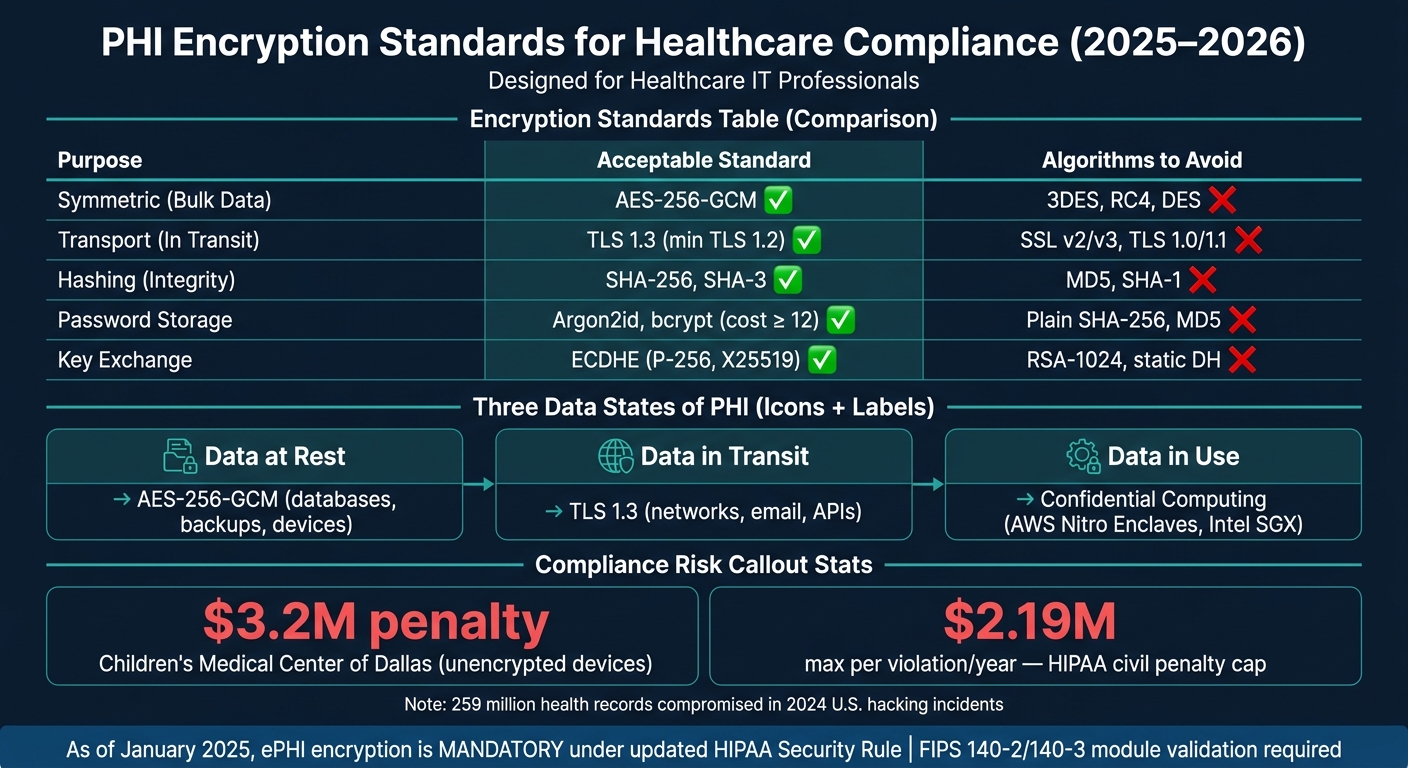
PHI Encryption Standards: Algorithms, Requirements & Compliance at a Glance
HIPAA Encryption Requirements
The HIPAA Security Rule specifically addresses encryption in two areas: § 164.312(a)(2)(iv) for data at rest and § 164.312(e)(2)(ii) for data in transit. Previously, these specifications were "addressable", meaning organizations could choose alternative controls if they documented why encryption wasn’t feasible and implemented an equivalent safeguard.
That has changed. Starting in January 2025, encryption will be a required implementation specification under the updated Security Rule [1]. The Department of Health and Human Services (HHS) clarified:
"An addressable implementation specification is not optional; rather, if an organization determines that [it] is not reasonable and appropriate, the organization must document why... and adopt an equivalent measure." [2]
Beyond compliance, proper encryption offers a critical advantage under the Breach Notification Rule. According to 45 CFR § 164.402, if electronic protected health information (ePHI) is encrypted using NIST-approved standards and the decryption key remains secure, the incident generally won’t be classified as a reportable breach. This provides a safeguard against OCR penalties and helps maintain patient trust [1].
To meet these requirements, healthcare organizations must follow NIST standards for encryption.
NIST Standards for PHI Encryption
While HIPAA establishes the legal framework, NIST provides the technical guidance. Two key NIST publications are particularly relevant for healthcare organizations:
- NIST SP 800-111: Focuses on encryption for storage devices, ensuring ePHI at rest is secure [7].
- NIST SP 800-52 Rev. 2: Covers the use of Transport Layer Security (TLS) for protecting data in transit [7].
The baseline encryption standards for 2026 are outlined below:
| Purpose | Acceptable Standard | Algorithms to Avoid |
|---|---|---|
| Symmetric (Bulk Data) | AES-256-GCM | 3DES, RC4, DES |
| Transport (In Transit) | TLS 1.3 (minimum TLS 1.2) | SSL v2/v3, TLS 1.0/1.1 |
| Hashing (Integrity) | SHA-256, SHA-3 | MD5, SHA-1 |
| Password Storage | Argon2id, bcrypt (cost ≥ 12) | Plain SHA-256, MD5 |
| Key Exchange | ECDHE (P-256, X25519) | RSA-1024, static DH |
Additionally, all cryptographic modules must be validated under FIPS 140-2 or 140-3 standards. Even if strong algorithms are used, non-certified modules can create compliance gaps that OCR audits may uncover [7][4].
These technical requirements extend beyond internal systems to third-party vendors, making vendor compliance a critical part of the encryption strategy.
Supply Chain and Vendor Compliance
Encryption standards aren’t just for internal use - they also apply to third-party vendors who handle PHI. Under HIPAA, any vendor that creates, receives, maintains, or transmits ePHI is considered a Business Associate (BA). This includes cloud providers, even if they only store encrypted data without access to the decryption keys [3].
"Lacking an encryption key does not exempt a CSP from business associate status and obligations under the HIPAA Rules." - U.S. Department of Health and Human Services [3]
To work with ePHI, vendors must sign a Business Associate Agreement (BAA). This requirement also extends to subcontractors. For example, if a BA uses a cloud service to store ePHI, that service provider must also sign a BAA. However, the "conduit exception" applies only to services that transmit data without storing it, such as postal carriers [3].
The risks of non-compliance are high. In one notable case, Children's Medical Center of Dallas faced a $3.2 million penalty after two incidents involving unencrypted devices - a lost BlackBerry in 2009 and a stolen laptop in 2013 - resulted in breaches affecting over 6,000 individuals [5].
Ensuring vendor compliance at scale requires robust oversight. Tools like Censinet RiskOps™ help healthcare organizations manage third-party risks by assessing vendor encryption practices, verifying BAAs, and tracking compliance with security requirements across their supply chain. This kind of systematic approach helps reduce vulnerabilities and ensures adherence to HIPAA and NIST standards.
Core Concepts of PHI Encryption
Data States: At Rest, In Transit, and In Use
Protected Health Information (PHI) exists in three primary states, each requiring a unique encryption strategy.
Data at rest refers to PHI stored in systems like databases, backup files, laptops, or mobile devices. To secure this, AES-256 encryption is commonly used, either through full-disk encryption (FDE) or more targeted file-level encryption.
Data in transit pertains to PHI moving across networks - whether between services, to a browser, or through email. This state is typically secured using transport-layer security protocols to protect the data during transfer.
The final state, data in use, involves PHI actively processed in application memory. Historically left unencrypted, this state is now increasingly safeguarded with confidential computing technologies like AWS Nitro Enclaves or Intel SGX. These tools isolate processing environments, and application logs should also be sanitized to avoid exposing PHI in observability systems.
Since PHI exists in these distinct states, each requires tailored encryption methods, which are explored further below.
Encryption Types and Algorithms
Two main approaches are used to encrypt PHI: symmetric and asymmetric encryption.
- Symmetric encryption relies on a single key for both encrypting and decrypting data. It’s efficient and ideal for securing large amounts of data at rest. AES-256-GCM is the industry benchmark for this method.
- Asymmetric encryption, on the other hand, uses a pair of keys (public and private) for secure exchanges and digital signatures. While it’s not suited for encrypting large datasets, ECDHE (Elliptic Curve Diffie-Hellman Ephemeral) is recommended for secure key exchanges, offering forward secrecy. This ensures that even if a private key is compromised, past sessions remain secure.
Hashing is another critical tool, though it doesn’t encrypt data. Instead, it ensures data integrity. Algorithms like SHA-256 and SHA-3 are the current standards, while older ones like MD5 and SHA-1 are no longer secure and should be avoided.
A growing trend is field-level encryption, where specific sensitive fields - like Social Security numbers or clinical notes - are encrypted at the application layer. This adds an extra layer of protection, safeguarding against threats such as SQL injection or misuse by over-privileged accounts.
No matter the encryption method, effective key management is essential to maintain security.
Key Management Best Practices
Even the strongest encryption is ineffective without rigorous key management. As VertiComply highlights:
"Encrypting data without a key management story is theater. If the keys live in the same database as the ciphertext, an attacker who reads the database reads the keys." - VertiComply [1]
The most important rule is to separate keys from the data they protect. A managed Key Management Service (KMS) - such as AWS KMS, Google Cloud KMS, or Azure Key Vault - helps ensure proper storage, regular rotation, and detailed audit logs.
For workloads with high sensitivity, Hardware Security Modules (HSMs) provide top-tier security. These tamper-resistant devices handle key generation and usage without exposing them to application memory. HSMs that meet FIPS 140-3 Level 3 standards are particularly well-suited for PHI.
Envelope encryption is a widely used method where a Data Encryption Key (DEK) encrypts the PHI, and a Key Encryption Key (KEK) secures the DEK. This method simplifies key rotation since only the DEK needs re-encryption, not the entire dataset.
Keys should be rotated every 90 days, a process that can be automated using KMS to ensure consistency. To meet HIPAA documentation rules, all key management activities must be logged and retained for at least six years [1].
sbb-itb-535baee
Implementing PHI Encryption in Healthcare Organizations
Building a PHI Encryption Strategy
Creating a robust PHI encryption strategy starts with mapping out every system that handles protected health information (PHI). This includes databases, object stores, message queues, backups, and external integrations. Knowing where PHI resides helps identify what needs protection and whether it’s at rest, in transit, or actively in use.
Next, classify PHI based on its sensitivity. For instance, a patient’s name linked to a diagnosis or Social Security Number (SSN) poses a higher risk than anonymized data. Critical information like Medical Record Numbers (MRNs), clinical notes, and SSNs should utilize field-level encryption at the application layer. Relying solely on full-disk encryption (FDE) isn’t enough - it won’t guard against threats like SQL injection or overly permissive service accounts.
Encryption policies should also align with clinical workflows. For example, clinicians accessing electronic health records (EHRs) during late-night shifts need secure, hassle-free access. Poorly integrated encryption measures can create barriers, pushing users toward insecure workarounds.
Platforms like Censinet RiskOps™ offer tools to evaluate and document risks across healthcare data environments. This includes third-party vendors and clinical applications that interact with PHI, ensuring a more comprehensive approach.
Encrypting PHI at Rest and In Transit
Once systems are inventoried and data is classified, implementing encryption becomes more straightforward. For data at rest, use AES-256-GCM encryption across servers, workstations, mobile devices, and backups. While full-disk encryption protects hardware from theft, sensitive fields like SSNs or MRNs should also be encrypted at the field level for added security.
For data in transit, enforce TLS 1.3 for all network transmissions. While TLS 1.2 is still acceptable with strong cipher configurations, older versions like TLS 1.0 and 1.1 must be phased out immediately. For secure email communication, use TLS for channel encryption alongside S/MIME or PGP for end-to-end message protection.
"Encryption is a lifecycle obligation, meaning that data sitting in an archive six years from now needs the same protection as data transmitted today." - Natasa Djalovic, Senior Content Writer, Jatheon [5]
Backups and archives also require encrypted, immutable storage with a six-year retention policy and audit trails. One critical detail: ensure your cloud provider’s Business Associate Agreement (BAA) explicitly covers encrypted storage, even if they don’t hold the decryption keys - a detail often overlooked [5].
Here’s a quick breakdown of key implementation areas and actions:
| Implementation Area | Required Action |
|---|---|
| Servers & Databases | AES-256 encryption; field-level encryption for sensitive data like SSNs, MRNs |
| Mobile Devices & Workstations | Full-disk encryption (e.g., BitLocker, FileVault); enforce MDM policies |
| Data in Transit | TLS 1.3 recommended; TLS 1.2 acceptable; remove TLS 1.0/1.1 |
| Email Communications | TLS for channel encryption; S/MIME or PGP for message-level security |
| Backups & Archives | Encrypt data at rest; ensure immutable storage; maintain 6-year retention |
This foundation prepares healthcare organizations to tackle encryption challenges unique to medical devices and telehealth platforms.
Encryption for Medical Devices, IoT, and Telehealth
External devices and telehealth platforms present additional hurdles for PHI security. Many medical devices, such as ventilators or patient monitors, run outdated firmware that doesn’t support encryption. Updating this firmware can void warranties or disrupt their clinical functions [6]. The workaround? Network-level isolation. Place these devices in segmented network zones and route their traffic through encrypted IPsec tunnels or VPNs. As Medcurity advises:
"Isolate medical devices on encrypted network tunnels, even if the devices themselves can't encrypt. This provides protection without firmware changes." - Medcurity [6]
For telehealth platforms, encryption alone isn’t enough. Consumer apps like WhatsApp may offer end-to-end encryption but lack essential features like audit logs, access controls, and archiving - making them unsuitable for HIPAA compliance [5]. Ensure any telehealth platform includes these capabilities. Additionally, if personal devices (BYOD) are being used, enforce full-disk encryption and remote-wipe options through Mobile Device Management (MDM) solutions.
Finally, review all API integrations across your environment, such as EHR-to-lab or device-to-cloud connections. Any integration using TLS versions below 1.2 represents a compliance issue that needs immediate attention [6]. For highly sensitive system-to-system data transfers, implement certificate pinning to guard against man-in-the-middle attacks. Modern AES-256 encryption is hardware-accelerated, with minimal performance impact - typically only 1–5% - so there’s little reason to leave any integration unsecured [6].
Governance and Continuous Improvement
Once encryption is in place, maintaining its effectiveness and staying compliant requires ongoing governance.
Policies, Documentation, and Compliance Tracking
To ensure encryption remains effective and compliant, continuous governance is key. Since the January 2025 update to the Security Rule, encrypting all ePHI - whether at rest or in transit - is mandatory [1]. This makes compliance tracking and key management essential for sustaining the encryption protocols established during initial implementation.
Organizations must retain documentation and logs for at least six years [5]. Each risk analysis should clearly outline the encryption algorithms in use - like AES-256 for data at rest and TLS 1.3 for data in transit - along with key lengths and the management strategies for each PHI repository [1]. Additionally, any third-party vendors handling encrypted PHI are required to sign a BAA [5].
Governance frameworks should assign at least two key custodians and ensure key revocation is part of the offboarding process. Access controls should adhere to the principle of least privilege [1].
These governance practices naturally set the stage for effective monitoring and incident response.
Monitoring and Incident Response
Audit logs play a crucial role in detecting and analyzing incidents. Each log entry should include details such as the user, timestamp, key ID, and the accessed resource, with logs retained for six years [5][1]. One potential issue to watch for is plaintext PHI accidentally appearing in error logs or observability pipelines. Regular reviews of logging configurations can prevent sensitive data from leaking into tools like CloudWatch [1].
Proper encryption can also determine whether a security incident escalates to a reportable data breach. This distinction has serious implications, as HIPAA violations can result in civil penalties of up to $2,190,294 per violation category per year [5].
"Properly implemented encryption also determines if a security incident becomes a reportable data breach in the first place, and that distinction carries enormous practical consequences." - Natasa Djalovic, Senior Content Writer, Jatheon [5]
Building a Maturity Model for PHI Encryption
A maturity model ensures continuous improvement by building on the policies and monitoring practices already in place. This model progresses through four stages: ad hoc (no formal policies), defined (documented standards with assigned roles), managed (automated key rotation, audit logging, and regular risk assessments), and optimized (continuous improvement through benchmarking and adopting new technologies like confidential computing).
Most healthcare organizations fall somewhere between "defined" and "managed." A key indicator of progress is shifting from manual key rotation - where delays and "policy drift" are common - to automated KMS rotation on a 90-day cycle [1]. Automation not only simplifies processes but also provides a verifiable audit trail, something manual methods often fail to deliver [1].
| Governance Component | Standard/Requirement | Frequency |
|---|---|---|
| Key Rotation | AES-256 (rest), TLS 1.3 (transit) | Every 90 days [1] |
| Audit Logs | User, Time, Key ID, Resource | Retained 6 years [5][1] |
| Documentation | Policies, Risk Analysis, BAAs | Retained 6 years [5] |
| Risk Assessment | Map all ePHI locations and states | Annual minimum [5] |
| Algorithm Standard | AES-256 (rest), TLS 1.3 (transit) | Continuous [5][1] |
Platforms like Censinet RiskOps™ can help organizations advance through this maturity model. These tools centralize risk management across third-party vendors, clinical applications, and enterprise systems. With automated workflows and a risk visualization command center, teams can monitor encryption-related findings, manage vendor BAA compliance, and benchmark their security posture - all while retaining the human oversight needed for critical decisions.
Conclusion
This guide has outlined the critical aspects of PHI encryption necessary to strengthen healthcare security. Encrypting PHI is no longer a mere compliance task. Since the January 2025 Security Rule update, encrypting all electronic PHI has become mandatory for every covered entity and business associate [1]. The risks are undeniable: in 2024 alone, U.S. healthcare hacking incidents compromised at least 259 million protected health records [8].
As discussed, implementing strong encryption protocols like AES-256-GCM for data at rest and TLS 1.3 for data in transit, combined with effective key management and detailed documentation, is vital for preventing breaches. These measures are part of a broader security strategy that includes access controls, sanitized logging, vendor BAA compliance, and regular risk assessments. A well-documented and governed encryption program ensures your organization is prepared for audits and security challenges.
Tools like Censinet RiskOps™ simplify third-party risk management, track vendor BAAs, and benchmark security measures, turning reactive responses into an evolving encryption strategy.
FAQs
What counts as ePHI in my systems?
Electronic Protected Health Information (ePHI) refers to sensitive data safeguarded under HIPAA regulations. This includes details like patient demographics - name, address, date of birth - as well as medical records, Social Security numbers, and biometric identifiers. Essentially, ePHI is any electronic information that can identify an individual and pertains to their health.
ePHI can be found in various forms, such as databases, backups, system logs, or even during network transmissions. To ensure compliance with HIPAA and maintain patient privacy, this data must be encrypted whenever it is stored or transmitted electronically.
How do I encrypt 'data in use' for PHI?
Protecting data in use - especially sensitive information like Protected Health Information (PHI) - requires specialized solutions. Technologies like AWS Nitro Enclaves, Azure Confidential Computing, and Intel SGX allow data to be processed in secure, isolated environments. These environments ensure that the data remains encrypted even while it's actively being used.
This approach differs from traditional encryption methods, such as AES-256 for protecting data at rest or TLS for securing data in transit. By keeping PHI encrypted during active processing, these solutions help meet strict HIPAA requirements for safeguarding sensitive data across all stages.
What’s the safest way to manage encryption keys?
In the healthcare industry, safeguarding encryption keys is critical, and the best approach involves a secure lifecycle process. This process should include strong storage methods, regular key rotation, and strict access controls to minimize risks.
Hardware Security Modules (HSMs) are a key component of this strategy. These devices, especially those validated under standards like FIPS 140-3, offer tamper-resistant environments to protect encryption keys from unauthorized access or physical attacks.
On top of that, automated key management solutions play a vital role. They help enforce essential policies, including:
- Regular key rotation to reduce the risk of compromised keys.
- Role-based access controls (RBAC) to ensure only authorized personnel have access.
- Multi-factor authentication (MFA) for an added layer of security.
- Detailed audit logging to monitor and track key usage, ensuring compliance with regulatory requirements.
By combining these tools and practices, healthcare organizations can maintain robust encryption key security while meeting strict compliance standards.

