
Top Features in CMMC Compliance Platforms
Post Summary
Healthcare organizations seeking Department of Defense (DoD) contracts must meet strict CMMC 2.0 compliance standards. This article highlights the most effective features of leading CMMC compliance platforms, focusing on automation, risk management, and benchmarking tools tailored for healthcare needs. With compliance costs ranging from $5,000 to $300,000, choosing the right platform can save time, reduce risks, and improve productivity. Understanding the economic impact of third-party risk is crucial for justifying these investments.
Key Features of Top Platforms:
- Automation Tools: Save time by automating evidence collection, assessments, and corrective action plans.
- Third-Party Risk Management: Monitor third-party vendor risks with pre-assessed catalogs and collaborative networks.
- Benchmarking: Align with frameworks like NIST CSF and CMMC Level 2 for better risk visibility and reporting.
Platforms Compared:
- Censinet RiskOps™: Healthcare-focused with vendor networks and 1-Click assessments.
- Platform B: Fast deployment with over 375 integrations but limited legacy system support.
- Platform C: Multi-framework management with reusable evidence but requires setup effort.
Quick Tip: Define your compliance priorities - automation, fast deployment, or multi-framework management - to select the best platform for your organization.
Achieve CMMC compliance with Google Workspace
sbb-itb-535baee
1. Censinet RiskOps™
Censinet RiskOps™ is designed specifically for healthcare organizations, simplifying the management of CMMC and HIPAA risks tied to patient data, PHI, clinical applications, medical devices, and supply chains.
Automation and AI Capabilities
The platform's Censinet TPRM AI™ significantly reduces the time needed to complete assessments - by over 80%. It achieves this by automating security questionnaire responses in minutes, summarizing vendor evidence (like SOC2 reports), and generating executive-level assessment reports based on established industry standards[2]. The Censinet Connect™ Copilot further boosts efficiency with a drag-and-drop feature that lets users upload completed questionnaires to auto-fill new risk assessment forms, spreadsheets, or PDFs[3].
1-Click Assessments™ allow vendors to fill out standardized questionnaires once and share them with unlimited clients, eliminating repetitive manual input[1]. The delta-based reassessments streamline the process even more by focusing on changes since the last review, reducing the average completion time to less than a day[1]. Additionally, the platform generates automated Corrective Action Plans (CAPs) that identify security gaps, recommend fixes, and track progress directly within the system[1][2].
"Censinet RiskOps allowed 3 FTEs to go back to their real jobs! Now we do a lot more risk assessments with only 2 FTEs required." - Terry Grogan, CISO, Tower Health[4]
This quote from Terry Grogan, CISO at Tower Health, highlights the platform's impact. By automating risk management, Tower Health reassigned three full-time employees to their core roles while increasing the number of assessments completed with just two FTEs[4]. Alongside automation, the platform strengthens third-party risk management efforts. This is critical for managing threats to patient care across the healthcare ecosystem.
Third-Party Risk Management
Censinet RiskOps™ goes beyond automation by improving oversight for third-party vendors. Its Digital Risk Catalog™ includes over 50,000 vendors and products that have already been assessed and scored[1]. This eliminates the need for manual questionnaires for many commonly used vendors. The Collaborative Risk Exchange offers a secure, cloud-based network where healthcare organizations and vendors can share standardized cybersecurity data. Over 100 provider and payer facilities are currently active on this network[1].
The platform also prioritizes emerging risks through automated risk tiering, which schedules reassessments based on factors like business impact, clinical importance, and PHI exposure. Vendors can continuously update their risk posture using the Cybersecurity Data Room™, while Nth Party Monitoring tracks risks among additional service providers, addressing supply chain concerns[1].
Cybersecurity Benchmarking
Censinet RiskOps™ supports peer benchmarking, enabling healthcare organizations to measure their performance against frameworks like NIST CSF 2.0, Health Industry Cybersecurity Practices (HICP), and Healthcare and Public Health Cybersecurity Performance Goals (CPGs)[2][4]. These benchmarks are mapped to CMMC domains, with features like centralized logging, drift detection, and detailed reports simplifying cross-framework alignment for Level 2 assessments. The platform also generates board-ready reports that present enterprise risk in clear, non-technical language, helping CISOs justify cybersecurity investments effectively[1][2].
The RiskOps Command Center enhances visibility into enterprise-wide risks through real-time dashboards. It also keeps a detailed record of assessment and remediation activities, which proves invaluable during audits[1].
Pricing and Plans
Censinet RiskOps™ is available in three flexible delivery models under the Censinet One™ offering, with custom pricing based on organizational needs. The Platform option provides full access to the software for in-house management. The Hybrid Mix combines platform access with managed services tailored to specific requirements. Lastly, the Managed Services tier offers fully outsourced cyber risk management, including end-to-end assessments and reporting[6].
2. Platform B
Building on the detailed features of Censinet RiskOps™, Platform B highlights the importance of tailored solutions for healthcare organizations. This section focuses on key capabilities within CMMC compliance platforms designed specifically for the healthcare sector.
Healthcare organizations face unique challenges, so they need platforms that offer measurable efficiency, comprehensive vendor insights, and flexible deployment options to handle their strict compliance needs. Choosing tools with proven automation, integrated third-party risk management across their supply chain, and benchmarking features aligned with industry standards helps these organizations safeguard patient data while meeting CMMC requirements. These critical features pave the way for further comparisons in the upcoming platform review.
3. Platform C
Platform C offers a specialized approach to CMMC compliance, focusing on automation tools and collaborative risk management tailored for healthcare settings. It tackles the challenges of managing vendor relationships while ensuring adherence to the strict security requirements of CMMC frameworks. Here's how its features streamline compliance and enhance risk management.
Automation and AI Capabilities
One standout feature of Platform C is its ability to save time through automation. Healthcare organizations using its AI-driven tools have reported an 80%+ reduction in assessment completion time and a 400%+ boost in risk assessment productivity [2][4]. These gains are powered by automated workflows and intelligent scoring systems that prioritize security gaps based on their actual risk levels [7].
Third-Party Risk Management
Platform C also strengthens third-party risk management by leveraging its automation capabilities. Acting as a healthcare-specific risk exchange, it connects healthcare delivery organizations (HDOs) with their vendor networks [5][6]. The platform offers continuous monitoring, including breach and ransomware alerts, for vendors across a network that includes over 100 provider and payer facilities [1]. Additionally, it generates Corrective Action Plans (CAPs) to address security gaps, providing actionable recommendations that teams can track and resolve directly within the platform [1][2].
Cybersecurity Benchmarking
Platform C goes a step further by offering tools to quantify and communicate risk effectively. With advanced analytics, including heatmaps and rollups, organizations can assess their security posture and demonstrate how addressing specific control gaps impacts the business [8]. For CMMC Level 2 readiness, it aligns controls with NIST 800-171 and 800-172 standards, feeding findings into a dynamic risk register that evolves alongside the organization’s security program [8]. These features ensure continuous visibility into risks while facilitating clear communication with executives about compliance progress.
Strengths and Weaknesses
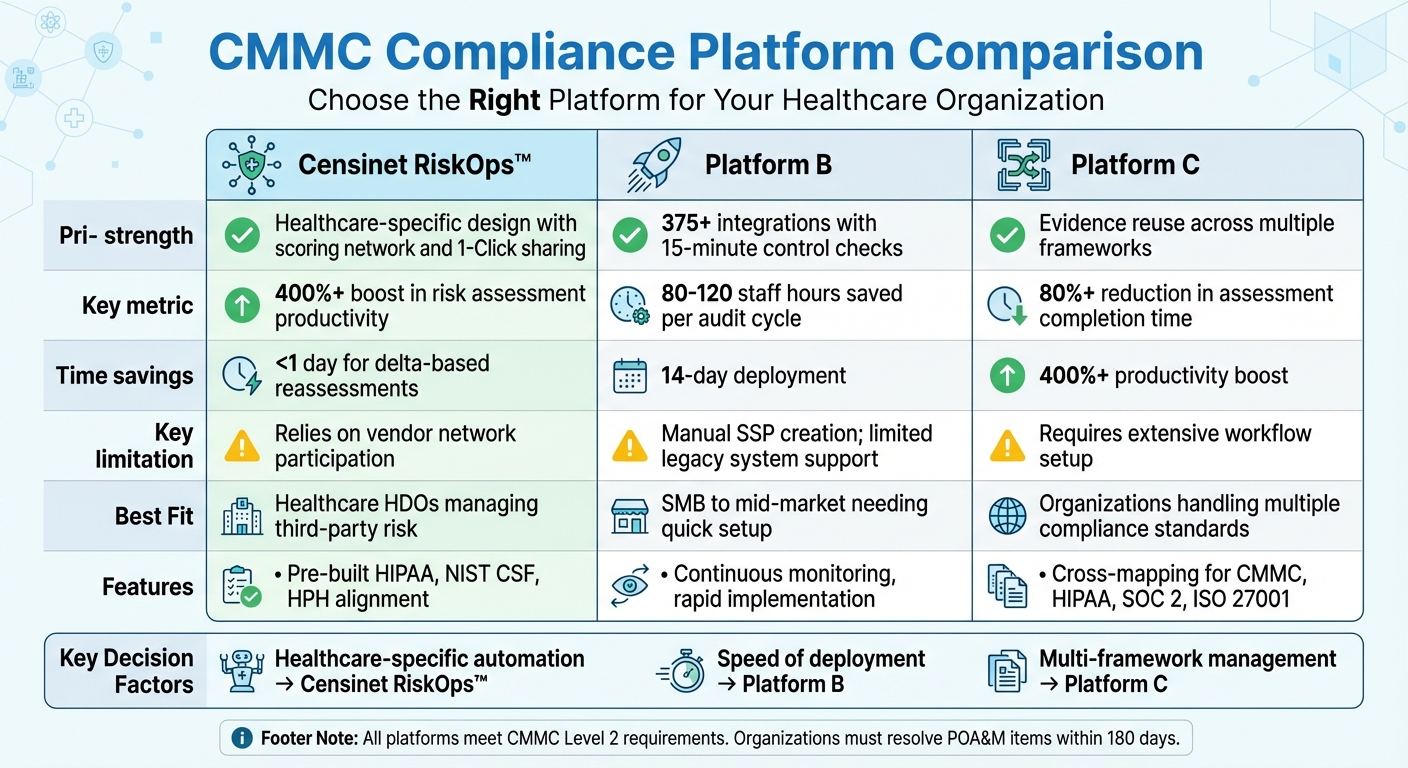
CMMC Compliance Platform Comparison for Healthcare Organizations
The comparison below highlights the key strengths and limitations of each platform, helping you align their capabilities with your organization's needs. Whether you're prioritizing healthcare-specific features, quick deployment, or managing multiple compliance frameworks, understanding these differences is crucial for making the right choice.
Censinet RiskOps™ is tailored specifically for healthcare organizations, offering pre-built alignment with HIPAA, NIST CSF, and HPH Cybersecurity Performance Goals. Its vendor network allows 1-Click sharing, improving risk assessment productivity by over 400% [4]. Additionally, delta-based reassessments focus only on changes since the last review, cutting completion time to less than a day [1]. However, the platform's full potential relies heavily on vendor participation in the Censinet Risk Network, which means its value increases when suppliers actively engage in the ecosystem.
Platform B is ideal for small- to mid-sized organizations, thanks to its rapid deployment - setup can take as little as 14 days. It boasts over 375 pre-built integrations and continuous monitoring that checks controls every 15 minutes, saving teams 80 to 120 staff-hours per audit cycle [8]. On the downside, users must manually create the SSP narrative, and the platform has limited support for on-premise or legacy healthcare systems, requiring manual evidence uploads [8].
Platform C shines in managing multiple frameworks, such as CMMC, HIPAA, and SOC 2, by reusing evidence and cross-mapping to eliminate duplicate work [8]. Its AI-driven tools can reduce assessment completion times by over 80% [2]. However, it demands significant upfront effort for workflow configuration, as organizations need to tailor the platform to their specific compliance requirements.
Here’s a quick breakdown of the platforms:
| Platform | Primary Strength | Key Limitation | Best Fit |
|---|---|---|---|
| Censinet RiskOps™ | Designed for healthcare; vendor scoring network; 1-Click sharing | Relies on vendor network participation | Healthcare HDOs managing third-party risk |
| Platform B | 375+ integrations; 15-minute control checks; fast deployment | Manual SSP creation; limited legacy system support | SMB to mid-market needing quick setup |
| Platform C | Evidence reuse across frameworks; significant time savings | Requires extensive workflow setup | Organizations handling multiple compliance standards |
While all three platforms meet CMMC Level 2 requirements, they still require organizations to address architectural gaps and strengthen policies [9]. Healthcare providers must resolve all open items in their Plan of Action and Milestones (POA&M) within 180 days to maintain certification [8]. Your decision should hinge on whether your focus is on healthcare-specific automation, speed of deployment, or seamless multi-framework management.
Conclusion
Each platform brings distinct advantages tailored to specific healthcare compliance needs, making the choice heavily dependent on your organization's operational priorities.
Censinet RiskOps™ is a strong option for healthcare delivery organizations seeking tools specifically designed to align with HIPAA, NIST CSF, and HPH Cybersecurity Performance Goals. Its 1‑Click sharing feature and vendor network model can boost risk assessment productivity by over 400% [4]. As Matt Christensen, Sr. Director GRC at Intermountain Health, explains:
"Healthcare is the most complex industry…You can't just take a tool and apply it to healthcare if it wasn't built specifically for healthcare." [4]
For smaller to mid-sized organizations, Platform B offers quick deployment and extensive automation capabilities. With over 375 integrations, organizations using similar tools report saving between 80 and 120 staff hours per audit cycle [8].
On the other hand, Platform C is well-suited for organizations managing compliance across multiple frameworks like HIPAA, SOC 2, and ISO 27001. Its features, such as evidence reuse and cross-mapping, significantly reduce the time required for multi-framework compliance [2][4].
Regardless of the platform, organizations must address internal architectural gaps and resolve POA&M items within 180 days [8][9]. Start by defining your CUI scope, prioritize automation if your team includes fewer than three full-time compliance staff, and focus on closing critical controls like MFA and encryption early [8]. Whether your focus is healthcare-specific automation, quick implementation, or multi-framework management, align your choice with what best supports your compliance goals.
FAQs
What should we automate first for CMMC Level 2?
To make the CMMC Level 2 assessment process more efficient and precise, start by automating key tasks. Focus on automating risk assessments, gap analyses, and continuous monitoring. Look for tools that simplify evidence collection, monitor compliance status, and handle vendor risk management. Automation in these areas not only reduces manual effort but also ensures smoother implementation of controls. It’s especially helpful for managing third-party assessments and maintaining certification over time.
How do we define our CUI scope for CMMC?
To determine your CUI scope for CMMC, start by clearly defining the boundaries where Controlled Unclassified Information (CUI) is processed, stored, or transmitted. Pinpoint the platforms it interacts with, track how it enters your systems, and identify where it resides. Tools like the Unified Scoping Guide (USG) can be invaluable, offering structured guidance to map out your environment. Combine this with established best practices for evaluating system components to maintain both accuracy and compliance throughout the process.
What evidence do we need ready for a CMMC audit?
For a CMMC audit, having thorough documentation is critical. This includes risk assessments, policies, procedures, and proof of vendor compliance. Tools like Censinet RiskOps™ can simplify this process by keeping all required evidence well-organized and easily accessible.

