
AI in healthcare is underperforming - only 15% of its $200–$300 billion potential is being realized. The issue isn't technology; it's governance. While most hospitals have adopted electronic health records, only a third have a clear AI strategy. Without proper governance, promising AI pilots fail to scale, leaving efficiency gains and patient outcomes unfulfilled.
Key points covered in this article:
Scaling AI governance is essential for healthcare organizations to achieve efficiency, improve patient care, and ensure compliance.

AI Governance in Healthcare: Key Statistics and Impact Metrics
Healthcare Leaders Reveal the Foundations of Scalable AI
sbb-itb-535baee
Building AI Governance Frameworks for Pilot Projects
Pilots are where governance frameworks truly demonstrate their value. The success of a pilot often hinges on how well the problem is defined, who is responsible for it, and what "ready for production" means from the outset. Pilots should always be treated as stepping stones to production, not standalone experiments. The goal is to establish governance structures during the pilot phase that can eventually scale across the organization. This groundwork is essential for setting clear metrics and responsibilities.
Setting AI Governance Goals and Metrics
Before launching a pilot, define what success looks like and document current baselines - such as cycle times, error rates, and staff hours - to measure the pilot's impact and return on investment (ROI) [4]. For instance, if the goal is to test an AI tool aimed at reducing prior authorization denials, start by recording the current denial rate, average turnaround time, and administrative hours spent per case.
Set clear go/no-go key performance indicators (KPIs) and production benchmarks, including auditability, access controls, uptime, and latency. Aim to decide whether to scale, refine, or halt the pilot within 90 to 180 days [4].
"If the workflow moment isn't clear, the pilot is a research project, not a path to production."
–
Balance quantitative metrics like model accuracy and processing time with qualitative insights such as clinician trust and user feedback [4]. Monitor "human-in-the-loop" metrics, such as how often clinicians override AI recommendations, to determine whether the tool aids or complicates decision-making [4]. Start small - focus on one site, service line, or workflow step - to simplify implementation while still achieving measurable ROI [4].
Once success metrics are established, bring together a diverse team to oversee and uphold these standards.
Forming an AI Governance Committee
Create a cross-functional team before the pilot begins. This governance committee should include data scientists, IT and security experts, clinical or business subject matter experts, and product leaders [4]. Such a team ensures shared ownership across departments and addresses a range of operational and ethical considerations [4].
Appoint a senior executive (VP or C-suite level) as the AI lead. Organizations with C-level sponsorship see better results - 78% report achieving ROI on at least one generative AI initiative [3]. This leader should combine operational expertise with a forward-looking mindset. As Jonathan Wakim and Max Timm from Vizient explain, "The key is that someone wakes up every day thinking about how AI contributes to the organization's success" [3].
Additionally, assign a clinical or business owner to be responsible for the pilot's outcomes, adoption, and long-term sustainability [4]. Use a standardized scoring system to evaluate pilot proposals based on factors like strategic alignment, feasibility, risk, and total cost of ownership [3]. The committee should also determine how AI outputs are integrated into workflows - such as appearing in an EHR work queue - and design human override mechanisms to ensure clear accountability for final decisions [4].
Validating Governance Frameworks Through Pilot Testing
Pilots serve as stress tests for governance frameworks. Document everything, including data lineage, feature definitions, training setups, and limitations, to prepare for audits, safety reviews, and scaling [4].
Set decision checkpoints with well-defined criteria. If a pilot fails to meet its governance KPIs within the designated timeframe, avoid letting it linger in "pilot purgatory" [4]. Use the pilot to identify weaknesses in governance processes, such as inadequate data quality checks, unclear approval workflows, or missing compliance controls. Maintain a centralized registry to track all AI projects, their current status, investment levels, and performance metrics, and review this registry quarterly with leadership [3].
"The organizations that win with AI in healthcare won't be the ones with the most pilots. They'll be the ones with the most repeatable path from pilot to production."
– Bewaji Health
From day one, implement change management strategies like targeted training and feedback channels to build operational buy-in [4]. These pilot-phase strategies are essential for scaling AI governance across the entire health system.
Developing Scalable AI Governance Structures
Once pilot programs confirm the effectiveness of governance frameworks, the next step is scaling them. This involves standardizing policies, automating oversight, and replicating successful processes. Using the lessons learned during the pilot phase, organizations must establish governance systems that consistently apply across all AI initiatives. The task is particularly pressing in healthcare, where workforce challenges are significant. For instance, the industry is projected to face a shortage of up to 124,000 physicians by 2033 and will need to hire at least 200,000 nurses annually to meet demand[5]. These constraints make efficient and scalable governance not just important - but essential.
Creating Standard Policies for AI Use
The foundation of scalable governance lies in creating clear, standardized policies. Start by defining key performance indicators (KPIs) during the initial evaluation of any AI system. These KPIs support automated tracking and maintain a historical log of performance, ensuring transparency and accountability[5]. By establishing these policies early, organizations set the stage for more advanced oversight mechanisms.
Automating Governance Processes
Automation plays a pivotal role in transforming governance from a labor-intensive activity into a streamlined, scalable operation. As noted in npj Digital Medicine, "Centralizing and consolidating compliance reporting is crucial for streamlining oversight processes and ensuring that all relevant data and incident reports are gathered in one place"[5]. A centralized system allows for real-time monitoring, enabling organizations to quickly adapt to regulatory updates or respond to incidents[5].
Automated systems can track performance metrics, flag potential issues like model degradation, and eliminate redundant tasks, boosting efficiency across the board[5]. However, not all governance tasks can be automated. For example, activities like red-teaming to assess algorithmic fairness require the expertise of skilled professionals[5]. Combining automated monitoring with periodic manual audits ensures a comprehensive approach, addressing gaps that automation alone might overlook.
Applying Governance Across Multiple AI Projects
Scaling governance across several AI projects requires a unified framework. This framework should integrate compliance requirements while also assigning clear accountability and simplifying reporting processes[5]. By bringing together compliance, risk management, and operational workflows under one system, organizations can ensure consistency and efficiency. In healthcare, where operational demands are high, such a centralized framework is crucial for managing AI initiatives effectively and responsibly.
Using Censinet RiskOps™ for Enterprise AI Risk Management
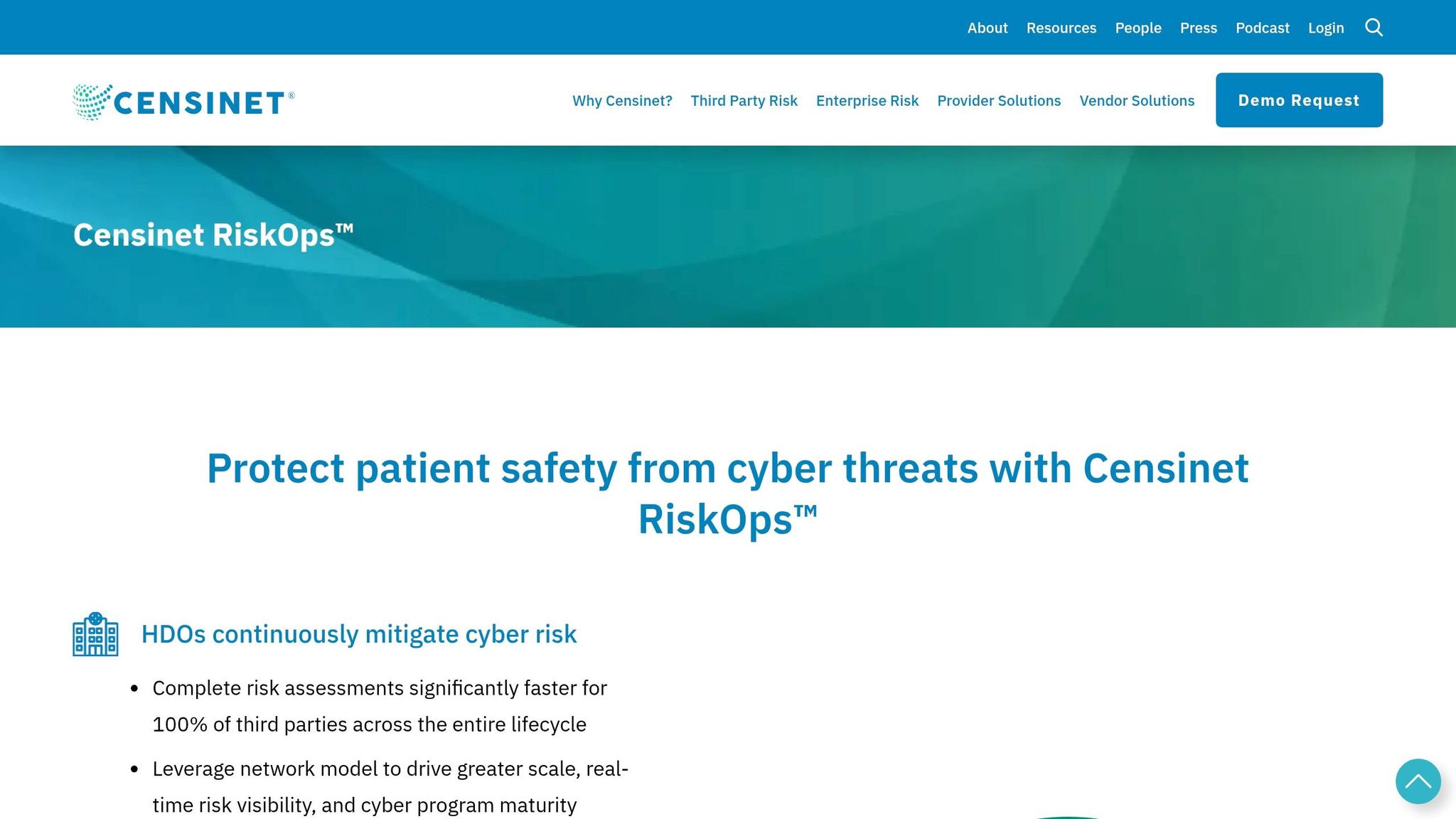
Platforms like Censinet RiskOps™ take AI risk management to the next level by combining standardized policies with automation, making the process more efficient for enterprises.
Managing AI Risk from a Central Platform
Censinet RiskOps™ simplifies AI risk management by centralizing compliance tracking and governance workflows. Through API integrations with tools like EHR systems, model repositories, and vendor platforms, it consolidates risk data into one place. This allows organizations to pinpoint high-risk AI models - like those in radiology pilots - and apply mitigations across the board. The result? Up to 50% less manual coordination.
The platform also tackles the "Inventory Visibility Crisis" by automatically detecting AI capabilities, including "shadow AI" that might otherwise slip through the cracks. Instead of juggling spreadsheets and scattered tools, users get a single dashboard to oversee risks for all AI projects, from early pilots to full-scale production. Healthcare organizations using this system have seen a 70% drop in the time spent on risk assessments and a 90% improvement in compliance audit success rates.
Accelerating Risk Assessments with Censinet AI
Censinet AI speeds up risk assessments by automating tedious tasks. Using machine learning, it evaluates model documentation, data sources, and performance metrics, completing assessments in minutes instead of days. It also validates evidence against regulatory standards like FDA AI/ML guidelines and HIPAA requirements, ensuring that submissions such as bias audits and validation datasets meet healthcare-specific benchmarks.
For example, a major U.S. health system managed 20 diagnostic AI pilots and scaled up to 150 production models with Censinet RiskOps™. By centralizing assessments, they reduced risk exposure by 40%, maintained HIPAA compliance, and cut oversight time by 60% through automated reporting. The platform’s evidence validation boasts 95% accuracy, catching issues like data drift in patient triage models before they become problems.
"Censinet RiskOps allowed 3 FTEs to go back to their real jobs! Now we do a lot more risk assessments with only 2 FTEs required." - Terry Grogan, CISO, Tower Health
Maintaining Oversight and Accountability
Real-time monitoring is another key feature, tracking metrics like model drift and performance degradation through integrated sensors and alerts. Continuous monitoring dashboards let governance committees act quickly, while historical data ensures thorough audit trails. One deployment successfully scaled from 50 AI pilots to over 200 deployments without a single compliance issue.
Collaboration is baked into the platform with role-based access, automated approval workflows, and detailed audit logs. Clinicians, IT teams, and compliance officers can comment on risks, assign tasks, and approve findings digitally. This "air traffic control" approach ensures tasks are routed to the right people at the right time. Organizations have reported a threefold increase in project capacity, aided by built-in templates that standardize accountability without requiring extensive training. These features provide a strong foundation for ongoing compliance and scalable governance across the enterprise.
Ensuring Compliance and Continuous Oversight
Deploying AI in healthcare isn't the finish line - it's just the beginning of a long journey of governance and monitoring. As Dr. Casmir Otubo aptly states, "Deployment is not the end of the governance story. In a functioning system, it is closer to the beginning." [6] Once AI systems are live, healthcare organizations must move beyond one-time validations to adopt ongoing accountability, ensuring that model performance remains reliable over time.
Meeting Regulatory Requirements for AI Deployment
Before deployment, healthcare AI tools must comply with regulations like HIPAA privacy rules and FDA AI/ML guidelines. But compliance doesn't stop there; these standards evolve. To keep up, organizations can embed "governance as code" into workflows. This approach automates compliance checks by enforcing rules and assigning approvers based on the level of risk. For example:
For high-risk deployments, a 90-day sunset notice period is often required to ensure a safe transition when retiring a model [2].
Monitoring and Validating AI Systems
AI performance isn't static - it can degrade over time. Without proper monitoring, these declines might go unnoticed. For instance, one study found that a mortality prediction model's AUROC dropped by 0.29 after a system-wide documentation update. Even when ranking abilities stay consistent, probability estimates can drift, which can significantly affect clinical decisions [6].
To maintain oversight, organizations can adopt a five-step process:
Rather than focusing solely on overall accuracy, it's crucial to track metrics by context - such as patient demographics or equipment types. Automated drift detection systems, which analyze at least 1,000 recent predictions, can flag significant drops, like a 5% decline in accuracy [2].
Creating Feedback Loops for Governance Improvement
Real-time monitoring paired with structured feedback is key to refining governance practices. Clinicians should have clear channels to report unexpected AI behavior or recurring issues. These inputs provide valuable insights for governance committees. Automated systems can also track metrics like latency, error rates, and success rates, triggering alerts when error rates exceed 5%. When severe issues arise, automated circuit breakers can deactivate models to prevent harm and provide immediate feedback.
Regular evaluations of bias, fairness, and robustness - conducted every 30 days - are essential. Linking incident reports to model metadata ensures that lessons from past failures shape future decisions. As Pranav Masariya puts it, "Governance in healthcare AI isn't a checkbox or a separate team that reviews things occasionally. It's a continuous practice embedded in code, enforced by systems, and overseen by multidisciplinary committees." [2]
Addressing Barriers to Scaling AI Governance
Breaking through the challenges that prevent successful AI pilot projects from scaling across an organization is essential for effective AI governance. However, rising hospital costs and a lack of readiness in managing AI risks are significant hurdles. In fact, only 23% of organizations feel well-prepared to handle AI risk and governance [7].
Managing Resource Constraints
The challenges go beyond budget limitations. Fragmented data systems, workforce shortages, and outdated technologies often stand in the way. Siloed data, inconsistent clinical workflows, and reliance on legacy systems make it difficult for many organizations to scale past the pilot phase [1][7]. Only 33% of healthcare organizations report having a solid AI strategy in place [3].
One solution is to appoint a senior executive - like a Chief AI Officer or Chief Digital Officer - who can take ownership of AI strategy and governance at the board level. Pair this leadership with a structured intake process that uses standardized scoring rubrics to evaluate and prioritize AI projects. This approach ensures that AI initiatives move from being experimental side projects to becoming formal, budgeted programs. As Kiran Mysore, Chief Data and Analytics Officer at Sutter Health, explains:
"Organizations with mature governance - AI governance - are about 2.3 times more likely to scale AI and deploy successful AI initiatives."
Addressing data challenges doesn’t always require massive infrastructure changes. Federated AI models, for instance, can analyze distributed datasets without moving or exposing sensitive patient information [7]. Successful organizations often dedicate 20% of their digital budgets specifically to AI [3].
Another key step is implementing role-specific training to help staff critically evaluate AI outputs instead of blindly trusting them. For example, automating grant application reviews with AI could save over 6 million hours - or about 40% of total time spent - but only if teams are properly trained to deploy and monitor these tools effectively [7].
Once resource and data challenges are tackled, the next step is to address ethical and operational risks.
Reducing Ethical and Operational Risks
Scaling AI isn’t just about expanding its use; it’s about ensuring its reliability and fairness. This requires shifting from one-time validations to continuous monitoring for bias, fairness, and operational performance. Organizations need to move beyond experimental environments and adopt production-grade infrastructure with features like dev/test/prod separation, version control, and automated CI/CD pipelines [4].
AI systems should integrate directly into existing workflows - such as electronic health records or administrative tools - rather than operating as separate, parallel processes [4]. Defining production standards early is also critical. These standards should cover uptime, latency, auditability, and security requirements from the pilot phase onward [4].
To guard against ethical risks, organizations can implement automated data validation checks to catch issues like missing data or schema changes that could degrade model performance. Human oversight remains crucial, especially for clinical or revenue-impacting decisions. Clear accountability mechanisms should ensure that humans make the final call in sensitive scenarios [4]. Additionally, most healthcare AI pilots should reach a clear go/no-go decision within 90 to 180 days, avoiding resource-draining projects that linger without delivering results [4].
With ethical and operational risks under control, the focus must shift to aligning AI governance with the organization’s broader goals.
Aligning AI Governance with Business Objectives
AI projects often fail to gain traction without clear alignment to organizational goals. As noted earlier, well-defined AI governance frameworks can directly improve operational outcomes and patient care.
"Without clear guardrails, AI doesn't get traction."
Governance frameworks should require a thorough assessment of the clinical or business problem before pursuing an AI solution. This ensures that AI is applied only where it provides distinct advantages over traditional methods [8].
Setting success metrics and KPIs during the initial evaluation phase is essential. These metrics should measure both technical performance (like accuracy and bias) and business outcomes (such as operational efficiency and patient satisfaction) [8][9]. A centralized registry of all AI projects, detailing their status, investment, and impact, can provide leadership with the oversight needed to keep initiatives on track. Reviewing this registry quarterly helps ensure strategic alignment [3].
Finally, organizations should expand their ROI metrics beyond cost savings. Metrics should include both input factors, like time saved, and output results, such as reduced staff burnout and improved patient experiences [1]. It’s worth noting that only 25% of AI initiatives have delivered the expected ROI to date [3], highlighting the importance of aligning AI governance with overarching business objectives.
Conclusion: Scaling AI Governance in Healthcare
Core Strategies for Scaling AI Governance
Taking AI from pilot projects to full-scale implementation demands a mix of technical know-how and organizational readiness. The key is to view governance as a strategic advantage rather than a bureaucratic hurdle. This starts with setting up clear frameworks during the pilot phase, creating scalable systems that work across multiple projects, and using centralized platforms to maintain control as AI efforts grow.
To achieve this, organizations should appoint executive sponsors, establish structured intake processes with scoring rubrics, and maintain a centralized registry to monitor AI projects. It's crucial to tie AI initiatives to measurable outcomes and quickly phase out projects that fail to deliver. These governance strategies ensure AI can effectively improve both patient care and operational workflows.
How Governance Supports AI-Driven Healthcare
Strong governance doesn't slow innovation - it accelerates it by providing clear guidelines that allow teams to act with confidence. When AI efforts align with key organizational goals like workforce support, cost management, and quality improvement, they are more likely to gain executive support and scale successfully. For instance, 78% of executives in organizations with C-level sponsorship report achieving ROI on at least one generative AI use case [3].
This cohesive approach ensures AI governance stays in sync with broader healthcare objectives, making sure every AI tool contributes meaningfully to better patient outcomes. Effective governance frameworks keep AI systems compliant, ethical, and secure throughout their lifecycle. They include ongoing checks for bias and performance, human oversight for critical decisions, and feedback loops to refine systems over time. By making AI a top priority at the board level and regularly updating strategies, healthcare organizations can turn AI from a scattered collection of tools into a powerful force for improving quality and efficiency system-wide.
FAQs
What makes an AI pilot 'ready for production' in a hospital?
When an AI pilot is deemed "ready for production", it means it has successfully integrated into actual clinical workflows, complies with regulatory standards such as HIPAA, and demonstrates measurable results that align with the organization’s objectives.
Key factors for readiness include:
Additionally, success shouldn't just be about accuracy. Metrics should also reflect the AI's operational impact, such as improvements in efficiency or tangible benefits to patient outcomes.
Who should be on an AI governance committee, and who owns outcomes?
An AI governance committee in healthcare works best when it brings together a variety of voices. This means including clinicians, IT professionals, compliance officers, legal experts, and patient advocates. Each of these stakeholders plays a key role in overseeing AI projects, addressing potential risks, and ensuring adherence to regulations like HIPAA and FDA guidelines.
When it comes to accountability, the responsibility for AI outcomes typically rests with senior leadership. For example, a Chief AI Officer (CAIO) often takes the lead in aligning AI strategies with the organization’s broader goals. They also ensure that AI systems are deployed securely, ethically, and in a way that supports the organization's mission.
How do we monitor deployed AI for drift, bias, and compliance over time?
Monitoring AI systems in action isn’t a one-and-done task - it demands ongoing attention and well-organized processes. For healthcare organizations, this means conducting regular performance evaluations, audits, and surveillance to catch issues like drift or bias before they escalate.
To stay ahead, it’s essential to have incident response plans ready to go and to keep a close watch on key performance indicators (KPIs). This not only helps ensure the system is running as intended but also keeps it aligned with compliance and ethical guidelines.
By weaving these practices into the AI lifecycle, organizations can better manage risks and maintain adherence to both regulatory requirements and ethical standards, creating a safer and more reliable environment over time.
Related Blog Posts
- AI Governance Talent Gap: How Companies Are Building Specialized Teams for 2025 Compliance
- The AI Governance Revolution: Moving Beyond Compliance to True Risk Control
- The Regulated Future: How AI Governance Will Shape Business Strategy
- Future-Ready Organizations: Aligning People, Process, and AI Technology
