
The Internet of Medical Things (IoMT) is transforming healthcare by connecting devices like ECG monitors, glucose meters, and infusion pumps to hospital networks. While these devices improve patient care and enable real-time data sharing, they also introduce security risks. With 75% of IoMT devices having known vulnerabilities, healthcare organizations face threats like ransomware attacks and data breaches, which can delay critical care and compromise patient safety.
To address these challenges, this checklist guides healthcare providers in securing IoMT devices across four key phases:
- Design and Development: Integrate security into device architecture with features like unique credentials, hardware-based security, and updatable software.
- Risk Management and Vendor Assessment: Use qualitative and quantitative methods to assess risks, evaluate vendor security practices, and ensure compliance with certifications like HIPAA.
- Deployment and Device Management: Maintain an updated inventory, classify devices by risk, enforce access controls, and use network segmentation to limit breaches.
- Monitoring and Incident Response: Implement real-time threat monitoring, prepare incident response plans, and conduct regular risk assessments to address emerging vulnerabilities.
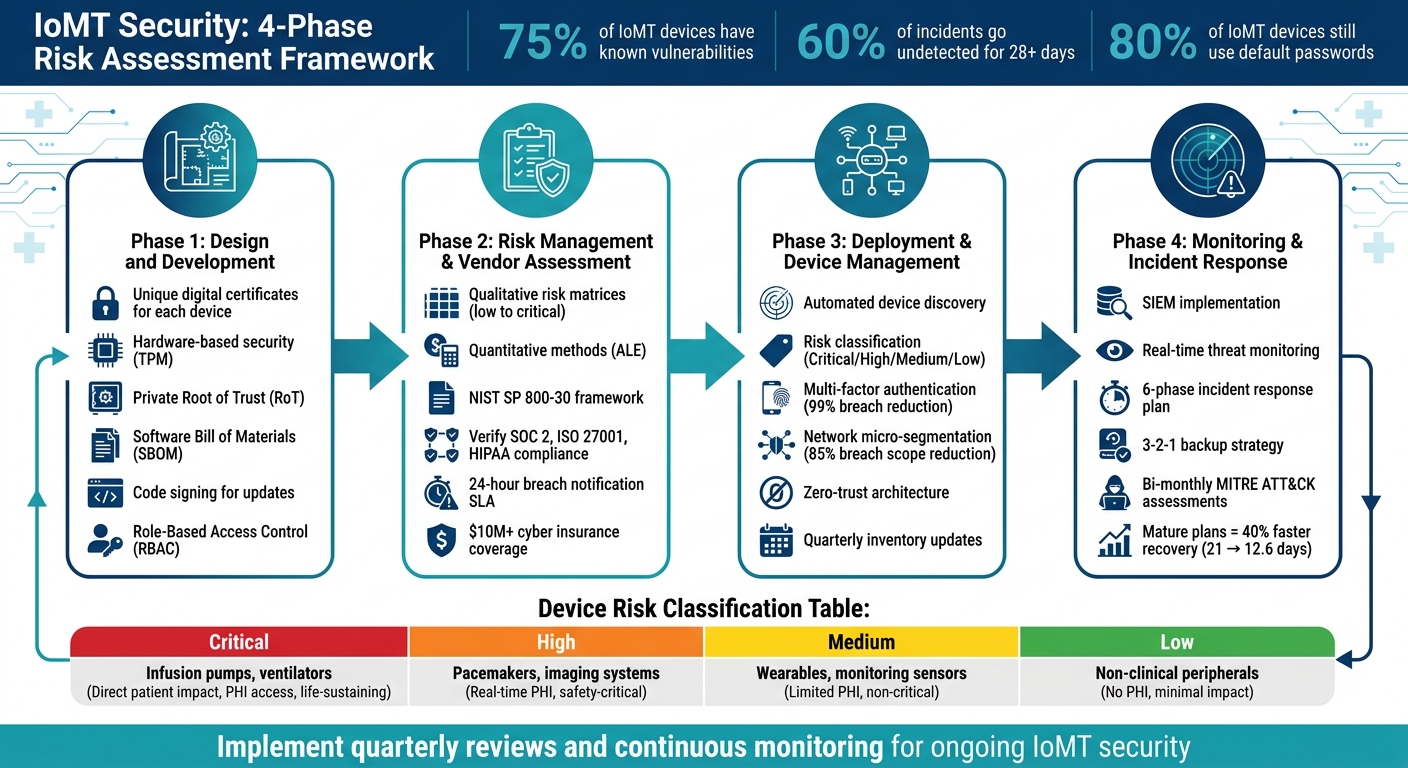
4-Phase IoMT Security Risk Assessment Framework for Healthcare Organizations
Phase 1: Design and Development
Building Secure Device Architecture
When designing IoMT devices, security needs to be part of the blueprint from the very beginning. Each device should carry a unique digital certificate or credential to enable strong authentication and verify the integrity of messages. This ensures that only authorized devices can connect to hospital networks and guarantees that data comes from trusted sources.
A crucial layer of protection comes from hardware-based security. Storing private keys in hardware, such as TPM (Trusted Platform Module) technology or secure crypto-processors, significantly reduces the risk of compromise. For devices with limited resources, lightweight encryption algorithms are essential to balance security and battery efficiency.
"Security in the healthcare industry differs from security in other industries – it's personal. People's lives are on the line." - Keyfactor [7]
To further strengthen security, organizations should implement a Private Root of Trust (RoT). This gives them full control over identity validation, reducing the risks tied to third-party certificate authorities. Additionally, devices must be designed to handle updatable and revocable credentials, which is critical as cryptographic algorithms evolve or weaken over time. This is particularly important since IoMT devices often remain in use for many years.
The FDA’s updated Premarket Guidance now mandates manufacturers to document cybersecurity measures during the design phase. This includes creating a Software Bill of Materials (SBOM) and conducting threat modeling [8]. Such documentation not only ensures readiness for audits but also provides a clear inventory of device components, making it easier to manage vulnerabilities.
Once a secure architecture is in place, the next priority is enabling timely and secure updates throughout the device's lifespan.
Software Updates and Patch Management
IoMT devices must support remote, secure firmware updates to address vulnerabilities that may arise post-deployment. Incorporating code signing for all updates ensures that only verified authors can make changes, safeguarding the device’s integrity.
Another key measure is enforcing strict input validation to prevent exploits like SQL injection, especially in devices that interact with hospital databases. Additionally, integrating Role-Based Access Control (RBAC) into the device’s management interface ensures that only authorized personnel can make configuration changes or initiate updates. Without these measures, devices risk becoming unpatchable liabilities, leaving healthcare organizations exposed to long-term security threats.
Phase 2: Risk Management and Vendor Assessment
Risk Assessment Methods
After establishing a secure design, conducting a thorough risk assessment is the next critical step to address threats in the Internet of Medical Things (IoMT). There are two main approaches to this:
- Qualitative assessments: These rely on risk matrices to score threats based on their likelihood and potential impact. Scores can range from low (e.g., minor operational delays) to critical (e.g., patient harm or regulatory fines exceeding $50,000 per HIPAA violation). This method is particularly useful for quick evaluations, like vendor triage or initial device assessments.
- Quantitative methods: Techniques like Annualized Loss Expectancy (ALE) provide a more structured approach by estimating potential losses. This is done by factoring in asset value, exposure level, and the frequency of threats.
- Hybrid approaches: Frameworks such as NIST SP 800-30 combine qualitative and quantitative methods. They offer a tailored process for healthcare, including steps like identifying threats, analyzing vulnerabilities, and evaluating impacts - especially in scenarios involving patient data exposure [1][6].
When assessing risks, focus on devices critical to patient care, such as infusion pumps, and consider the impact on confidentiality, integrity, and availability of protected health information (PHI). Facilities with a high density of devices face amplified security risks. For high-impact risks, immediate actions are necessary. Measures like multi-factor authentication (which can reduce breach likelihood by up to 99%), credential rotation, and implementing zero-trust architecture for legacy devices that can't be patched are essential [3][4].
To ensure ongoing risk management, organizations should maintain updated risk registers. These should include clear ownership - often the responsibility of the Chief Information Security Officer (CISO) - to enable continuous monitoring and reassessment.
Evaluating Vendor Security
Once device-related risks are quantified, the next step is to evaluate vendor security practices to minimize supply chain vulnerabilities. Start by verifying vendors' security certifications and compliance standards. Look for SOC 2 Type II reports, ISO 27001 certification, and proof of HIPAA compliance. A cautionary example: the 2021 Scripps Health ransomware attack compromised 147,000 patients' PHI due to poor vendor patching, highlighting how vendor security lapses can directly impact your organization [4][5].
To streamline this process, standardized questionnaires like the Manufacturer Disclosure Statement for Medical Device Security (MDS2) are invaluable. Tools such as Censinet RiskOps™ further simplify vendor assessments by automating data collection and providing real-time benchmarks. This eliminates manual errors and ensures consistency.
Key evaluation criteria include:
- Breach notification SLAs requiring alerts within 24 hours.
- Incident response plans with containment achieved within 72 hours.
- Quarterly tabletop exercises to test preparedness.
- Documentation of a Software Bill of Materials (SBOM) to address supply chain risks.
- Cyber insurance coverage of at least $10 million.
For high-risk vendors, on-site audits are a must. Medium-risk vendors should submit quarterly attestations and undergo continuous monitoring to ensure compliance [1][5].
Contracts should include SLAs with clear metrics like 99.9% uptime and a 24-hour window for incident reporting, aligning with NIST 800-53 controls. To enhance efficiency, maintain a centralized catalog of previously assessed devices. This allows for quicker evaluations in the future. Assigning internal experts, such as BioMed technicians, to oversee remediation tasks through automated Corrective Action Plans (CAPs) can also help streamline the process [2][6].
Phase 3: Deployment and Device Management
Device Inventory and Classification
After selecting vendors, the next hurdle is understanding exactly what devices are connected to your network. Surprisingly, 75% of healthcare IT leaders report seeing less than half of their IoMT devices, leaving a significant portion unmanaged. This gap is risky - 30–50% of these devices often go unmonitored, creating easy targets for attackers.
To address this, start with automated discovery tools that use passive network scanning to locate connected devices without interrupting operations. Document critical details such as manufacturer, model, firmware version, location, and function. Make it a habit to update this inventory quarterly or after any network changes. Tools like agentless CMDB-integrated platforms (e.g., ServiceNow) are particularly useful for maintaining real-time accuracy in large, dynamic environments.
Next, classify devices by risk. Not all devices pose the same level of threat, so assess their risk based on factors like access to protected health information (PHI), impact on patient safety, internet connectivity, and vulnerability history. For example, infusion pumps and ventilators - critical for life-sustaining functions and handling PHI - should be categorized as critical and require stricter controls. Devices like pacemakers and imaging systems, which deal with real-time PHI and safety-critical tasks, fall under high risk. Wearables and monitoring sensors might be considered medium risk, while non-clinical peripherals, such as basic thermometers, are generally low risk.
| Risk Level | Device Examples | Key Criteria |
|---|---|---|
| Critical | Infusion pumps, ventilators | Direct patient impact, PHI access, life-sustaining |
| High | Pacemakers, imaging systems | Real-time PHI, safety-critical functions |
| Medium | Wearables, monitoring sensors | Limited PHI, non-critical monitoring |
| Low | Non-clinical peripherals | No PHI, minimal patient impact |
A real-world example highlights the importance of this step: In 2023, Universal Health Services (UHS) experienced a Ryuk ransomware attack that affected over 250 facilities. The root cause? Poor IoMT inventory and flat network design. After implementing robust device classification and segmentation, UHS not only reduced recovery time by 40% during security tests but also prevented lateral malware spread in follow-up drills. This shows how proper inventory and classification can significantly reduce risks.
With a detailed inventory and risk-based classification in place, the next priority is securing device access.
Access Control and Authentication
A well-maintained inventory enables precise access control measures across the network. One of the biggest vulnerabilities is default credentials. According to a 2024 Ponemon Institute study, 80% of IoMT devices still use weak or default passwords. This was a key factor in the 2017 WannaCry attack, which spread across UK NHS hospitals through devices left on factory settings.
To mitigate this, implement role-based access control (RBAC) with a least-privilege approach via centralized identity providers like Active Directory. For example, clinicians might only need view-only access, while administrators require full configuration rights. Strengthen security further by enforcing multi-factor authentication (MFA) - using biometrics or hardware tokens - for all device logins. A 2023 HIMSS survey found that MFA can reduce unauthorized access by 99% in healthcare settings. Additionally, enforce password policies that require 12-character complexity, regular rotation every 90 days, and account lockouts after five failed login attempts.
Legacy devices without built-in authentication features present another challenge. Use network access control (NAC) proxies or VPNs requiring MFA to secure access to these devices. Out-of-band authentication gateways can also add an extra layer of protection for devices that can’t be patched. Adopting a zero-trust approach, as recommended by HHS guidelines, ensures even older devices meet modern security standards without costly replacements.
Once access controls are in place, network segmentation becomes the next line of defense.
Network Segmentation
Flat networks are a major risk because a single breach can expose all connected devices. By contrast, network segmentation can reduce the scope of a breach by up to 85%, compared to flat architectures.
Use micro-segmentation through VLANs or software-defined networking (SDN) to isolate different device types. For instance, imaging devices, EHR systems, and administrative equipment should each have their own VLAN. Further strengthen security by enforcing east–west traffic rules with next-generation firewalls, which monitor traffic not just at the network perimeter but also between internal segments. This approach aligns with FDA recommendations for IoMT deployments.
Zero-trust architecture builds on segmentation by verifying every connection, regardless of its origin. For example, the Mayo Clinic implemented NSX micro-segmentation, reducing lateral movement risks by 80%, according to their internal security reports. For highly sensitive devices like ventilators or medication dispensers, consider air-gapped networks. These completely isolate critical systems from internet access, offering maximum protection.
During the 2024 UHS breach response, effective segmentation proved invaluable. Malware was contained to non-clinical devices, preventing it from reaching patient care systems. Tools like Censinet RiskOps™ enhance these efforts by automating segmentation compliance checks and providing real-time access audits. This helps healthcare organizations manage PHI risks across their IoMT infrastructure with minimal manual effort.
sbb-itb-535baee
Identifying and Mitigating Security Risks Targeting Critical IoMT Infrastructure
Phase 4: Monitoring and Incident Response
After tackling design, deployment, and risk management, the next step is ensuring IoMT security stays strong throughout the device lifecycle. This means keeping a close eye on potential threats and being ready to act quickly when issues arise.
Real-Time Threat Monitoring
Once IoMT devices are up and running, continuous monitoring becomes a must. In 2023, 75% of healthcare cybersecurity incidents involved IoMT devices, and 60% of these incidents went undetected for over 28 days, primarily because of weak monitoring systems. The risks are high - ranging from exposing sensitive patient health information to enabling ransomware attacks.
To keep threats in check, a Security Information and Event Management (SIEM) system is crucial. SIEM collects and analyzes logs from IoMT devices, networks, and security tools, allowing you to set up custom alerts for unusual activity. For instance, an alert could be triggered if network traffic spikes by 20% or if there are repeated failed login attempts in a short window. Key metrics like the mean time to detect threats and how quickly alerts are escalated can help measure the effectiveness of your monitoring.
Since many IoMT devices don’t have built-in monitoring, network-based monitoring is a practical solution. Using sensors to analyze traffic patterns, you can avoid installing agents directly on devices. Tools like SIEM, intrusion detection systems (IDS), and behavioral analytics help establish normal activity baselines and flag anomalies. For example, if an infusion pump suddenly starts communicating with an external IP address or a ventilator tries accessing unrelated systems, these should immediately raise red flags.
The Change Healthcare breach in September 2024 is a cautionary tale. BlackCat ransomware exploited gaps in monitoring through unguarded IoMT gateways, compromising one-third of U.S. claims data. Recovery took three months, but after the breach, Change Healthcare adopted AI-powered endpoint detection and response (EDR), cutting breach response time from 72 hours to just 18 hours during 2025 simulations led by CISO Brian Murphy.
To strike a balance between thorough monitoring and uninterrupted clinical operations, fine-tune systems to minimize false positives. Use tiered alert systems - critical alerts should demand immediate attention, while less urgent ones can be logged for regular reviews. These strategies lay the groundwork for a fast and organized incident response.
Incident Response and Recovery
When monitoring detects a threat, a well-prepared and coordinated response can make all the difference. According to a 2024 HIMSS report, organizations with mature incident response plans cut IoMT breach recovery time by 40%, reducing the average from 21 days to about 12.6 days. The key? A structured framework with clear roles and escalation paths.
An effective incident response plan includes six phases: preparation, detection and analysis, containment, eradication, recovery, and post-incident review. Start by forming a response team with members from IT security, clinical engineering, risk management, and legal departments. Define severity levels (e.g., 1 to 4) based on factors like patient safety and data exposure. Prepare communication templates and contact lists for notifying the FDA, HHS, and affected patients, as required by breach notification laws.
When an incident occurs, log it immediately, isolate affected devices, secure forensic evidence, and evaluate patient safety. Containment strategies should focus on isolating compromised devices without disrupting care - for instance, switching patients to backup equipment or manual protocols while addressing the issue.
Backup and recovery plans are critical. Use a 3-2-1 backup strategy: maintain three copies of data, store two locally but on different mediums, and keep one offsite. For IoMT, back up firmware, configuration files, and calibration data regularly. Define recovery time objectives (RTO) and recovery point objectives (RPO) for each device type. For example, a critical patient monitoring device might need an RTO of 15 minutes and an RPO of 5 minutes, meaning it must be restored within 15 minutes with no more than 5 minutes of data loss. Test these recovery procedures quarterly to ensure readiness.
The 2023 UHS ransomware attack is another example of the cost of delayed detection. A 28-day dwell time led to $67 million in losses. Afterward, UHS implemented SIEM with IoMT segmentation, reducing future detection times to under four hours.
Responding to New Threats
The IoMT threat landscape changes constantly, with new vulnerabilities emerging all the time. Annual risk assessments are essential, and additional reviews should happen when: new vulnerabilities are identified, significant changes occur in your IoMT setup, security incidents or near-misses happen, vendors issue advisories or announce end-of-life for devices, or regulatory requirements shift.
Stay proactive by monitoring vendor alerts and threat intelligence feeds. When a vulnerability is announced, cross-check your inventory to find affected devices, assess their risk based on criticality and exposure, and prioritize fixes.
Conduct bi-monthly risk assessments using frameworks like MITRE ATT&CK for IoMT. Focus on areas like firmware vulnerabilities, device criticality, network exposure, authentication, encryption, patch management, and vendor security practices. Keep detailed records of assessment dates, findings, remediation steps, and verification of fixes to show regulators and auditors that you’re staying diligent.
Platforms like Censinet RiskOps™ can simplify this process. They offer dashboards that track vendor alerts and compare your security posture to other healthcare organizations. These tools automate risk assessments and provide real-time visibility into your IoMT ecosystem, helping you respond faster to new threats.
Conclusion and Next Steps
Key Takeaways
Securing IoMT devices is an ongoing commitment, not a one-and-done effort. Our checklist outlines a step-by-step approach that spans the entire lifecycle of these devices, ensuring a strong defense against potential vulnerabilities. Here’s how the four phases come together:
- Phase 1: Focuses on security from the start, incorporating secure architecture and patch management during device design.
- Phase 2: Assesses risks and thoroughly evaluates vendors before devices are introduced into your network.
- Phase 3: Ensures proper deployment through inventory tracking, access controls, and network segmentation.
- Phase 4: Maintains vigilance with real-time monitoring and fast incident response.
Each phase addresses specific risks, working together to protect patient safety and secure sensitive data.
Putting the Checklist into Practice
To make this checklist actionable, a "Do-Confirm" approach works best. Complete tasks in each phase, then verify progress at key checkpoints. Assign clear responsibilities to relevant teams - IT security teams might handle deployment in Phase 3, while clinical engineering teams oversee design reviews in Phase 1. Schedule quarterly reviews to evaluate progress and adapt the checklist as new threats or regulations emerge.
Keep your process transparent by documenting every step in a shared platform, creating an audit trail. Train your teams within 30 days and update the checklist quarterly to stay ahead of evolving risks. This iterative method ensures your security efforts remain aligned with organizational goals while avoiding gaps in accountability. For advanced management, consider integrating tools like Censinet RiskOps™ to streamline these practices.
Managing IoMT Security with Censinet RiskOps™
Censinet RiskOps™ ties all the phases together, offering an automated and scalable way to manage IoMT security. By unifying IT, Risk, Cybersecurity, and BioMed departments - often siloed teams - the platform simplifies collaboration and eliminates inefficiencies.
Here’s what it brings to the table:
- Vendor Evaluations: Automatically processes MDS2 forms (2013 and 2019 versions), reducing manual errors.
- Risk Insights: Provides automated risk ratings and dashboards, giving both technical teams and executives a clear view of the IoMT environment.
- Corrective Action Plans: Assigns and tracks remediation tasks, ensuring accountability.
- Digital Risk Catalog™: Speeds up evaluations with access to an extensive library of assessed medical devices.
With features like centralized inventory management, evidence capture, and continuous monitoring, Censinet RiskOps™ transforms the checklist into an automated, streamlined security program. It enables your organization to stay proactive and scalable, ensuring IoMT security is both manageable and effective.
FAQs
Where do we start if we don’t know what IoMT devices we have?
To get started, use passive monitoring tools to map out and identify all the devices connected to your network. This step is crucial for spotting untracked or unknown devices that could introduce security vulnerabilities. As you go, make sure to document important details for each device, such as serial numbers, firmware versions, and risk scores. This detailed inventory will serve as a strong foundation for maintaining security and meeting compliance requirements over time.
How do we secure legacy IoMT devices that can’t be patched?
To protect legacy IoMT devices that can't be patched, healthcare organizations should explore a few key strategies. One option is to decommission or securely deactivate unsupported devices, ensuring all data is properly wiped during the process. Another practical approach is network segmentation, which isolates at-risk devices from critical systems, limiting potential damage.
Additionally, regular risk assessments and continuous monitoring can help identify and address vulnerabilities proactively. Partnering with vendors to plan security measures or explore device upgrade options is another crucial step in safeguarding sensitive systems and reducing risks.
What should we require in IoMT vendor contracts and SLAs?
Healthcare organizations must prioritize cybersecurity when working with IoMT vendors. Contracts and service-level agreements (SLAs) should include key protections like encryption, multi-factor authentication, and breach notifications within 24–72 hours. It's also essential to require vendors to comply with regulations such as HIPAA and FDA standards.
Additionally, agreements should include provisions for audit rights, vendor liability, regular security updates, and ongoing risk management. These steps are crucial for safeguarding patient data and ensuring vendors uphold essential security standards.
