
Healthcare facilities rely on IoT devices like patient monitors, infusion pumps, and imaging systems to deliver quality care. However, these devices often run outdated software, making them vulnerable to cyberattacks. Network segmentation is a key strategy to mitigate these risks by isolating devices into secure zones, limiting the spread of breaches, and safeguarding patient data.
Key Takeaways:
- Security Risks:
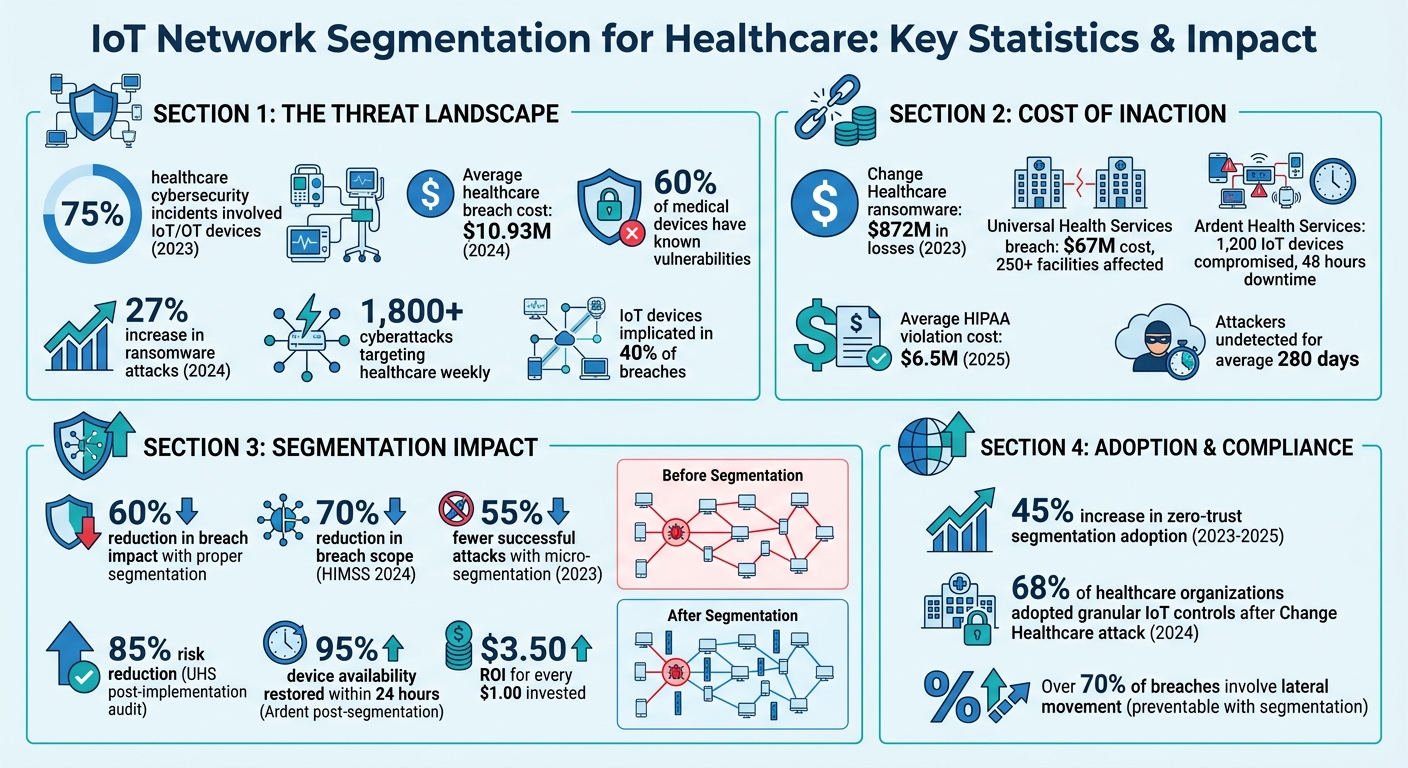
- 60% of medical devices have known vulnerabilities.
- Ransomware attacks on unsegmented networks caused millions in losses (e.g., $872M in 2023 at Change Healthcare).
- Benefits of Segmentation:
- Implementation Steps:
- Inventory all IoT devices with detailed data (e.g., firmware version, IP address).
- Categorize devices by function and risk level.
- Use tools like VLANs, NAC systems, and micro-segmentation platforms.
- Continuously monitor and update policies to address evolving threats.
- Cost of Inaction:
- Average healthcare breach cost: $10.93M in 2024.
- Segmented networks reduce breach impact by 60%.
By adopting network segmentation, healthcare organizations can protect both patient safety and sensitive data.
Healthcare IoT Network Segmentation Statistics and Impact
Healthcare Microsegmentation in 2025: RSAC Expert Discussion | Elisity
sbb-itb-535baee
Why Healthcare Organizations Need IoT Network Segmentation
Network segmentation has become a must-have strategy for healthcare organizations grappling with a sharp rise in cyber threats. In 2023, a staggering 75% of healthcare cybersecurity incidents involved IoT or operational technology devices, with the average breach costing an eye-watering $10.93 million. These numbers highlight the importance of isolating medical devices from broader hospital networks to safeguard patient data and maintain clinical operations.
The stakes are climbing higher every year. In 2024, ransomware attacks surged by 27%, often targeting unsegmented IoT networks. However, research from NIST reveals that proper segmentation can reduce the impact of breaches in 60% of cases, proving its worth as a key containment strategy.
"Healthcare is the most complex industry... You can't just take a tool and apply it to healthcare if it wasn't built specifically for healthcare."[2]
- Matt Christensen, Sr. Director of GRC at Intermountain Health
Isolating Devices to Limit Breach Impact
Flat networks allow attackers to move laterally, compromising everything from patient monitors to billing systems. Network segmentation, on the other hand, creates isolated zones, limiting the spread of threats and protecting critical infrastructure.
Take the October 2023 BlackCat ransomware attack on Ardent Health Services, for example. The attack affected 1,200 IoT devices across 30 hospitals, resulting in 48 hours of downtime for infusion pumps and major disruptions to patient care. The lack of segmentation enabled the attack to spread quickly. After adopting micro-segmentation under the leadership of CISO Mark Smith, Ardent restored 95% device availability within 24 hours and avoided projected losses of $45 million.
Another case is Universal Health Services, which faced a Ryuk ransomware attack in February 2024. The breach affected 250+ facilities, spreading to 30% of medical devices due to unsegmented networks. Operations were disrupted for three weeks, costing the organization $67 million. Post-incident, UHS implemented VLAN-based segmentation, reducing risks by 85% in later security audits.
Meeting HIPAA and Regulatory Requirements
Healthcare organizations must also navigate stringent regulatory requirements, like HIPAA, to protect patient data. HIPAA violations are no small matter, with the average breach costing U.S. organizations $6.5 million in 2025. Network segmentation plays a vital role in meeting these safeguards by enforcing access controls, protecting electronic protected health information (ePHI), and maintaining audit trails.
Beyond HIPAA, segmentation helps organizations comply with HITRUST and FDA security requirements for connected medical devices. The FDA has pushed for stronger security controls, driving a 45% increase in zero-trust segmentation adoption from 2023 to 2025.
"Benchmarking against industry standards helps us advocate for the right resources and ensures we are leading where it matters."[2]
- Brian Sterud, CIO at Faith Regional Health
Platforms like Censinet RiskOps™ enable healthcare organizations to benchmark IoT risks and align third-party vendor compliance with HIPAA segmentation policies. This proactive approach not only satisfies regulatory audits but also minimizes breach notification risks.
Maintaining Device Availability and Patient Safety
Ensuring device availability during cyber incidents is critical for patient safety. Segmentation keeps essential devices like ventilators, cardiac monitors, and infusion pumps operational even if other parts of the network are compromised. By isolating clinical workflows from administrative systems, emergency departments and ICUs can continue functioning during attacks.
The move toward micro-segmentation reflects this focus. After the 2024 Change Healthcare ransomware attack, 68% of healthcare delivery organizations adopted more granular IoT controls to protect patient-facing devices.
"The Risk Never Sleeps Podcast highlights the people protecting patient safety in today's fast-paced, increasingly digital healthcare environment."[2]
- Censinet
To enhance security, healthcare organizations should classify IoT devices by risk level. High-risk equipment, like infusion pumps, should be placed in isolated VLANs with strict traffic controls. Integrating segmentation with Security Information and Event Management (SIEM) systems allows for real-time monitoring, meeting HIPAA audit requirements. Additionally, conducting quarterly segmentation tests through simulated breaches ensures that critical devices remain accessible when needed, proving that these measures support - not hinder - patient care.
The next section will provide a step-by-step guide on implementing these strategies effectively.
How to Implement IoT Network Segmentation: A Step-by-Step Guide
Setting up network segmentation for healthcare IoT devices requires a methodical approach. It starts with identifying all the devices on your network and organizing them into secure groups based on their purpose and risk level.
Discovering and Inventorying All IoT Devices
The first step is knowing exactly what devices are connected to your network. Use tools like OT sensors, endpoint agents, and micro-agents to identify both managed and unmanaged devices across all network zones. These tools can merge duplicate entries by matching IP and MAC addresses. Aim to collect detailed information - over 30 data points per device - including manufacturer, hardware model, serial number, firmware version, operating system, IP addresses, MAC address, VLAN assignment, and communication protocols. This level of detail is critical, especially for devices like smart IV pumps that play a vital role in patient care.
"Gathering details about your devices helps your teams proactively investigate vulnerabilities that can compromise your most critical assets."
– Microsoft Defender for IoT [3]
During the initial setup, implement a "learning period" where all detected devices are treated as authorized. After this baseline is established, flag any new devices as unauthorized or rogue, paying close attention to transient devices that briefly appear on the network. Organize your inventory by sites and zones to align with Zero Trust principles and enhance clarity [3].
Once you have a complete inventory, the next step is to group devices by their function and associated risks.
Categorizing Devices by Function and Risk Level
After inventorying, categorize devices based on their clinical roles and security risks. Healthcare IoT devices generally fall into these categories:
- Wearable/Implantable: Includes devices like smartwatches and pacemakers. These prioritize data privacy and require lightweight encryption.
- On-site/Stationary: Covers equipment such as infusion pumps, ventilators, and MRI machines. These are critical to patient safety but often run on outdated firmware.
- Remote Monitoring: Examples include glucose meters and blood pressure monitors. Risks here involve data leakage and unauthorized remote access.
- Infrastructure: Includes systems like smart lighting, HVAC, and security cameras, which, if compromised, could allow lateral movement into clinical networks.
Risk classification should factor in whether a breach could affect patient safety or confidentiality. For example, legacy devices with outdated firmware should be isolated in highly restricted segments. In contrast, more modern devices with stronger authentication can be managed with less restrictive controls. Flagging critical assets as "important" helps prioritize them for risk analysis and threat modeling [5][3].
| Device Category | Examples | Primary Risk Factor |
|---|---|---|
| Wearable/Implantable | Smartwatches, pacemakers | Data privacy, lightweight encryption needs |
| On-site/Stationary | Infusion pumps, ventilators | Patient safety, legacy firmware vulnerabilities |
| Remote Monitoring | Glucose meters, blood pressure monitors | Data leakage, unauthorized remote access |
| Infrastructure | Smart lighting, HVAC, security cameras | Lateral movement into clinical networks |
Analyzing Device Communication and Clinical Workflows
Understanding how devices communicate within the clinical environment is essential for creating segmentation policies that support patient care without causing operational issues. Map out device interactions, protocols, and data flows. For example, an infusion pump might need to communicate with an electronic health record (EHR) system, pharmacy systems for medication verification, and nursing stations for dosage alerts. Documenting these workflows ensures segmentation rules don’t disrupt critical functions.
Using edge computing can help process data closer to its source, reducing exposure to sensitive information and minimizing network delays for critical operations [5]. Additionally, confirm that all devices comply with privacy laws like HIPAA before adding them to your inventory [4].
These insights provide the foundation for creating precise segmentation policies.
Creating and Enforcing Segmentation Policies
With a complete inventory and a clear understanding of device roles and communication patterns, you can develop segmentation policies based on Zero Trust principles. Define which communications, protocols, and access conditions are allowed. Tailoring these policies to device roles ensures compliance with clinical workflows while maintaining patient safety.
Automate processes like firmware updates, password rotations, and certificate management to enhance security [4]. Use centralized platforms to monitor device health and connectivity in real-time, ensuring security measures don’t interfere with clinical availability [4]. For example, Censinet RiskOps™ helps healthcare organizations align IoT risk assessments with HIPAA requirements, balancing regulatory compliance with operational needs.
Finally, test your segmentation policies through simulated breaches to ensure critical devices remain accessible during incidents. Regular testing helps identify and address new security gaps or workflow disruptions caused by network changes. The ultimate goal is to create resilient network segments that contain threats while keeping patient care systems fully operational.
Tools and Technologies for IoT Network Segmentation
Securing healthcare IoT networks requires specialized tools that can identify devices, evaluate risks, control access, and enforce isolation. These technologies are the backbone of a secure IoT ecosystem, safeguarding patient data while ensuring uninterrupted clinical operations. By building on established segmentation processes, these tools help enforce security policies effectively.
Device Visibility and Risk Management Platforms
Once device roles and communication patterns are defined, the next step is implementing tools that provide complete visibility into IoT devices and their associated risks. This visibility is crucial for creating effective segmentation strategies. Platforms that combine detailed inventory data with risk intelligence allow healthcare organizations to make informed decisions.
For instance, Censinet RiskOps™ offers a cloud-based risk exchange that provides access to cybersecurity data for over 50,000 vendors and products across the healthcare industry [2]. Using AI-powered risk intelligence, it automates risk assessments for medical devices and vendors, helping organizations balance rapid adoption with robust risk management.
"Censinet RiskOps allowed 3 FTEs to go back to their real jobs! Now we do a lot more risk assessments with only 2 FTEs required" [2].
- Terry Grogan, CISO at Tower Health
Network Access Control (NAC) Systems
After creating a detailed device inventory, Network Access Control (NAC) systems step in to enforce segmentation policies. These systems manage device authentication and regulate network access, ensuring only authorized devices connect to the network. Solutions like Cisco ISE and Aruba ClearPass act as gatekeepers, isolating compromised or unauthorized devices based on risk intelligence provided by visibility platforms.
NAC systems use identity-based access control to verify devices before granting access. For example, if a device is flagged as high-risk or running outdated firmware, the NAC system can automatically place it in a restricted VLAN with limited connectivity. When integrated with visibility platforms, NAC systems create a closed-loop security process. If a risk management platform detects a vulnerable infusion pump, it can signal the NAC system to restrict the device’s communication to its designated management server [7]. This automation ensures seamless alignment with segmentation policies.
Firewalls and Micro-Segmentation Solutions
While traditional firewalls control north-south traffic across broad network boundaries, they often lack the precision required for healthcare IoT environments. Micro-segmentation addresses this gap by applying fine-grained controls at the individual device level, focusing on east-west traffic between medical devices and clinical systems [6]. This approach isolates critical devices, preventing lateral movement by attackers - a factor in over 70% of breaches.
For example, policies can be configured so that infusion pumps communicate only with their management servers, while vital signs monitors connect exclusively to nurse stations. Considering the high cost of healthcare data breaches (averaging $10.93 million per incident in 2024), micro-segmentation not only mitigates risks but also offers financial benefits. For every $1.00 invested, organizations can expect a $3.50 return, provided clinical workflows are carefully simulated to avoid disruptions and ensure least privilege access is maintained [6].
Best Practices for IoT Network Segmentation in Healthcare
Balancing security with operational efficiency is essential for safeguarding patient care in healthcare environments. To implement effective network segmentation, healthcare organizations need strategies that protect medical devices without interrupting clinical workflows. By focusing on these principles and incorporating Zero Trust strategies, healthcare networks can ensure every device and connection is continuously verified.
Applying Zero Trust Security Principles
Traditional security models often assume that devices within the network are inherently trustworthy. Zero Trust flips this assumption, requiring constant verification for every device and connection. In healthcare settings, where attackers typically go undetected for an average of 280 days[6], this approach is particularly important. By enforcing least privilege access, each device is granted only the connectivity it needs for its specific clinical function. This limits lateral movement, a tactic used in over 70% of successful breaches[6].
Additionally, identity-based segmentation is replacing outdated, location-based controls. This shift ensures that security policies adapt to clinical workflows, even as environments evolve.
"Healthcare organizations must segment between clinical and non-clinical workflows to ensure patient care isn't disrupted during security incidents"[6]. - William Toll, Elisity
This principle sets the stage for implementing isolated network zones to enhance security.
Creating Isolated Zones with VLANs and Subnets
VLANs (Virtual Local Area Networks) and subnets are essential tools for creating isolated zones within a network. By dividing the network into subnetworks based on device functionality, healthcare organizations can limit the spread of malware while ensuring clinical workflows remain uninterrupted. Devices like ventilators and anesthesia machines, which often lack modern security features, should be placed in dedicated zones to prevent them from becoming weak points for attackers[8][7].
However, over-segmentation can create unnecessary complexity, burden IT teams, and disrupt workflows. To strike the right balance, simulation tools can analyze clinical traffic patterns before implementing strict policies, helping to identify potential disruptions to patient care[6].
Continuous Monitoring and Policy Updates
Network segmentation isn’t a one-and-done task. Healthcare networks are dynamic, with new devices being added and existing equipment changing over time. Continuous monitoring is critical for detecting suspicious activity in real time. Tools like Intrusion Detection Systems (IDS) and Intrusion Prevention Systems (IPS) help provide this ongoing oversight[9].
"Maintain continuous monitoring and enforce policies to address evolving threats"[9]. - Lucas Modrall, Firewalls.com
Advanced machine learning and behavioral analytics are also playing a growing role. These technologies can detect anomalies and adjust segmentation policies dynamically[7]. Integrating segmentation platforms with vulnerability management tools allows healthcare organizations to isolate devices with critical vulnerabilities until patches are applied[6]. With healthcare data breaches costing an average of $10.93 million per incident as of 2024[6], such proactive measures not only enhance patient safety but also deliver financial protection.
Comprehensive solutions like Censinet RiskOps™ simplify risk assessments and support adaptive segmentation strategies. These tools align security measures with evolving threats and regulatory requirements, ensuring healthcare environments remain secure and operationally efficient.
Conclusion: Securing Healthcare IoT Through Network Segmentation
Protecting IoT medical devices in healthcare settings hinges on implementing strong network segmentation. By isolating devices into distinct zones, healthcare organizations can limit lateral movement during breaches, reduce attack surfaces, and safeguard both patient data and clinical operations. For instance, organizations utilizing micro-segmentation reported 55% fewer successful attacks in 2023[11], while segmented networks reduced the scope of breaches by 70%, according to a HIMSS 2024 study[10].
Beyond security, segmentation plays a key role in regulatory compliance and patient safety. It helps demonstrate adherence to HIPAA standards for safeguarding Protected Health Information (PHI) and ensures critical devices remain operational through prioritized traffic policies. This dual benefit enhances both compliance efforts and the protection of sensitive data.
To address these challenges effectively, healthcare-specific tools are vital. A continuous and thorough segmentation process, backed by regular monitoring and updates, is essential. Platforms like Censinet RiskOps™ simplify this process by offering comprehensive risk assessments and aligning segmentation strategies with clinical workflows. This solution allows healthcare organizations to manage risks across their ecosystems, from medical devices to supply chains, all while requiring fewer resources. Such an approach ensures that security measures support both patient safety and operational needs.
With over 1,800 cyberattacks targeting healthcare every week and IoT devices implicated in 40% of breaches[1], segmentation is no longer optional - it’s a necessity. By embracing zero trust principles, automating policy enforcement, and fostering collaborative risk management, healthcare organizations can create resilient networks that protect both their cybersecurity infrastructure and their patients.
FAQs
Where should we start segmenting medical IoT devices first?
Start by isolating critical, high-risk devices that play a direct role in patient safety and data protection. This includes EHR systems, infusion pumps, ventilators, imaging equipment, and any systems managed by vendors. By focusing on these, you ensure that sensitive systems are shielded from cyber threats while also supporting HIPAA compliance.
Once these crucial devices are secured, you can extend segmentation to other IoMT devices. This step-by-step approach helps create a stronger and more resilient network defense.
How do we segment legacy devices that can’t be patched or upgraded?
To manage legacy devices that can't be patched or upgraded, it's crucial to isolate them into secure network zones. This approach restricts their access to important systems, effectively lowering cybersecurity risks. Here's how you can do it:
- Set up dedicated network segments: Place these devices in separate zones to limit their interaction with critical infrastructure.
- Enforce strict access controls: Define clear rules about who or what can interact with these devices.
- Monitor traffic closely: Keep an eye out for unusual activity that could signal a potential threat.
Using tools like firewalls and network access controls - alongside a zero trust model - adds an extra layer of protection. These measures safeguard sensitive data while ensuring the overall security of your operations.
How can we prove segmentation won’t break clinical workflows or uptime?
Healthcare organizations aiming to implement network segmentation without disrupting clinical workflows or uptime should take a structured approach. Start by mapping and classifying networks to understand their layout and dependencies. Then, create isolated zones to separate critical systems from less sensitive ones, reducing potential vulnerabilities. Regularly monitor network activity to detect and address issues before they escalate.
Additionally, conducting risk assessments helps identify potential challenges, while setting clear segmentation rules ensures consistency. Testing the segmentation process thoroughly can validate its safety and effectiveness. Tools like Censinet RiskOps™ can simplify the implementation process, helping maintain compliance and operational stability - critical for ensuring patient care and workflows remain uninterrupted.
