
If you need the short answer, here it is: ISO 13485 checks whether a medical device supplier runs cybersecurity through its quality system, while IEC 62443 checks whether the product itself has the right security controls.
That difference matters more now in the U.S. because FDA’s QMSR took effect on February 2, 2026. So if I’m reviewing a supplier, I’m usually asking two separate questions:
- Does the company control cybersecurity through its QMS? → ISO 13485
- Does the device or software include tested security controls? → IEC 62443
- Do supplier contracts cover items like SBOMs, patch timing, incident reporting, and change notice? → Mostly ISO 13485
- Do the products support items like authentication, encryption, logging, and secure updates? → Mostly IEC 62443
- Who owns what after deployment - vendor, integrator, or hospital? → Clarified well by IEC 62443
Put another way: one standard looks at process, the other looks at product.
Here’s the simplest way I’d use them:
- Use ISO 13485 for supplier reviews tied to design controls, purchasing, CAPA, traceability, and postmarket records
- Use IEC 62443-4-1 for secure development and vulnerability handling
- Use IEC 62443-4-2 for technical controls you can test
- Use both together when patient safety, network risk, and FDA-aligned documentation all matter
Quick Comparison
| Criteria | ISO 13485 | IEC 62443 |
|---|---|---|
| Main question answered | Does the supplier run cybersecurity through a controlled QMS? | Is the connected product built with the right security controls? |
| Main focus | Quality system | Product security |
| Best for | Supplier qualification, design records, CAPA, purchasing controls | Secure development, authentication, encryption, logging, patching |
| Applies to | Organization and supplier oversight | Components, devices, and connected systems |
| U.S. role | Linked to FDA QMSR as of 02/02/2026 | Used as a recognized cybersecurity practice |
| Common evidence | Quality agreements, risk files, design history, CAPA records | SDL records, test results, security features, patch process |
Bottom line: if I want a full supplier risk view, I would not pick one and ignore the other. ISO 13485 shows how cybersecurity is governed. IEC 62443 shows how it is built and checked. That’s the core point of this comparison.
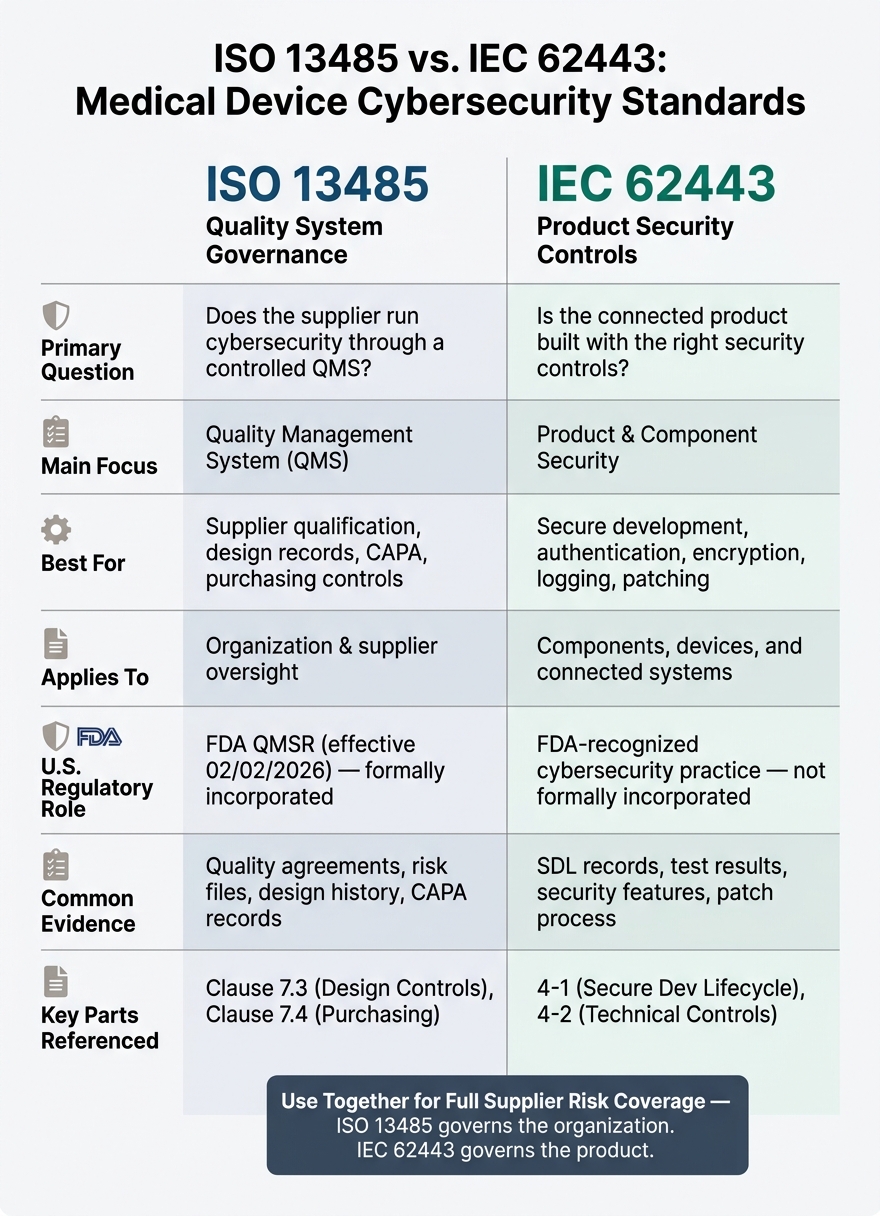
ISO 13485 vs. IEC 62443: Medical Device Cybersecurity Standards Compared
A Closer Look at ISA/IEC 62443
sbb-itb-535baee
ISO 13485: How quality system requirements shape cybersecurity accountability
ISO 13485 makes cybersecurity a QMS issue, not just an IT task. Across the device lifecycle, it sets the expectation that security work is planned, documented, reviewed, and tied to product quality. Under FDA's QMSR, effective February 2, 2026, ISO 13485:2016 is the framework for showing devices are designed and manufactured safely, including cybersecurity.[2][9] Put simply, security work has to live inside controlled QMS records.
Supplier controls, purchasing, and risk-based oversight
Clause 7.4 requires organizations to evaluate, select, monitor, and re-evaluate suppliers based on risk to device quality and patient safety.[13] That applies to more than parts vendors. It also includes software vendors, cloud hosts, contract manufacturers, and service providers.
In practice, supplier agreements should spell out the security basics that often cause trouble later if they are left vague. That includes:
- vulnerability disclosure
- patch timelines
- change notice
- incident reporting
- subcontractor flow-down
- compliance evidence
Those terms matter most when they carry through the rest of the system. If supplier controls stop at purchasing, they fall apart fast. The same expectations need to show up in design, validation, and postmarket monitoring.
Lifecycle risk management inside the QMS
ISO 13485 connects risk management to design, development, production, servicing, and corrective action.[3][14] So cybersecurity risk work cannot sit off to the side in a separate folder no auditor can tie back to quality records. Threat models, SBOM reviews, and vulnerability analyses need traceability inside the QMS.
FDA's February 2026 premarket cybersecurity guidance now points to ISO 13485 Clause 7.3 for design-control evidence.[15] That has a clear effect on how teams document security work:
- Threat models should appear as design inputs.
- Security requirements, such as authentication, encryption, access control, and secure updates, should trace to design outputs and verification records.
- Security testing, including penetration testing and vulnerability scanning, should be part of design validation under Clause 7.3.7.
This is where accountability gets real. If a team says a device needs secure updates or role-based access, there should be a straight line from that requirement to the design output, the test record, and the review trail.
Unresolved software defects and vulnerabilities also do not just sit on an engineering backlog forever. When they are not investigated, corrected, and trended, they become CAPA issues.
The key point is simple: ISO 13485 does not tell manufacturers which cyber methods to use. What it does provide is the management structure, including document control, design controls, supplier oversight, complaint handling, CAPA, and postmarket monitoring, that makes cybersecurity decisions owned, tracked, and defensible across the product lifecycle. IEC 62443 picks up where ISO 13485 stops by defining the technical controls that support this governance.
IEC 62443: Cybersecurity requirements for connected products and supply chains
Where ISO 13485 sets the governance layer, IEC 62443 gets into the hands-on security controls that back it up. Put simply, it turns policy into engineering work. For medical device suppliers, the parts that matter most are IEC 62443-4-1 and IEC 62443-4-2.
IEC 62443-4-1: Secure development lifecycle requirements
IEC 62443-4-1 focuses on how a product is built and supported over time. It sets requirements for the organizational processes used to develop and maintain secure components, including medical device security risks and threat analysis, secure design and implementation, verification, vulnerability handling, patching, and postrelease maintenance [18][11].
For medical device suppliers, the point is simple: show repeatable, auditable security work. A supplier aligned with 4-1 can show that security is part of the engineering workflow from the start, not something tacked on right before launch. That matters a lot in healthcare. Software-driven devices can stay in clinical use for years, so a one-time review won't cut it. IEC 62443-4-1 sets a secure development lifecycle that gives reviewers a steady way to judge whether a supplier's security work is organized, documented, and maintained across product generations.
Once that development process is in place, 4-2 shifts the focus to the component controls a reviewer should check.
IEC 62443-4-2: Technical security requirements for components
If 4-1 is about the process, 4-2 is about the product itself. IEC 62443-4-2 defines technical security requirements for components across seven Foundational Requirements (FRs) [16][17][21]:
| Foundational Requirement | What It Covers |
|---|---|
| Identification and Authentication Control (IAC) | Verifying the identity of users, devices, and processes |
| Use Control (UC) | Enforcing authorization and least-privilege access |
| System Integrity (SI) | Protecting against unauthorized modification, including secure boot and signed updates |
| Data Confidentiality (DC) | Encrypting sensitive data in transit and at rest |
| Restricted Data Flow (RDF) | Limiting network communication to approved paths |
| Timely Response to Events (TRE) | Logging, alerting, and responding to security incidents |
| Resource Availability (RA) | Maintaining function under adverse or attack conditions |
These FRs line up with controls a reviewer can actually test, such as:
- unique credentials
- role-based access
- encrypted communications
- audit logs
- resistance to denial-of-service conditions
IEC 62443 also uses four Security Levels, SL 1-4, for components. That gives reviewers a clear way to judge whether a device's protections fit the risk level of the environment where it will be used [17][19].
Roles and supply chain responsibilities under IEC 62443
IEC 62443 defines three roles across the supply chain: Product Supplier, System Integrator, and Asset Owner [20]. In healthcare, those roles map pretty cleanly to day-to-day stakeholders. Medical device manufacturers and software vendors act as product suppliers. HDOs serve as asset owners, taking responsibility for secure operations, access control, patching, and network segmentation after deployment. System integrators, enterprise IT teams, or managed service providers take the integrator role when devices are connected to clinical platforms or hospital networks.
This role split matters during supplier assessments. It helps teams assign responsibility for control design, deployment, and patching before a review starts. That mapping is what assessments should use to separate what belongs to the vendor, the integrator, and the HDO.
ISO 13485 vs. IEC 62443: Side-by-side comparison for medical device suppliers
This comparison matters because suppliers and HDOs don’t ask the same question every time. Sometimes the issue is process discipline. Other times, it’s product security. So the real decision is simple: does this supplier review need proof of QMS controls, or proof of product security controls?
| Dimension | ISO 13485 | IEC 62443 (Parts 4-1 & 4-2) |
|---|---|---|
| Primary focus | Quality management system (QMS) discipline across the device lifecycle | Cybersecurity engineering controls for connected products and systems |
| Scope | Organization-level: manufacturers, suppliers, and service providers in the medical device ecosystem | Product and component level: suppliers of connected devices, embedded systems, and industrial control components |
| Requirement type | Management-system requirements: documented processes, purchasing controls, CAPA, risk management, and design controls | Technical and engineering requirements: secure development lifecycle, authentication, encryption, patching, and security event logging |
| Risk approach | Risk-based QMS across safety, regulatory, and quality dimensions; cybersecurity as one element within that broader framework | Dedicated cybersecurity risk model using security levels (SL 1–4), threat analysis, and control-specific requirements |
| Supplier applicability | Applies directly to third-party vendors and component suppliers through purchasing controls, quality agreements, and supplier oversight | Assigns product supplier responsibilities for secure development and technical controls in connected components |
| U.S. regulatory relevance | Direct: FDA's QMSR, effective February 2, 2026, incorporates ISO 13485:2016 by reference into 21 CFR Part 820 [23][24][25] | Recognized practice: FDA references ANSI/ISA 62443-4-1 in its cybersecurity guidance, but it is not formally incorporated into regulation [10][9] |
At a high level, both standards ask for security work that is documented, repeatable, and maintainable. They both deal with requirements definition, risk analysis, verification, and maintenance. But they do different jobs. ISO 13485 controls the QMS. IEC 62443 sets out product controls you can test.
A simple way to think about it: ISO 13485 governs the organization; IEC 62443 governs the product.
Use ISO 13485 when the supplier review is about process questions, often managed via automated security questionnaires, such as:
- supplier qualification
- change control
- CAPA
- design risk management
Use IEC 62443 when the review is about product-security questions, such as:
- secure development
- access control
- encryption
- patch support
SBOM questions sit across both standards. ISO 13485 gives you the QMS documentation context, while IEC 62443-4-1 supports software transparency and update control. [1][27] That split is exactly why the two fit well together in supplier risk management. When used together, they show what evidence is needed for a full supplier risk review.
Using both standards together in healthcare supplier risk management
A practical combined approach for suppliers and HDOs
The practical move is to treat ISO 13485 as the QMS backbone and IEC 62443 as the technical control set.
Here’s what that looks like in practice: suppliers tie secure development, vulnerability management, patching, and end-of-life planning to ISO 13485 design controls, risk management, validation, and CAPA records. When they do that, those security activities show up in records a reviewer can actually trace and audit, such as design files, validation reports, vulnerability logs, and CAPA files.[8][6][5][22]
For third-party risk reviews, HDOs can use ISO 13485 Clause 7.4 purchasing controls to lock cybersecurity requirements into supplier management. That can include:
- SBOMs
- Patch timelines
- Vulnerability disclosure
- Secure update evidence
Then IEC 62443 supplies the exact technical criteria used to judge those items.[12][31][7]
Why does this matter? Because it gives HDOs a steady, standards-linked set of evidence across vendors. Instead of sorting through one-off questionnaires and ad hoc answers, teams get a cleaner way to compare supplier risk across the portfolio.
Operationalizing standards-based assessments with Censinet
To put that process into day-to-day use, Censinet RiskOps™ helps HDOs and vendors run standards-aligned third-party assessments, compare evidence, and track medical device, clinical application, and supply chain risk in one workflow.
Key takeaways for decision-makers
ISO 13485 governs the QMS. IEC 62443 lays out the technical security controls.
Used together, they give HDOs a repeatable way to assess both supplier process maturity and product security. That lines up with FDA's QMSR and cybersecurity guidance, while also showing the technical controls in place and how the product was built.[9][4][5][30]
FAQs
Do I need both ISO 13485 and IEC 62443?
Not exactly. The two standards do different jobs, and they work well together in medical device development.
ISO 13485 sets the base for a Quality Management System (QMS) and is now required for U.S. FDA compliance. IEC 62443 is often used to protect manufacturing networks and operational technology environments.
In practice, many organizations build secure lifecycle practices into an ISO 13485-compliant QMS so they can deal with both quality issues and cybersecurity risks at the same time.
Which IEC 62443 part matters most for medical devices?
The available information does not point to one IEC 62443 part as the single most important for medical devices.
Instead, the guidance points in a more practical direction: match each device’s security needs to the IEC 62443 parts that fit, build cybersecurity into the ISO 13485 quality management system, and use the Secure Product Development Framework to support FDA compliance.
How does FDA QMSR affect cybersecurity reviews?
FDA QMSR puts cybersecurity inside the core ISO 13485:2016 quality system. It’s not a side job for IT. Manufacturers need to bake security into design controls, purchasing controls, and CAPA.
During inspections, FDA investigators look at management reviews, quality audits, and the Design History File. They use those records to check whether threat models, SBOM, and risk assessments are kept up to date as living documents linked to safety and performance requirements.
