
GDPR and HIPAA are two major data protection regulations that govern how organizations handle sensitive information. While GDPR applies globally to data involving EU residents, HIPAA focuses on safeguarding health information within the U.S. Here’s a quick summary of their key differences:
For organizations subject to both regulations, aligning processes to GDPR’s stricter 72-hour rule and maintaining clear governance roles can simplify compliance and reduce risks.
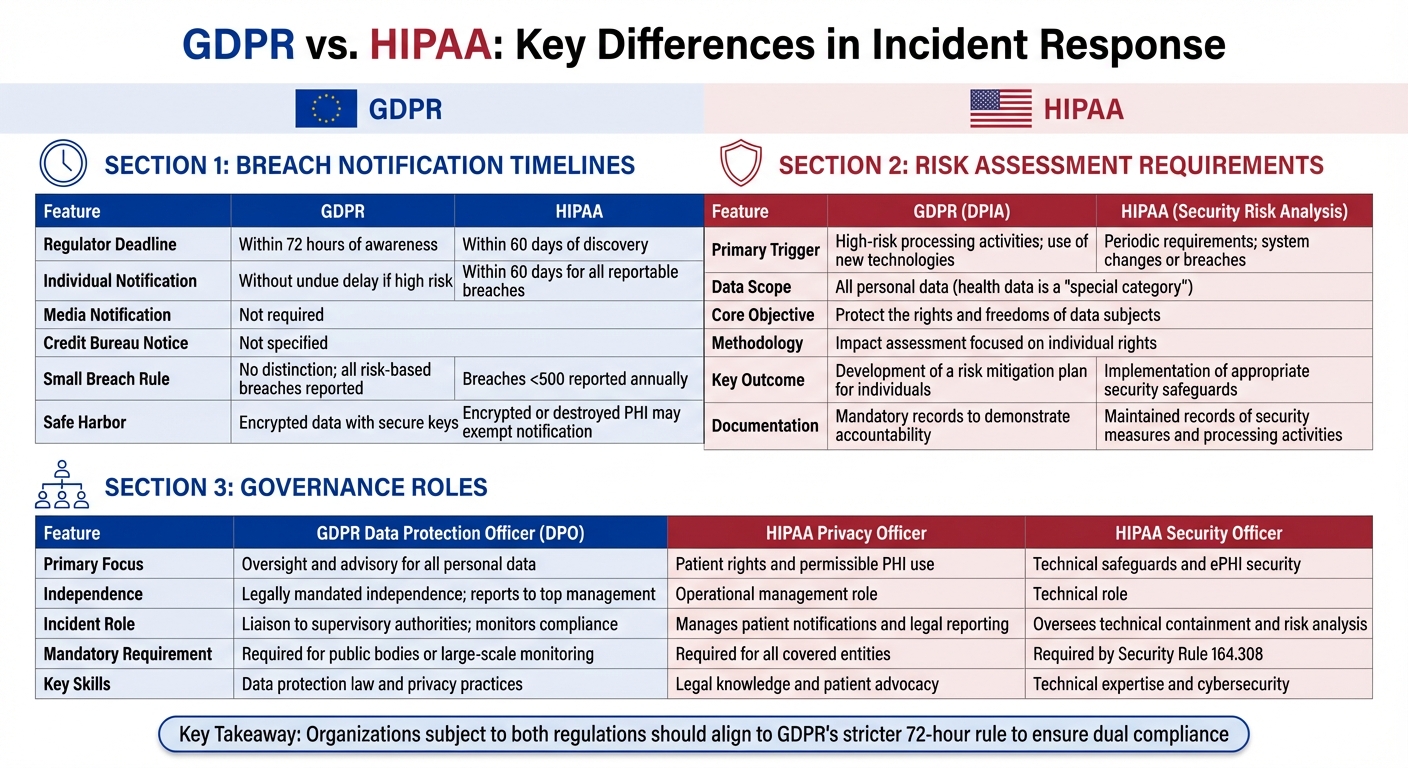
GDPR vs HIPAA Incident Response Requirements Comparison Chart
GDPR and HIPAA Compliance Secrets You Need to Know
sbb-itb-535baee
Breach Notification Timelines
When a data breach happens, the response clock starts ticking - but the deadline to act depends on the specific regulation. GDPR and HIPAA each have their own timelines, and understanding these differences is key to avoiding fines and maintaining credibility. This is especially critical as cyberattacks and data breaches continue to disrupt clinical applications and patient care. Here's how each regulation shapes the response process.
GDPR's 72-Hour Notification Rule
Under GDPR, organizations must notify the appropriate supervisory authority within 72 hours of confirming a breach. This countdown begins when there's reasonable certainty that a breach has occurred. If the breach is likely to create a high risk to individuals' rights and freedoms, affected individuals must also be informed without undue delay.
Miss the 72-hour window? You'll need to provide a detailed justification to the supervisory authority. However, if the compromised data was encrypted with a strong, uncompromised key, the breach may not require notification since the risk is considered minimal.
HIPAA's 60-Day Notification Requirements
HIPAA gives organizations 60 days from the discovery of a breach to notify affected individuals and the Department of Health and Human Services (HHS). Discovery is defined as the date the breach is known - or should reasonably have been known.
For breaches impacting 500 or more individuals in a single state or jurisdiction, notification must also be sent to prominent media outlets. If 1,000 or more individuals are affected, the three major credit reporting agencies (Equifax, Experian, and TransUnion) must be informed. Smaller breaches, involving fewer than 500 individuals, are reported to HHS annually in a consolidated log.
HIPAA also includes a safe harbor provision: if a formal risk assessment determines there's a low probability that protected health information (PHI) was compromised, notification may not be necessary. This often applies when data is encrypted or destroyed.
Comparison Table: Notification Timelines and Requirements
Feature
GDPR
HIPAA
Regulator Deadline
Within 72 hours of awareness
Within 60 days of discovery
Individual Notification
Without undue delay if high risk
Within 60 days for all reportable breaches
Media Notification
Not required
Required if 500+ individuals affected
Credit Bureau Notice
Not specified
Required if 1,000+ individuals affected
Small Breach Rule
No distinction; all risk-based breaches reported
Breaches <500 reported annually
Safe Harbor
Encrypted data with secure keys
Encrypted or destroyed PHI may exempt notification
For organizations governed by both GDPR and HIPAA, following GDPR's 72-hour rule ensures compliance with HIPAA's 60-day requirement. To meet these demands, organizations may need tools like real-time log monitoring, automated anomaly detection, and a preliminary breach assessment completed within 48 hours. This approach not only supports compliance but also strengthens overall incident response efforts, especially for healthcare providers navigating these dual regulations.
Risk Assessment Requirements
Risk assessments play a critical role in identifying vulnerabilities and safeguarding sensitive data. However, the approaches of GDPR and HIPAA differ significantly when it comes to triggers, methods, and intended outcomes.
Data Protection Impact Assessments (DPIAs) Under GDPR
Under GDPR, a Data Protection Impact Assessment (DPIA) is required whenever processing activities present high risks to individuals' rights. Since health data is classified as a "special category" under GDPR, its processing nearly always necessitates a DPIA [1].
"GDPR requires Data Protection Impact Assessments (DPIAs) for processing that poses high risk to individuals. Health data processing almost always qualifies."
– Aleksander Cudny, Business Analyst,
A DPIA outlines potential risks, explains the nature of the processing, and suggests mitigation strategies. GDPR’s accountability principle (Article 5[1]) further mandates that organizations document these assessments to demonstrate compliance. Ignoring this requirement can lead to severe penalties - up to 4% of annual global turnover or €20 million, whichever is higher [1].
While GDPR centers on protecting individual rights through DPIAs, HIPAA takes a different path by focusing on system vulnerabilities.
Security Risk Analysis Under HIPAA
HIPAA emphasizes ongoing, periodic assessments to identify and address potential risks to the confidentiality, integrity, and availability of electronic Protected Health Information (ePHI) [1]. These assessments are often triggered by changes such as new technology implementations, system upgrades, or potential security incidents.
Unlike GDPR's focus on individual rights, HIPAA's Security Risk Analysis prioritizes implementing technical, administrative, and physical safeguards to prevent unauthorized access and data loss. The regulation requires "reasonable" safeguards, tailored to the size and complexity of the entity [5]. Penalties under HIPAA vary, ranging from $100 to $50,000 per violation, with an annual cap of $1.5 million for repeated violations [1].
Comparison Table: Risk Assessment Triggers and Processes
Feature
GDPR (DPIA)
HIPAA (Security Risk Analysis)
Primary Trigger
High-risk processing activities; use of new technologies
Periodic requirements; system changes or breaches
Data Scope
All personal data (health data is a "special category")
Protected Health Information (PHI)
Core Objective
Protect the rights and freedoms of data subjects
Ensure the confidentiality, integrity, and availability of PHI
Methodology
Impact assessment focused on individual rights
Vulnerability and threat analysis of systems , including those posed by
Key Outcome
Development of a risk mitigation plan for individuals
Implementation of appropriate security safeguards
Documentation
Mandatory records to demonstrate accountability
Maintained records of security measures and processing activities
Bridging the Gap Between GDPR and HIPAA
The differences between GDPR and HIPAA highlight the need for a unified approach to risk assessments, especially for organizations subject to both regulations. A harmonized framework can simplify compliance by addressing the requirements of both standards. Aleksander Cudny reflects on this advantage:
"Both [GDPR and HIPAA risk assessments] can be addressed through a single risk assessment framework that covers the requirements of each regulation"
.
To streamline compliance, organizations should tag data records with their applicable regulatory jurisdiction at the point of collection. This ensures that the correct risk assessment processes and data lifecycle rules are applied automatically. Since GDPR's requirements are often broader, using GDPR as a baseline can help cover much of what HIPAA demands.
Roles and Governance Structures in Incident Response
When it comes to managing incident response effectively, setting up well-defined governance roles is a must. Both GDPR and HIPAA approach this differently. GDPR emphasizes independent oversight, while HIPAA focuses on operational roles to handle daily compliance tasks.
Data Protection Officer (DPO) Under GDPR
The Data Protection Officer (DPO) plays a pivotal role in GDPR compliance, acting as an independent advisor for all personal data processing activities. Healthcare organizations that process health data, classified as a "special category" under GDPR, are legally required to appoint a DPO [2].
What sets the DPO apart is their independence. They report directly to top management and are protected from job-related risks while performing their duties [6][7]. In the event of a breach, the DPO coordinates with Data Protection Authorities, ensures compliance with GDPR’s 72-hour notification deadline, and serves as a go-to resource for individuals exercising their data rights [4][6][8]. If there’s a delay in notification, the DPO must document the reasons, as the organization bears the burden of proof [4].
"The DPO operates independently, avoids conflicts of interest, and reports to the highest management level."
– Kevin Henry, HIPAA Expert
Unlike operational roles, the DPO doesn’t handle technical or forensic aspects of a breach. Their focus is on ensuring the response aligns with GDPR's accountability principles [6][8]. For smaller healthcare organizations, hiring an external consultant as a DPO can be a cost-efficient alternative to employing one full-time [2].
Privacy and Security Officers Under HIPAA
HIPAA takes a different route by requiring two key operational roles: the Privacy Officer and the Security Officer [8]. These roles are hands-on, managing compliance policies and technical safeguards on a daily basis, unlike the advisory nature of a GDPR DPO [6][8].
The Privacy Officer is responsible for patient rights and ensuring that Protected Health Information (PHI) is used appropriately. During an incident, they handle notification requirements and patient communication [8]. On the other hand, the Security Officer, as mandated by Security Rule 164.308, focuses on technical containment, forensic investigations, and protecting electronic PHI (ePHI) [9][10].
"Privacy is related to the disclosure of patient data, whereas security is focused on the actual IT protocols (e.g. passwords and encryption) put in place to safeguard that data."
–
Organizations with 500 or more employees should consider keeping these roles separate due to their distinct skill requirements. The Privacy Officer needs expertise in legal matters and patient advocacy, while the Security Officer requires strong technical and cybersecurity knowledge [8][9].
Comparison Table: Governance Roles and Responsibilities
Feature
GDPR Data Protection Officer (DPO)
HIPAA Privacy Officer
HIPAA Security Officer
Oversight and advisory for all personal data
Patient rights and permissible PHI use
Technical safeguards and ePHI security
Legally mandated independence; reports to top management
Operational management role
Technical role
Liaison to supervisory authorities; monitors compliance
Manages patient notifications and legal reporting
Oversees technical containment and risk analysis
Required for public bodies or large-scale monitoring
Required for all covered entities
Required by Security Rule 164.308
Data protection law and privacy practices
Legal knowledge and patient advocacy
Technical expertise and cybersecurity
Having clearly defined roles under both GDPR and HIPAA strengthens incident response processes. This alignment is a key finding in recent healthcare cybersecurity benchmarking studies that track industry maturity. GDPR’s 72-hour rule can help streamline internal procedures, while HIPAA’s focus on operational roles ensures no aspect of compliance is overlooked. Additionally, organizations should prepare a documented succession plan for the HIPAA Security Officer to avoid lapses in compliance if the position becomes vacant unexpectedly [8].
Building a Unified Incident Response Strategy
Healthcare organizations in the U.S. and EU face the challenge of navigating two distinct regulatory frameworks: GDPR's 72-hour breach notification deadline and HIPAA's more lenient 60-day window. Instead of juggling separate processes, organizations can streamline their efforts by creating a unified incident response strategy. This approach not only reduces administrative complexity but also ensures compliance with both standards.
Using GDPR's 72-Hour Deadline as a Baseline
A practical starting point is adopting GDPR's stricter 72-hour notification window as the default timeline for all incidents[12]. This approach ensures compliance with both GDPR and HIPAA while eliminating the need for separate workflows. The breach clock starts immediately, fostering a culture of urgency.
GDPR allows phased notifications, meaning if full details aren’t available within 72 hours, organizations can submit initial reports and follow up as investigations progress[12]. This flexibility aligns with HIPAA’s requirements for thorough analysis. To maintain momentum, activate a response team within the first hour of an incident. Assign roles promptly and use pre-drafted notification templates tailored for EU supervisory authorities and the U.S. Department of Health and Human Services (HHS)[4][12]. This preparation ensures rapid response when every minute counts.
Integrating HIPAA-Specific Reporting Requirements
While GDPR sets the timeline, HIPAA brings specific reporting triggers that must be incorporated into the unified strategy. For example, GDPR requires reporting when individual rights and freedoms are at risk[12], while HIPAA focuses on breaches involving unauthorized access, use, or disclosure of Protected Health Information (PHI)[10]. These nuances should guide the notification process.
To handle these requirements effectively, form multidisciplinary teams that include IT, clinical, legal, and compliance experts[11]. Coordination between GDPR Data Protection Officers and HIPAA Privacy and Security Officers is essential to ensure notifications are consistent across jurisdictions[11][2]. Additionally, routing forensic and risk assessment reports through legal counsel can help maintain attorney-client privilege during regulatory inquiries or litigation[4]. Don’t forget to track state-specific deadlines - like New York’s SHIELD Act, which requires reporting within 30 days - to ensure no secondary obligations are overlooked[4].
How Censinet RiskOps™ Supports Incident Response
Technology can play a critical role in simplifying this dual compliance challenge. Manual processes are prone to errors, which are a leading cause of data breaches, accounting for about 74% of incidents[2]. Platforms like Censinet RiskOps™ automate detection, documentation, and reporting workflows, enabling healthcare organizations to meet GDPR and HIPAA requirements more efficiently.
Censinet RiskOps™ offers automated data discovery and inventory tools that help distinguish between PHI and special category health data ahead of time, avoiding last-minute classification issues during incidents[11][2]. When a breach occurs, the platform streamlines risk assessment by quantifying the potential harm to individuals[4]. Its centralized command center provides visibility across the organization’s risk landscape, allowing teams to respond cohesively while maintaining the comprehensive audit trails regulators expect. Pre-drafted templates integrate seamlessly with the platform’s case management features, further reducing response times.
"It's far cheaper and more efficient to embed your data protection bits at the beginning than create your shiny new thing and think, 'where are we going to put that data protection bit now?'" – Kristy Gouldsmith, Data Protection, Privacy, and Cybersecurity Partner, Spencer West LLP
With healthcare data breaches averaging $11.05 million per incident in 2024 - the highest of any industry - investing in tools like Censinet RiskOps™ is not just practical but financially crucial[4]. These technologies help organizations minimize risk exposure while demonstrating accountability to both EU and U.S. regulators through consistent documentation and notification practices.
Conclusion
Key Differences Between GDPR and HIPAA
One of the most striking differences between GDPR and HIPAA lies in their notification timelines. GDPR requires organizations to report breaches to Data Protection Authorities within 72 hours of discovery. In contrast, HIPAA allows up to 60 days to notify both individuals and the HHS when a breach impacts 500 or more people[4]. These differing deadlines push healthcare organizations to establish efficient response protocols tailored to each regulation.
Another notable difference is in their risk assessment criteria. Under GDPR, individual notifications are necessary only if there's a "high risk" to the rights and freedoms of individuals. HIPAA, on the other hand, uses a "harm-based safe harbor", allowing organizations to forgo notification if a written risk assessment determines there's a low probability that PHI was compromised[4]. Understanding these frameworks is crucial for avoiding unnecessary alerts while staying compliant.
Lastly, their governance structures vary. GDPR requires certain organizations to appoint a Data Protection Officer, while HIPAA mandates separate Privacy and Security Officers. This creates distinct yet overlapping areas of accountability that organizations must carefully manage.
These differences underscore the importance of efficient tools and strategies to navigate compliance with both regulations.
How Technology Simplifies Dual Compliance
Given the complexity of managing GDPR and HIPAA requirements simultaneously, relying on manual processes can lead to costly mistakes. With GDPR fines reaching up to €20 million or 4% of global annual revenue[4], the financial risks are enormous. This is where technology, like Censinet RiskOps™, becomes indispensable.
Censinet RiskOps™ automates critical processes such as detection, documentation, and reporting, ensuring compliance with GDPR's 72-hour deadline and HIPAA's specific requirements. By centralizing data management, the platform eliminates the need for separate systems and reduces the risk of human error. For instance, it automatically identifies and classifies PHI and EU resident data, removing the chaos of last-minute breach responses.
The platform also provides a centralized dashboard for real-time tracking and pre-drafted templates to speed up incident responses. Detailed audit trails and automated workflows ensure that healthcare organizations can demonstrate compliance to both European regulators and the U.S. Department of Health and Human Services. By streamlining breach responses and maintaining meticulous records, Censinet RiskOps™ turns the challenge of dual compliance into an operational strength.
FAQs
When does the GDPR 72-hour breach clock start?
When the data controller becomes aware of a personal data breach that may affect individuals' rights and freedoms, the 72-hour GDPR breach notification clock starts ticking. "Awareness" in this context generally means having a reasonable level of certainty that a breach has occurred and that it involves personal data.
If we follow GDPR’s 72-hour rule, will we still meet HIPAA requirements?
Adhering to GDPR's 72-hour breach notification rule can be a helpful way to stay ahead of HIPAA's more relaxed 60-day notification requirement. However, it's not just about meeting the timeline. HIPAA has its own set of rules for how breaches must be documented and reported. While following GDPR's stricter timeline might put you in a good position, you still need to carefully address all of HIPAA's specific obligations to ensure you're fully compliant.
How should we handle a breach that involves both PHI and EU personal data?
When dealing with breaches that involve both Protected Health Information (PHI) and EU personal data, it's crucial to adhere to the strictest standards set by GDPR and HIPAA. Here's how each regulation approaches breach notifications:
To ensure compliance with both frameworks, conducting thorough risk assessments and issuing timely notifications are non-negotiable. Tools like Censinet RiskOps™ can help streamline compliance efforts and manage these processes effectively.
