
Cloud adoption in healthcare is growing, but it brings unique risks like data breaches, misconfigurations, and third-party risk. ISO 27017 addresses these challenges with 7 cloud-specific controls, making it a key framework for healthcare organizations managing Protected Health Information (PHI). Here's what you need to know:
Each framework plays a role in securing cloud environments, but ISO 27017 stands out for its focus on cloud-specific risks. Healthcare organizations can strengthen their security posture by integrating these frameworks and automating compliance tasks. Tools like Censinet Connect™ Copilot can streamline this process by automatically answering security questionnaires.
Quick Comparison
Cloud-specific risks
PHI protection
Unified healthcare compliance
3-year cycle with audits
No official certification
2-year cycle with assessments
High
Low
Moderate
International
U.S. only
U.S.-centric, global recognition
ISO 27017 is ideal for addressing cloud-specific challenges, while HIPAA and HITRUST ensure compliance with legal and operational standards. Together, they provide a strong foundation for managing healthcare data in the cloud.
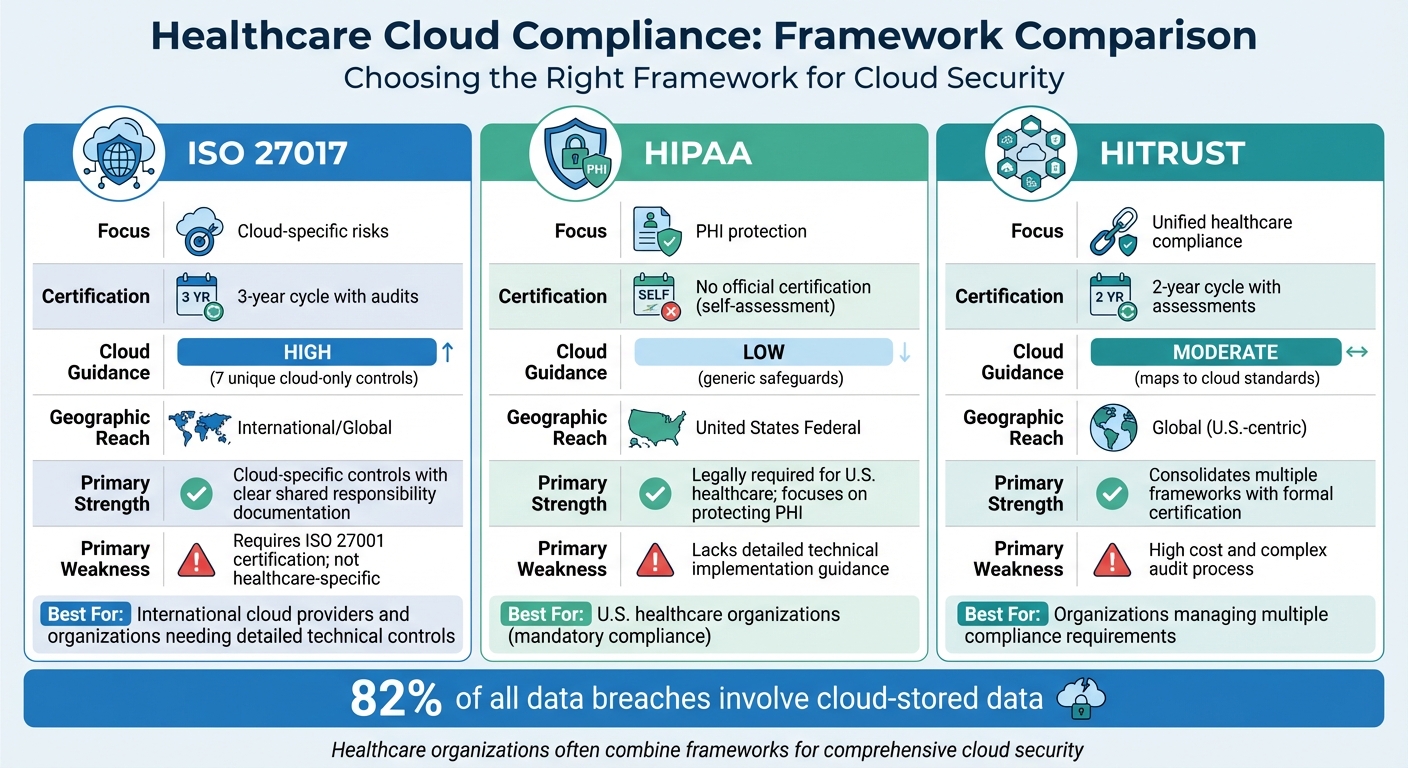
ISO 27017 vs HIPAA vs HITRUST Cloud Compliance Framework Comparison
ISO 27017 in the cloud: real security or audit theater EN
sbb-itb-535baee
1. ISO 27017
ISO/IEC 27017 builds on the ISO 27001 framework by introducing seven controls specifically designed for cloud environments. While ISO 27001:2022 focuses on data centers and on-premises setups, ISO 27017 addresses the unique risks of cloud computing, such as multi-tenancy, virtualization, and shared responsibility. These additional controls are tailored to mitigate the challenges that come with managing sensitive data in the cloud.
Cloud-Specific Controls
The seven cloud-focused controls in ISO 27017 fill critical gaps for healthcare organizations transitioning protected health information (PHI) to the cloud:
Implementation Guidance
To implement these controls effectively, ISO 27017 integrates seamlessly into an existing ISO 27001 Information Security Management System (ISMS) [4]. Instead of creating a separate document, organizations should update their Statement of Applicability (SoA) to include the seven cloud-specific controls. For organizations already certified under ISO 27001, incorporating these controls typically takes 2–4 months.
A key requirement of ISO 27017 is the creation of a Shared Responsibility Matrix, which outlines security responsibilities across different cloud service models:
Rebecca Williams, a GRC Consultant at Complyance, highlights the practical benefits:
"ISO 27017 builds the operational scaffolding that helps Enterprise GRC and IT teams prove secure configuration, isolation, and accountability in the cloud"
.
2. HIPAA
PHI/Healthcare Data Protection
HIPAA sets out administrative, physical, and technical safeguards to protect Protected Health Information (PHI) [3]. However, unlike ISO 27017, it outlines what needs to be protected without prescribing how to do it. This lack of implementation guidance can complicate cloud migrations for healthcare organizations. As eSentire puts it:
"The HIPAA Security Rule... covers what your organization needs to do for compliance, but not how it should be done"
.
Technical safeguards play a critical role in securing PHI. Key measures include:
Failing to implement these safeguards can be costly. Breaches involving unencrypted regulated data resulted in an average loss of $4.29 million per incident in 2024 [3]. These technical controls form the backbone of HIPAA compliance, especially under its shared responsibility model.
Regulatory Alignment
HIPAA's technical requirements are closely tied to its shared responsibility framework for cloud environments. Compliance requires a Business Associate Agreement (BAA) between the healthcare organization and the Cloud Service Provider (CSP) [3]. Under this model, the CSP oversees physical data center security, while customers are tasked with configuring virtual private clouds (VPCs), security groups, identity and access management (IAM) policies, and encryption.
This division of responsibilities parallels ISO 27017's CLD.6.3.1 control but lacks the detailed operational guidance ISO 27017 provides for handling multi-tenant environments and securing virtual machines. Additionally, HIPAA mandates organizations to retain PHI audit logs for 6 to 7 years, a stricter requirement compared to standard ISO 27017 practices [3]. To comply, organizations can use tools like AWS CloudTrail or Azure Monitor, configured with lifecycle policies to automate log retention.
Implementation Guidance
To address HIPAA's regulatory demands, healthcare organizations need to adopt precise technical measures. Cloud misconfigurations are a recurring threat to PHI, underscoring the importance of strong encryption and strict access controls [3]. Key steps include:
Automated monitoring tools like AWS GuardDuty or Azure Defender can help detect unusual database activity or large-scale data downloads that might signal a breach [3]. By combining these measures with diligent oversight, healthcare organizations can better navigate the complexities of HIPAA compliance in cloud environments.
3. HITRUST
Cloud-Specific Controls
HITRUST brings together elements of HIPAA, NIST 800-53, and ISO standards into a single, unified framework designed to simplify cloud security compliance for healthcare organizations [3]. Instead of introducing brand-new cloud-specific controls, it consolidates existing frameworks, creating a more streamlined process for managing compliance [1][4].
The framework ensures cloud security through a validated audit process that evaluates how well an organization safeguards healthcare data [2][4]. This process includes five key stages: scoping, readiness assessment, validated audits, scoring, and evidence management. As Rhonda Willert, Partner at Linford & Co., explains, this process results in "verified trust" in protecting healthcare data [6]. By unifying these steps, HITRUST not only simplifies compliance but also makes regulatory adherence more efficient, as explored further in the next section.
Regulatory Alignment
HITRUST is specifically designed for healthcare data protection and is widely recognized for HIPAA compliance [3][4]. Unlike ISO 27017, which serves as a global, technology-neutral standard, HITRUST focuses solely on the unique requirements of healthcare data. Its framework complements ISO 27017's technical controls and HIPAA's safeguard requirements by offering a certifiable standard that integrates these elements into a cohesive system.
Governance, risk, and compliance (GRC) platforms can map HITRUST controls to other frameworks like ISO 27017, SOC 2, or HIPAA, significantly cutting down on the time needed for audit preparation [1]. For SaaS providers working with healthcare clients, combining HITRUST with ISO 27017 creates a strong compliance strategy. Willert points out that this pairing helps establish "a resilient, trust-based cloud presence" that meets both U.S. and international standards for procurement [6]. By offering a certifiable standard tailored to healthcare risks, HITRUST also supports ISO 27017's shared responsibility model, ensuring clear accountability in cloud environments [2][6].
Implementation Guidance
To effectively implement HITRUST, healthcare organizations should use a per-service RACI matrix for IaaS, PaaS, and SaaS models. This ensures that security responsibilities are clearly defined between vendors and clients, leaving no room for gaps [1][4]. Such a structured approach is particularly useful for managing multi-tenant environments while meeting HIPAA safeguards. HITRUST's framework provides a solid governance structure for protecting healthcare data [3].
Strengths and Weaknesses
This section dives into the strengths and weaknesses of the healthcare cloud compliance frameworks, offering a side-by-side comparison of their key features.
ISO 27017 stands out for its cloud-specific technical controls, particularly its seven "CLD" controls that address risks like virtual machine hardening and multi-tenancy segregation - areas where HIPAA's safeguards fall short [6]. Its global recognition makes it appealing for healthcare organizations collaborating with international cloud service providers. Additionally, its three-year certification cycle, supported by annual surveillance audits, provides a more consistent compliance structure compared to frameworks requiring yearly renewals [6]. Rhonda Willert, Partner at Linford & Co., highlights its value:
"ISO 27017 is an internationally recognized certification that results in a concise, 1-2 page certificate stating that your management system meets global best practices"
.
HIPAA, as the mandatory standard for U.S. healthcare organizations, focuses on protecting Protected Health Information (PHI) through administrative, physical, and technical safeguards [2]. However, it lacks detailed technical guidance, leaving organizations to determine how to implement protections [3]. For example, HIPAA allows alternative controls when encryption isn't feasible, which can introduce potential vulnerabilities [3].
On the other hand, HITRUST integrates multiple frameworks into a single certifiable standard, simplifying compliance for organizations juggling various requirements. Its "assess once, report many" approach is especially convenient for healthcare providers managing multiple audits. However, HITRUST's complexity and the heavy documentation it demands often create hurdles during scoping, gap analysis, and audit preparation [2][3]. Organizations can mitigate these challenges by using automated vendor solutions to streamline security questionnaires.
A common obstacle across all three frameworks is the shared responsibility model. While ISO 27017 offers clear guidance on defining cloud security roles, such as through RACI matrices, organizations still need to actively manage tasks like operating system patching, application updates, and identity access management policies [6]. Ultimately, while these frameworks strengthen security measures, healthcare organizations must remain proactive in managing shared responsibilities in ever-changing cloud environments.
Cloud-specific controls with clear shared responsibility documentation
Legally required for U.S. healthcare; focuses on protecting PHI
Consolidates multiple frameworks with formal certification
Requires ISO 27001 certification; not healthcare-specific
Lacks detailed technical implementation guidance
High cost and complex audit process
High - 7 unique cloud-only controls
Low - generic, addressable safeguards
Moderate - maps to cloud standards like ISO 27017
3-year cycle with annual surveillance
No official certification (self-assessment or attestation)
2-year cycle with annual interim assessments
International/Global
United States Federal
Global (U.S.-centric)
Conclusion
Healthcare organizations face a challenging cloud compliance environment, where no single framework fully addresses every potential risk. ISO 27017 offers cloud-specific technical controls - such as virtual machine hardening, multi-tenancy segregation, and secure asset removal - that tackle the unique risks tied to modern cloud systems. With 82% of all data breaches involving cloud-stored data [7], these controls are critical for building a more secure and accountable framework.
One of ISO 27017's key strengths is its ability to clarify responsibilities. By clearly outlining roles, it eliminates ambiguity in managing tasks like encryption key management and log monitoring. As Microsoft highlights:
"ISO 27017 is unique in providing guidance for both cloud service providers and cloud service customers"
This clarity is essential in navigating the complexities of shared responsibilities in cloud environments. That said, implementing ISO 27017's 37 enhanced controls and 7 cloud-specific requirements can be daunting, especially when relying on manual processes. For example, Tower Health discovered that manual workflows hindered their ability to effectively assess third-party risks [9].
Platforms like Censinet RiskOps™ offer a solution by automating these workflows. They replace fragmented processes with centralized risk management that addresses third-party vendors, enterprise risks, while helping manage third-party risk more broadly, and the specific demands of frameworks like ISO 27017. This automation ensures continuous oversight of security tasks, bridging gaps between cloud providers and customers, and making shared responsibility more actionable.
FAQs
Do I need ISO 27001 before ISO 27017?
No, ISO 27001 is not a prerequisite for implementing ISO 27017. While ISO 27017 zeroes in on cloud-specific security risks, ISO 27001 offers a broader framework for managing overall information security. If an organization’s main focus is strengthening cloud security, they can adopt ISO 27017 directly without first implementing ISO 27001.
Which ISO 27017 controls matter most for PHI in the cloud?
Key ISO 27017 controls designed to safeguard Protected Health Information (PHI) in cloud environments focus on tackling cloud-specific risks. These include:
These measures are critical for maintaining the privacy and security of sensitive healthcare information in cloud-based systems.
How do we document shared responsibility with our cloud vendor?
Healthcare organizations must clearly outline shared responsibilities when working with cloud vendors. One way to achieve this is by setting up Business Associate Agreements (BAAs), which formalize the roles and obligations of each party. Additionally, using frameworks like ISO 27017 can help define how security controls and responsibilities are divided between the provider and the client. This approach ensures both compliance and a clear understanding of how cloud security is managed.
