
Healthcare organizations working with the Department of Defense (DoD) must meet Cybersecurity Maturity Model Certification (CMMC) standards starting November 10, 2025. Non-compliance can result in losing eligibility for DoD contracts. Internal audits are critical for preparing healthcare contractors for these stringent requirements, especially as third-party assessments replace self-certification.
Key points to know:
Healthcare providers must prioritize internal audits to safeguard sensitive data, meet DoD standards, and avoid contract disruptions.
How to Complete Your CMMC Self-Assessment and Get Audit Ready
sbb-itb-535baee
CMMC Levels and What They Require for Audits
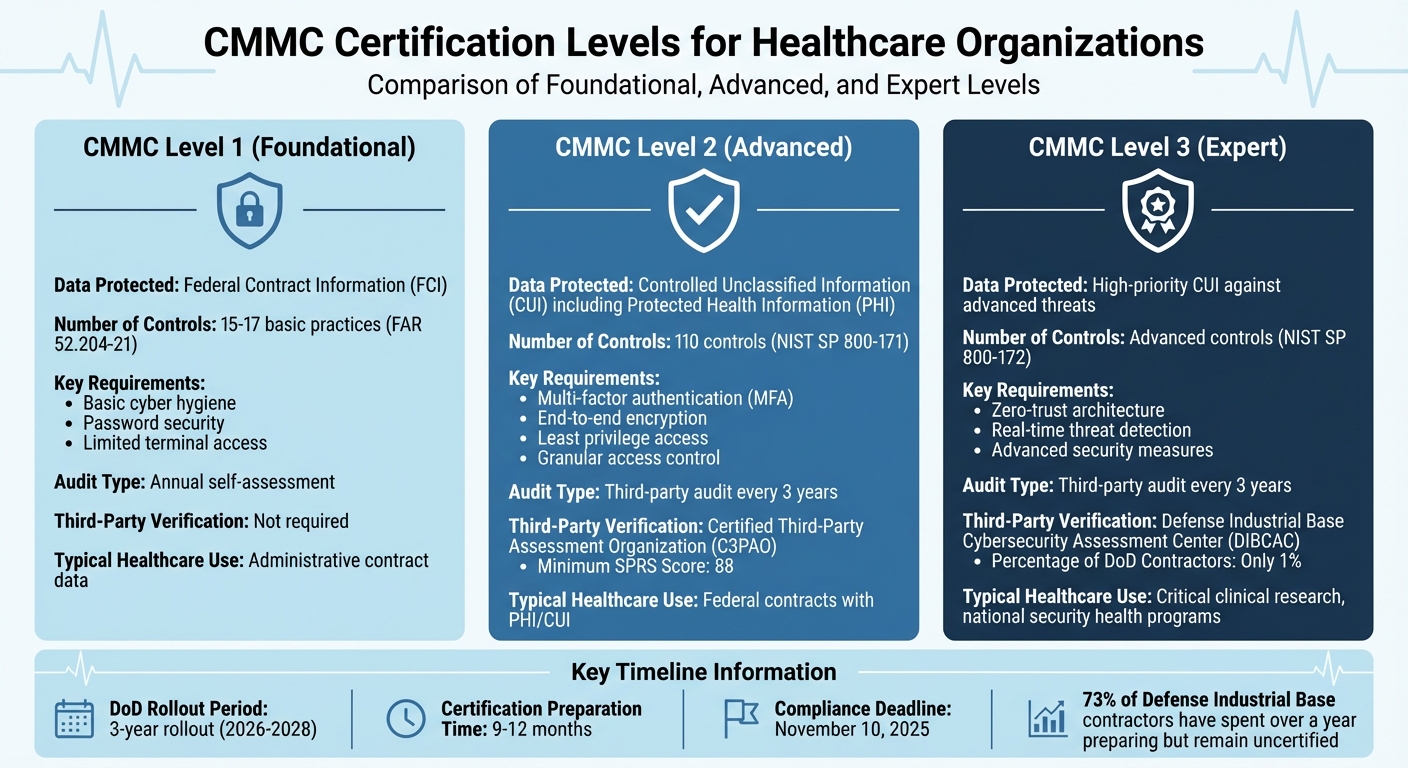
CMMC Levels 1-3 Requirements and Audit Processes for Healthcare Organizations
CMMC Levels 1, 2, and 3: What Each Level Requires
The Cybersecurity Maturity Model Certification (CMMC) framework organizes cybersecurity requirements into three levels, each with specific audit processes. Here's how they break down:
The DoD plans a three-year rollout (2026–2028) for CMMC compliance, with certifications typically taking 9–12 months to complete. Interestingly, 73% of Defense Industrial Base contractors have spent over a year preparing but remain uncertified [2]. These timelines and requirements significantly influence how healthcare organizations secure sensitive data.
Connecting CMMC Controls to Healthcare Data Protection
The connection between CMMC controls and healthcare data protection becomes clearer when considering the unique challenges healthcare organizations face. A common misconception is that HIPAA compliance alone meets CMMC standards. However, this assumption can leave critical gaps. As Coalfire Federal points out:
"HIPAA focuses on protected health information (PHI), which may also be classified as CUI in federal contracts. Organizations may assume that existing policies are sufficient, only to find that CMMC requires more granular access control, auditing, encryption, and incident response planning"
.
The stakes are high. In 2023, the average cost of a healthcare data breach hit $10.93 million per incident, while ransomware attacks on healthcare providers surged by over 94% since 2021 [2]. While HIPAA addresses PHI, CMMC enforces stricter and more formal standards for access, auditing, encryption, and incident response [1].
To prepare, healthcare organizations must map the flow of CUI to pinpoint where DoD-funded research data or other CUI is stored, processed, or transmitted. Many hospitals are adopting network segmentation to separate CUI-related systems from general administrative networks. This reduces the scope of CMMC audits by clearly defining the "assessment boundary" in environments where clinical, research, and administrative systems often overlap [1].
Third-party risk management further complicates compliance. Healthcare systems often rely on external providers for electronic health records (EHR), telehealth services, and medical devices. Organizations must ensure subcontractors handling CUI comply with flow-down clauses, as prime contractors remain accountable for vendor compliance [1].
How to Conduct Effective Internal CMMC Audits
Running Gap Analyses to Find Compliance Weaknesses
A gap analysis is your first step toward identifying how your current cybersecurity measures stack up against the 110 requirements outlined in NIST SP 800-171 Rev 2 for Level 2 compliance [6]. Start by clearly defining your Controlled Unclassified Information (CUI) boundary and documenting data flows. Once that's done, rank identified risks as high, medium, or low to prioritize remediation efforts. Pay special attention to "five-point" controls, as these have the greatest influence on your Supplier Performance Risk System (SPRS) score, which begins at 110 points [6]. This process ensures you're validating system controls, not just checking off documentation boxes. As Emily Bonnie, Senior Content Marketing Manager at Secureframe, puts it:
"The most expensive mistake in a CMMC gap analysis is treating it as a documentation exercise instead of a systems validation exercise."
For small environments, this analysis might take two to four weeks. Larger organizations, such as multi-site healthcare providers, may need 12 weeks or more [6]. Achieving a Level 2 certification requires a minimum SPRS score of 88 and the resolution of all controls that cannot be deferred to a Plan of Action and Milestones (POA&M) [6].
Once gaps are identified and risks are prioritized, the next step is to implement monitoring systems that validate your controls.
Setting Up Logging and Monitoring Systems
After pinpointing compliance gaps, the focus shifts to implementing effective logging and monitoring systems. A Managed Security Information and Event Management (SIEM) system can help correlate security event logs, providing auditors with clear evidence that your controls are functioning as intended [8]. To streamline this process, create a traceability matrix that maps logs and policies to each CMMC control. Regularly review the coverage of these logs against your asset inventory using tools like CloudTrail, GuardDuty, or Azure Activity Logs [4][9]. As IS Partners emphasizes:
"It's not enough to say you're secure - you need to show it through policies, logs, and proof of implementation."
Remember, while certification is only required every three years, maintaining compliance is a continuous effort. Conduct formal reviews annually or whenever there are significant system changes [6].
Testing Access Controls, Encryption, and Incident Response Plans
With your logging framework in place, it's time to rigorously test access controls, encryption measures, and incident response plans. These tests ensure that your controls remain effective over time. Use audit findings to guide targeted testing. For instance, verify that critical controls like Multi-Factor Authentication (MFA), access rights, encryption, and incident response are functioning as required. For MFA, check authenticator logs to confirm enforcement across all administrative groups [9]. Regularly review privileged access and test workflows to ensure access rights are updated promptly when roles change or employees leave [9].
Encryption testing should involve scanning for misconfigured storage buckets or open security groups. Generate Key Management Service (KMS) audit logs to demonstrate encryption both at rest and in transit [9][10]. For incident response, conduct cybersecurity drills to simulate recovery scenarios. These drills validate that backups are operational and that key rotation is happening as planned [9][10]. Additionally, running internal or third-party mock assessments before formal certification can help you practice responding to assessor questions and identify any documentation gaps [5].
The entire journey, from the initial gap analysis to achieving certification, generally takes nine to twelve months for most organizations. The formal CMMC Level 2 assessment itself typically lasts four to six weeks [5][6].
Using Censinet RiskOps to Simplify Internal Audits
Censinet RiskOps Features for Healthcare Compliance
Relying on spreadsheets to manage CMMC audits often leads to version control headaches and inconsistent data. Censinet RiskOps™ eliminates these issues by introducing automated workflows tailored for healthcare organizations aiming for CMMC compliance [7][11].
The platform uses standards-based questionnaires, such as NIST CSF and HICP, that align seamlessly with CMMC requirements [7]. This ensures your internal audits match the controls assessors will review during formal certification. For example, Baptist Health in Jacksonville, Florida, under the leadership of VP/CISO James Case, replaced manual processes with Censinet RiskOps across six acute care hospitals and a workforce of 14,250. This shift not only saved time on risk assessments but also brought consistency across the entire health system [7].
With its centralized platform, teams can collaborate on assessments while maintaining a single, accurate source of truth. Additionally, the tool allows organizations to benchmark their security posture against other healthcare entities within the Censinet community, ensuring readiness for formal CMMC evaluations [7]. A Team Lead in Information Security at Baptist Health highlighted the platform's benefits:
"Censinet's customer service is great and responsive... the tool is centralized, collaborative, and reliable – it gives me the ability to share internally and the flexibility to pick up where I left off."
These collaborative advantages are further enhanced by advanced automation, which simplifies the audit process even more.
Using AI and Automation to Speed Up Audits
Automation plays a key role in maintaining continuous CMMC compliance. Tower Health previously relied on spreadsheets for third-party risk assessments, which limited their efficiency [11][12]. By adopting Censinet RiskOps, they leveraged AI-driven capabilities to automate evidence validation and risk mapping. This allowed them to scale their audits while improving the accuracy of their data.
A standout feature is automated evidence validation, which identifies gaps in NIST SP 800-171 controls before assessors do. This gives organizations the chance to address issues proactively, mapping findings to established security practices and clearly linking controls to CMMC requirements [4][5]. By automating repetitive tasks, the platform frees up your team to focus on strategic remediation efforts.
For healthcare organizations juggling risks across clinical applications, medical devices, and supply chains, automation ensures the continuous monitoring required by CMMC without the need for additional staff. When issues arise, the platform's collaborative workflows automatically route them to the appropriate stakeholders, keeping remediation efforts on track and aligned with organizational goals.
Documenting Audit Results and Fixing Issues
Ranking Risks and Setting Fix Priorities
When documenting audit findings, it's essential to create a formal report that outlines nonconformances and provides clear recommendations for remediation.
However, not all gaps are equally urgent. Healthcare organizations must have a structured system to rank risks and assign appropriate timelines for fixing them. The table below highlights how findings can be categorized and who is responsible for addressing them:
Risk Category
Description
Recommended Remediation Timeline
Responsibility
Missing critical controls like MFA or encryption, posing a direct threat to CUI/FCI.
Immediate to 30 Days
CISO / IT Director
Incomplete implementation of NIST 800-171 controls or documentation gaps.
30 to 90 Days
System Administrator
High-risk issues demand immediate attention because they directly jeopardize the security of Controlled Unclassified Information (CUI) and Federal Contract Information (FCI). Medium-risk issues, while less urgent, often involve incomplete documentation or partially implemented controls that could fail a formal assessment.
To manage these deficiencies effectively, use a Plan of Action and Milestones (POA&M). This document should stay up-to-date and track all remediation efforts. Additionally, incorporate a traceability matrix that links each CMMC control to relevant evidence, such as logs, screenshots, or policy documents.
Once the risks are ranked and remediation priorities are set, the next step is to develop a detailed compliance plan to ensure long-term security and readiness.
Creating a Long-Term Compliance Plan
After addressing immediate risks, it's crucial to shift focus toward a proactive and sustainable compliance strategy. Using the audit findings and the risk rankings as a foundation, your System Security Plan (SSP) should detail how each NIST 800-171 control is implemented. This document should also be updated regularly to reflect any changes in systems or risks.
Conduct internal audits on a regular schedule - monthly or quarterly - using a checklist aligned with official CMMC assessment criteria. Follow up three to six months after corrective actions to verify that compliance is being maintained. This ongoing process not only avoids surprises during formal certification but also helps catch recurring issues before they grow into larger problems.
Automation can significantly ease the burden of maintaining compliance. Tools like GRC software can create time-stamped, unalterable audit trails of system activities. A continuous monitoring plan should also be established, specifying roles, automated tools (such as SIEM or EDR), and alert thresholds. This approach shifts the organization’s focus from periodic audit preparation to constant readiness, ensuring consistent oversight without overloading the team.
Healthcare organizations face unique challenges when it comes to documentation. Beyond CMMC requirements, they must also meet CMS regulations, which include proving "medical necessity" and maintaining patient consent records. Documentation failures are a common reason for audit issues in programs like Chronic Care Management (CCM). For example, claim denial rates can climb as high as 4.8%. On the flip side, well-documented care management programs can reduce hospital readmission rates by 21% [13].
Conclusion
Internal audits play a key role in achieving strong CMMC compliance within the healthcare sector. They replace unreliable manual processes with standardized, dependable methods for managing risk. For instance, organizations such as Baptist Health and Tower Health successfully transitioned from chaotic spreadsheets to efficient, automated risk assessments by adopting tools like Censinet RiskOps [7][11].
This shift leads to more proactive cybersecurity practices, allowing organizations to address vulnerabilities before they escalate into serious breaches. Regular audits not only close cybersecurity gaps but also prepare healthcare providers for formal CMMC certification. This ensures the protection of critical care operations against cyberattacks while safeguarding sensitive patient data [12]. Moreover, automation enables more comprehensive risk management, evaluating a broader range of vendors and systems without increasing workload.
Centralized tools, like Censinet RiskOps, further enhance audit processes by streamlining workflows and improving tracking. As noted by a Team Lead for Information Security at Baptist Health:
"Censinet's customer service is great and highly responsive, which is uncommon; moreover, the tool is centralized, collaborative, and reliable – it gives me the ability to share internally and the flexibility to pick up where I left off"
.
FAQs
How do I determine our CUI boundary for a CMMC audit?
To figure out your Controlled Unclassified Information (CUI) boundary for a CMMC audit, start by conducting a scope analysis. This involves identifying all the systems, data, and processes that handle CUI. Pay close attention to areas where CUI is created, stored, transmitted, or processed.
Next, map your organization’s assets to the specific CMMC requirements. This step ensures you know exactly how and where CUI interacts with your systems. Dive into your data flows and system architecture to get a clear picture of how information moves through your organization.
It’s also a good idea to bring in cross-functional teams during this process. Their input can help you document your boundaries in detail and ensure nothing is overlooked. Make sure everything aligns with frameworks like NIST SP 800-171 to avoid any compliance gaps. Clear documentation is key to staying on track.
What evidence will auditors expect for Level 2 controls?
Auditors need to see clear and tangible proof that Level 2 controls are not just in place but are actively monitored and reviewed on a regular basis. This means having documentation like:
Make sure all these materials clearly show a pattern of consistent compliance and continuous oversight.
How can we maintain CMMC compliance between three-year assessments?
To maintain compliance with CMMC between assessments, it's essential to focus on proactive risk management and continuous monitoring. Start by performing regular gap analyses to identify areas that need improvement. Keeping detailed documentation is equally important, as it helps track compliance efforts and demonstrates adherence to standards.
Leverage tools like Censinet RiskOps™ to simplify the process of managing security controls and tracking compliance. Regularly train your staff to stay updated on the latest requirements and best practices. Forming cross-functional oversight teams can also enhance accountability and ensure a more comprehensive approach to compliance.
Using standardized questionnaires, such as those based on NIST CSF, can help you assess and confirm adherence to required standards. Additionally, automation can play a big role - streamlining audits, monitoring third-party risks, and addressing vulnerabilities as they arise in real-time.
