
Global AI Rules, Local Implementation: International Compliance Strategies
Post Summary
Navigating global AI regulations is a growing challenge for healthcare organizations. Here's why: AI adoption in healthcare has surged, with the U.S. FDA approving over 1,000 AI-enabled medical devices by late 2024. However, only 15.2% of countries have binding AI-specific laws, while nearly half lack any framework. This fragmented regulatory landscape - spanning the EU AI Act, U.S. FDA and HIPAA guidelines, and China's NMPA framework - creates a complex maze for compliance.
Key Points:
- The EU AI Act enforces strict rules for high-risk AI systems, with penalties up to €35M or 7% of global revenue.
- U.S. regulations focus on sector-specific oversight, emphasizing patient data protection (HIPAA) and AI medical device approval (FDA).
- China mandates centralized registration and compliance with its Personal Information Protection Law (PIPL), imposing penalties up to ¥50M or 5% of revenue.
To tackle these challenges, healthcare organizations must map global regulations to local operations, automate compliance processes, and ensure human oversight for high-risk applications. Tools like Censinet RiskOps™ streamline this process by automating risk assessments, reducing manual workloads, and providing real-time compliance tracking. Organizations that prioritize compliance not only mitigate risks but also position themselves for safer and faster AI adoption in healthcare.
The Current State of Medical Device AI Regulation with Eric Henry
This discussion highlights the complexities of regulatory oversight, which often necessitates robust third-party AI risk management to ensure clinical safety and data security.
sbb-itb-535baee
Key Global AI Regulations for Healthcare

Global AI Healthcare Regulations Comparison: EU, US, and China Compliance Requirements
Healthcare organizations navigating AI implementation must contend with three major regulatory frameworks: the EU AI Act, U.S. regulations (HIPAA and FDA), and China’s NMPA guidelines. While these frameworks differ in structure and approach, they share a focus on critical elements such as data protection, human oversight, and cybersecurity.
The EU AI Act
The EU AI Act takes a broad, risk-based approach, classifying most healthcare AI applications - like medical devices, electronic health records (EHRs), and biometric identification systems - as "high-risk." This classification brings strict requirements for data governance, technical documentation, and human oversight. For instance, healthcare providers are required to ensure clinical staff can intervene and override AI decisions when necessary.
Cybersecurity is also a key focus. Article 12 mandates automatic operational logging to ensure traceability and post-market monitoring. As Joe Braidwood, CEO of GLACIS, explains, "Article 12 is not satisfied by vague promises that logging exists somewhere. High-risk teams need records they can actually retrieve and explain" [3]. Additionally, systems must use AES-256 encryption for data at rest and TLS 1.2 or higher for data in transit. Non-compliance with prohibited AI systems can result in fines of up to $38.5 million or 7% of global annual revenue [1].
US Healthcare Compliance: HIPAA and FDA Guidelines
In the U.S., AI regulation follows a sector-specific model. The FDA oversees AI as Software as a Medical Device (SaMD) using a risk-based classification system (Classes I, II, or III). As of January 2024, over 600 AI/ML-enabled medical devices have been authorized by the FDA, with 90% cleared through the 510(k) pathway. Notably, radiology AI accounts for 75% of these approvals [2]. A groundbreaking example is IDx-DR, the first autonomous AI diagnostic system approved in April 2018 to detect diabetic retinopathy without clinician input [2]. The FDA also supports adaptive algorithms through Predetermined Change Control Plans (PCCPs), enabling developers to outline updates and validation methods without requiring new approvals for every change [2].
HIPAA focuses on safeguarding Protected Health Information (PHI) through two key rules. The Privacy Rule enforces the Minimum Necessary Standard, while the Security Rule requires measures like encryption, multi-factor authentication, and audit logs. AI developers working as business associates must sign Business Associate Agreements (BAAs) with healthcare providers. Fines for willful neglect can reach $50,000 per violation, with an annual cap of $1.5 million per category [2].
China's NMPA Guidelines for AI in Healthcare
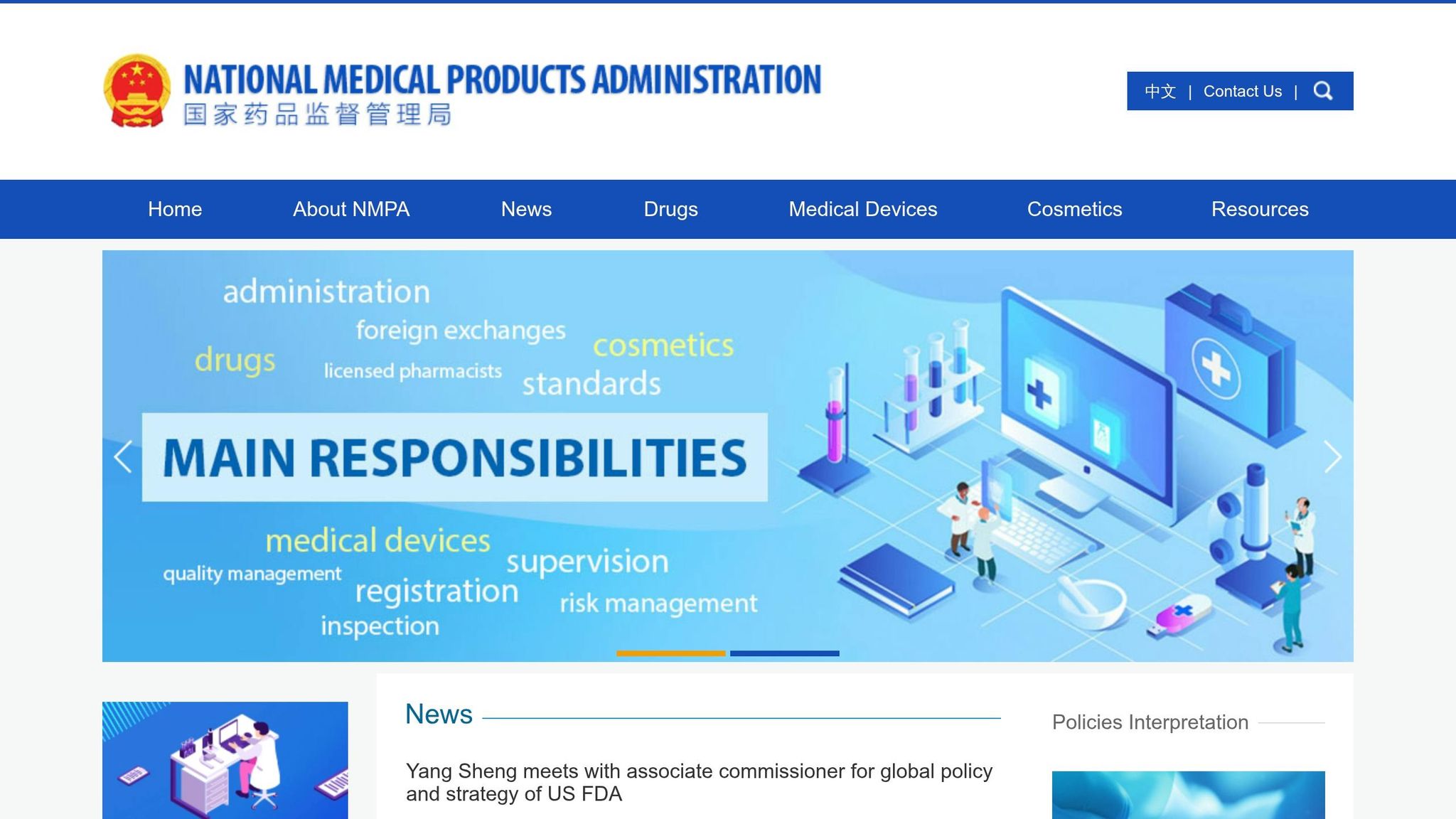
China’s approach is centralized, with the National Medical Products Administration (NMPA) managing AI-aided software through a Total Product Lifecycle (TPLC) framework. This system emphasizes deep learning features and data quality management. Developers must comply with both NMPA device regulations and Cyberspace Administration of China (CAC) requirements for algorithm registration and security assessments.
China’s Personal Information Protection Law (PIPL) imposes penalties of up to $6.9 million or 5% of annual revenue for severe violations. Generative AI services are also subject to strict content moderation rules aligned with government-defined social stability standards [1].
| Regulation | Primary Approach | Healthcare Focus | Max Penalty |
|---|---|---|---|
| EU AI Act | Horizontal, risk-based | High-risk systems (devices, EHRs) | $38.5M or 7% of global revenue [1] |
| US FDA | Sectoral, product-specific | SaMD classification (Class I-III) | Market removal, civil penalties [2] |
| US HIPAA | Data privacy/security | PHI protection, BAAs | $1.5M per category/year [2] |
| China NMPA/CAC | Centralized registration | TPLC risk assessment | $6.9M or 5% of annual revenue [1] |
The "Brussels Effect" is influencing global compliance strategies, as multinational healthcare companies increasingly adopt EU AI Act standards to streamline operations across borders. This reflects the Act's extraterritorial reach, applying to any AI system used within the EU, regardless of the provider's location [1].
How to Implement Global AI Rules Locally
Bringing global AI regulations into day-to-day healthcare operations takes a clear, step-by-step approach. It begins with mapping international regulations - like the EU AI Act, US HIPAA/FDA guidelines, and China's NMPA requirements - to your organization's specific AI tools and workflows. This process includes conducting a gap analysis to pinpoint areas where compliance falls short and then creating localized policies that adapt these global standards to your operations. Once this groundwork is laid, automated systems can take over to make compliance more manageable.
Manual tracking of vendor compliance can drag on for months, but automation can cut this down to just days. By centralizing governance through platforms that standardize questionnaires, collect evidence automatically, and offer real-time compliance scores across various regions, organizations can streamline the entire compliance process.
Using Censinet RiskOps™ for Compliance
To tackle these complex regulatory demands, Censinet RiskOps™ offers a solution that automates third-party risk assessments and evidence collection. This tool reduces manual workloads by up to 70% by using AI to match vendor responses to regulations and employing predictive analytics to flag potential compliance risks. For instance, it can simulate NMPA trial data requirements for China or detect possible violations of the EU AI Act from non-transparent models. These capabilities enable faster remediation - up to 40% quicker - by delivering intelligent, region-specific recommendations[4]. Additionally, customizable dashboards provide real-time insights, including compliance statuses, risk heatmaps, and audit trails, all accessible through API integrations.
Region-Specific Challenges and Solutions
Each region brings its own regulatory hurdles, and addressing them requires tailored strategies. The table below highlights the main challenges, regulatory priorities, and how Censinet offers solutions across the EU, US, and China:
| Region | Key Challenges | Regulatory Focus | Censinet Solutions |
|---|---|---|---|
| EU | High-risk AI classifications, explainability requirements, automatic logging | AI Act risk tiers, Article 12 traceability | RiskOps™ automates classification and evidence collection for conformity assessments[4] |
| US | PHI protection across AI tools, FDA validation for SaMD, dynamic deployments | HIPAA Security Rule, FDA 510(k) pathway | AI dashboards for real-time PHI risk monitoring and audit trails[4] |
| China | Data sovereignty, mandatory clinical trials, NMPA registration | TPLC framework, CAC algorithm registration | Connect™ enables localized vendor assessments and secure, compliant data exchange[4] |
Managing third-party vendor risks also demands region-specific approaches. Censinet Connect™ is designed to address these challenges by enabling secure, regulation-compliant data exchanges during vendor onboarding. It automatically maps vendor AI tools to local requirements, such as ensuring HIPAA Business Associate Agreement compliance in the US or meeting GDPR sharing standards in the EU. This method has helped organizations lower third-party breach risks by 50% while maintaining the agility needed for cross-border AI operations[4].
Case Studies in AI Compliance
Case studies reveal how healthcare organizations are transitioning from manual spreadsheets to automated risk management systems, leading to faster and more efficient compliance processes. These examples showcase how automation transforms assessment timelines and boosts overall efficiency.
Reducing Assessment Times with Censinet RiskOps™
Intermountain Health, based in Salt Lake City, Utah, previously relied on manual methods to manage third-party risk. With hundreds of vendors to evaluate, the organization faced the challenge of staying compliant with evolving AI regulations while safeguarding patient data.
By adopting Censinet RiskOps™, Intermountain Health reduced the time needed for third-party risk assessments by 65%. Additionally, Institutional Review Board (IRB) assessments, which once took weeks, could now be completed in just a few days. Matt Christensen, Sr. Director of Governance, Risk, & Compliance, explained the impact:
"With Censinet, we spend less time 'documenting risk', and more time actively managing risk to help the business make better decisions." [7]
Another example is Tower Health, which also transitioned away from inefficient manual processes. By leveraging automated risk assessments, the organization significantly sped up vendor onboarding while maintaining strong compliance standards. [5]
Overcoming Lengthy Assessment Timelines: The Emory Healthcare Example

Other organizations have also seen dramatic improvements in their risk assessment timelines.
For instance, Emory Healthcare managed to cut its risk assessment cycle from over 60 days to a much faster process using automated tools. [6]
These cases highlight how automating risk management processes not only enhances efficiency but also supports the localized application of global AI compliance standards.
Building Scalable AI Compliance Programs
Creating a compliance program that grows with your organization requires a structured framework. This includes well-defined roles, clear documentation, and modular components that can expand as your AI usage increases. According to the Deloitte 2025 Healthcare AI Report, while 92% of healthcare leaders acknowledge faster AI adoption, only 35% have implemented mature governance frameworks to manage it effectively [8].
Automated risk management plays a vital role here. Scalable compliance programs help organizations keep pace with the growing number of AI tools. Without such systems, the gap between adoption and governance can lead to major risks. Gartner's research highlights this issue: 78% of healthcare organizations using AI tools struggle with compliance monitoring scalability unless they have automated dashboards in place [9]. Manual processes simply can't handle the sheer volume of AI models being deployed in healthcare.
Tools for AI Oversight
Censinet AI addresses these scalability challenges with three key features:
- Customizable rules: These allow organizations to tailor compliance checks to specific regulations, such as HIPAA for protecting patient information or the EU AI Act for high-risk classifications. Automating these rules reduces human error and ensures consistent enforcement across all AI systems.
- Real-time dashboards: These provide centralized tracking of compliance metrics, such as risk scores, audit trails, and regulatory adherence. With this visibility, teams can oversee multiple regions and numerous AI vendors without needing to proportionally increase staff. Organizations using these dashboards have reported up to a 60% reduction in compliance monitoring costs [9].
- Human-in-the-loop automation: This combines automation with expert oversight. For instance, high-risk AI models can be flagged for manual review under FDA guidelines. This ensures critical healthcare applications receive the necessary scrutiny, while routine compliance checks are automated. This approach enables organizations to handle growing volumes of AI models efficiently while maintaining human judgment where it’s most needed.
These tools provide a foundation for building a compliance program that can adapt to your organization’s evolving needs.
Choosing the Right Compliance Plan
Once you have the right tools in place, the next step is selecting a compliance plan that aligns with your organization’s size, resources, and goals. Censinet offers three pricing tiers designed to meet different needs:
- Platform Plan: Starting at $50,000 annually, this plan provides self-service access to customizable rules and dashboards. It's ideal for tech-savvy healthcare organizations with in-house compliance teams capable of managing AI oversight independently [10].
- Hybrid Mix Plan: Ranging from $150,000 to $400,000 annually, this plan combines the platform’s automation tools with consulting support. It’s a good fit for organizations navigating region-specific challenges, such as balancing HIPAA requirements in the US with EU AI Act compliance. The mix of automation and human expertise helps manage both routine and complex tasks [10].
- Managed Services Plan: Starting at $300,000 annually, this option offers end-to-end oversight by Censinet experts. It includes custom implementations and ongoing monitoring, making it ideal for large enterprises, like multi-hospital networks, that need comprehensive governance without overburdening internal teams [10].
| Compliance Plan | Key Features | Ideal For | Starting Price (Annual) |
|---|---|---|---|
| Platform | Customizable rules, dashboards, self-service | Tech-savvy healthcare orgs | $50,000 [10] |
| Hybrid Mix | Platform + consulting, human-in-loop | Mid-size with mixed resources | $150,000 [10] |
| Managed Services | Full oversight, automation, expert support | Large orgs needing scalability | $300,000 [10] |
Selecting the right plan comes down to assessing your team’s capacity, current staffing levels, and the number of AI models you’re managing. Smaller teams may find the Platform Plan sufficient, while growing organizations might benefit from the Hybrid Mix. For those requiring full-scale support, Managed Services offers a comprehensive solution. The goal is to align your compliance strategy with your operational needs, ensuring you’re ready to scale as AI deployments and regulations continue to evolve.
Conclusion
The strategies and examples discussed earlier highlight a clear path toward achieving sustainable AI compliance in healthcare. For success, healthcare organizations need a framework that integrates global regulations with local practices. With varying approaches like the EU AI Act, US HIPAA and FDA guidelines, and China's NMPA requirements, it's crucial to design compliance systems tailored to each region while maintaining a unified oversight strategy.
Rushing into AI adoption without proper governance can lead to risks involving patient safety and data protection. However, organizations that treat compliance as a strategic asset can position themselves as leaders in the field. This approach enables faster AI deployment, builds trust among stakeholders, and reduces regulatory risks.
Tools like Censinet RiskOps™ and Censinet AI offer centralized solutions to manage these challenges effectively. Features such as customizable rules, real-time dashboards, and human-in-the-loop automation allow healthcare organizations to oversee compliance across multiple jurisdictions without requiring significant increases in staffing. By automating compliance processes while retaining human oversight for high-risk applications, these tools enhance both efficiency and patient safety. This infrastructure not only simplifies operations but also lays a foundation for compliance programs that can scale with organizational growth.
Scalable compliance programs should match an organization's resources - whether through self-service platforms, a hybrid consulting approach, or fully managed services. By aligning governance with AI deployment, organizations can meet regulatory demands while building systems that grow alongside their AI initiatives.
Although achieving mature AI compliance may take 18–36 months, the advantages - faster market access, reduced risks, and increased stakeholder confidence - are well worth the effort. Strong compliance frameworks help organizations navigate evolving regulations, reduce legal exposure, and bring innovative, patient-focused AI solutions to market more effectively.
FAQs
How do I decide if my healthcare AI is “high-risk” in each region?
Determining whether your healthcare AI falls into the "high-risk" category depends heavily on local regulations and specific classification frameworks.
In the U.S., the FDA evaluates risk primarily based on two factors: the potential for patient harm and the AI's intended use. This is especially critical when the AI functions as a medical device. Meanwhile, the EU AI Act categorizes AI systems as high-risk if they play a role in clinical decision-making or diagnostics.
On a global scale, standards like ISO/IEC 27001 offer guidance for assessing risks, emphasizing key areas such as patient safety and secure implementation. To ensure compliance, focus on the AI's intended purpose, its impact on patient outcomes, and the regulatory requirements specific to your region.
What evidence should we keep to pass an AI compliance audit?
To successfully navigate an AI compliance audit, it's crucial to maintain comprehensive documentation. Key records to keep include:
- Audit logs: Track all system activities to ensure transparency and traceability.
- Risk assessments: Document evaluations of potential risks tied to AI systems.
- Access records: Keep a clear record of who has access to sensitive data and systems.
- Policies and procedures: Outline the rules governing AI use and data handling.
- Training documentation: Provide evidence that staff have received proper training on compliance and AI-related protocols.
- Proof of secure storage and disposal: Show how sensitive data is securely stored and disposed of when no longer needed.
These records should be retained for at least six years, aligning with HIPAA and other regulatory requirements. Keeping detailed records not only demonstrates compliance but also helps mitigate risks effectively.
How can we manage cross-border patient data and vendor risk safely?
Healthcare organizations face a complex challenge when handling sensitive health information, like Protected Health Information (PHI), across borders. To navigate this safely, it's essential to adopt a structured approach.
Start by mapping and classifying data flows. This helps track where PHI moves and ensures compliance with regulations. Using legal transfer mechanisms such as Standard Contractual Clauses (SCCs) or Binding Corporate Rules (BCRs) is equally important to meet international data protection standards.
Security is non-negotiable. Implement robust encryption protocols like AES-256 and TLS 1.2 or 1.3 to safeguard data during transmission. Additionally, conducting Transfer Impact Assessments (TIAs) helps evaluate risks tied to cross-border data transfers.
To tighten security further, enforce strict access controls and adopt continuous monitoring practices. These measures not only ensure compliance but also help mitigate risks and maintain patient trust, even when operating across multiple jurisdictions.

