
HIPAA encryption rules are evolving, and understanding them is crucial for clinical app and medical device developers. Here's what you need to know:
Quick takeaway: Start with HIPAA compliance for U.S. apps handling ePHI. For global or multi-partner apps, consider HITRUST or ISO 27001 for added security and flexibility.
HIPAA Encryption Requirements Explained
HIPAA Security Rule and Encryption
The HIPAA Security Rule takes a somewhat flexible stance on encryption. According to 45 CFR 164.312, encryption is classified as "addressable" for ensuring access control and securing data during transmission. This means healthcare organizations and clinical app developers need to assess whether encryption is feasible or document a solid alternative. Tools like Censinet Connect™ Copilot can help automate these assessments using standardized questionnaires. The process for making these decisions is outlined under 45 CFR 164.306(d).
Kevin Henry, a HIPAA Specialist at AccountableHQ, explains: "Addressable does not mean optional; it requires you to evaluate feasibility and risk, implement encryption when reasonable and appropriate, or implement an equivalent alternative and document a defensible rationale."
One of the biggest reasons to implement encryption is the breach notification safe harbor. When ePHI (electronic protected health information) is encrypted using NIST-approved methods, it becomes unusable to unauthorized users. Under 45 CFR 164.402, if encrypted data is lost or stolen but the encryption keys remain secure, the entity may be exempt from breach notification requirements. This applies to ePHI both at rest (stored on devices, servers, or databases) and in transit (transmitted via email, APIs, or networks). These guidelines lay the groundwork for understanding the technical details discussed in the next section.
Technical Specifications
HIPAA relies on NIST to define encryption standards, recommending AES-256 for data at rest and TLS 1.2 or higher for data in transit. For data at rest, AES-256 (using XTS or CBC mode) is outlined in NIST SP 800-111 and is applicable to full-disk encryption on devices like laptops and mobile phones, as well as Transparent Data Encryption (TDE) for databases. For data in transit, NIST SP 800-52 provides the framework, emphasizing that outdated protocols like TLS 1.0, TLS 1.1, and weak ciphers such as 3DES and RC4 should be disabled.
The regulatory environment is evolving. Starting in early 2025, the Department of Health and Human Services (HHS) proposed a significant update to the Security Rule, aiming to make encryption a mandatory requirement for all ePHI at rest and in transit. The comment period for this proposal ended on March 7, 2025. If finalized, organizations will likely have a 180-day window to comply. This shift highlights an effort to make encryption a standard practice rather than a situational choice.
Organizations are also moving toward newer encryption standards, like transitioning from FIPS 140-2 to FIPS 140-3 validated cryptographic modules for handling ePHI. Additionally, there’s growing attention to post-quantum encryption readiness, with developers monitoring NIST’s post-quantum standards and experimenting with hybrid key exchanges to prepare for potential future threats.
Application to Clinical Apps
In clinical applications, encryption needs to be integrated at every level, from data storage to patient-facing interfaces. For platforms like electronic health records (EHRs), telehealth services, and imaging systems, developers should implement "default-on" encryption for object storage and block volumes, ensuring that snapshots and replicas automatically inherit these protections. Telehealth video streams can benefit from using TLS 1.3 with forward secrecy across web portals, APIs, and other patient-facing systems.
Mobile clinical apps require strict Mobile Device Management (MDM) policies. These policies should block local backups of ePHI and enable remote-wipe capabilities. Additionally, service-to-service communication within clinical systems should use mutual TLS (mTLS) to provide both enhanced encryption and authentication.
The risks of non-compliance are significant. For example, in 2019, the University of Rochester Medical Center faced a $3 million fine after losing a single unencrypted flash drive and laptop. Similarly, Children's Medical Center of Dallas paid a $3.2 million penalty in 2017 following the theft of an unencrypted Blackberry and laptop. These cases highlight why encryption is increasingly seen as a critical practice, even when regulations currently classify it as "addressable."
sbb-itb-535baee
HIPAA Encryption vs. Other Standards
HIPAA vs. NIST Standards
HIPAA and NIST serve different purposes. HIPAA is a legal requirement enforced by the Office for Civil Rights (OCR), while NIST provides detailed technical guidelines. Although HIPAA references NIST, it doesn’t mandate its use directly.
The key distinction lies in their approach: HIPAA offers broad directives, like "implement a mechanism" to secure electronic Protected Health Information (ePHI), leaving room for interpretation. NIST, on the other hand, provides specific technical protocols, such as AES-256 for data at rest, TLS 1.3 for data in transit, and SHA-256 for hashing. HIPAA focuses solely on PHI, while NIST applies to all federal and sensitive data environments [4].
A 2021 amendment to the HITECH Act introduced an incentive for using NIST standards. If a covered entity demonstrates 12 months of compliance with a recognized security framework like NIST, the OCR may reduce enforcement actions [3]. This makes NIST an attractive option for clinical app developers who want clear technical guidance while meeting HIPAA requirements.
Feature
HIPAA Encryption Requirements
NIST Standards (SP 800-66/111/52)
Legal/Regulatory Requirement
Technical Framework/Guideline
High ("Addressable" specifications)
Low (Specific technical protocols)
Vague ("Implement a mechanism")
Precise (AES-256, TLS 1.3, SHA-256)
OCR (Fines and Corrective Action Plans)
Voluntary (unless mandated by law/contract)
Patient Privacy and Data Confidentiality
Information Security and System Integrity
Must be rendered "unusable" to unauthorized users
Recommends full disk encryption or equivalent
Applied "whenever deemed appropriate"
Mandates TLS 1.3 or IPSec VPNs
Margaret Hales, J.D., CEO of ET&C Group LLC, notes, "These days, encrypting PHI in transit and at rest is essential for any healthcare organization"
.
NIST SP 800-57 also provides comprehensive guidelines for encryption key management, covering everything from creation to destruction. This ensures that encryption keys are as secure as the data they protect [5].
HIPAA vs. HITRUST CSF
HITRUST CSF goes beyond NIST by combining HIPAA and NIST controls into a unified, risk-based framework. While HIPAA establishes baseline requirements and NIST offers detailed technical guidelines, HITRUST provides a prescriptive set of controls tailored to healthcare enterprise risks. For clinical app developers, HITRUST certification demonstrates compliance with HIPAA while also aligning with NIST, ISO 27001, and other standards.
HIPAA vs. ISO 27001
For clinical apps operating globally, ISO 27001 offers added value. Unlike HIPAA, which is specific to U.S. healthcare, ISO 27001 is an international standard for information security management. It takes a broader approach through an Information Security Management System (ISMS) that covers all types of data, not just PHI.
ISO 27001’s cryptographic controls, outlined in Annex A 10.1, require organizations to establish clear policies for using encryption. It emphasizes risk assessment and management processes rather than prescribing specific technical measures. Certification involves third-party audits by accredited bodies and detailed key management processes, including policies for key generation, storage, retrieval, and destruction.
For clinical app developers targeting international markets, ISO 27001 certification can provide a competitive edge and access to opportunities that HIPAA compliance alone may not. Organizations can further strengthen their security posture by utilizing automated vendor risk assessment solutions to streamline compliance across these various standards.
Implementation Guidance for Clinical App Developers
Determining Compliance Requirements
Before diving into development, it's crucial to identify the encryption standards your clinical app must meet. In the United States, HIPAA compliance is mandatory for organizations handling electronic protected health information (ePHI). Meanwhile, frameworks like HITRUST and ISO 27001 are optional but provide a certifiable path to meeting compliance standards [6].
To figure out your app's compliance scope, tools like the HITRUST MyCSF portal can be incredibly useful. These tools help pinpoint the necessary controls based on your organization's size, industry, and systems [9]. For instance, if your app is intended for federal government use, you'll need to meet NIST compliance standards [6]. Similarly, if your app processes data beyond ePHI - like credit card information or international customer data - opting for HITRUST or ISO 27001 can simplify compliance across multiple regulatory frameworks [10].
In some cases, your partners may specifically require HITRUST certification. As Ryan Winkler, a HITRUST Advisory Council Member at 360 Advanced, points out:
"Because the framework [HITRUST] covers all HIPAA standards, it can help companies focus in on what they need for compliance. This means that as long as a company implements the applicable HITRUST CSR control requirements, they're also meeting HIPAA specifications"
.
Budget is another key factor to consider. HITRUST certification for startups typically costs between $60,000 and $120,000 annually, while failing to comply with HIPAA can result in fines of up to $1.5 million per year [7][8][9].
Once you've outlined your compliance requirements, the next step is integrating these standards into your app's risk management strategy.
Encryption in Risk Management Platforms
After determining compliance needs, incorporating encryption standards into a risk management platform can save time and reduce errors. For example, Censinet RiskOps™ provides healthcare organizations with a centralized system to manage encryption requirements across third-party and internal risk assessments. This platform automates critical safeguards like audit logging, role-based access control (RBAC), and session management - all essential for HIPAA compliance [11].
Automation helps shift security efforts from manual tracking to structured management. Instead of juggling vendor BAAs (Business Associate Agreements) and encryption protocols manually, Censinet RiskOps™ consolidates all this information into a single dashboard. This is especially helpful when dealing with the shared responsibility model, where compliance depends not only on the platform provider's measures but also on additional safeguards like multi-factor authentication (MFA) and RBAC implemented by developers [11].
For organizations pursuing HITRUST certification - covering 19 control categories with varying implementation levels - a risk management platform is almost indispensable [10]. Censinet RiskOps™ simplifies risk assessments and cybersecurity benchmarking, helping healthcare organizations and vendors continuously enforce HIPAA and HITRUST encryption standards. It ensures encryption controls are consistently applied across the vendor ecosystem, minimizing the chance of PHI ending up in non-compliant areas like server logs, third-party analytics, or customer support systems [12].
HIPAA Requirements: Encryption at Rest and in Transit #HIPAA #cybersecurity #breach #data #it #phi
Conclusion: Selecting the Right Encryption Standard
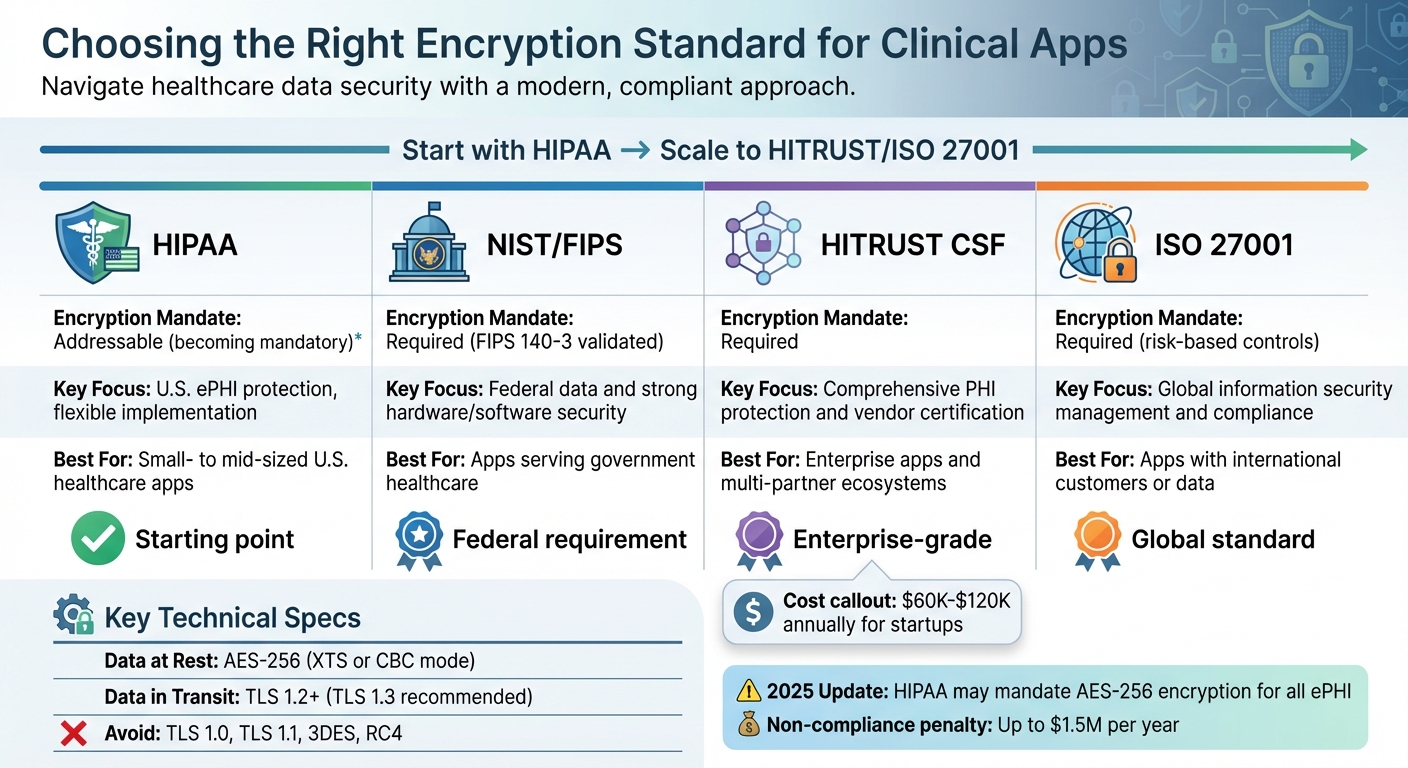
HIPAA vs NIST vs HITRUST vs ISO 27001 Encryption Standards Comparison
Choosing the right encryption standard means matching your clinical app's needs with the appropriate framework, considering both the sensitivity of the data and the operational environment. For handling U.S. ePHI, HIPAA’s addressable encryption provides a reliable starting point. However, more complex environments - such as federal, international, or multi-partner settings - might require adherence to NIST, HITRUST, or ISO 27001 standards.
Change is on the horizon. By 2025, HIPAA updates may require AES-256 encryption. Margaret Hales, J.D., suggests using a hybrid approach that combines HIPAA with NIST or HITRUST controls to counter emerging threats like phishing [13][2]. This highlights the growing importance of staying ahead with strong encryption practices.
The Office for Civil Rights (OCR) monitoring reveals a troubling trend: most healthcare breaches happen because encryption is either missing or insufficient. Annual OCR investigations often trace major breaches back to outdated encryption protocols, weak passwords, or inadequate logging practices [14]. Addressing these vulnerabilities can reduce the risk of breaches and the financial penalties that follow [1].
Here’s a quick comparison of the key standards:
Addressable (becoming mandatory)
U.S. ePHI protection, flexible implementation
Small- to mid-sized U.S. healthcare apps
Required (FIPS 140-3 validated)
Federal data and strong hardware/software security
Apps serving government healthcare
Required
Comprehensive PHI protection and vendor certification
Enterprise apps and multi-partner ecosystems
Required (risk-based controls)
Global information security management and compliance
Apps with international customers or data
For most healthcare organizations, starting with HIPAA compliance is a practical first step. As your app or organization scales, transitioning to HITRUST or ISO 27001 can provide broader security coverage and meet more demanding requirements. Tools like Censinet RiskOps™ can simplify this process by centralizing encryption management, automating audit logs, and handling third-party risk assessments. These solutions help ensure your clinical applications remain compliant and secure as standards and threats evolve.
FAQs
Does HIPAA require encryption today?
Yes, HIPAA mandates the encryption of all electronic Protected Health Information (ePHI) when it is stored, transmitted, or accessed remotely. This encryption requirement has been reinforced under the 2025 guidelines to provide stronger safeguards for sensitive patient information.
What qualifies as 'NIST-approved encryption' for safe harbor?
When we talk about NIST-approved encryption for safe harbor, we're referring to algorithms validated under FIPS 140-2. This includes encryption methods such as AES-256, Triple DES, and RSA, all of which align with NIST guidelines like SP 800-52 for encryption protocols. These standards are essential for meeting HIPAA requirements and ensuring the protection of sensitive data, such as Protected Health Information (PHI).
When should a clinical app pursue HITRUST or ISO 27001?
When developing a clinical app, pursuing HITRUST certification can showcase a strong security framework tailored to healthcare. This certification combines HIPAA requirements with well-known standards like NIST and ISO, making it particularly suited for managing healthcare-specific risks. It's especially valuable for cloud-based services that handle Protected Health Information (PHI).
On the other hand, ISO 27001 is a great choice for organizations aiming for a globally recognized, risk-focused approach to information security. It’s ideal for businesses with international operations or those needing to address a broader range of compliance requirements beyond healthcare-specific concerns.
Related Blog Posts
- How PHI Encryption Impacts System Performance
- Best Practices for End-to-End Encryption in Healthcare
- HIPAA Encryption Rules for Data in Transit
- Encryption in Transit: Compliance for Healthcare IT
{"@context":"https://schema.org","@type":"FAQPage","mainEntity":[{"@type":"Question","name":"Does HIPAA require encryption today?","acceptedAnswer":{"@type":"Answer","text":"<p>Yes, HIPAA mandates the encryption of all electronic Protected Health Information (ePHI) when it is stored, transmitted, or accessed remotely. This encryption requirement has been reinforced under the 2025 guidelines to provide stronger safeguards for sensitive patient information.</p>"}},{"@type":"Question","name":"What qualifies as 'NIST-approved encryption' for safe harbor?","acceptedAnswer":{"@type":"Answer","text":"<p>When we talk about <strong>NIST-approved encryption</strong> for safe harbor, we're referring to algorithms validated under <strong>FIPS 140-2</strong>. This includes encryption methods such as <strong>AES-256</strong>, <strong>Triple DES</strong>, and <strong>RSA</strong>, all of which align with NIST guidelines like <strong>SP 800-52</strong> for encryption protocols. These standards are essential for meeting <strong>HIPAA requirements</strong> and ensuring the protection of sensitive data, such as <strong>Protected Health Information (PHI)</strong>.</p>"}},{"@type":"Question","name":"When should a clinical app pursue HITRUST or ISO 27001?","acceptedAnswer":{"@type":"Answer","text":"<p>When developing a clinical app, pursuing <strong>HITRUST certification</strong> can showcase a strong security framework tailored to healthcare. This certification combines HIPAA requirements with well-known standards like NIST and ISO, making it particularly suited for managing healthcare-specific risks. It's especially valuable for cloud-based services that handle Protected Health Information (PHI).</p> <p>On the other hand, <strong>ISO 27001</strong> is a great choice for organizations aiming for a globally recognized, risk-focused approach to information security. It’s ideal for businesses with international operations or those needing to address a broader range of compliance requirements beyond healthcare-specific concerns.</p>"}}]}
