
Healthcare organizations juggle two critical priorities: safeguarding sensitive patient data and meeting strict privacy regulations. ISO 27001 and GDPR are two frameworks that, when combined, help achieve both goals effectively:
Together, they support healthcare providers in building a secure, compliant system. ISO 27001 offers a systematic way to manage security risks, while GDPR ensures legal accountability for protecting patient rights. Both frameworks overlap in areas like breach response and data protection measures, making their integration a practical choice for healthcare compliance.
Key Takeaways:
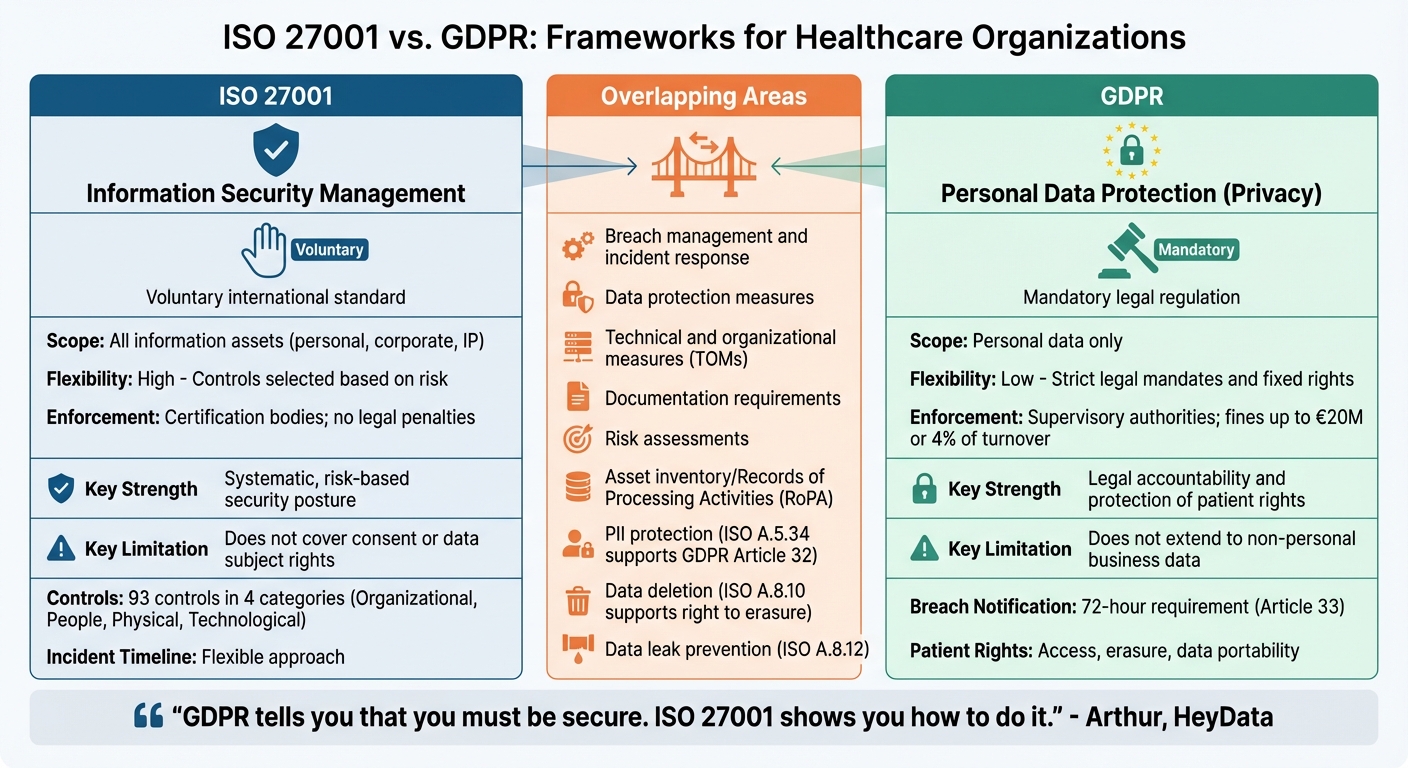
ISO 27001 vs GDPR: Key Differences and Overlap for Healthcare Compliance
1. ISO 27001
Scope and Purpose
ISO 27001 is an international standard offering healthcare organizations a structured way to establish and maintain an Information Security Management System (ISMS). It addresses the protection of all types of information assets - patient records, corporate data, intellectual property, and financial data - through a systematic, risk-based approach. This framework ensures security across organizational, human, physical, and technological domains [2].
The standard is voluntary, meaning organizations can choose to implement it. Many pursue certification as a way to demonstrate their dedication to safeguarding information. Certification involves an external audit by accredited bodies, remains valid for three years, and includes annual audits to ensure compliance [2].
These principles lay the groundwork for implementing the standard effectively.
Implementation Requirements
To adopt ISO 27001 in healthcare, organizations must take several key steps. First, they need to establish an ISMS that identifies threats and vulnerabilities unique to their operations. Based on this, they develop risk treatment plans tailored to mitigate these risks [1]. The 2022 version of ISO 27001 includes 93 controls, grouped into four categories: Organizational, People, Physical, and Technological [2].
Documentation plays a major role in the process. Healthcare providers must prepare an ISMS Scope to define boundaries, an Information Security Policy, a Risk Assessment Methodology, and a Statement of Applicability (SoA) [1]. On the technical side, implementing measures such as multi-factor authentication (MFA), role-based access control (RBAC), privileged access management (PAM), and encryption for data at rest and in transit is critical [1]. For patient data, additional controls like network segmentation, secure file transfer protocols, Data Loss Prevention (DLP) tools, and regular vulnerability scans are essential [1].
Incident Response and Breach Management
ISO 27001 also emphasizes a structured incident management process to detect, report, and respond to security events. Unlike GDPR's strict 72-hour notification rule, ISO 27001 allows flexibility in incident management timelines [2]. The standard focuses on continual improvement, urging organizations to refine their ISMS as new threats emerge and lessons are learned from past incidents [2].
Annex A of ISO 27001 includes controls directly tied to breach management. For instance, A.5.34 addresses privacy and the protection of personally identifiable information (PII), while A.8.12 focuses on preventing data leaks - both vital for managing patient data breaches [2][4]. Additionally, A.8.10 supports secure information deletion, aligning with patient rights like the "Right to Erasure" [4]. Maintaining detailed incident records is crucial, as they serve as evidence during ISO 27001 audits and regulatory reviews [4].
Healthcare-Specific Considerations
Healthcare settings come with unique challenges that ISO 27001 helps tackle. One major issue is "Shadow IT" - unapproved applications used by staff that may store sensitive patient data outside the organization's security protocols. Regular SaaS audits can identify these tools and close potential compliance gaps [4]. Control A.5.21 addresses risks from third-party software vendors by requiring supplier risk assessments and signed Data Processing Agreements [4].
To align ISO 27001 security measures with GDPR privacy requirements, organizations should assign dual ownership of data - one person for ISO 27001 compliance and another for GDPR compliance [3]. Additionally, incident response service level agreements should be calibrated to meet GDPR’s 72-hour breach notification rule, ensuring both frameworks are addressed with a unified approach [3].
sbb-itb-535baee
2. GDPR
Scope and Purpose
The General Data Protection Regulation (GDPR) is a legal framework designed to safeguard the personal data and rights of individuals within the European Union (EU). Unlike ISO 27001, which is a voluntary standard, GDPR is mandatory and applies to any organization - no matter where it's based - that processes the personal data of EU residents [1][3]. The regulation focuses on protecting the rights of data subjects, such as patients in the healthcare sector. Core principles include lawfulness, fairness, transparency, purpose limitation, data minimization, and storage limitation [1]. Essentially, this means organizations should only collect data that's absolutely necessary for a specific purpose and must clearly communicate how that data will be used.
GDPR also grants patients several rights, such as access to their medical records, the "right to be forgotten" (erasure of their data), and the ability to transfer their data to another provider (data portability) [1][5].
Under Article 32, healthcare organizations must implement both technical and organizational measures (TOMs) to protect sensitive patient data [5]. Arthur from HeyData puts it succinctly:
"GDPR tells you that you must be secure. ISO 27001 shows you how to do it."
This legal framework lays the groundwork for the detailed documentation and technical safeguards discussed in later sections.
Implementation Requirements
GDPR builds on its foundational principles with strict documentation and proactive compliance measures. Healthcare organizations are required to maintain Records of Processing Activities (RoPA), issue privacy notices, and track consent records [1][5]. For high-risk data processing - common in healthcare due to the sensitive nature of medical information - a Data Protection Impact Assessment (DPIA) is mandatory to evaluate potential risks to patients [3][5].
Many GDPR compliance tasks overlap with ISO 27001 controls, making it easier to align efforts. For instance, a unified asset register can simplify compliance for both GDPR and ISO 27001 [5]. Similarly, GDPR's RoPA aligns with ISO 27001's asset inventory requirements (Control A.5.9), reducing redundant work [4][5]. Specific ISO controls also directly support GDPR obligations:
These steps not only meet legal requirements but also enhance the structured approach promoted by ISO 27001.
Incident Response and Breach Management
GDPR enforces a strict rule: personal data breaches must be reported to supervisory authorities within 72 hours, as outlined in Article 33 [3][5]. This is far stricter than ISO 27001's more flexible incident management framework. Organizations need robust systems to detect and report breaches quickly to meet this deadline.
The financial penalties for non-compliance are steep. Fines can reach up to €20 million or 4% of an organization's annual turnover [2]. To illustrate, British Airways faced a £20 million fine, and Marriott International paid £18.4 million for GDPR violations in 2020 [2]. For healthcare providers, aligning incident response service level agreements (SLAs) with GDPR's 72-hour requirement is crucial to satisfy both legal and ISO 27001 obligations [3].
This tight timeline highlights the importance of integrated risk management strategies across frameworks.
Healthcare-Specific Considerations
Healthcare data is classified as sensitive personal data under GDPR, covering information such as health records and biometric data [2]. Due to the high-risk nature of processing this information, Article 35 often requires a DPIA. Healthcare organizations must incorporate a "harm to the data subject" dimension into their risk assessments, addressing both GDPR's patient-centered focus and ISO 27001's organizational risk management [3][5].
One common challenge in healthcare is the presence of Shadow IT - unauthorized applications that may handle patient data outside approved protocols. This can violate GDPR rules on consent and data processing [4]. Regular audits and a unified vendor questionnaire addressing both ISO 27001 and GDPR requirements can help close these gaps [5].
Tools like Censinet RiskOps™ offer integrated solutions, streamlining risk assessments for GDPR and ISO 27001. These platforms help healthcare providers protect patient data while simplifying compliance efforts.
How to integrate GDPR with ISO 27001 [live webinar]
Pros and Cons
When examining how ISO 27001 and GDPR function together in healthcare, it’s clear that each brings its own set of strengths and challenges. Understanding these helps organizations create a stronger, more integrated defense strategy.
ISO 27001 offers flexible, risk-based controls that cater to a variety of healthcare data needs. This adaptability allows organizations - whether small clinics or sprawling hospital systems - to implement security measures tailored to their specific risks. It doesn’t just focus on patient data but also protects intellectual property, financial records, and operational information. Achieving ISO 27001 certification signals a mature security posture to both patients and partners through a globally recognized standard.
GDPR, on the other hand, emphasizes strict legal mandates and patient rights. It holds organizations accountable with requirements like breach notifications within 72 hours and patient-focused rights such as data erasure and portability. These legal obligations ensure transparency and empower individuals, making GDPR a cornerstone of patient privacy.
Together, these frameworks work well as complementary tools. ISO 27001 focuses on technical controls - like encryption and access management - while GDPR prioritizes transparency, consent, and rights for data subjects. For instance, GDPR’s Article 32 requires “appropriate technical measures,” which ISO 27001 controls can help fulfill.
However, there are gaps. ISO 27001 certification alone doesn’t guarantee GDPR compliance. It lacks mechanisms for handling data subject access requests, implementing the “right to be forgotten,” or establishing a legal basis for processing personal data. Healthcare organizations must bridge this gap by integrating GDPR-specific policies into their ISO 27001 framework. This often involves assigning dual responsibilities: one team handles security, while another focuses on privacy, ensuring both technical and legal requirements are met.
Here’s a summary of how these two frameworks compare and overlap:
Feature
ISO 27001
GDPR
Information Security Management
Personal Data Protection (Privacy)
Voluntary international standard
Mandatory legal regulation
All information assets (personal, corporate, IP)
Personal data only
High: Controls selected based on risk
Low: Strict legal mandates and fixed rights
Certification bodies; no legal penalties
Supervisory authorities; fines up to €20M or 4% of turnover
Systematic, risk-based security posture
Legal accountability and protection of patient rights
Does not cover consent or data subject rights
Does not extend to non-personal business data
Conclusion
Healthcare organizations face the dual challenge of keeping sensitive data secure while adhering to strict legal requirements. ISO 27001 and GDPR offer a complementary approach to tackle these demands. ISO 27001 provides a structured, risk-based framework for managing security, while GDPR focuses on the legal obligations of protecting personal data. Together, they create a layered strategy that addresses both technical and privacy-related challenges.
"Privacy without security is fragile. Security without privacy is blind. The future lies in aligning both thoughtfully - not just on paper, but in practice." - Nojus Bendoraitis, General Counsel, Copla
Aligning these frameworks streamlines governance, reduces audit fatigue, and eliminates redundant efforts. By incorporating GDPR's Records of Processing Activities into ISO 27001's asset inventory, organizations can establish a unified data management system. Additionally, aligning incident response plans with both ISO 27001 standards and GDPR’s 72-hour breach notification rule ensures a cohesive and effective approach to handling potential breaches.
To achieve this integration, healthcare organizations can take practical steps. Conduct a unified gap analysis to evaluate current practices against both frameworks. Establish a joint Security and Privacy Committee to oversee compliance efforts. Use the Plan-Do-Check-Act cycle to fine-tune processes and controls continuously. This approach not only ensures compliance but also strengthens patient trust and demonstrates a strong security posture to partners and regulators.
Leveraging integrated risk management tools, like the capabilities provided by Censinet RiskOps™, can further simplify these efforts. These solutions help healthcare organizations protect patient data effectively while maintaining compliance with regulatory standards.
FAQs
Does ISO 27001 certification prove GDPR compliance?
ISO 27001 certification is not a direct ticket to GDPR compliance, but it can definitely support the process. This certification focuses on establishing a strong information security management system, which aligns with many GDPR principles. However, to fully comply with GDPR, organizations must go further. They need to ensure transparency, uphold data subject rights, and adhere to specific breach notification procedures. These additional steps are crucial for meeting GDPR requirements.
How can healthcare meet GDPR’s 72-hour breach reporting rule with an ISO 27001 ISMS?
Healthcare organizations can address GDPR's 72-hour breach reporting rule by aligning their compliance efforts with an ISO 27001-based Information Security Management System (ISMS). ISO 27001 offers a structured approach to managing risks, focusing on areas like incident response, continuous monitoring, and routine risk assessments.
By implementing clear procedures for detecting and reporting breaches - bolstered by automated tools and thorough staff training - healthcare providers can not only meet reporting deadlines but also enhance their overall data security practices.
What’s the quickest way to map ISO 27001 controls to GDPR requirements in healthcare?
To quickly align ISO 27001 controls with GDPR requirements in healthcare, the best approach is to create a crosswalk matrix. Start by focusing on critical areas like data security, access management, and incident response, and match them with GDPR principles such as data minimization and breach notification.
Leveraging automated tools or ready-made templates can make this process smoother. These resources help healthcare organizations spot overlaps, cut down on repetitive efforts, and streamline compliance efforts effectively.
Related Blog Posts
- GDPR vs HIPAA: Cloud PHI Compliance Differences
- GDPR vs. HIPAA: Key Differences for Healthcare
- GDPR vs. HIPAA: Cross-Border Breach Rules
- ISO 27001 vs HIPAA: Compliance in Healthcare
{"@context":"https://schema.org","@type":"FAQPage","mainEntity":[{"@type":"Question","name":"Does ISO 27001 certification prove GDPR compliance?","acceptedAnswer":{"@type":"Answer","text":"<p>ISO 27001 certification is not a direct ticket to GDPR compliance, but it can definitely support the process. This certification focuses on establishing a strong information security management system, which aligns with many GDPR principles. However, to fully comply with GDPR, organizations must go further. They need to ensure <strong>transparency</strong>, uphold <strong>data subject rights</strong>, and adhere to specific <strong>breach notification procedures</strong>. These additional steps are crucial for meeting GDPR requirements.</p>"}},{"@type":"Question","name":"How can healthcare meet GDPR’s 72-hour breach reporting rule with an ISO 27001 ISMS?","acceptedAnswer":{"@type":"Answer","text":"<p>Healthcare organizations can address GDPR's 72-hour breach reporting rule by aligning their compliance efforts with an ISO 27001-based Information Security Management System (ISMS). ISO 27001 offers a structured approach to managing risks, focusing on areas like incident response, continuous monitoring, and routine risk assessments.</p> <p>By implementing clear procedures for detecting and reporting breaches - bolstered by automated tools and thorough staff training - healthcare providers can not only meet reporting deadlines but also enhance their overall data security practices.</p>"}},{"@type":"Question","name":"What’s the quickest way to map ISO 27001 controls to GDPR requirements in healthcare?","acceptedAnswer":{"@type":"Answer","text":"<p>To quickly align ISO 27001 controls with GDPR requirements in healthcare, the best approach is to create a <strong>crosswalk matrix</strong>. Start by focusing on critical areas like <strong>data security</strong>, <strong>access management</strong>, and <strong>incident response</strong>, and match them with GDPR principles such as <strong>data minimization</strong> and <strong>breach notification</strong>.</p> <p>Leveraging <strong>automated tools</strong> or ready-made templates can make this process smoother. These resources help healthcare organizations spot overlaps, cut down on repetitive efforts, and streamline compliance efforts effectively.</p>"}}]}
