
Key Criteria for HIPAA Encryption Algorithm Selection
Post Summary
- HIPAA Compliance and Encryption: Encryption is an "addressable" requirement under HIPAA, meaning organizations must either encrypt electronic Protected Health Information (ePHI) or document equally protective alternatives. This applies to both stored data (data at rest) and data shared over networks (data in transit).
- NIST Guidelines: HIPAA relies on NIST standards to define encryption practices. For data at rest, AES-256 is a trusted standard. For data in transit, protocols like TLS 1.3, IPsec VPNs, and SSL VPNs are recommended.
- Safe Harbor Protection: Proper encryption can protect organizations from breach notifications under HIPAA's Safe Harbor rule. However, encryption keys must be securely managed and kept separate from the encrypted data.
-
Key Recommendations:
- Use AES-256 for strong encryption of ePHI.
- Ensure encryption tools are FIPS 140-2 or 140-3 validated.
- Maintain a minimum key length of 128 bits, but 256 bits is preferred for long-term security.
- Avoid Common Pitfalls: Failing to encrypt data or secure keys can lead to costly breaches and penalties, as seen in past enforcement actions.
- Long-Term Compliance: Encryption isn’t a one-time task. Regular risk assessments, key management, and updates to encryption standards are essential.
Encryption is critical for protecting sensitive healthcare data and maintaining compliance. The right algorithm, proper key management, and adherence to NIST standards are key to safeguarding ePHI.
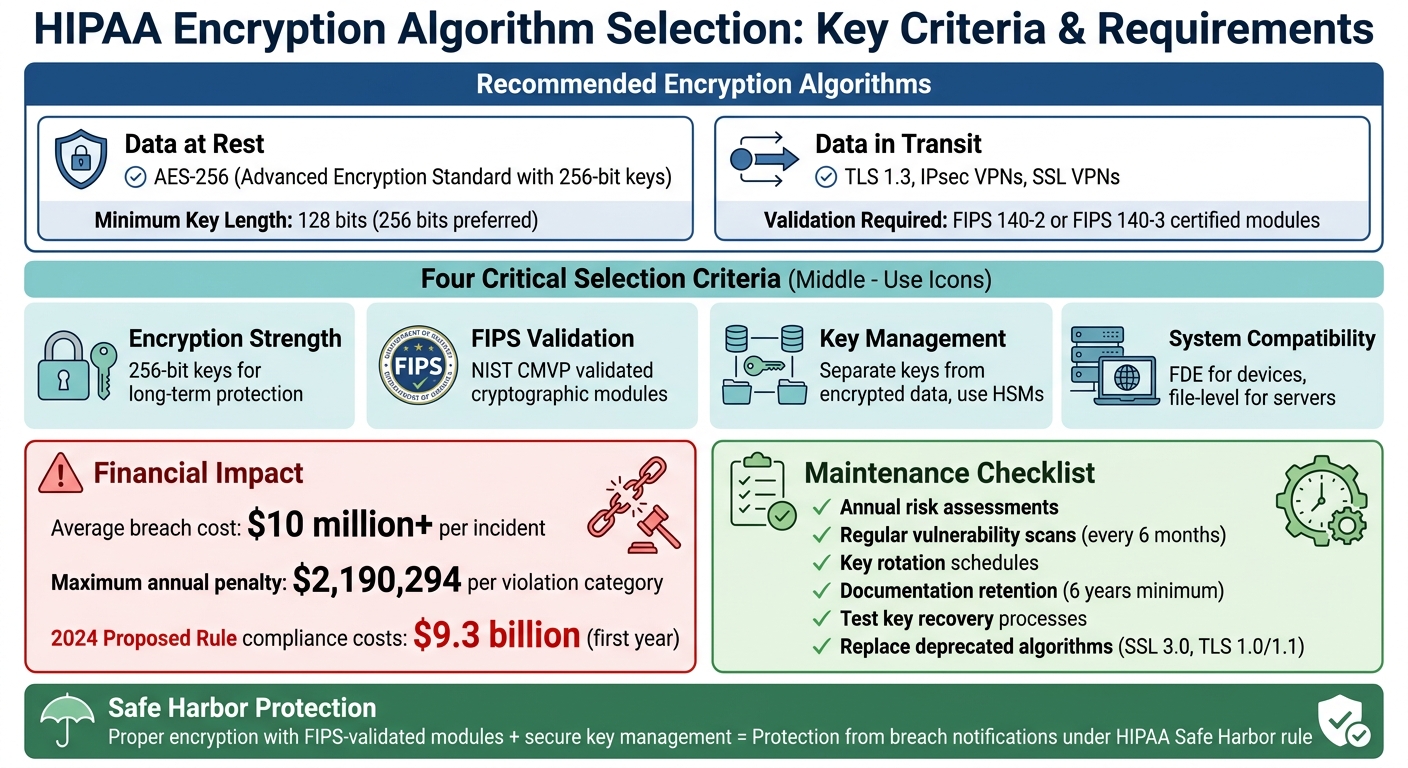
HIPAA-Compliant Encryption Algorithm Selection Criteria and Requirements
HIPAA Requirements: Encryption at Rest and in Transit #HIPAA #cybersecurity #breach #data #it #phi
sbb-itb-535baee
Recommended Encryption Algorithms
Following HIPAA's encryption mandates and NIST guidelines, this section highlights the recommended algorithms and key parameters for safeguarding sensitive healthcare data.
AES-256 for Symmetric Encryption
AES-256 (Advanced Encryption Standard with 256-bit keys) is the go-to choice for securing ePHI across servers, workstations, mobile devices, and backup media. NIST Special Publication 800-111 endorses AES specifically for protecting sensitive data on end-user devices and servers, making it a cornerstone of healthcare encryption practices.
While AES-128 also meets NIST standards, AES-256 offers an additional layer of security, especially critical for the long-term retention of healthcare data. This added strength helps guard against potential future advances in cryptanalysis.
"AES-256 encryption satisfies HIPAA requirements when properly implemented and, critically, qualifies PHI as 'unusable, unreadable, or indecipherable' under HHS guidance."
- Danielle Barbour, HIPAA Compliance Specialist at Kiteworks
By adopting AES-256, healthcare organizations can align their encryption practices with HIPAA's stringent requirements while ensuring robust data protection.
Minimum Key Lengths and Long-Term Protection
HIPAA mandates a minimum encryption key length of 128 bits, but using 256-bit keys is strongly advised for enhanced security. This applies to data stored on physical devices, in the cloud, and on portable storage media.
Longer keys provide a critical defense against future advances in computational power. Given the long-term nature of healthcare data retention and the high costs of breaches - averaging over $10 million per incident[2] - 256-bit keys strike a balance between security and performance. To ensure consistent protection, organizations should apply AES-256 encryption to all data at rest, including backups and archived files.
FIPS-Validated Cryptographic Modules
Encryption must be implemented using FIPS 140-2 or FIPS 140-3 validated cryptographic modules to meet HHS requirements for Safe Harbor provisions under HIPAA. These validations, managed by NIST's Cryptographic Module Validation Program (CMVP), confirm that the encryption algorithms are properly implemented and provide the expected level of security.
"FIPS 140-3 compliance requires a validated cryptographic module, not merely the use of an AES algorithm. An application using an unvalidated AES software library does not satisfy FIPS mandates for federal systems."
- Information Security Authority[4]
To ensure compliance, healthcare organizations should verify their encryption tools against the NIST CMVP validated modules database and document this validation as part of their risk assessments. This practice is essential for maintaining a defensible position during OCR audits.
For additional support, healthcare entities might consider risk management tools like Censinet RiskOps™ (https://censinet.com) to simplify documentation, monitor encryption practices, and stay aligned with HIPAA requirements.
Selection Criteria for HIPAA-Compliant Encryption Algorithms
Selecting the right encryption algorithm is about finding a balance between robust security and practical usability. Healthcare organizations need to weigh several technical and operational factors to ensure their encryption strategies protect ePHI while keeping systems functional. This section dives into how these considerations apply to algorithm selection, building on earlier recommendations.
Encryption Strength and Key Length
The strength of encryption determines how effectively it can resist unauthorized access. While HIPAA doesn’t specify exact algorithms, it points to NIST standards as a trusted guide. For data at rest, NIST Special Publication 800-111 provides key recommendations. For data in transit, organizations should follow NIST SP 800-52 (TLS), SP 800-77 (IPsec), or SP 800-113 (SSL VPNs) guidelines [2][7].
NIST advises using at least 128-bit keys, though 256-bit keys are the better choice for long-term security and meeting Safe Harbor requirements. To qualify for HIPAA’s breach notification Safe Harbor, encryption must render PHI "unusable, unreadable, or indecipherable" to unauthorized users. This requires using NIST-approved algorithms and cryptographic modules validated under FIPS 140-2 or FIPS 140-3 standards [2][6]. Proper key lengths and validated modules are essential for meeting these standards and avoiding mandatory breach notifications.
Encryption strength is just one part of the equation. The mode of operation also plays a critical role in how effectively data is secured.
Cryptographic Modes of Operation
The mode of operation dictates how data is processed and safeguarded. For data in transit, TLS 1.3 is the preferred choice. It eliminates outdated cipher suites, minimizes downgrade attack risks, and supports strong AES-256 encryption configurations [1][2]. For secure email communications, while TLS secures the transmission channel, additional content-layer encryption like S/MIME or PGP can provide an extra layer of security. However, this approach may add complexity [1].
System Compatibility and Performance
Once encryption strength is established, it’s crucial to ensure compatibility with existing systems. Organizations often choose between full-disk encryption (FDE) and file- or folder-level encryption. FDE, using tools like BitLocker or FileVault, is ideal for portable devices such as laptops and tablets. Meanwhile, file-level encryption offers more precise control, especially useful in server environments [1].
In BYOD (Bring Your Own Device) scenarios, deploying MDM (Mobile Device Management) software is key. MDM can enforce encryption policies and provide remote wipe capabilities for lost or stolen devices [1]. For cloud-based environments, it’s essential to separate encryption keys from the encrypted ePHI. Many organizations are adopting Customer-Owned Keys (HYOK) models, which give them full control over their encryption keys [2].
Encrypted archiving systems must remain searchable and indexed, allowing for easy record retrieval without compromising data security [1]. Tools like Censinet RiskOps™ (https://censinet.com) can help healthcare organizations streamline risk assessments and ensure their encryption practices stay aligned with HIPAA’s evolving standards.
Risk Assessment and Documentation Requirements
Choosing an encryption algorithm is just one part of the puzzle. To stay compliant and avoid hefty penalties - up to $2,190,294 per violation category per year - you'll also need to conduct formal risk assessments and maintain thorough documentation [1].
Threat and Vulnerability Analysis
Start by identifying every location where electronic Protected Health Information (ePHI) is stored or processed. This includes systems like EHR platforms, medical imaging systems (PACS), billing databases, email archives, backup media, and endpoint devices such as laptops or smartphones [2]. Once you've mapped these, evaluate potential threats. These might range from physical theft of devices to intercepted data during transmission over unsecured networks, or even unauthorized access to cloud-based systems [2][7].
Check whether your encryption methods align with NIST standards, and avoid outdated protocols. Pay close attention to key management. If encryption keys are stored alongside the encrypted data or are accessible to unauthorized individuals, your encryption won’t qualify for Safe Harbor protection [2]. Documenting these assessments not only strengthens compliance but also ensures informed decisions about encryption.
Documenting Encryption Decisions
Healthcare entities are required to keep records of encryption decisions, protected systems, and key management practices for at least six years to meet audit expectations [5]. If encryption is deemed unreasonable in a specific case, you must document the rationale and outline alternative measures that provide equivalent protection [2][5].
"Encryption is almost always reasonable and appropriate for ePHI. The documentation burden required to justify not encrypting PHI - combined with the loss of breach safe harbor protection - makes non-encryption a compliance risk."
– Danielle Barbour, HIPAA Compliance Specialist [2]
The stakes for poor documentation are high. For example, in July 2020, Lifespan Health System faced a $1,040,000 settlement with the OCR after a breach involving an unencrypted laptop. Even though a prior risk assessment recommended encryption, the organization failed to implement it or document an alternative, exposing 20,431 individuals’ ePHI [7]. Properly documenting risk assessments and encryption decisions is critical to maintaining compliance with HIPAA standards and retaining Safe Harbor protection.
Key Management Practices
Key management is essential for safeguarding encrypted data and involves four key stages: generation, active use, deactivation/archiving, and destruction [8]. To keep keys secure, store them in Hardware Security Modules (HSMs), ensuring they are isolated from protected systems [1][8]. Avoid storing keys in plaintext or alongside the encrypted data.
Set up and document key rotation schedules. Keys should be rotated regularly and immediately after any suspected compromise [1][8]. Use the least-privilege principle by assigning specific "key custodian" roles, and maintain tamper-evident logs of key access. These logs should detail who accessed the keys, when, and for what purpose [1][8]. If you’re operating in a cloud environment, consider a Customer-Owned Keys (HYOK) model. This ensures your keys remain under your control in organization-managed HSMs, preventing cloud providers from decrypting your data [2].
Tools like Censinet RiskOps™ can simplify the process by helping healthcare organizations maintain detailed documentation of their encryption practices and risk assessments, keeping them prepared for audits as standards evolve.
Monitoring and Updating Encryption Standards
Once encryption decisions and risk assessments are in place, continuous monitoring becomes essential to maintain HIPAA compliance. This ongoing process ensures the protection of electronic protected health information (ePHI) throughout its entire lifecycle.
Encryption isn’t a one-and-done task - it’s an ongoing responsibility for as long as ePHI exists.
Enabling Default Encryption
To safeguard data effectively, enable default encryption across all systems. This includes activating Full Disk Encryption (FDE) on end-user devices, configuring storage-layer database encryption, and encrypting backup media before it’s used externally. Additionally, ensure that systems automatically revert to an encrypted state after session timeouts [1].
Identifying Deprecated Algorithms
Outdated encryption algorithms create vulnerabilities. Conduct regular vulnerability scans - ideally every six months, as suggested by proposed regulations - to identify and address weak or deprecated algorithms like SSL 3.0, TLS 1.0, and TLS 1.1 [1][3]. Replace these with stronger options, such as AES-256 for data at rest and TLS 1.3 for data in transit [1][3]. Upgrading to TLS 1.3 eliminates outdated cipher suites and minimizes the risk of downgrade attacks. For RSA encryption, ensure a minimum modulus of 2,048 bits, in line with NIST SP 800-131A Rev 2 requirements [3].
These upgrades are essential for maintaining secure systems and ensuring compliance, while also laying the groundwork for verifying key recovery processes.
Testing Key Recovery Processes
HIPAA mandates that ePHI must remain accessible to authorized users when needed [5]. Losing encryption keys could render ePHI permanently inaccessible, leading to compliance violations [1]. To prevent this, regularly test your key recovery procedures, document each test, and verify the functionality of your Hardware Security Modules (HSMs). This ensures that systems can recover quickly during failures or ransomware attacks against healthcare delivery organizations [1].
"If keys are lost and ePHI becomes inaccessible as a result, you may also face a separate compliance problem: HIPAA requires that ePHI remain available to authorized users."
– Natasa Djalovic, Senior Content Writer, Jatheon [1]
Using advanced risk management platforms like Censinet RiskOps™ can further streamline the monitoring of encryption standards, allowing organizations to quickly identify and address vulnerabilities.
Conclusion
Summary of Selection Criteria
Choosing the right encryption algorithm to safeguard ePHI hinges on four key factors: the strength of the algorithm, FIPS validation, effective key management, and lifecycle protection. For data at rest, AES-256 is the preferred choice, while cryptographic modules validated under FIPS 140-2 meet the Breach Notification Safe Harbor requirements. It's also crucial to consider cryptographic modes of operation, compatibility with existing systems, and performance needs. These decisions should be informed by detailed risk assessments and supported by regular reviews to ensure compliance remains intact.
Historical enforcement actions highlight the importance of adhering to these practices. These criteria are not just for initial implementation - they serve as a foundation for maintaining compliance over time.
Maintaining Compliance Over Time
Encryption isn’t a one-and-done task; it’s an ongoing commitment. Data stored to meet HIPAA’s six-year retention rule requires the same level of protection as data actively in use. To stay compliant, organizations should conduct annual risk assessments, perform regular vulnerability scans to identify outdated algorithms, and enforce strict key management policies. This includes scheduled key rotations and immediate key revocations during employee offboarding [1]. Documenting these processes is as vital in daily operations as it was when the original risk assessments were conducted.
Regulations are becoming stricter, with the 2024 Proposed Rule aiming to make encryption universally mandatory, removing its "addressable" status. The projected first-year compliance costs are estimated at $9.3 billion, with civil penalties reaching up to $2,190,294 per violation category per year [1]. Staying proactive in meeting these evolving requirements is essential.
For organizations, tools like Censinet RiskOps™ can simplify compliance efforts. They help monitor encryption practices, identify vulnerabilities across internal systems and third-party vendors, and maintain the documentation needed to demonstrate compliance during audits. This kind of support ensures that healthcare entities can respond effectively to regulatory changes while protecting sensitive data.
FAQs
When does HIPAA actually require encryption for ePHI?
HIPAA identifies encryption of electronic protected health information (ePHI) as an addressable safeguard. This means organizations should apply it when it makes sense for their specific circumstances to protect sensitive data. Common encryption methods include AES-256 for securing data at rest and TLS 1.2 or higher for safeguarding data in transit. These measures are particularly important in cloud-based environments to maintain compliance and reduce the risk of data breaches.
What qualifies encryption for HIPAA Safe Harbor?
Encryption meets the HIPAA Safe Harbor requirements when it employs NIST-approved methods such as AES-256 for securing data at rest and TLS 1.3 for protecting data in transit. Additionally, encryption keys must be properly safeguarded to ensure that protected health information (PHI) cannot be accessed or understood by unauthorized individuals.
How should we manage and rotate encryption keys to stay compliant?
To meet HIPAA requirements, it's crucial to handle encryption keys with care. Start by storing keys separately from the encrypted data to reduce risks. Use tools like hardware security modules (HSMs) or cloud-based key management systems (KMS) for secure storage. These solutions offer added layers of protection.
Make sure to automate key rotation - this not only lowers the risk of key compromise but also aligns with NIST guidelines. Additionally, enforce strict access controls and implement safeguards like multi-factor authentication to limit unauthorized access.
Stay proactive by regularly updating your encryption policies and conducting risk assessments. These steps help identify vulnerabilities and ensure your encryption practices remain strong and compliant.

