
Cybersecurity in healthcare has shifted from being an IT issue to a leadership priority. The updated NIST Cybersecurity Framework (CSF) 2.0 introduces a new core function, "Govern", which places responsibility for cybersecurity directly on senior executives and boards. This change ensures that cybersecurity is treated as an enterprise risk that requires strategic oversight, funding, and accountability at the highest level.
Key updates in NIST CSF 2.0 include:
- "Govern" as a standalone function: Elevates governance from a sub-category under "Identify" in version 1.1, making it central to all cybersecurity efforts.
- Leadership accountability: Senior leaders must define risk tolerance, allocate resources, and oversee cybersecurity strategies.
- Focus on supply chain security challenges: Organizations must now manage vendor security more rigorously, addressing growing vulnerabilities in software and medical device supply chains.
- Tailored for healthcare: Aligns with regulatory goals to prioritize patient safety and data protection.
In healthcare, this shift requires a leadership-driven approach to cybersecurity, with clear metrics, cross-departmental collaboration, and a focus on preventing breaches, which averaged $3.84 million in costs in 2024. By integrating governance into their strategies, healthcare organizations can better protect patient data and mitigate risks.
1. NIST CSF 1.1
Leadership Accountability
In the earlier version of the NIST Cybersecurity Framework (CSF 1.1), cybersecurity was often treated as just an IT issue rather than a broader enterprise risk. This perspective left IT directors without the necessary executive support to secure funding or prioritize cybersecurity measures. Richard Mendoza highlighted the problem:
"For years, IT directors tried to push security 'up' to the board. It failed. Budgets were cut, and risks were ignored" [3].
Without leadership buy-in, cybersecurity initiatives lacked the authority and resources to succeed. This gap between technical teams and top executives left critical vulnerabilities unaddressed, creating a weak foundation for effective governance.
Governance Integration
Governance, under NIST CSF 1.1, was treated as a minor component rather than a central pillar. It was categorized under "Identify" as a sub-category, which reduced its role to a procedural checkbox. Richard Mendoza explained:
"In NIST CSF 1.1 (The Old Way): Governance was a small sub-category tucked away inside the 'Identify' function. It was treated as a paperwork exercise - 'Do we have a policy? Check.'" [3].
This approach often led organizations to focus on whether policies existed in name rather than ensuring they were actively enforced. The result? A superficial governance process that added complexity to security systems and diminished the framework’s overall impact.
Healthcare-Specific Applications
The challenges of NIST CSF 1.1 were even more pronounced in healthcare settings. For example, the "Identify" function was particularly difficult to implement due to issues with medical device security risks. Accuracy rates for connected and connectable clinical assets were alarmingly low, with errors reaching up to 40% [1][2]. Without reliable visibility into these devices, healthcare leaders struggled to assess risks or establish effective security controls. This lack of clarity weakened the framework’s ability to address the unique needs of clinical environments.
Risk Management Execution
The lack of proactive planning under NIST CSF 1.1 often forced healthcare organizations into a reactive stance. Security tools were typically deployed after incidents occurred, leading to fragmented systems riddled with overlapping solutions and security gaps [3]. This patchwork approach further undermined the framework’s effectiveness in mitigating risks.
sbb-itb-535baee
2. NIST CSF 2.0
Leadership Accountability
NIST CSF 2.0 emphasizes the critical role of leadership in cybersecurity. A key update is the introduction of "Govern" as a sixth core function, which places responsibility for cybersecurity directly on senior leadership and boards. This addition ensures that executives are actively involved in shaping, communicating, and overseeing the organization's cybersecurity strategy. By doing so, cybersecurity evolves from being an IT-centric issue to a broader enterprise risk that demands attention at the highest levels.
Scott Trevino, Senior Vice President of Cybersecurity at TRIMEDX, highlighted this shift:
"The govern function encourages leadership to take an active role in guarding against cyber threats, by making sure their organization's cyber strategy, expectations, and policies are established, communicated, and monitored" [1].
This top-down approach replaces the traditional model where IT departments often led the charge for cybersecurity funding and initiatives. Now, leadership accountability ensures more robust executive involvement.
Governance Integration
In NIST CSF 1.1, governance was treated as a sub-category under "Identify." However, version 2.0 elevates "Govern" to a standalone function that influences all five original functions - Identify, Protect, Detect, Respond, and Recover. This shift enables streamlined decision-making and fosters quicker, more coordinated responses to cyber threats.
Additionally, supply chain risk management has been upgraded from a minor sub-category to a major focus area (GV.SC). This necessitates effective third-party risk assessments to ensure vendor compliance. This change holds organizations, including healthcare providers, accountable for the cybersecurity of their vendors, whether they manage payroll or produce medical devices. Richard Mendoza, Senior vCISO at CompassMSP, explained:
"The addition of the 'Govern' function explicitly states that cybersecurity is no longer a technical problem to be solved by your IT department. It is an enterprise risk that must be owned, funded, and overseen by senior leadership" [3].
This centralized governance model not only refines internal processes but also addresses the unique challenges of managing risks in sectors like healthcare.
Healthcare-Specific Applications
NIST CSF 2.0 directly addresses the specific needs of the healthcare sector by requiring organizations to tailor their governance frameworks to their mission and stakeholder expectations. For healthcare, this includes prioritizing patient safety and data protection. This leadership-driven approach ensures that cybersecurity strategies are designed for clinical settings rather than relying on generic solutions.
The framework also aligns with the HHS Healthcare and Public Health Sector Cybersecurity Performance Goals (HPH CPGs), offering healthcare organizations a clear path to meet regulatory requirements. This alignment supports compliance while tackling challenges such as maintaining accurate medical device inventories.
By incorporating these healthcare-specific strategies, the framework ensures risk management is not only actionable but also integrated into the organization's overall mission.
Risk Management Execution
The "Govern" function transforms risk management into a proactive process. Healthcare leaders are now tasked with establishing clear metrics and Key Performance Indicators (KPIs) to measure the effectiveness of cybersecurity programs. These metrics provide transparency and enable data-driven reporting to senior leadership [1].
Another critical aspect is the enhancement of incident communication protocols. By integrating incident response across all departments, rather than isolating it within IT, organizations can respond faster and improve collaboration. Tools like Censinet RiskOps™ support this unified approach by offering centralized risk visualization and automated workflows that align with NIST 2.0's governance standards.
This focus on measurable outcomes and proactive planning ensures that leadership plays a central role in strengthening healthcare cybersecurity practices.
How to Plan Cybersecurity in Healthcare: SOC Plan, Ransomware Lessons & Risk Strategy
Pros and Cons
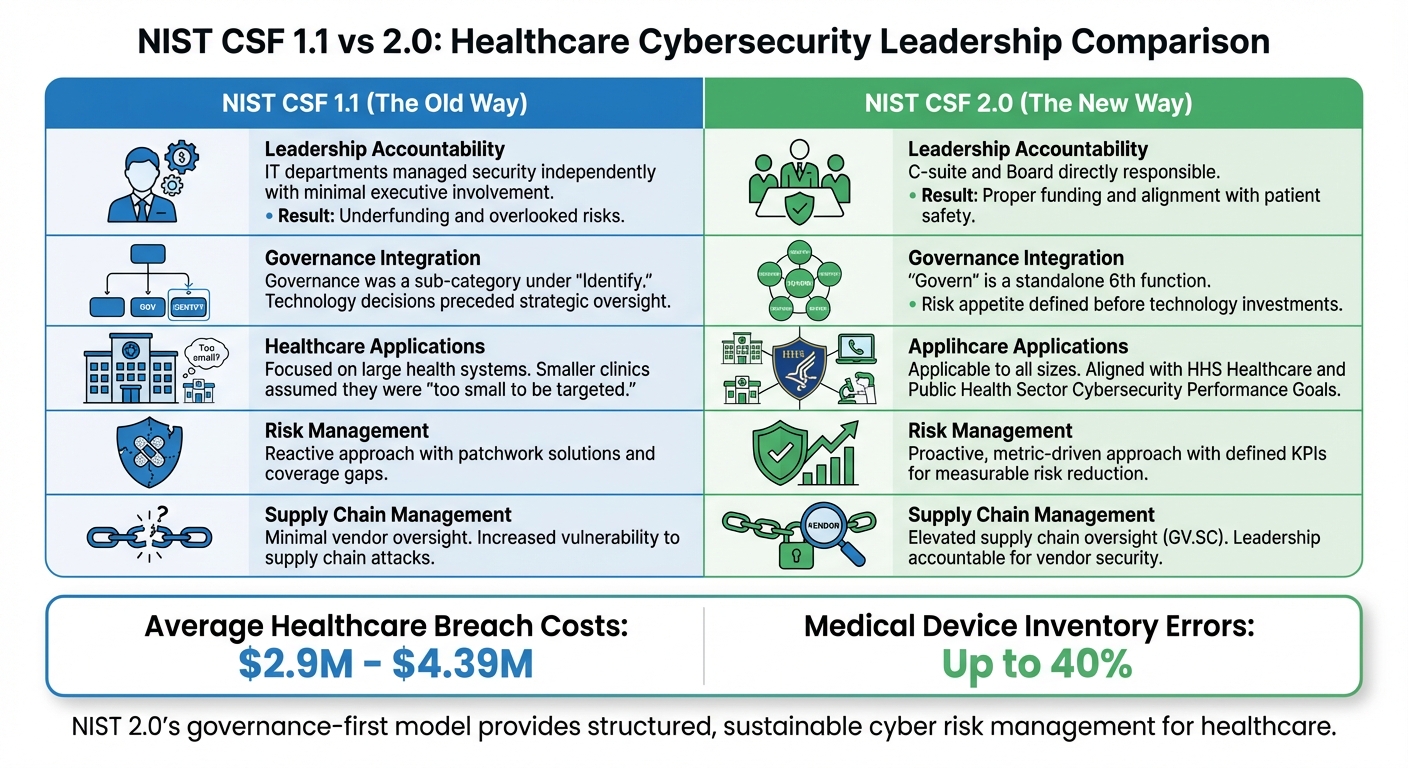
NIST CSF 1.1 vs 2.0: Key Differences for Healthcare Cybersecurity Leadership
The transition from NIST CSF 1.1 to 2.0 marks a notable shift in how healthcare organizations approach cybersecurity leadership. This change directly influences strategic decisions at the leadership level.
Below is a table comparing key aspects of NIST CSF 1.1 and 2.0 in the healthcare context:
| Aspect | NIST CSF 1.1 | NIST CSF 2.0 |
|---|---|---|
| Leadership Accountability | Pros: IT departments independently managed technical security with minimal executive involvement. Cons: Cybersecurity was often isolated within IT, leading to underfunding and overlooked risks. |
Pros: Cybersecurity now falls under the direct responsibility of the C-suite and Board, ensuring proper funding and alignment with patient safety objectives. Cons: Expanding responsibility outside IT requires senior leaders to integrate cybersecurity into their broader strategic roles. |
| Governance Integration | Pros: The simpler five-function structure was easier for technical teams to adopt initially. Cons: Governance was only a sub-category under "Identify", which sometimes led to technology decisions preceding strategic oversight. |
Pros: The new "Govern" function ensures that risk appetite is defined before making technology investments, creating a unified strategy. Cons: If leadership integration is delayed, complex systems could lead to higher breach costs [3]. |
| Healthcare-Specific Applications | Pros: Focused on critical infrastructure, which benefited large health systems. Cons: Smaller clinics often assumed they were "too small to be targeted", neglecting necessary security measures. |
Pros: Now applicable to organizations of all sizes, with alignment to HPH Cybersecurity Performance Goals providing a clear compliance path. Cons: Smaller practices must meet the same standards as larger hospitals, potentially requiring unplanned resource investments. |
| Risk Management Execution | Pros: A reactive approach allowed organizations to address immediate threats without extensive planning. Cons: This bottom-up approach often resulted in patchwork solutions and coverage gaps. |
Pros: A proactive, metric-driven approach enables measurable risk reduction through defined KPIs. Cons: Inaccurate medical device inventories - reported to be off by as much as 40% - can hinder precise governance baselines [2]. |
| Supply Chain Management | Pros: Minimal vendor oversight reduced administrative complexity. Cons: Limited vendor accountability increased vulnerability to supply chain attacks. |
Pros: By elevating supply chain oversight (GV.SC), leadership is now directly accountable for vendor security, addressing growing supply chain risks [3]. Cons: Establishing comprehensive vendor risk management programs requires significant resources and ongoing audits. |
Breach costs range from $2.9 million to $4.39 million [3], depending on how effectively organizations respond to incidents. This financial reality highlights the importance of NIST 2.0's governance-first model, which offers a more structured and sustainable way for healthcare organizations to manage cyber risks. Tools like Censinet RiskOps™ can ease this transition by centralizing risk visualization and automating workflows, ensuring alignment with NIST 2.0's governance standards and simplifying the adoption of the updated framework.
Conclusion
The updated NIST CSF 2.0 framework shifts the responsibility for cybersecurity from IT departments to senior leadership by making governance a central function. Previously, governance was tucked away as a sub-category under "Identify", often viewed as an IT-specific task rather than a strategic priority. With NIST 2.0, governance takes center stage, emphasizing that safeguarding patient data requires direct involvement from the C-suite and Board. This change calls for active engagement and decision-making from top executives.
Healthcare leaders now need to clearly define their organization's risk tolerance and assign cybersecurity duties across various departments - not just IT. This includes HR, Legal, and executive leadership roles [3]. Setting up quarterly reporting systems, where key cybersecurity metrics and KPIs are shared with the Board, ensures that leadership remains informed about the program’s progress and effectiveness [1][2]. Tackling inventory challenges and achieving full asset visibility is another crucial step in this process.
To support this governance-focused approach, Censinet RiskOps™ offers tools to centralize risk visualization, streamline workflows, and promote collaboration. This ensures that healthcare cybersecurity efforts are aligned with both patient safety and financial considerations. By treating cybersecurity as a strategic, leadership-driven initiative rather than a reactive IT issue, healthcare organizations can better protect patient data while addressing the financial impact of breaches, which average around $3.84 million per incident [3].
FAQs
What should the Board oversee under the new “Govern” function?
The new "Govern" function places the Board at the center of key cybersecurity responsibilities. This includes making leadership-driven decisions, conducting regular risk assessments, defining roles clearly, allocating necessary resources, and maintaining oversight at the board level. These actions help healthcare organizations stay ahead in addressing cybersecurity risks effectively.
Which cybersecurity KPIs should healthcare leaders report quarterly?
Healthcare leaders need to consistently track and share key cybersecurity metrics to maintain and improve resilience. Reporting these metrics quarterly ensures a clear picture of their organization's security posture. Some of the most critical indicators include:
- Mean Time to Contain (MTTC): Measures how quickly threats are contained after detection.
- Patch Compliance: Tracks the percentage of systems updated with the latest security patches.
- Incident Response Time: Evaluates how swiftly the team responds to potential security events.
- Breach Detection and Reporting Time: Assesses how long it takes to identify and report breaches.
- Medical Device Security Adoption: Indicates progress in securing connected medical devices.
By keeping a close eye on these metrics, healthcare organizations can strengthen their defenses, protect patient data, and ensure the reliability of critical systems.
How can we improve medical device inventory accuracy for NIST 2.0?
To align with NIST 2.0 standards, healthcare organizations need to prioritize risk management and supply chain security. Here’s how they can achieve better inventory accuracy:
- Conduct Regular Risk Assessments: Evaluate potential risks associated with medical devices to identify vulnerabilities.
- Monitor Supply Chain Weaknesses: Keep a close eye on supply chain processes to address any security gaps.
- Maintain Precise Documentation: Ensure all devices are accurately documented to avoid errors and improve tracking.
Using tools like Censinet RiskOps™ can make this process smoother. These tools help by automating vendor assessments, centralizing critical data, and simplifying compliance with NIST 2.0 requirements.
