
When it comes to cybersecurity in healthcare, choosing the right framework is critical. Healthcare delivery organizations (HDOs) often rely on two NIST frameworks: NIST CSF and NIST 800-53. Here's a quick breakdown:
- NIST CSF: Focuses on high-level cybersecurity goals. It's flexible, easier to implement, and ideal for small to medium-sized organizations or those starting their cybersecurity journey.
- NIST 800-53: Provides detailed technical controls (1,189 in total) across 20 categories. It's mandatory for federal contractors and best suited for larger HDOs with complex systems.
Both frameworks help secure patient health information (PHI) and align with regulations like HIPAA. While NIST CSF is outcome-driven, NIST 800-53 is more prescriptive, offering in-depth guidance for compliance and security.
Quick Comparison
| Feature | NIST CSF | NIST 800-53 |
|---|---|---|
| Focus | High-level goals | Detailed technical controls |
| Implementation Effort | Lower | Higher |
| Flexibility | High | Low |
| Mandatory? | No (voluntary) | Yes (for federal systems) |
| Best For | Small/medium organizations | Large/federal contractors |
For many HDOs, combining both frameworks offers the best of both worlds: strategic planning with NIST CSF and technical execution with NIST 800-53. Organizations can further validate their progress by measuring performance against cybersecurity benchmarks.
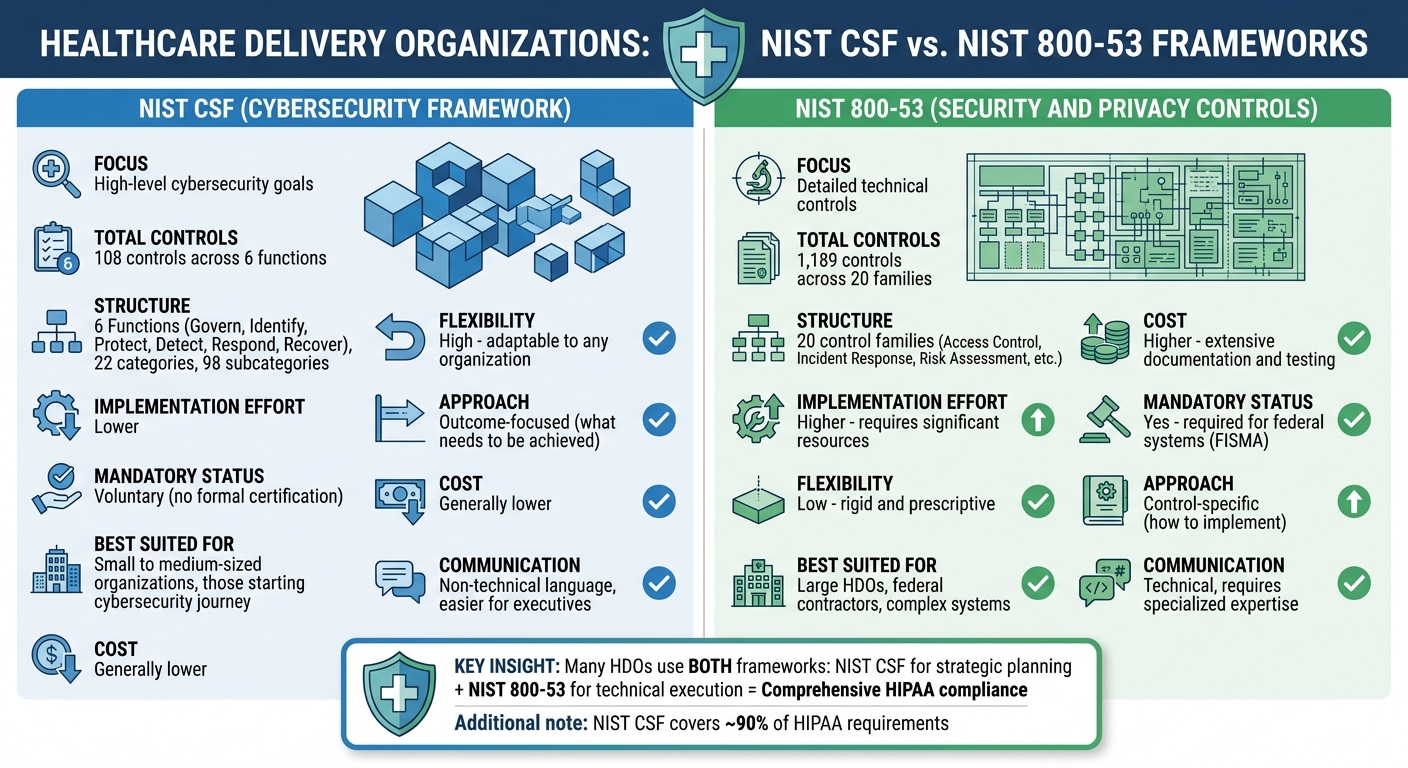
NIST CSF vs NIST 800-53 Framework Comparison for Healthcare Organizations
NIST CSF vs 800-53 vs 800-171: Side-by-Side Comparison
sbb-itb-535baee
How NIST CSF and NIST 800-53 Are Structured
To choose the right framework, healthcare delivery organizations (HDOs) need to understand how NIST CSF and NIST 800-53 are organized. These frameworks take distinct approaches: NIST CSF emphasizes high-level goals, while NIST 800-53 dives into detailed technical controls. Here's a closer look at their structures.
The 6 Functions of NIST CSF
NIST CSF breaks cybersecurity into six key functions: Govern, Identify, Protect, Detect, Respond, and Recover. The "Govern" function was introduced in version 2.0. These functions provide a top-down perspective that aligns technical efforts with organizational goals, making them accessible to both IT teams and executives.
For HDOs, these functions translate into actionable steps. For example:
- Identify: Pinpoint critical assets like patient data, medical devices, and clinical systems.
- Protect: Implement safeguards to prevent breaches.
- Detect: Monitor for unusual or malicious activity.
- Respond: Address incidents, such as ransomware attacks.
- Recover: Restore systems and operations after disruptions.
The framework focuses on what needs to be achieved, offering flexibility in how to accomplish those goals. This adaptability makes it suitable for organizations of all sizes, allowing HDOs to align cybersecurity efforts with their unique risks and compliance needs.
The 20 Control Families in NIST 800-53
Unlike the outcome-driven NIST CSF, NIST 800-53 takes a more prescriptive approach. Its Revision 5 organizes 1,189 controls into 20 specific control families, each targeting a particular security domain. For instance:
- The Access Control (AC) family defines rules for who can access sensitive health information.
- The Incident Response (IR) family outlines procedures for managing breaches or ransomware incidents [3].
The 20 control families include:
- Access Control
- Awareness and Training
- Audit and Accountability
- Security Assessment and Authorization
- Configuration Management
- Contingency Planning
- Identification and Authentication
- Incident Response
- Maintenance
- Media Protection
- Physical and Environmental Protection
- Planning
- Personnel Security
- Risk Assessment
- System and Services Acquisition
- System and Communications Protection
- System and Information Integrity
- Supply Chain Risk Management
- Program Management
- Privacy Control [1]
This detailed structure provides the technical foundation needed to secure complex healthcare systems. As Anchore explains, NIST 800-53 serves as a versatile base not only for federal standards like FedRAMP but also for healthcare and commercial standards like HIPAA and PCI DSS [1]. However, Anchore also notes that applying all these controls is a significant undertaking - potentially requiring full-time effort over several years - making it a better fit for larger HDOs with dedicated security teams and strict compliance demands [1].
When HDOs Must Use Each Framework
Deciding between NIST CSF and NIST 800-53 often depends on legal mandates and the strategic needs of your organization. While one framework might be required in specific scenarios, the other offers a more adaptable way to strengthen your cybersecurity efforts.
When NIST 800-53 Is Required
NIST 800-53 is mandatory for HDOs that manage federal information systems or act as government contractors. This requirement applies across all U.S. federal information systems, agencies, departments, and their contractors, as stipulated by the Federal Information Security Management Act (FISMA). FISMA sets the standards for safeguarding sensitive information within federal environments [5].
Even though FISMA doesn’t require private-sector HDOs to use NIST 800-53, many adopt it to meet HIPAA's "reasonable and appropriate" safeguard expectations [5][6]. With over 1,000 security and privacy controls spread across 20 families, this framework provides a thorough guide for organizations aiming to demonstrate due diligence, whether during audits by the Office for Civil Rights or in legal proceedings. For HDOs working with federal systems or under government contracts, compliance with NIST 800-53 is a non-negotiable baseline.
When NIST CSF Is Chosen Voluntarily
NIST CSF is a voluntary framework designed to help HDOs align their cybersecurity strategies with industry best practices while staying ahead of regulatory changes. In fact, regulators may soon revise the HIPAA Security Rule to explicitly acknowledge frameworks like NIST CSF as compliance benchmarks. As noted by The HIPAA E-Tool:
Regulators may more explicitly recognize frameworks like NIST and could promote or reference them as benchmarks for 'reasonable and appropriate' safeguards
[6].
HDOs often turn to NIST CSF for its flexibility in addressing emerging threats, such as double-extortion ransomware, vulnerabilities in telehealth systems, and risks tied to connected medical devices. Unlike the exhaustive 1,000+ controls of NIST 800-53, NIST CSF allows organizations to tailor their approach while still meeting HIPAA’s key requirements for enterprise-wide risk analysis and management. This adaptability helps document risk-based security decisions, which can serve as a strong defense in legal or regulatory challenges. With enforcement becoming more rigorous [6], adopting NIST CSF demonstrates a proactive commitment to recognized standards, even when not legally mandated. This sets the stage for understanding how these frameworks can work together for comprehensive compliance.
Main Differences Between NIST CSF and NIST 800-53
Grasping the key differences between these two frameworks helps healthcare delivery organizations (HDOs) determine which framework aligns better with their operational goals and compliance needs.
Outcome-Focused vs. Control-Specific Approaches
The NIST Cybersecurity Framework (CSF) emphasizes achieving specific outcomes, like detecting and responding to incidents, without dictating the exact methods to get there. This flexibility allows HDOs to tailor their risk management strategies and communicate effectively with non-technical leadership.
On the other hand, NIST 800-53 takes a more prescriptive approach by laying out detailed technical, operational, and management controls. As ComplianceForge puts it, "NIST CSF is a 'dumbed down' and civilianized version of NIST 800-53." Revision 5 of NIST 800-53 includes 1,189 individual controls [3], offering a comprehensive blueprint for compliance, especially useful during audits or legal proceedings. This distinction becomes even more apparent when considering how these frameworks scale across organizations of varying sizes.
Flexibility for Different Organization Sizes
NIST CSF is built to accommodate organizations of all sizes and maturity levels. With its straightforward language and scalable structure - organized into 22 categories and 98 subcategories [4] - it’s ideal for teams looking to prioritize initiatives based on their specific risk tolerance and operational needs.
In contrast, NIST 800-53's extensive control catalog demands significant resources, expertise, and time to implement. Its granular requirements make it more suitable for large HDOs with established security programs or those handling federal data, where comprehensive coverage across 20 control families is essential. This is particularly critical when managing security threats in third-party vendor relationships. For smaller organizations, the sheer volume of requirements can be overwhelming unless they’re pursuing government contracts.
Comparison Table: Pros and Cons for HDOs
Here’s a side-by-side look at how these frameworks differ:
| Feature | NIST CSF | NIST 800-53 |
|---|---|---|
| Primary Focus | Risk management outcomes | Prescriptive security controls |
| Implementation Effort | Lower; relies on self-assessments, no formal audits | Higher; requires significant resources and rigorous testing |
| Flexibility | High; works for any size or sector | Low; rigid and prescriptive |
| Detail Level | Broad; 98 subcategories | Highly detailed; 1,189 controls |
| Regulatory Status | Voluntary (unless required by contracts) | Mandatory for federal systems; a benchmark for HDOs |
| Target HDO Size | Small to medium; adaptable | Large/enterprise; structured |
| Stakeholder Communication | Easier; uses non-technical language | More technical; needs specialized expertise |
| Cost to Implement | Generally lower; no formal certification needed | Higher; requires extensive documentation and testing |
Combining NIST CSF and NIST 800-53 for Compliance
Pairing NIST CSF with NIST 800-53 creates a powerful compliance framework by merging NIST CSF's high-level strategy (what needs to be done) with NIST 800-53's detailed controls (how to do it). Together, they help healthcare delivery organizations (HDOs) meet multiple regulatory requirements, including HIPAA and FISMA.
How to Map NIST CSF to NIST 800-53
The two frameworks align through direct mappings between NIST CSF subcategories and NIST 800-53 control families. For example, subcategories related to identity and access management can be tied to specific control families in NIST 800-53. NIST CSF's six core functions - Govern, Identify, Protect, Detect, Respond, and Recover - serve as a way to present overarching goals to leadership. Meanwhile, technical teams can focus on implementing the detailed controls outlined in NIST 800-53 to achieve those goals. Using this mapping approach sets the stage for further compliance work with official crosswalks.
Using Crosswalks for HIPAA Compliance
Once the mapping is in place, official HHS crosswalks further align NIST CSF subcategories and NIST 800-53 controls with HIPAA safeguards. These crosswalks outline how specific controls meet HIPAA's administrative, physical, and technical requirements, helping HDOs design a security program that not only complies with regulations but also protects patient data effectively.
"By mapping your HIPAA requirements to the NIST framework, you create a defense that satisfies the regulators and actually protects your patients." - Emily Zaczynski, vCISO, Compass MSP [7]
HDOs that fully adopt NIST frameworks often go beyond the minimum standards set by the HIPAA Security Rule. In fact, implementing NIST CSF typically covers about 90% of HIPAA compliance, leaving only a few HIPAA-specific areas like breach notification and patient rights to address [7]. This approach not only ensures compliance but also strengthens defenses against threats like ransomware by unifying risk management teams.
How to Choose the Right Framework for Your HDO
Selecting between NIST CSF and NIST 800-53 depends on your regulatory requirements, organization size, and cybersecurity maturity. Many HDOs find value in using both frameworks to create a strong security program.
When to Choose NIST CSF
NIST CSF is a great fit for smaller HDOs or those just beginning to establish their cybersecurity program. With only 108 controls [8], it provides a manageable entry point without overwhelming your team. Its focus on outcomes rather than technical specifics makes it easier to explain cybersecurity priorities to non-technical stakeholders like board members or executives.
"NIST CSF works great for smaller and unregulated businesses that just want to align with a recognized cybersecurity framework."
- ComplianceForge
If your HDO doesn’t handle federal contracts and prefers flexibility, NIST CSF allows you to adapt controls to your unique environment. It also helps unify communication across departments - whether IT, legal, or clinical operations - by establishing a shared understanding of key cybersecurity goals in healthcare.
When to Choose NIST 800-53
NIST 800-53 is essential if your HDO is a federal contractor or manages federal data under FISMA [2]. Check your contracts for clauses related to DFARS, FISMA, or NIST 800-171 before deciding. Even without federal requirements, larger HDOs with complex IT systems often lean toward NIST 800-53 for its detailed guidance. With 1,189 controls [8], it provides thorough instructions for implementing and formalizing security measures.
"NIST 800-53, often considered the gold standard for cybersecurity on a global scale, offers a set of security controls and guidelines."
- Omar Ijaz, Security Expert
NIST 800-53 also serves as a versatile foundation for aligning with multiple compliance frameworks. Often described as a "super-set" of ISO 27002, it includes all ISO components and additional requirements. This compatibility with standards like HIPAA, PCI DSS, and CMMC can streamline compliance efforts and reduce duplication. For many HDOs, combining NIST CSF and NIST 800-53 delivers the best balance of security and compliance.
Using Both Frameworks with Censinet RiskOps™
To leverage the strengths of both frameworks, many HDOs use NIST CSF for strategic planning and NIST 800-53 for technical implementation. This dual approach ensures comprehensive compliance and effective risk management. Censinet RiskOps™ simplifies this process by centralizing risk assessments, mapping controls between frameworks, and tracking compliance progress.
Through automated workflows, Censinet RiskOps™ eliminates the need for manual cross-referencing. For instance, it identifies which NIST 800-53 controls align with specific NIST CSF subcategories. This streamlined visibility helps manage risks tied to patient data, medical devices, and clinical applications while ensuring alignment with HIPAA and other healthcare regulations.
Conclusion
Each framework discussed has its own strengths when it comes to managing healthcare cybersecurity risks. This includes conducting effective third-party risk assessments to ensure vendor compliance. Choosing between NIST CSF and NIST 800-53 largely depends on what your organization needs. NIST CSF takes a flexible, outcome-oriented approach, making it a great fit for smaller organizations or those just starting to build their cybersecurity programs. On the other hand, NIST 800-53 - with its 1,189 controls spanning 20 families - delivers the technical depth required for federal agencies and large healthcare systems [3].
For healthcare delivery organizations (HDOs) handling federal data under FISMA, NIST 800-53 is mandatory [2]. Meanwhile, private-sector organizations without federal obligations can use NIST CSF as a voluntary and cost-conscious framework [4].
Interestingly, many organizations find value in combining both frameworks. This approach enables HDOs to use NIST CSF to communicate risk priorities effectively to leadership while leveraging NIST 800-53 for detailed technical execution. Together, these frameworks create a strong, HIPAA-aligned foundation [1].
To streamline this process, platforms like Censinet RiskOps™ offer real-time automation for control mapping and compliance tracking. This added visibility helps protect critical assets like patient data, medical devices, and clinical applications across the organization.
FAQs
How do I know if my HDO is required to use NIST 800-53?
Healthcare organizations are required to follow NIST 800-53 if they are federal agencies, contractors, receive federal funding, or if specific regulations or contracts mandate its use. For others, adopting it is voluntary but strongly advised as it helps establish strong security measures.
What’s the fastest way to map NIST CSF outcomes to NIST 800-53 controls?
The quickest way to align NIST CSF outcomes with NIST 800-53 controls is by leveraging structured tools and frameworks built for this purpose. Automation platforms like Censinet RiskOps™ streamline the process by automating vendor assessments and directly mapping outcomes to NIST frameworks. Similarly, crosswalk tools - like the OCR crosswalk - make it easier to pinpoint gaps and align NIST CSF categories with NIST 800-53 controls, cutting down on manual work while boosting precision.
How can I use NIST CSF to show HIPAA “reasonable and appropriate” safeguards?
You can use the NIST Cybersecurity Framework (CSF) to meet HIPAA's "reasonable and appropriate" safeguard requirements by aligning its core functions - Identify, Protect, Detect, Respond, and Recover - with the HIPAA Security Rule. Tools like the OCR crosswalk can help you map controls, spot gaps, and create a structured, risk-based strategy for compliance and managing security effectively.
