
AI is transforming healthcare, improving diagnostics, streamlining operations, and enhancing patient care. However, its rapid adoption has introduced major privacy risks. Key concerns include data breaches, unapproved AI tools, and inconsistent regulations. In 2023, over 689 healthcare breaches exposed 112 million patient records, with incidents like the Change Healthcare ransomware attack costing billions. By 2025, 85% of AI projects are expected to fail due to issues like bias and privacy lapses.
Key Takeaways:
- Shadow AI: Nearly half of healthcare organizations use unapproved AI tools, which bypass critical security checks.
- Data Breaches: Large systems face higher risks, with the average breach costing $7.4 million, according to a 2025 healthcare cybersecurity tools comparison.
- Privacy Barriers: 75% of executives cite privacy as the biggest challenge to AI adoption.
Solutions:
- Governance Frameworks: Establish clear policies for AI use and data handling.
- Privacy-by-Design: Embed encryption and anonymization into AI systems.
- Human Oversight: Monitor AI outputs to ensure accuracy and ethical use.
- Risk Assessment Tools: Platforms like Censinet RiskOps™ streamline vendor evaluations, reduce costs, and enhance compliance.
With privacy risks growing, healthcare organizations must prioritize governance, training, and secure AI integration to protect patient trust and data security.
Healthcare AI Governance - Risks, Compliance, and Frameworks Explained
sbb-itb-535baee
Common Privacy Challenges in AI Governance for Healthcare
The integration of AI into healthcare has brought about significant privacy concerns, particularly when AI tools are used without proper oversight. One major issue is the rise of Shadow AI, which opens the door to several security risks.
Shadow AI and Unapproved Data Use
Shadow AI refers to the use of unauthorized AI tools by healthcare staff, bypassing critical checks for security, reliability, and clinical appropriateness [5]. When sensitive patient information is uploaded to these unapproved systems, it exposes healthcare organizations to serious risks, including data breaches and disputes over intellectual property. Additionally, these tools can introduce unauthorized applications into hospital networks, creating potential entry points for cyberattacks [5].
Another concern is that the use of Shadow AI often sidesteps Business Associate Agreements (BAAs) - a key requirement for HIPAA compliance. Without these agreements, organizations may face regulatory penalties and increased vulnerability to data misuse.
How Organization Size Affects Privacy Risks
Healthcare organizations, regardless of size, face challenges in managing AI-related privacy risks. However, data from 2025 highlights a distinct gap between large health systems and smaller organizations in terms of exposure to these risks. This divide creates unique vulnerabilities, especially for larger entities navigating complex operations.
Larger Organizations Face Greater Threats
Health systems with more than 25,000 employees are significantly more vulnerable to privacy risks. In 2025, 57% of large health systems identified data breaches as their top concern, compared to just 30% across organizations of all sizes. Similarly, 46% of administrators at hospitals with 12,000 or more employees ranked privacy among their top two issues [6].
Why are larger organizations more at risk? The reasons are multifaceted. These systems often manage thousands of access points across multiple facilities, each serving as a potential entryway for unauthorized AI use or data breaches. Additionally, with so many employees, ensuring consistent enforcement of privacy policies becomes a daunting task [6].
The financial impact of these breaches is staggering. In 2025, the average cost of a security breach in the healthcare sector exceeded $7.4 million [6]. Alarmingly, 97% of organizations that experienced AI-related security incidents lacked proper controls to manage AI access [6]. This gap in governance leaves organizations vulnerable, especially as overworked staff, facing burnout and staffing shortages, turn to unauthorized AI tools to save time. To mitigate these risks, organizations can use tools like Censinet Connect™ Copilot to automate security assessments and ensure compliance.
"In 2025, shadow AI surged across healthcare organizations, as staff across all aspects of care sought ways to improve efficiency amid persistent burnout, staffing shortages, and other factors." – Alex Tyrrell, Senior Vice President and Chief Technology Officer, Wolters Kluwer [6]
While leadership teams, particularly CFOs - 37% of whom rank privacy as their top concern [6] - acknowledge the risks, inconsistent adherence to policies among frontline staff worsens the problem. This disconnect between executive priorities and daily operations creates gaps that can be exploited. Addressing these size-specific challenges is essential for building stronger AI privacy governance frameworks.
Building a Governance Framework for AI Privacy
Creating a strong governance framework helps manage AI privacy risks throughout its lifecycle. This framework sets clear guidelines for handling patient data, ensuring compliance with regulations and safeguarding sensitive information. It's the foundation for implementing more specific solutions in later steps.
Risk-Based Classification of AI Applications
After identifying privacy challenges, the next step is to classify AI tools based on their risk levels. This involves assessing their potential impact and allocating resources accordingly. For example, systems involved in diagnostics or managing large amounts of protected health information (PHI) should be prioritized through third-party risk management. The EU AI Act offers a helpful model by categorizing AI systems into different risk tiers. Healthcare organizations can adopt a similar approach, focusing oversight on tools that directly impact patient care or handle sensitive data. This method ensures critical systems get the attention they need without overextending governance efforts.
Privacy-by-Design and Data Minimization Principles
Incorporating privacy measures during the design phase can significantly reduce risks. Privacy-by-design means embedding features like anonymization and encryption directly into AI systems. Automated tools that scrub PHI can help prevent unintentional disclosures. Advanced techniques such as homomorphic encryption allow data analysis while keeping it encrypted, minimizing risks during processing. Data minimization ensures that only the data necessary for a specific purpose is collected and used - nothing extra. Considering that 75% of patients are concerned about the safety of their health data [7], these principles not only enhance security but also build trust and reduce legal liabilities.
The Role of Human Oversight
AI systems can sometimes produce inaccurate results, often referred to as "hallucinations", which can jeopardize patient care if not properly monitored. Even with strong privacy features in place, human oversight remains critical, especially in high-stakes situations. This is particularly relevant given that 97% of organizations reporting AI-related security incidents lacked sufficient access controls for their AI systems [6]. Establishing clear protocols for clinicians to review AI outputs ensures ethical decision-making and accountability.
"Healthcare leaders will be forced to rethink AI governance models and implement more formalized organization-wide frameworks that ensure the responsible use of AI, including proper training around the technology and appropriate guardrails to maintain compliance" – Alex Tyrrell from Wolters Kluwer [6].
Practical Solutions for AI Privacy Governance Using Censinet RiskOps™
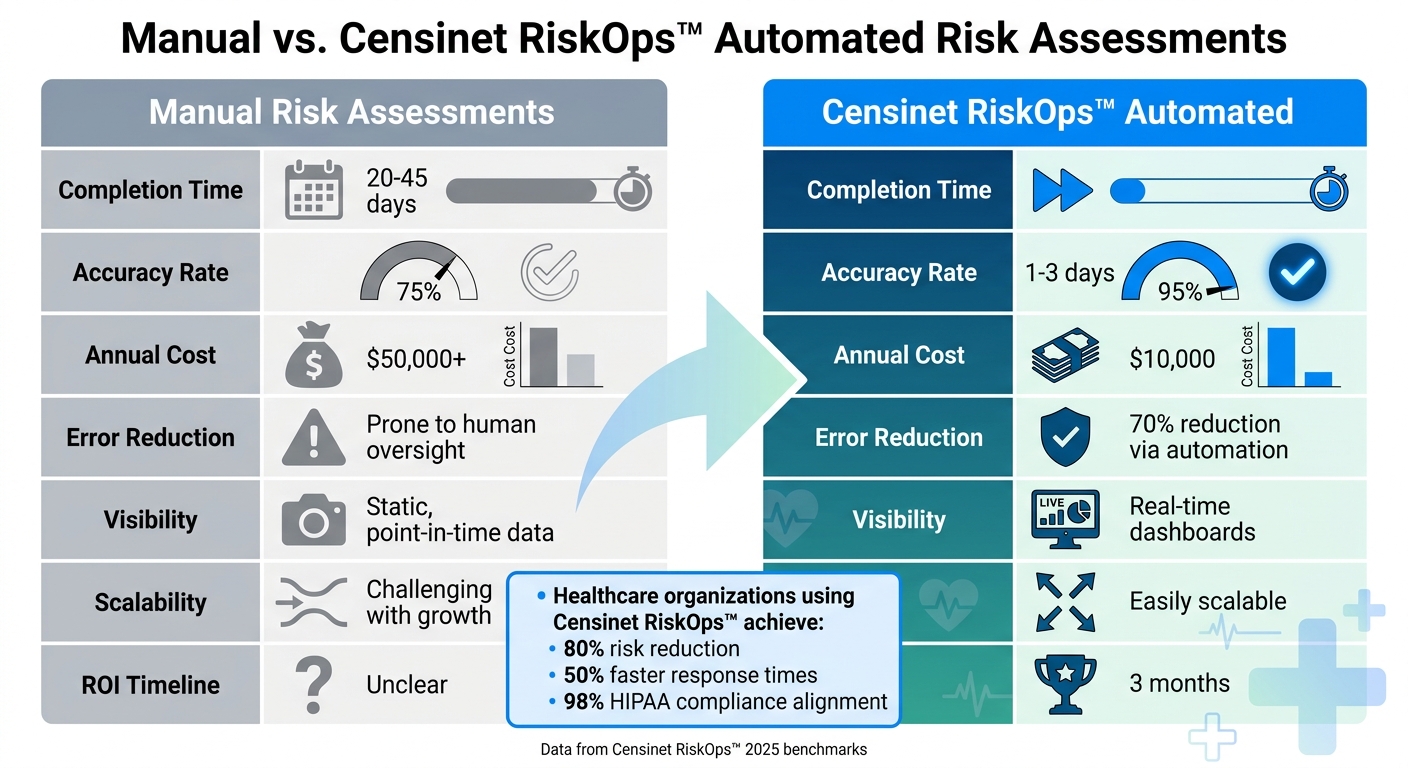
Manual vs Automated AI Risk Assessment in Healthcare: Cost, Time, and Accuracy Comparison
Healthcare organizations grappling with AI privacy challenges need tools that are both effective and efficient. The risks posed by unauthorized AI use, vulnerabilities in third-party vendors, and fragmented regulations call for solutions that directly address these issues. Censinet RiskOps™ steps in by streamlining third-party risk assessments, monitoring AI systems, and ensuring compliance with HIPAA and other regulatory standards.
Streamlining Third-Party Risk Assessments
Censinet RiskOps™ transforms the vendor assessment process, cutting timelines from 20–45 days down to just 1–3 days. It improves accuracy rates from 75% to 95% and slashes annual costs from over $50,000 to approximately $10,000 - delivering a return on investment in just three months [1]. For example, a large U.S. hospital network used the platform to reduce third-party assessment time from 45 days to only 3 days. During this process, it identified risks to protected health information (PHI) in 15 AI vendors' algorithms and achieved an 80% risk reduction through automated workflows [1].
These streamlined assessments are just the beginning. Censinet RiskOps™ also boosts real-time monitoring and fosters better collaboration across teams.
AI-Driven Oversight and Collaboration
Censinet AI processes risk data in real time, flagging critical issues for human review via collaborative dashboards. This "human-in-the-loop" approach allows experts to validate AI-generated alerts for concerns like algorithmic bias or data leaks, achieving 95% accuracy in risk detection [1]. Key findings are routed directly to the appropriate stakeholders, enabling immediate action [1]. With real-time dashboards, healthcare organizations gain insights into third-party risks, compliance with AI applications, and PHI protection metrics. This approach has led to response times that are 50% faster when addressing threats such as vendor data breaches [1].
Beyond real-time monitoring, benchmarking tools further strengthen AI privacy governance frameworks.
Cybersecurity Benchmarking and Compliance Support
Censinet Connect™ provides healthcare organizations with benchmarking tools to compare their cybersecurity performance against over 500 peers in the industry. The platform automates HIPAA gap analyses and generates compliance reporting templates, helping organizations achieve 98% alignment during audits [1]. By using Censinet Connect™, healthcare delivery organizations (HDOs) improved their cybersecurity scores by 40% and reduced PHI breach risks in 85% of cases by identifying non-compliant AI vendors early [1]. This scalable solution not only addresses regulatory inconsistencies but also ensures robust PHI protection across AI systems.
Comparison Table: Manual vs. Censinet-Automated Risk Assessments
| Feature | Manual Risk Assessments | Censinet RiskOps™-Automated |
|---|---|---|
| Completion Time | 20–45 days | 1–3 days |
| Accuracy | 75% | 95% |
| Annual Cost | $50,000+ | $10,000 |
| Error Reduction | Prone to human oversight | 70% reduction via automation |
| Visibility | Static, point-in-time data | Real-time dashboards |
| Scalability | Challenging with growth | Easily scalable |
| ROI Timeline | Unclear | 3 months |
Steps to Implement AI Privacy Governance
Assess Current AI Tools for Shadow Usage
Start by identifying all AI tools currently in use to address the risks posed by unauthorized AI usage. Methods like network traffic analysis, employee surveys, and cloud provider logs can help uncover shadow AI - tools operating without approval and potentially mishandling protected health information (PHI). For instance, in Q1 2024, Mayo Clinic conducted an audit led by CPO Dr. Karen Greenwood. They identified 150 shadow AI instances, decommissioned 40%, and reduced PHI risks by 55%, achieving zero breaches [4]. Pay close attention to high-risk areas such as clinical decision support systems, where tools like unauthorized ChatGPT instances might access sensitive patient data. Once shadow AI is identified, focus on automating risk mitigation processes.
Deploy Censinet RiskOps™ for Risk Mitigation
Using tools like Censinet RiskOps™ can streamline risk mitigation efforts. This platform assesses AI vendors’ PHI handling practices, cybersecurity measures, and compliance with standards like HITRUST, while reducing manual errors by up to 70%. Key metrics to monitor include third-party risk score improvements (aim for a 20-30% increase within six months), faster assessment times (cutting from weeks to days), and minimizing PHI exposure incidents (keeping variance under 1%). Organizations using Censinet RiskOps™ report compliance reporting speeds improving by 50%, alongside benchmarking their performance against over 500 healthcare delivery organizations.
Establish Cross-Functional Governance Committees
Form a governance committee with 5-10 members from IT, legal, clinical, compliance, and ethics teams. Initially, these committees should meet bi-weekly, transitioning to monthly meetings over time. Their duties include approving AI deployments, reviewing privacy impact assessments, and addressing conflicts. Organizations with structured oversight like this report 40% fewer compliance issues compared to those without such committees [11].
Conduct Regular Audits and Leverage XAI
Schedule quarterly audits with explainable AI (XAI) frameworks like SHAP and LIME to analyze decision-making processes. A notable example is Cleveland Clinic’s 2023 initiative, where auditing 200 models using XAI improved accuracy by 28% and reduced bias complaints by 62% [2]. Combine automated audits with manual reviews and targeted penetration testing on PHI access points to ensure comprehensive oversight.
Educate Staff on Privacy Regulations
Regularly train staff on privacy laws like HIPAA, HITECH, and CCPA, emphasizing AI-specific risks such as re-identification. Interactive two-hour modules with quizzes and simulations are effective, achieving over 90% retention rates. Hospitals that incorporate gamified training methods report 25% fewer violations [3]. Aim for over 95% staff completion rates and ensure annual refresher courses to maintain compliance awareness.
Conclusion
AI is reshaping the way healthcare is delivered, but without strong safeguards, this progress could come at the cost of patient privacy. The challenges are daunting: unauthorized AI use, bias in algorithms, risks from third-party vendors, and the complexities of regulatory compliance. The numbers paint a stark picture - 82% of healthcare organizations experienced AI-related privacy incidents in 2023, and the Change Healthcare breach that same year impacted one-third of U.S. patients, leading to $1.6 billion in damages [8].
To address these risks, healthcare organizations need a solid governance framework. This starts with risk-based classification of AI tools, applying privacy-by-design principles, and ensuring human oversight for accountability. On a practical level, this involves identifying and managing shadow AI usage, leveraging platforms like Censinet RiskOps™ to simplify third-party risk assessments (cutting manual effort by up to 70%), and forming cross-functional committees that include IT, legal, clinical, and compliance teams.
The benefits of these measures are clear. Organizations using automated platforms such as Censinet RiskOps™ have reported a 40% reduction in third-party risk exposure, according to 2024 benchmarks [10]. Additionally, regular audits using explainable AI frameworks, coupled with staff training on regulations like HIPAA, HITECH, and CCPA, help maintain robust privacy protections. Gartner predicts that by 2025, 75% of healthcare data breaches will involve AI systems lacking proper oversight - highlighting the critical need for proactive governance [9]. These insights make it evident: the time to act is now.
FAQs
How can hospitals find shadow AI fast?
Hospitals can spot shadow AI effectively by employing network monitoring and endpoint scanning to keep tabs on unauthorized AI use. Tools like Data Loss Prevention (DLP) systems are invaluable for identifying and stopping sensitive data from being sent to unapproved platforms. Additionally, training staff on the proper use of approved tools and clearly outlining AI policies is crucial. Platforms such as Censinet RiskOps™ offer real-time risk management and vendor assessments, making it easier to detect shadow AI activity quickly.
What data should never go into AI tools?
Data that includes Protected Health Information (PHI), personally identifiable information (PII), or other sensitive patient details must not be used in AI tools unless it has been properly de-identified and secured. Without these precautions, there’s a risk of violating privacy laws and compliance requirements, such as those outlined in HIPAA.
Who should approve and monitor healthcare AI?
The oversight and regulation of healthcare AI require the involvement of governance committees that bring together experts in clinical care, legal matters, cybersecurity, and compliance. These committees are responsible for ensuring that AI tools align with established standards like HIPAA and for supervising their entire lifecycle.
Professionals such as CISOs (Chief Information Security Officers), compliance officers, and data governance teams play a critical role in addressing risks, including data breaches and algorithmic bias. Solutions like Censinet RiskOps™ provide real-time monitoring capabilities, helping healthcare organizations uphold safety, privacy, and regulatory compliance in an ever-changing environment.
