
Ultimate Guide to Cloud Security for Healthcare
Post Summary
Cloud security is critical for healthcare organizations due to the sensitive nature of electronic protected health information (ePHI). Breaches can disrupt patient care, expose private data, and lead to fines up to $1.9 million per violation annually under HIPAA and HITECH. Here's what you need to know:
- Key Regulations: HIPAA mandates safeguards for ePHI, while HITECH expands enforcement and breach notification requirements. HITRUST CSF and NIST CSF help organizations meet compliance goals.
- Technical Safeguards: Encryption (AES-256 for data at rest, TLS 1.2+ for data in transit), access controls, and audit trails are essential for securing systems.
- Vendor Risk Management: Evaluate cloud providers with frameworks like HITRUST and SOC 2, ensuring signed Business Associate Agreements (BAAs) are in place.
- Threat Modeling: Use frameworks like STRIDE to identify vulnerabilities in cloud setups, focusing on risks like ransomware, data leaks, and misconfigurations.
- Resilience: Regular backups, disaster recovery plans, and continuous monitoring are necessary to avoid costly downtime and ensure patient safety.
With healthcare breaches costing an average of $10.93 million per incident, securing cloud environments isn’t optional - it’s a necessity for compliance, patient trust, and operational stability.
Is the Cloud REALLY HIPAA Compliant? - 10 Critical Questions Answered!
sbb-itb-535baee
Key Regulatory Frameworks and Compliance Standards
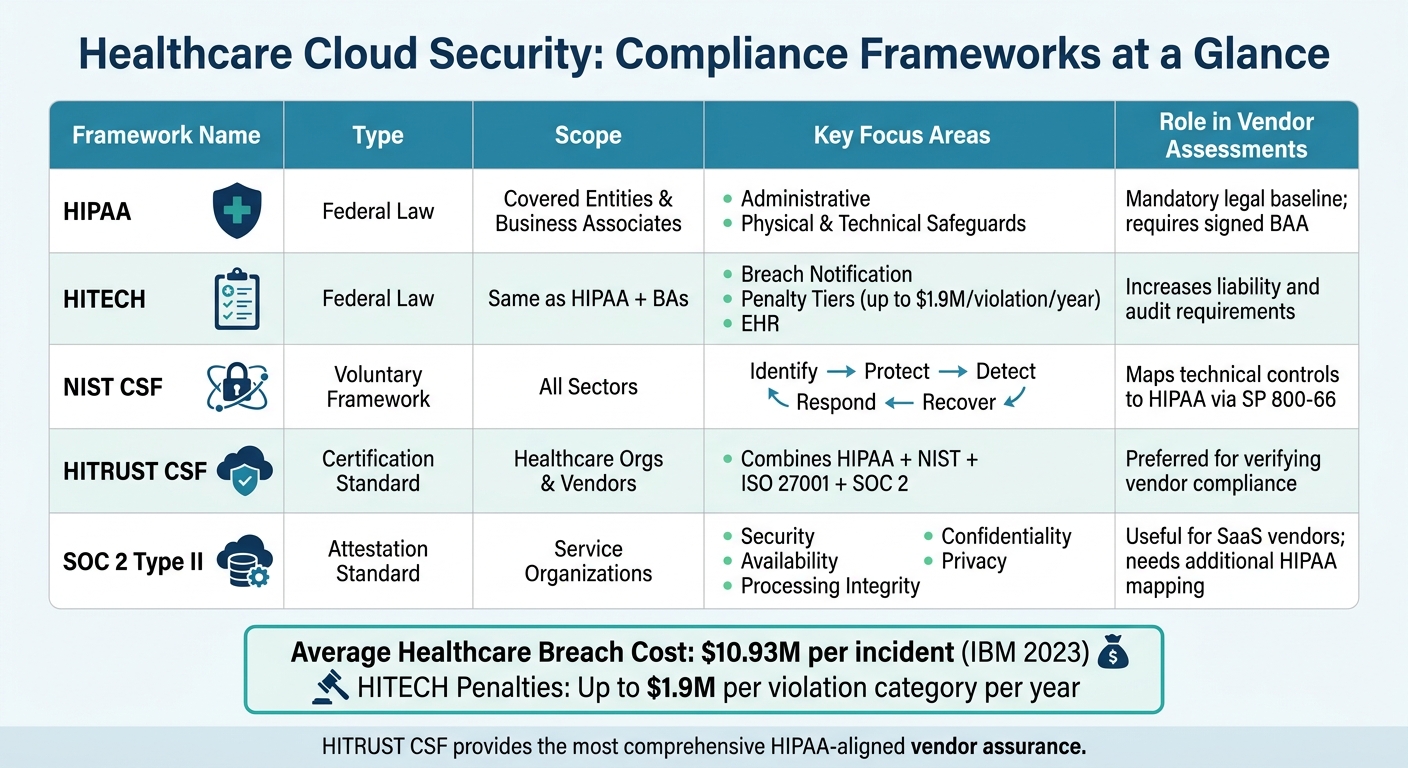
Healthcare Cloud Security Compliance Frameworks Compared
Healthcare organizations face a challenging regulatory environment when it comes to cloud security. To navigate this, it’s important to understand the difference between regulations and frameworks. Regulations like HIPAA and HITECH establish legal requirements, while frameworks such as NIST CSF and HITRUST CSF provide structured approaches to help organizations meet those requirements effectively.
Healthcare Regulations That Affect Cloud Security
The HIPAA Security Rule (45 CFR Parts 160 and 164) is a cornerstone regulation. It mandates that covered entities and their Business Associates adopt administrative, physical, and technical safeguards to protect electronic protected health information (ePHI). What makes the Security Rule particularly adaptable is its flexibility:
"The Security Rule is designed to be flexible, scalable, and technology neutral, enabling a regulated entity to implement policies, procedures, and technologies that are appropriate for the entity's particular size." - HHS.gov [2]
HIPAA categorizes safeguards as either Required (must be implemented) or Addressable (can be substituted with an equivalent solution if documented). While encryption is technically "addressable", current enforcement trends have made AES-256 for data at rest and TLS 1.2+ for data in transit de facto standards.
The HITECH Act expanded HIPAA’s reach by including Business Associates, such as cloud providers, under its Security Rule. It also introduced tiered penalties, which can go as high as $1.9 million per violation category per calendar year [1]. Additionally, HITECH requires that affected individuals and HHS be notified of any breach within 60 days of its discovery [1].
For organizations managing substance use disorder records, 42 CFR Part 2 imposes stricter data handling and segregation requirements compared to HIPAA. Meanwhile, HHS 405(d) guidance provides cybersecurity recommendations tailored specifically to healthcare needs. These regulations form the baseline for compliance, but frameworks help organizations operationalize these requirements.
Security Frameworks Used in Healthcare
Regulations define what needs to be protected, while frameworks guide how to secure it. The NIST Cybersecurity Framework (CSF) organizes security activities into five key functions: Identify, Protect, Detect, Respond, and Recover. In healthcare, NIST SP 800-66 Revision 2 is especially relevant, as it maps NIST controls directly to HIPAA requirements.
The HITRUST CSF is widely recognized in healthcare as a certification standard. It combines elements from HIPAA, NIST, ISO 27001, and SOC 2 into a unified framework. As the Cloud Security Authority notes:
"HITRUST certification incorporates HIPAA-specific control requirements directly and is the attestation framework most directly aligned with covered entity compliance documentation needs." - Cloud Security Authority [1]
For SaaS vendors, SOC 2 Type II is a common attestation standard, addressing security, availability, and other operational aspects. However, as the Cloud Security Authority emphasizes:
"SOC 2 Type II alone does not demonstrate HIPAA compliance, a distinction HHS OCR enforcement actions have reinforced." - Cloud Security Authority [1]
While SOC 2 reports can help evaluate vendors, they should not be the sole measure of HIPAA compliance.
Comparing Compliance Frameworks Side by Side
| Framework / Regulation | Purpose | Scope | Focus Areas | Use in Vendor Assessments |
|---|---|---|---|---|
| HIPAA | Federal law for data privacy/security | Covered entities & Business Associates | Administrative, physical, and technical safeguards | Mandatory legal baseline; requires a signed BAA |
| HITECH | Strengthens HIPAA enforcement | Same as HIPAA | Breach notification, penalty tiers, EHR requirements | Increases liability and audit requirements |
| NIST CSF | Voluntary cybersecurity framework | All sectors | Identify, Protect, Detect, Respond, Recover | Maps technical controls to HIPAA via SP 800-66 |
| HITRUST CSF | Consolidated standards for healthcare certification | Healthcare organizations & vendors | Combines HIPAA, NIST, ISO 27001, and SOC 2 | Preferred for verifying vendor compliance |
| SOC 2 Type II | General security attestation | Service organizations | Security, Availability, Processing Integrity, Confidentiality, Privacy | Useful for SaaS vendors; needs additional HIPAA-specific mapping |
When evaluating cloud vendors, HITRUST CSF certification often provides more comprehensive assurance than SOC 2 alone. Additionally, it’s crucial to ensure that Business Associate Agreements (BAAs) extend to subcontractors handling ePHI. This layered approach to compliance sets the stage for effective threat modeling and HIPAA-compliant vendor risk management.
Core Components of Cloud Security for Healthcare
This section shifts from regulatory frameworks to focus on the practical elements necessary to secure healthcare cloud environments. Effective cloud security in healthcare depends on a mix of technical measures, organizational policies, and operational resilience - each working together to create a strong defense.
Technical Safeguards for Data and Systems
Under the HIPAA Security Rule (45 CFR § 164.312), technical safeguards are broken into five essential areas. These are the foundation of any secure healthcare cloud system.
| HIPAA Technical Safeguard | Requirements | Common Practices |
|---|---|---|
| Access Control | Limit system access to authorized users | Unique user IDs, auto log-off, encryption/decryption |
| Audit Controls | Track and review activity in ePHI systems | Automated logs, audit trails, log analysis tools |
| Integrity | Protect ePHI from unauthorized changes | Digital signatures, checksums, version control |
| Authentication | Confirm the identity of users accessing ePHI | Passwords, biometrics, multi-factor authentication (MFA) |
| Transmission Security | Secure ePHI during network transfers | TLS 1.2+, VPNs, email encryption |
For encryption, AES-256 is recommended for stored data, while TLS 1.2+ ensures secure data in transit. When handling highly sensitive data, using Customer-Managed Keys (CMK) can provide greater control, though it introduces added complexity. Proper encryption not only protects data but can also reduce regulatory fallout if a breach occurs. If encrypted data is compromised but the keys remain secure, it may not qualify as "unsecured" ePHI under federal rules, potentially avoiding mandatory breach notifications [1].
Of course, technical safeguards alone aren't enough. Strong governance is necessary to manage these tools effectively.
Organizational Controls and Governance
Technical measures secure systems, but organizational policies ensure those measures are applied consistently and correctly. Governance frameworks should define roles, responsibilities, and standards for managing cloud security.
Role-Based Access Control (RBAC) is critical, paired with the "minimum necessary" access standard to limit exposure of ePHI [1]. To catch misconfigurations or policy violations, consider using a Cloud Security Posture Management (CSPM) tool for continuous monitoring.
The shared responsibility model is another key aspect of governance. In IaaS (Infrastructure as a Service) setups, your team must secure the operating system and applications. In SaaS (Software as a Service) environments, the vendor handles technical safeguards, while you focus on evaluating Business Associate Agreements (BAAs) and third-party vendor risks [1]. BAAs should clearly outline breach notification timelines, subcontractor obligations, and recovery responsibilities before any ePHI is entrusted to the vendor.
Availability and Resilience in Cloud Environments
Ensuring availability and resilience is as important as securing data. Healthcare systems must remain operational to support patient care, and downtime can have severe consequences. Cyberattacks like ransomware often cause these disruptions to clinical applications and patient care. The HIPAA Security Rule's Contingency Plan standard (45 CFR § 164.308(a)) mandates documented strategies for data backup, disaster recovery, and emergency operations [1].
Regularly test backup systems to confirm they work as intended. Pair these efforts with tamper-evident audit logs to track access, modifications, or deletions of ePHI. This aligns with the requirements under 45 CFR § 164.312(b) and ensures you can reconstruct events accurately during incidents [1].
Interruptions to service not only delay care but can also lead to hefty penalties. Under the HITECH Act, violations tied to downtime or exposed ePHI can cost up to $1.9 million per violation category per year [1]. Building resilience into your cloud environment isn't optional - it's a critical part of compliance and patient safety.
Threat Modeling for Healthcare Cloud Environments
Identifying vulnerabilities before attackers can exploit them is critical in securing healthcare cloud environments. As Palo Alto Networks explains:
"Threat modeling operates earlier in the lifecycle, at the design and development phases. Taking this proactive measure allows organizations to architect defenses upstream, reducing remediation costs and narrowing the attack surface before a single line of code runs in production." [4]
Cloud Threats Specific to Healthcare
Healthcare cloud systems face unique risks compared to other industries. Ransomware is particularly disruptive - attackers often target cloud-hosted EHR systems and clinical applications, knowing that downtime can pressure organizations into paying. Beyond ransomware, data integrity attacks are a growing threat. For example, unauthorized changes to lab results or medication records stored in the cloud can have life-threatening outcomes.
Another critical vulnerability lies in the supply chain. Third-party APIs, cloud-hosted medical devices, and SaaS vendors all introduce potential entry points for attackers, making it essential to effectively manage third-party risk.
One of the most common causes of PHI exposure is misconfigured cloud storage. Publicly accessible storage buckets have been at the center of some of the largest healthcare data breaches. Organizations managing substance use disorder records face even stricter regulations under 42 CFR Part 2, which requires more rigorous data segregation than standard HIPAA ePHI rules [1]. These challenges highlight the need for tailored threat modeling approaches to pinpoint vulnerabilities.
Threat Modeling Methods and Use Cases
The STRIDE framework is a widely used approach for healthcare cloud threat modeling. It organizes threats into six categories, each linked to a critical security property that healthcare systems must protect:
| STRIDE Threat | Property Violated | Healthcare Example |
|---|---|---|
| Spoofing | Authentication | Attacker impersonating a clinician to access a cloud-hosted EHR [3] |
| Tampering | Integrity | Unauthorized modification of patient lab results in a cloud database [3] |
| Repudiation | Non-Repudiation | Malicious action taken with no audit logs to trace it [3] |
| Information Disclosure | Confidentiality | PHI exposed via misconfigured cloud storage buckets [3] |
| Denial of Service | Availability | Cloud resource exhaustion blocking access to a telehealth platform [3] |
| Elevation of Privilege | Authorization | Standard user gaining admin access to medical device settings [3] |
While STRIDE addresses fundamental threats, other frameworks like LINDDUN focus on privacy risks, and PASTA ties security priorities to clinical needs [3][4].
Threat modeling works best as a team effort. It requires developers to offer insights into application design, a business owner to ensure security measures don’t disrupt clinical workflows, a security expert, and an infrastructure lead to clarify the cloud provider's shared responsibility boundaries [3].
Threats by Cloud Deployment Model
The type of cloud deployment your organization uses greatly influences its threat surface. In public cloud setups like AWS or Azure, the provider handles the physical infrastructure, but your team is responsible for securing everything above the operating system in IaaS models. This can lead to overlooked vulnerabilities, especially with temporary cloud assets:
"Cloud-native architectures complicate this further by abstracting infrastructure behind orchestration layers, increasing the risk of overlooking transient assets and ephemeral workloads." - Palo Alto Networks [4]
Private cloud environments offer more control but require your team to manage additional responsibilities, such as network segmentation and physical access controls. Hybrid and multi-cloud setups are the most complex. Maintaining consistent policies across environments is a challenge, and elements like third-party API integrations or serverless functions often fall outside the primary codebase and evade assessments [4].
No matter the deployment model, Data Flow Diagrams (DFDs) are indispensable. They identify trust boundaries - the points where data moves between systems with different trust levels. For instance, when a clinical application interacts with a remote cloud process or a cloud-hosted database, each trust boundary becomes a potential threat vector. Teams should evaluate these boundaries using STRIDE for every interaction.
The CMS Threat Modeling Handbook suggests conducting a formal 90-day follow-up after each modeling session. This ensures that identified risks have been addressed or formally accepted by the Business Owner and ISSO [3]. Recognizing these deployment-specific threats is a crucial step in assessing cloud vendor security thoroughly.
Assessing and Managing Cloud Vendor Security
To strengthen your defenses, it's critical to evaluate the security measures of every third party handling patient data. Once you've mapped out potential risks, ensure that each vendor adheres to a clearly defined security standard.
Cloud Vendor Security Assessment Frameworks
A thorough vendor security assessment involves evaluating eight key areas: governance and risk management, data protection, identity and access management (IAM), application and infrastructure security, incident detection and response, business continuity and disaster recovery, third-party and supply chain risk, and privacy and compliance. These align with HIPAA's safeguards, while the HITRUST CSF framework provides more detailed controls.
Vendor assessments shouldn't rely solely on questionnaire responses. Request supporting documentation like SOC 2 Type II reports, HITRUST certifications, ISO 27001 certificates, penetration test summaries, and incident response plans. For data protection, confirm the use of AES-256 encryption for data at rest, TLS 1.2+ encryption for data in transit, customer-managed key options, and documented processes for data destruction. In IAM, verify that multi-factor authentication is enforced for all administrative accounts, role-based access control (RBAC) is implemented, and periodic access reviews are conducted. For incident response, ask for redacted post-incident reports that include root-cause analysis and HIPAA breach notification timelines.
The vendor's cloud deployment model - SaaS, PaaS, or IaaS - affects how responsibilities are divided. Here's a breakdown:
| Deployment Model | Vendor Responsibility | Your Responsibility |
|---|---|---|
| SaaS | Application, data storage, and most security controls | User management, data classification, endpoint security |
| PaaS | Platform, runtime, and tenant isolation | Application code, database security, OS hardening |
| IaaS | Physical infrastructure and virtualization layer | OS, applications, network controls, workload security |
Make sure a signed Business Associate Agreement (BAA) is in place, covering all subcontractors handling PHI. According to the Office for Civil Rights (OCR), cloud service providers are considered business associates - even if they store encrypted PHI and lack the decryption key - because they maintain PHI for covered entities.
Adding Threat Modeling to Vendor Assessments
Standard questionnaires often result in generic answers that don't provide a full picture of potential risks. Incorporating threat modeling into your vendor evaluation process can address this issue. Start by categorizing the vendor's service - whether it's a system of record, a telehealth platform, or a clinical analytics tool - and map out PHI data flows using Data Flow Diagrams (DFDs). Identify trust boundaries where data transitions between your organization, the vendor, and their subprocessors.
Next, apply frameworks like STRIDE or MITRE ATT&CK for Cloud to pinpoint specific threats to these data flows. For example, if token theft is a concern for an API-connected SaaS vendor, you might ask: "How are short-lived tokens issued and rotated, and what measures are in place to detect and contain refresh token compromises?" This approach yields actionable insights rather than vague assurances.
Threat modeling also helps prioritize risks. For instance, if a vendor's misconfigured storage bucket poses a high-likelihood, high-impact threat, it should carry more weight in your risk assessment than a missing policy document. You can create reusable threat models for common vendor setups, such as EHR-integrated SaaS systems or cloud-based imaging platforms, adapting them as needed for new vendors. This ensures your evaluation process remains efficient and consistent.
How Censinet RiskOps™ Supports Vendor Risk Management
Managing vendor risk at scale is a major challenge for healthcare organizations. According to a KLAS Research report, health systems using specialized third-party risk management platforms have reduced vendor security assessment times from 6–9 months to under 90 days while also improving standardization and documentation.
Censinet RiskOps™ simplifies vendor risk management by centralizing vendor inventories, automating workflows, and ensuring consistent documentation. Its Censinet AI™ feature speeds up the process by allowing vendors to complete security questionnaires quickly, summarizing evidence, identifying fourth-party risks, and generating detailed risk reports. While automation handles data collection, risk teams retain control through customizable rules and reviews. For healthcare organizations managing PHI across complex vendor networks, this balance between speed and oversight is crucial.
Putting Cloud Security Into Practice in Healthcare
Continuous Testing and Validation
It's not enough to rely on paper-based controls; they need to be tested in real-world scenarios. For healthcare organizations, this means frequently verifying their cloud security posture - not just during an annual audit. One effective strategy is using automated cloud security posture management (CSPM) tools alongside regular vulnerability scans and event-triggered assessments. These tools provide continuous oversight, ensuring security gaps are addressed quickly [1].
CSPM tools are particularly helpful for catching misconfigurations in real time. For example, they can detect issues like an unintentionally open storage bucket or a misconfigured firewall rule. Additionally, cloud environments must generate tamper-evident audit logs that track every access, modification, and deletion of electronic protected health information (ePHI). This is critical for meeting HIPAA requirements. Regularly testing backup restoration procedures is equally important, as this helps identify any recovery issues before a real incident occurs [1].
These ongoing validations lay the groundwork for secure and flexible development practices.
Embedding Security into DevOps Processes
When healthcare teams are rolling out frequent code changes, security must be embedded into the CI/CD pipeline to catch vulnerabilities early - before they ever reach production.
This involves integrating automated security measures, such as static code analysis, dependency checks, and container image scanning, directly into the CI/CD workflow. Infrastructure-as-code templates should also be reviewed for potential misconfigurations before deployment. Additionally, any changes impacting ePHI should automatically trigger a compliance check against HIPAA control requirements. Referencing frameworks like NIST SP 800-66 Revision 2 can provide clear guidance for meeting these security standards [1].
To maintain secure operations, enforce role-based access control (RBAC) and ensure that permissions are limited to what’s necessary. Periodic reviews of these permissions help ensure they remain appropriate over time.
Cloud Governance and Security Metrics
Strong governance is the glue that holds technical and procedural defenses together, ensuring that cloud security remains a top priority. This means assigning clear responsibilities for security decisions, defining escalation paths, and using actionable metrics to track and improve security performance.
Healthcare organizations should focus on key performance indicators (KPIs) that reflect the state of their cloud security. Metrics related to incident detection and response times are particularly valuable for gauging overall health.
Governance also requires keeping risk assessments up to date with real-time management. HIPAA mandates regular risk analyses, and any major change - like integrating a new vendor, migrating platforms, or making significant configuration updates - should trigger a targeted review to reassess potential risks. By maintaining this proactive approach, organizations can ensure their cloud security measures evolve alongside their needs.
Conclusion: Building Stronger Cloud Security in Healthcare
Cloud security in healthcare requires a continuous effort that brings together people, processes, and technology. This collaborative strategy forms the foundation for regulatory compliance, threat modeling, and vendor risk management - the key areas discussed earlier.
Regulations like HIPAA and HITECH provide the groundwork, while frameworks such as NIST CSF, HITRUST CSF, and NIST SP 800-53 translate those rules into actionable steps. These guidelines don’t just set legal requirements; they shape the technical and organizational controls essential for securing cloud environments. Implementing measures like strong identity and access management (IAM), advanced encryption, continuous monitoring, and Zero Trust principles transforms compliance into a more practical and effective security strategy. According to IBM's 2023 Cost of a Data Breach report, healthcare organizations face an average breach cost of $10.93 million per incident, the highest across industries - making cloud security a priority that can’t be overlooked. [8]
Proactive threat modeling is another cornerstone of a strong security approach. By mapping the flow of protected health information (PHI) and testing system designs, threat modeling helps identify vulnerabilities early - when they’re easier and cheaper to fix. [5][6]
Vendor risk management is just as vital. With 54% of healthcare organizations reporting breaches tied to third-party vendors, applying the same level of scrutiny to cloud vendors as to internal systems is essential. [7] Tools like Censinet RiskOps™ simplify this process by standardizing vendor assessments, centralizing critical documentation (such as SOC 2 reports), and tracking remediation efforts across clinical, IT, and compliance teams.
To strengthen cloud security further, focus on the highest-risk PHI workloads first, follow a primary security framework, secure configurations, and integrate vendor oversight from the start. Gradually improving metrics like mean time to remediate and multi-factor authentication (MFA) coverage will lead to a more resilient security posture over time.
FAQs
What cloud security controls are mandatory for HIPAA, and what’s “addressable” in practice?
HIPAA mandates specific cloud security measures to protect sensitive healthcare data. These include:
- Encryption: Data at rest should use AES-256 encryption, while data in transit must be secured with TLS 1.2 or higher.
- Audit Controls: Systems must track and log access to electronic protected health information (ePHI).
- Access Controls: Only authorized individuals should have access to sensitive data.
HIPAA also includes addressable controls, which allow flexibility. For example, encryption methods or authentication mechanisms can be customized based on your organization's risk assessment and operational needs. However, these controls must still align with HIPAA's overall goal of safeguarding ePHI effectively. Tailoring these measures ensures they address the specific risks your healthcare organization faces.
How do I run a simple threat model (like STRIDE) for a PHI cloud workflow?
To ensure the security of Protected Health Information (PHI) in a cloud-based workflow, follow these steps:
- Create a Data Flow Diagram (DFD): Start by mapping out how PHI moves through the cloud. Identify every point where data enters, travels, and exits the system.
- Analyze Using STRIDE: Examine each component of the workflow for potential threats, such as Spoofing, Tampering, or Denial of Service. This step helps pinpoint vulnerabilities in different parts of the system.
- Mitigate Risks: Address identified threats by implementing safeguards like encryption, multi-factor authentication, or other security measures. Make sure to revisit and update your threat model regularly to maintain strong PHI protection.
What should I require from a cloud vendor before sending them any ePHI (including in a BAA)?
Before you share ePHI with a cloud vendor, it's critical to have a valid Business Associate Agreement (BAA) in place. This agreement should clearly define the scope of data handling, the required security measures, breach reporting responsibilities, and compliance with HIPAA regulations. A well-drafted BAA is key to protecting sensitive information and ensuring you meet healthcare compliance standards.

