
How NY SHIELD Act Aligns with Cybersecurity Standards
Post Summary
The NY SHIELD Act is a New York law requiring businesses to implement safeguards for protecting private data of New York residents. It applies to any organization handling such data, regardless of location. Key points include:
- Three safeguard areas: administrative, technical, and physical measures.
- Healthcare focus: Stricter breach definitions and timelines, including a 72-hour reporting rule for hospitals under new state regulations.
- Alignment with frameworks: Compliant with NIST Cybersecurity Framework and overlaps with HIPAA, but covers more data types like biometric and online credentials.
- Vendor oversight: Mandates secure practices and breach notification from third-party providers.
- Penalties: Up to $250,000 for breach notification failures; $5,000 per safeguard violation.
The Act pushes organizations, especially in healthcare, to strengthen their cybersecurity measures and manage cyber risks more effectively.
New York's SHIELD Act: "Reasonable" Safeguards on Private Information
sbb-itb-535baee
Key NY SHIELD Act Requirements for Healthcare Organizations
The NY SHIELD Act breaks down its security requirements into three main areas: administrative, technical, and physical safeguards. These collectively create a framework that healthcare organizations need to meet to protect private information effectively.
Administrative Safeguards
Healthcare organizations are required to assign one or more employees to oversee their security programs. For New York hospitals, this means appointing a qualified Chief Information Security Officer (CISO) under 10 NYCRR §405.46. The CISO's role includes leading risk assessments and updating security measures, which is crucial since detecting breaches can take nearly 300 days on average [3]. Regular risk assessments are necessary to automate security questionnaires, identify potential enterprise risks, both internal and external, and to adapt security programs as risks evolve. Non-compliance with these safeguards can result in civil penalties of up to $5,000 per violation [4]. These requirements align with the governance principles outlined in the NIST Cybersecurity Framework (CSF) and HIPAA's administrative safeguard standards.
While administrative safeguards focus on leadership and planning, technical safeguards provide critical tools to defend against cyber threats.
Technical Safeguards
Healthcare organizations must evaluate risks tied to their network and software design, as well as how information is processed, transmitted, and stored. They are expected to implement and routinely test systems designed to detect, prevent, and respond to cyberattacks. For example, multi-factor authentication (MFA) is a required measure under New York State Department of Health (NYSDOH) hospital regulations. This is especially important given that compromised credentials are responsible for 16% of data breaches [3]. These technical measures align with the NIST CSF's Protect and Detect functions and are consistent with HIPAA's technical safeguard standards.
Beyond technical defenses, physical safeguards ensure the security of data throughout its entire lifecycle.
Physical Safeguards
Healthcare organizations must safeguard private information at every stage - storage, transit, and disposal. This includes maintaining documented chain-of-custody procedures, responding to intrusions, and securely disposing of electronic media to prevent data recovery. For organizations managing large volumes of records across multiple facilities, clearly defined disposal timelines are essential. These physical safeguards align with the NIST CSF's Protect function and closely match HIPAA's physical safeguard standards.
How the NY SHIELD Act Aligns with Cybersecurity Frameworks
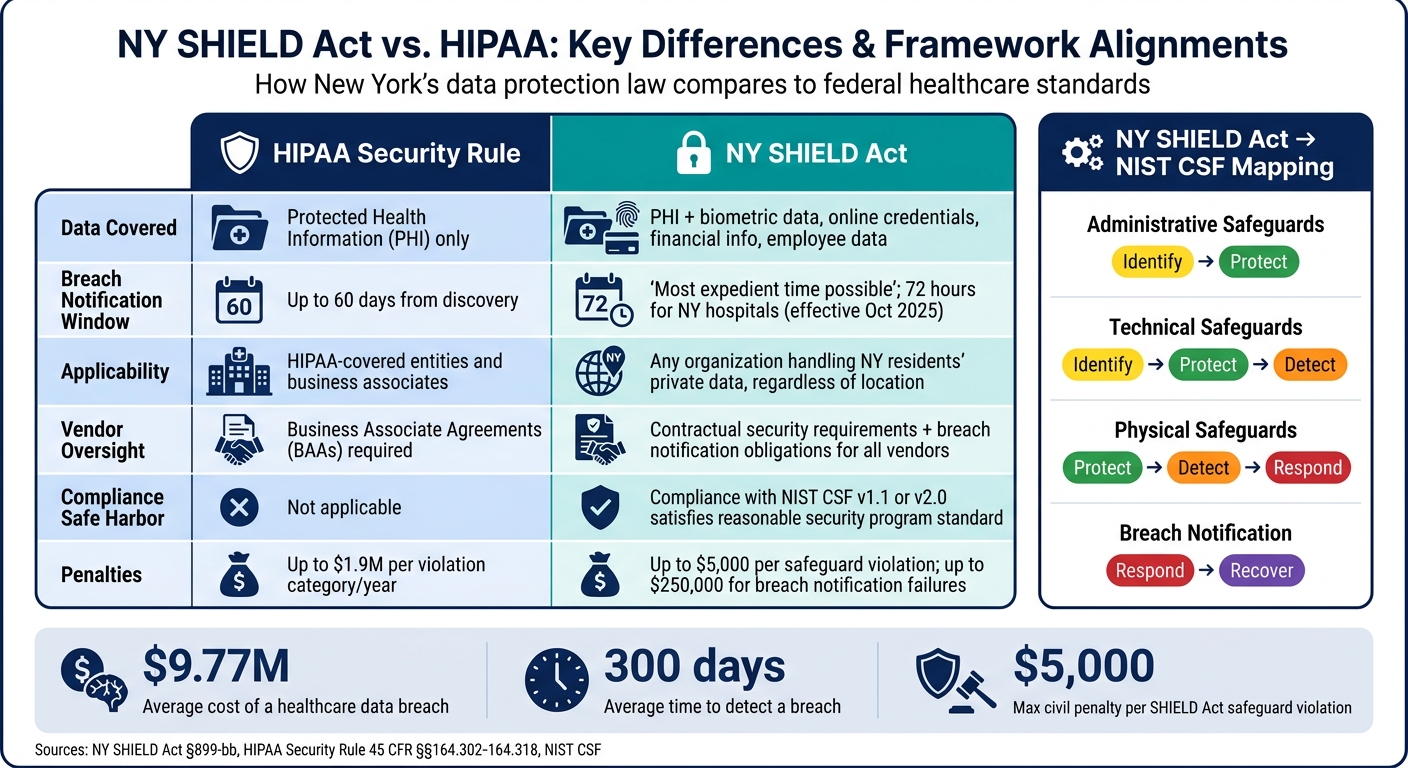
NY SHIELD Act vs. HIPAA: Key Differences & Framework Alignments
The NY SHIELD Act doesn't operate in a vacuum. Its safeguard requirements align closely with established cybersecurity frameworks, which many healthcare organizations are already using. This alignment means compliance efforts can build on existing practices rather than starting from scratch.
Mapping to the NIST Cybersecurity Framework
One standout feature of the SHIELD Act is its safe harbor provision: organizations that comply with NIST CSF v1.1 or v2.0 are considered to meet the Act's "reasonable data security program" standard [6].
The Act's safeguard categories align directly with the core functions of the NIST CSF:
| NY SHIELD Act Safeguard | Specific Requirement | NIST CSF Function |
|---|---|---|
| Administrative | Risk identification and assessment | Identify |
| Administrative | Employee training and management | Protect |
| Technical | Network/software risk assessment | Identify |
| Technical | Detecting and responding to attacks | Detect / Respond |
| Technical | Regular testing and monitoring | Detect |
| Physical | Intrusion detection and response | Detect / Respond |
| Physical | Secure disposal of private information | Protect |
The Act also addresses the Recover function by requiring timely breach notifications to affected New York residents and state authorities after a qualifying incident [2][6]. For organizations already adhering to NIST standards, this mapping simplifies compliance efforts.
Overlap with the HIPAA Security Rule
The SHIELD Act's alignment with NIST also extends to HIPAA requirements. Healthcare organizations already complying with the HIPAA Security Rule (45 CFR §§ 164.302–164.318) automatically meet the SHIELD Act's data security program requirement [6].
"Compliance with any of the following [including HIPAA] satisfies the 'reasonable data security program' standard under § 899-bb10." - New York Security Authority [6]
However, the SHIELD Act covers a wider range of data than HIPAA. While HIPAA focuses on Protected Health Information (PHI), the SHIELD Act also includes biometric data, online account credentials, and other types of private information not addressed by HIPAA [6]. Healthcare organizations should perform a gap analysis to identify data types that fall under the SHIELD Act but not HIPAA. This is particularly critical as research shows many risk assessments fail to secure the third-party healthcare ecosystem effectively.
Another key difference lies in breach notification timelines. HIPAA allows up to 60 days from discovery to notify affected individuals, while the SHIELD Act requires notification in the "most expedient time possible" without unreasonable delay. Additionally, new NYSDOH hospital regulations, effective October 2025, will require cybersecurity incidents to be reported to the state within 72 hours [1][6].
Support for HITRUST Control Practices

The SHIELD Act also reinforces practices outlined in HITRUST. Requirements like appointing a security coordinator, conducting regular risk assessments, and performing annual tests of key controls align well with HITRUST's structured approach to control implementation and validation [1][2].
For organizations pursuing or maintaining HITRUST certification, the SHIELD Act complements existing efforts. For instance, technical measures like multi-factor authentication (MFA), mandated under NYSDOH hospital regulations, and physical measures like documented disposal procedures align with HITRUST's access control and physical protection standards [1][2]. Organizations already mapping their controls to HITRUST will find much of the SHIELD Act's groundwork already in place.
NY SHIELD Act Requirements Beyond Healthcare Regulations
The SHIELD Act extends data protection responsibilities beyond the scope of healthcare regulations. While it builds on established cybersecurity frameworks, this law pushes organizations to safeguard private information that goes beyond what is traditionally covered under healthcare rules. Even entities compliant with HIPAA might find gaps in how they protect certain types of data.
Expanded Definitions of Private Information
HIPAA focuses on protecting PHI (Protected Health Information), but the SHIELD Act takes a broader approach. It includes biometric identifiers like fingerprints, voice prints, and retina or iris scans, as well as online credentials such as email addresses combined with passwords or security questions [2][4].
For example, a hospital's HR department may collect employee fingerprints for time-clock systems, or a clinic might store staff login credentials in unsecured formats. While these do not qualify as PHI under HIPAA, they are considered "private information" under the SHIELD Act. As Hunton Andrews Kurth explains:
"The SHIELD Act requires any person or business owning or licensing computerized data that includes the private information of a resident of New York... to implement and maintain reasonable safeguards to protect the security, confidentiality and integrity of the private information." [7]
This means organizations must audit all their data - not just patient records - to ensure that employee credentials, biometric data, and even non-patient financial account numbers are properly secured. Additionally, the SHIELD Act holds external service providers to the same standards.
Service Provider Oversight
The SHIELD Act doesn’t stop at internal controls; it also requires strict oversight of vendors to ensure data security throughout the supply chain. Organizations must choose service providers capable of maintaining proper safeguards and must formalize these obligations in contracts [2][4].
For HIPAA-covered entities, there’s an added layer of urgency. If a breach is reported to HHS, the organization must notify the New York Attorney General within five business days [5]. This tight timeline highlights the importance of seamless communication between internal teams and external vendors. As noted by John C. Cleary and Alexander Boyd of Polsinelli PC:
"If a 'covered entity' under HIPAA is required to provide notification of a breach to HHS, the covered entity must also notify the New York Attorney General of the breach within five business days." [5]
To stay compliant, it’s vital to review and update vendor contracts to include specific breach notification timelines and clear security requirements.
Balanced Attention to All Safeguard Categories
The SHIELD Act places equal importance on administrative, technical, and physical safeguards [2][8]. Unlike some regulations that lean heavily on technical controls, this law ensures all three areas are treated with the same level of priority. For instance, physical safeguards often get overlooked, but the SHIELD Act mandates that electronic media be securely erased to prevent private information from being reconstructed when it’s no longer needed [2][7]. This is especially relevant for healthcare organizations decommissioning devices like workstations, tablets, or medical equipment with built-in storage.
Failure to comply can result in civil penalties of up to $5,000 per violation, even if no breach occurs, as enforced by the New York Attorney General [2][7][8]. Regularly evaluating safeguards across all categories is critical to staying compliant and avoiding penalties, laying the groundwork for the practical steps discussed in the next section.
Steps Healthcare Organizations Can Take to Meet NY SHIELD Act Requirements
Understanding how the SHIELD Act goes beyond HIPAA is just the beginning. The real challenge lies in turning that understanding into practical changes. Many of the required actions build on existing measures, focusing on aligning policies, managing vendor risks, and maintaining readiness for audits.
Aligning Policies Across Frameworks
A good first step is conducting a gap analysis to compare your current HIPAA safeguards - administrative, technical, and physical - against the more specific requirements of the SHIELD Act. As Holland & Knight explains:
"These Regulations add more detail to HIPAA's flexible and scalable security requirements." [1]
While HIPAA allows for some flexibility, the SHIELD Act demands clear-cut measures like multi-factor authentication (MFA) for external network access and regular penetration testing to strengthen defenses. Appointing a skilled CISO to oversee your cybersecurity program is strongly recommended. Additionally, update internal policies to cover not only PHI but also other personal data, such as employee credentials and biometric identifiers, which fall under the SHIELD Act’s broader scope.
Third-Party Risk Management
Managing vendor relationships is a critical, yet often overlooked, aspect of SHIELD Act compliance. As Patient Protect highlights:
"Third-party risk is a major compliance challenge." [9]
The risks are real. For example, in late 2023, Delta Dental of New York faced a $2.25 million settlement with the New York State Department of Financial Services after a vulnerability in the MOVEit file-transfer software exposed data from over 7 million patients [9]. This case shows that organizations cannot shift responsibility for vendor-related security failures. Implementing healthcare vendor breach response best practices is a vital part of this accountability.
To address these risks, review all active Business Associate Agreements (BAAs) and replace vague compliance terms with specific, enforceable security requirements. Identify vendors handling electronic PHI (ePHI) and request detailed technical documentation, such as their patching schedules and vulnerability management practices. Tools like Censinet RiskOps™ can simplify third-party risk assessments, help manage vendor relationships, and support collaborative risk management. These efforts are essential for meeting the SHIELD Act’s broader cybersecurity expectations.
Documentation and Audit Readiness
Compliance isn’t just about putting controls in place - it’s also about proving they exist. Under the SHIELD Act and related NYSDOH cybersecurity regulations, organizations must maintain audit trails, risk assessments, training records, and system improvement documentation for at least six years.
Here’s a quick overview of key documentation requirements:
| Documentation Type | Minimum Frequency | Retention Period |
|---|---|---|
| Risk Assessment | At least annually | 6 years |
| Audit Trails / Logs | Continuous | 6 years |
| CISO Program Attestation | Annually | 6 years |
| Training Completion Records | Annually | 6 years |
| Incident Response Plan | Reviewed/tested annually | 6 years |
| System Improvement Records | As identified | 6 years |
Having a written incident response plan is non-negotiable. It should be tested regularly through tabletop exercises and designed to ensure quick detection and response to cybersecurity events. The SHIELD Act’s 72-hour breach reporting requirement is much stricter than HIPAA’s 60-day window, making readiness even more critical. Centralizing all documentation in a master repository can help streamline responses to regulator requests, keeping everything organized and accessible when needed.
Conclusion: Aligning with the NY SHIELD Act to Strengthen Cybersecurity
The NY SHIELD Act sets a new standard for how healthcare organizations approach cybersecurity, offering a clear framework to enhance defenses. By requiring measures like a dedicated CISO, multi-factor authentication (MFA), annual risk assessments, and a 72-hour breach reporting window, the Act ensures organizations are equipped to respond swiftly to threats.
Healthcare data breaches now average a staggering $9.77 million per incident, with detection often taking as long as 300 days [3]. The Act’s expanded data scope goes beyond protecting traditional PHI, addressing other critical vulnerabilities such as employee credentials, financial information, and operational systems. This broader focus reflects the reality that cyberattacks can disrupt care, compromise patient safety, and erode trust.
Solutions like Censinet RiskOps™ can simplify compliance by streamlining third-party risk assessments and maintaining essential documentation. Healthcare organizations that weave the SHIELD Act’s requirements into their broader cybersecurity strategies will not only meet regulatory demands but also strengthen their ability to safeguard patients and operational integrity. Adopting these measures builds a foundation for trust and resilience in an era of escalating cyber threats.
FAQs
Does the NY SHIELD Act apply to my organization if we’re not based in New York?
Yes, the NY SHIELD Act applies to any organization that manages the private data of New York residents, no matter where the organization operates. If your business processes or stores data from New York residents, you’re required to meet the Act’s obligations.
If we’re already HIPAA compliant, what SHIELD Act gaps should we check for?
If you comply with HIPAA, it’s worth examining whether there are gaps in meeting broader data security standards. For instance, the SHIELD Act has stricter breach notification timelines, requiring action "without unreasonable delay" - a sharper contrast to HIPAA’s 60-day window. Additionally, take a closer look at vendor management processes. The SHIELD Act also enforces reasonable security measures for all private data belonging to New York residents, potentially extending beyond HIPAA’s requirements.
What should our vendor contracts include to meet SHIELD Act requirements?
When drafting vendor contracts, it’s crucial to include clauses that enforce robust security measures. These should cover essentials like encryption, multi-factor authentication, and a requirement for breach notifications within 24 to 72 hours. Additionally, contracts must clearly outline who is responsible for security, establish audit rights, and specify liability for breaches. These steps are key to staying compliant with the SHIELD Act.

