
Ransomware attacks are paralyzing healthcare systems, disrupting patient care, and creating safety risks. These attacks lock providers out of critical systems like electronic health records (EHRs), diagnostic tools, and patient portals, forcing facilities to halt operations or switch to inefficient manual workflows. The impact includes delayed treatments, canceled procedures, and increased risks for patients. Recent incidents, such as the University of Mississippi Medical Center attack in 2026, highlight how these disruptions can take months to resolve, costing millions in revenue and jeopardizing lives.
Key Points:
To mitigate these risks, healthcare organizations must strengthen cybersecurity measures, monitor third-party vendor security risks, and prepare for system outages with detailed incident response plans.

Ransomware Impact on Healthcare: Key Statistics and Recovery Costs
Cyberattacks on Hospitals Are Attacks on Communities: Why Ransomware Is a Patient Safety Crisis
sbb-itb-535baee
Key Risks of Ransomware in Clinical Workflows
When ransomware strikes a healthcare organization, it causes widespread operational breakdowns that jeopardize patient safety, disrupt essential services, and can take months to fully resolve.
Disruption to Patient Care and Clinical Operations
Ransomware doesn’t just lock up data - it cripples the digital systems that healthcare facilities depend on. Electronic Health Records (EHRs) become inaccessible, patient portals like MyChart shut down, and diagnostic tools stop functioning. The result? Elective procedures are canceled, and outpatient clinics are forced to close.
Take the University of Mississippi Medical Center in February 2026. A ransomware attack led to the closure of 36 clinics statewide and the suspension of all elective procedures. While emergency departments stayed open, staff had to switch to manual, paper-based workflows for several days. Their EPIC EHR system remained offline for over a week, with recovery efforts stretching into months [2][5].
Paper-based workflows bring their own challenges. Clinical teams must manually document everything, which slows down triage, medication orders, and interdepartmental coordination [2]. For younger providers who are accustomed to digital systems, working with paper records can be particularly difficult, as they lose quick access to lab results and patient histories [1].
The delays hit time-sensitive treatments hardest. Chemotherapy sessions are postponed, imaging appointments like CT scans and mammograms are canceled, and prescription refills stall. These aren’t just inconveniences - they’re serious disruptions to care plans that increase risks for patients [2][1].
"Healthcare downtime has a direct human cost. When outpatient clinics close, chemotherapy, imaging, follow-ups, and elective surgeries do not simply get delayed on a calendar. Care plans get disrupted, risk increases, and clinical teams lose the speed and coordination they rely on." - CyberFortress
These disruptions not only delay treatment but also place patients in increasingly vulnerable situations.
Increased Risk of Patient Harm
Prolonged system outages create conditions where patient safety is at serious risk. Without access to digital records or diagnostic tools, clinical decision-making slows down and becomes less precise. Emergency departments may even need to divert ambulances to other facilities, delaying critical care when every minute counts.
For example, in May 2024, Ascension Health System - a network of 140 hospitals - was hit by a cyberattack that forced ambulance diversions in multiple states, including Kansas and Florida. Patients missed vital imaging appointments, and clinicians had to make decisions without access to medical histories or recent test results [1].
Overworked staff further compound the problem. Nurses and physicians face longer shifts while trying to maintain care standards with manual processes, leading to exhaustion and higher chances of errors. Connie Smith, President of the Wisconsin Federation of Nurses and Health Professionals, described the toll:
"You're doing everything to the best of your ability but you leave feeling frustrated because you know you could have done things faster or gotten that patient home sooner if you just had some extra hands."
In August 2023, Manchester Memorial Hospital dealt with the fallout of a Rhysida ransomware attack, operating without X-rays or CT scans for nearly six weeks. Ambulances were diverted, elective surgeries canceled, and critical decisions were made with incomplete diagnostic information [3].
As patient care deteriorates, ransomware’s ability to spread across interconnected systems worsens the situation.
Network Propagation and System Failures
Ransomware thrives on interconnected healthcare systems, escalating disruptions by exploiting linked networks. EHRs are connected to imaging devices, pharmacy systems, billing platforms, and even medical equipment. While this integration boosts efficiency under normal circumstances, it also means a single ransomware attack can compromise the entire network in minutes [4].
To contain the spread, IT teams often take entire networks offline. While this may prevent further damage, it also halts all digital operations, forcing every connected system into downtime simultaneously [1].
The ripple effects are enormous. When EHRs go offline, it’s not just patient records that are affected - lab orders, medication dispensing, surgical scheduling, and even basic patient registration are disrupted. During the February 2024 Change Healthcare attack, encrypted clearinghouse systems brought insurance claims and prescription processing to a standstill nationwide, impacting thousands of facilities [4].
Extended Recovery Times
Restoring healthcare operations after a ransomware attack is a painstaking process that can stretch over weeks or even months. The complexity of medical IT systems - combined with the need to verify data integrity and investigate breaches - makes a quick recovery nearly impossible.
For instance, Manchester Memorial Hospital needed almost six weeks to fully restore services after the Rhysida attack in 2023 [3]. Following the University of Mississippi Medical Center attack in February 2026, experts estimated that full recovery could take six months to a year. During this time, facilities faced staggering losses, averaging $2,500 per bed, per day in revenue during these "Digital Darkness" events [5][4]. After the Change Healthcare outage, 94% of affected hospitals reported severe financial consequences [4].
"Resilience has to be measured by time to restore critical services, not only time to detect an incident." - CyberFortress
Ransomware attackers are well aware of these vulnerabilities. Increasingly, they target backup systems and administrative credentials, making recovery impossible without paying the ransom [2]. In 2025, the average ransomware demand in the healthcare sector rose to $343,000, with attacks increasing by 58% compared to the previous year [5].
How to Reduce Ransomware Risks
Ransomware's impact on healthcare systems can be devastating, but taking proactive steps can make a huge difference. By focusing on vendor oversight, leveraging automation, and preparing resilient operational plans, healthcare organizations can safeguard clinical workflows and reduce the risk of disruption.
Strengthening Vendor and Third-Party Risk Management
A significant number of ransomware attacks infiltrate healthcare systems through third-party vendors or supply chain partners. Relying on manual reviews or annual assessments leaves gaps that attackers can exploit. By the time an annual review is conducted, a vendor's security may have already weakened, creating vulnerabilities.
Continuous monitoring of vendors helps close these gaps by tracking security changes in real time. Tools like Censinet RiskOps™ simplify pre-engagement assessments, allowing security teams to identify weaknesses by asking the right third-party risk assessment questions before a vendor connects to critical systems. Automation ensures all vendors, even smaller ones, are thoroughly vetted - not just those flagged as high-risk.
Leveraging AI and Automation to Minimize Risks
AI tools significantly speed up risk assessment processes, replacing manual, time-consuming tasks. For example, Censinet AI™ can complete security questionnaires in seconds, summarize documentation, and produce risk reports based on collected data. This blend of automation and human oversight ensures the process remains efficient while maintaining control.
In 2025, healthcare systems reported 1,174 security incidents. Among organizations lacking automation, only 22% restored operations within a week. AI-driven platforms provide actionable insights, enabling teams to detect and address vulnerabilities before attackers exploit them [6][8].
Additionally, Censinet AI ensures critical findings are routed to the right stakeholders for prompt action. With configurable rules in place, teams can maintain oversight and make informed decisions. This balance between automation and human input strengthens clinical workflow resilience.
Building Resilient Clinical Workflows
Even with strong preventive measures, healthcare organizations must be prepared for attacks. Offline backups are crucial - they should be isolated from networks and tested regularly to ensure reliability during emergencies.
Incident response plans serve as a blueprint during attacks, detailing steps like isolating affected systems, notifying stakeholders, and shifting to manual operations. These plans can reduce delays in patient care, even during widespread disruptions [6][7].
Another important tool is the software bill of materials (SBOM), which gives IT teams visibility into all software components on clinical systems. This visibility allows rapid identification and patching of vulnerabilities, minimizing disruptions to essential services like claims processing and prescription management [6][7]. Network segmentation, designed with workflow dependencies in mind, further limits the spread of ransomware while ensuring critical systems - such as EHRs, imaging devices, and pharmacy platforms - can still communicate [8].
Case Study: Ransomware's Impact on Healthcare Delivery
Lessons from Past Incidents
These incidents highlight the serious risks to operations and patient care when healthcare systems are disrupted by ransomware. Past attacks have shown just how vulnerable clinical workflows can be when digital systems fail.
Take the case of Ascension Health in May 2024. This 140-hospital system, operating across 19 states, was hit by a ransomware attack that crippled its Epic EHR and MyChart systems. The fallout was immediate: ambulance services had to be diverted because staff could no longer safely admit new patients. The disruption didn’t stop there. A patient tragically died after waiting four hours for lab results that should’ve been processed in under an hour. In another instance, Marvin Ruckle, a NICU nurse, almost administered the wrong dose of a narcotic to an infant because the switch to paper records eliminated automated safety checks. Lisa Watson, an ICU nurse, narrowly prevented a fatal error, later reflecting:
"My patient probably would have passed away had I not caught it"
.
The attack also had a staggering financial toll, exposing 5.6 million patient records and costing the organization $1.1 billion in net losses [13].
A year later, in May 2025, Kettering Health in Ohio faced a similar crisis. The Interlock ransomware group targeted its 14-hospital network, disrupting EHR systems, lab operations, and ambulance routing for nearly two weeks. Staff had to rely on walkie-talkies and cellphones to coordinate care while neighboring hospitals absorbed the overflow of patients. By June, the attackers had begun leaking 941 GB of sensitive data - including patient records, blood-bank information, and employee passports - on the dark web [12]. The rapid collapse of systems and subsequent data leaks further compounded the crisis.
In February 2026, the University of Mississippi Medical Center (UMMC) became the latest victim. The attack shut down its Epic EHR platform, forcing the closure of all 35 outpatient clinics across the state. The chaos was palpable: chemotherapy appointments and elective surgeries were indefinitely postponed, and staff had to revert to manual processes, physically transporting lab results between departments. Dr. LouAnn Woodward, Vice Chancellor for Health Affairs, described the situation:
"To use a medical phrase - we have stopped the bleeding. And while we know much more now than we did 24 hours ago, the extent and the scope of the intrusion is still not fully understood"
.
These cases share alarming similarities: weak multi-factor authentication on critical systems, poor network segmentation that allowed malware to spread quickly, and a lack of robust downtime planning for extended outages. However, organizations that had invested in immutable backups, conducted regular paper-drill exercises, and implemented aggressive network isolation measures recovered faster and faced fewer patient safety issues [11][12][13]. These lessons underline the importance of stronger authentication protocols, better network design, and proactive planning to mitigate the impact of ransomware attacks.
Conclusion
Key Takeaways
Ransomware attacks pose serious risks to patient safety and hospital operations. Surveys reveal that 70% of IT professionals reported patient transfers, and 68% observed longer hospital stays as a direct result of such attacks[14]. These delays can lead to higher rates of medical complications and even increased mortality.
In 2022, healthcare breaches cost an average of over $10 million, with ransom payments climbing from $282,675 to $352,541 within just two years[14]. Human-operated ransomware attacks are particularly dangerous, as they involve skilled attackers who may spend months gathering intelligence and moving through networks before striking. Another alarming trend is the rise in third-party vendor vulnerabilities - 46% of ransomware incidents in 2022 were linked to third-party vendors, up from 36% in 2021[14].
Past incidents highlight how weaknesses such as poor multi-factor authentication, inadequate network segmentation, and insufficient downtime planning can leave healthcare organizations vulnerable. Those that invested in strong cybersecurity measures and well-thought-out incident response plans recovered faster and faced fewer disruptions to their clinical operations.
Strengthening cybersecurity is not just a technical necessity - it’s a critical step in protecting patient safety and ensuring uninterrupted care.
How Censinet Supports Healthcare Cybersecurity
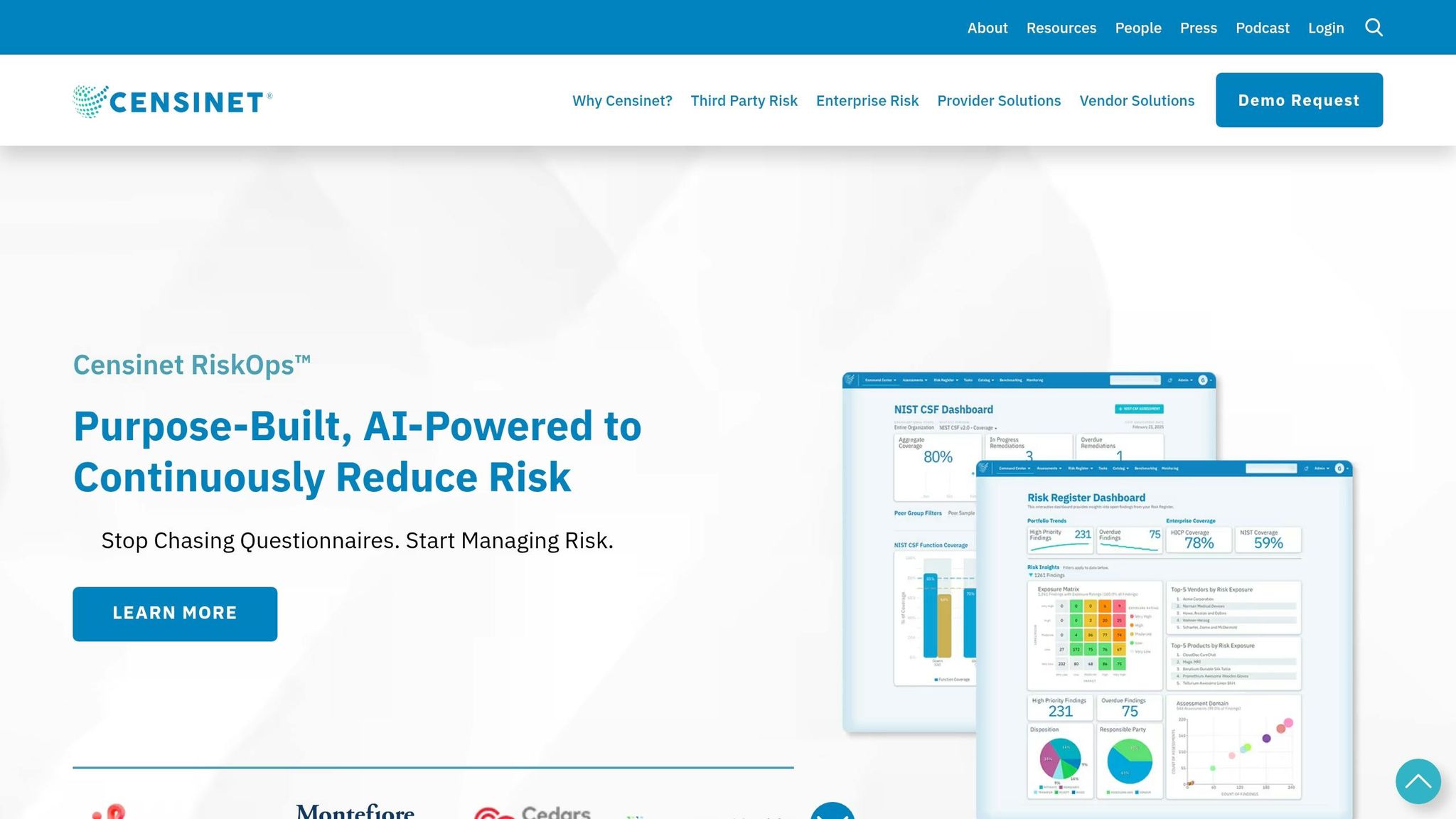
Censinet RiskOps™ offers a proactive solution to these challenges by automating third-party and enterprise risk management, specifically designed to safeguard healthcare systems. As a Preferred Cybersecurity Provider of the American Hospital Association (AHA), Censinet provides a cloud-based risk exchange tailored to mitigate threats to patient safety and care delivery.
The platform simplifies risk assessments across all technology vendors and internal systems, identifying vulnerabilities - like those from software updates or new remote access tools - in real time. With Censinet AI™, healthcare organizations can manage the risks tied to the rapid adoption of AI in clinical environments. Additionally, integrated cybersecurity benchmarking allows organizations to compare their security posture with industry peers. This collaborative approach helps unify IT, procurement, and compliance teams, ensuring that risk management efforts are aligned to protect patient care and maintain operational stability.
Effective risk management is key to keeping clinical workflows reliable and resilient. By addressing these challenges head-on, healthcare organizations can better protect their patients and their systems.
FAQs
What should clinicians do first when the EHR goes down?
When an EHR system goes offline - whether from a ransomware attack or another disruption - clinicians need to rely on downtime procedures. This usually means shifting to manual processes, like using paper documentation, to keep patient care on track and ensure safety. These measures are critical for maintaining clinical operations while IT teams focus on getting the system back online.
How can hospitals keep ransomware from spreading across connected systems?
Hospitals can take steps to contain ransomware threats by using network segmentation, which helps stop infections from spreading across systems. Conducting regular risk assessments, providing staff with phishing awareness training, and keeping backups current are other key measures to reduce risk. Testing recovery plans is crucial for ensuring systems can be restored quickly without resorting to ransom payments. Tools like centralized access controls, such as single sign-on (SSO), and monitoring remote access points also play a vital role in preventing unauthorized movement within hospital networks.
What makes backups ransomware-resistant in healthcare?
Backups play a crucial role in protecting healthcare organizations from ransomware. They securely store critical data, enabling systems to be restored without succumbing to ransom demands. This safeguard ensures that essential information remains accessible, allowing healthcare providers to maintain continuity of care - even in the face of a ransomware attack.
Related Blog Posts
- One in Three Hospitals Confirm Cyber Incidents Directly Impacted Patient Care in Benchmark Findings
- How Healthcare Organizations Lost Access to Patient Records for 15 Hours - And What Happens Next
- Cancer Center Vendor Risk: Oncology Equipment, Drugs, and Treatment Safety
- Top 7 Topics for Healthcare Cybersecurity Training
{"@context":"https://schema.org","@type":"FAQPage","mainEntity":[{"@type":"Question","name":"What should clinicians do first when the EHR goes down?","acceptedAnswer":{"@type":"Answer","text":"<p>When an EHR system goes offline - whether from a ransomware attack or another disruption - clinicians need to rely on <strong>downtime procedures</strong>. This usually means shifting to manual processes, like using paper documentation, to keep patient care on track and ensure safety. These measures are critical for maintaining clinical operations while IT teams focus on getting the system back online.</p>"}},{"@type":"Question","name":"How can hospitals keep ransomware from spreading across connected systems?","acceptedAnswer":{"@type":"Answer","text":"<p>Hospitals can take steps to contain ransomware threats by using <strong>network segmentation</strong>, which helps stop infections from spreading across systems. Conducting regular <strong>risk assessments</strong>, providing staff with <strong>phishing awareness training</strong>, and keeping backups current are other key measures to reduce risk. Testing recovery plans is crucial for ensuring systems can be restored quickly without resorting to ransom payments. Tools like centralized access controls, such as <strong>single sign-on (SSO)</strong>, and monitoring remote access points also play a vital role in preventing unauthorized movement within hospital networks.</p>"}},{"@type":"Question","name":"What makes backups ransomware-resistant in healthcare?","acceptedAnswer":{"@type":"Answer","text":"<p>Backups play a crucial role in protecting healthcare organizations from ransomware. They securely store critical data, enabling systems to be restored without succumbing to ransom demands. This safeguard ensures that essential information remains accessible, allowing healthcare providers to maintain continuity of care - even in the face of a ransomware attack.</p>"}}]}
