
When it comes to SOC 2 compliance, understanding the difference between a gap analysis and a full audit is crucial for organizations, especially in healthcare third-party risk management. Here's the main takeaway:
Key Points:
Quick Comparison:
Feature
SOC 2 Gap Analysis
Full SOC 2 Audit
Identify weaknesses
Formal certification
Internal team/consultant
Independent CPA firm
Remediation plan
SOC 2 Report (Type I/II)
1–4 weeks
6–12 months (Type II)
Lower
Higher
A gap analysis helps you prepare, while the audit delivers the official proof of compliance. Most organizations spend 60–120 days addressing gaps before transitioning to a full audit.
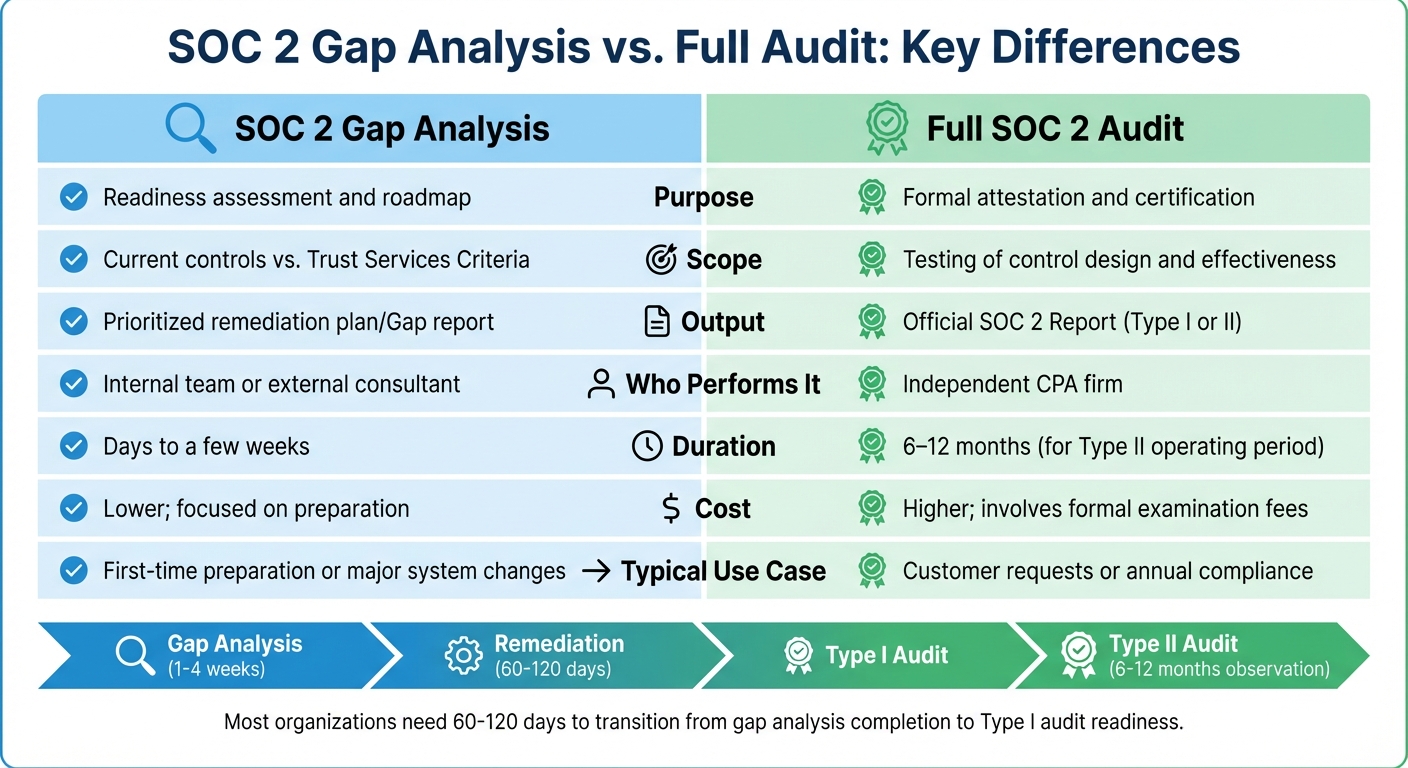
SOC 2 Gap Analysis vs Full Audit Comparison Chart
What is a SOC 2 Gap Analysis?
A SOC 2 gap analysis is an internal review designed to measure how your organization's current security practices align with the SOC 2 framework's requirements [1][4]. This process evaluates your existing controls against the Trust Services Criteria (TSC) to identify shortfalls and areas needing improvement.
Unlike a formal audit, a gap analysis is more flexible and focuses on uncovering gaps such as undocumented controls, weak access reviews, or insufficient logging. For industries like healthcare, where SOC 2 often overlaps with HIPAA requirements, this analysis becomes even more valuable. It highlights shared controls that can address multiple compliance needs, simplifying the overall process.
Purpose of a SOC 2 Gap Analysis
A SOC 2 gap analysis is a crucial preparatory step before a formal audit. It helps pinpoint critical security weaknesses early, allowing your team to address them proactively and avoid last-minute surprises during the audit.
This process categorizes findings into two main groups: "audit-blockers" - issues that could lead to audit failure - and areas for ongoing improvement. Examples might include missing access control documentation, outdated penetration tests, or gaps in logging practices [1]. It also evaluates how well your organization's controls align with the five Trust Service Principles: Security, Availability, Processing Integrity, Confidentiality, and Privacy. This helps you decide which criteria to include based on client commitments [4][5].
Timing is everything. As SecurityWall advises:
"The gap analysis should come first - before you schedule the auditor, not after. Remediating gaps under a fixed audit deadline is expensive and stressful"
.
A thorough gap analysis can save you significant time and effort. It could mean the difference between a focused 90-day sprint to audit-readiness and a drawn-out 12-month ordeal with unexpected issues [1].
Steps in Conducting a Gap Analysis
Here’s a structured approach to performing a SOC 2 gap analysis. Depending on your organization’s complexity, this process typically takes one to four weeks [5]:
Leith Khanafseh, Audit Managing Partner at Thoropass, highlights the importance of preparation:
"From an auditor's perspective, organizations that conduct thorough gap analyses demonstrate a level of security maturity that stands out immediately... it transforms the audit from a stressful examination into an evaluation of well-implemented security practices"
.
Following these steps lays a solid foundation for audit readiness and ensures your organization is well-prepared for the challenges ahead.
sbb-itb-535baee
What is a Full SOC 2 Audit?
A full SOC 2 audit goes beyond identifying gaps in your security controls - it verifies that those controls are in place and working as intended.
This type of audit is conducted by an independent, licensed CPA firm to confirm that your security measures align with the AICPA's Trust Services Criteria (TSC) [1][7]. Unlike a gap analysis, which is more of an internal diagnostic tool, a full SOC 2 audit results in an official attestation report. This report can be shared with healthcare vendors, partners, and customers to show your dedication to safeguarding data and ensuring operational reliability [7].
The audit evaluates your controls against the TSC framework. While Security is mandatory for all SOC 2 audits, you can also include optional criteria such as Availability, Processing Integrity, Confidentiality, and Privacy [1][7]. The criteria you choose should reflect your service commitments and what matters most to your clients. For healthcare organizations managing PHI or clinical data, this independent verification helps build trust with partners who need assurance of your consistent security practices.
Types of SOC 2 Audits
There are two main types of SOC 2 audits:
For most healthcare organizations, a Type II audit is the goal because it demonstrates ongoing compliance rather than a one-time snapshot.
Purpose of a Full SOC 2 Audit
The main goal of a full SOC 2 audit is to provide independent verification that your security controls are not just documented but are actively functioning as intended [1]. This is especially important in healthcare, where protecting patient data and maintaining system availability for critical applications are non-negotiable.
A successful audit transforms your internal security measures into an external credential. As Jerry Hughes from Compass IT Compliance explains:
"SOC 2 is one such standard that attests to an organization's commitment to ensuring data protection and operational reliability"
.
This credential becomes a competitive edge when working with healthcare delivery organizations or responding to security questionnaires during procurement processes.
Another key benefit is ensuring your policies align with your actual practices. Auditors don’t just review your documentation - they test it. For example, if your policy states that access reviews occur quarterly, the auditor will check for evidence that these reviews happened as planned. Any inconsistencies between policy and practice result in findings that need to be addressed.
For healthcare organizations, SOC 2 audits often complement HIPAA compliance. While HIPAA focuses specifically on protecting PHI, SOC 2 offers broader assurance by covering security, availability, and confidentiality across your entire operational infrastructure - not just your PHI handling practices.
Steps in the Full Audit Process
The SOC 2 audit process is systematic, with each step designed to verify control effectiveness.
Organizations typically need 60 to 120 days to transition from completing a gap analysis to being audit-ready for a Type I report [1]. For Type II audits, you’ll also need to account for the observation period, during which your controls must operate consistently without major failures.
Main Differences Between Gap Analysis and Full Audit
Gap analyses and full SOC 2 audits both measure your security controls against the Trust Services Criteria, but they serve different roles in your compliance process. For healthcare organizations managing sensitive patient data and clinical systems, understanding these differences is key to selecting the right approach. Think of a gap analysis as your internal guide, while a full audit is a formal review that results in an official SOC 2 report - something you can confidently share with customers and partners.
The two processes differ greatly in scope and intensity. A gap analysis focuses on reviewing your current processes, including informal ones, to identify missing controls or documentation. On the other hand, a full audit rigorously tests whether your controls are properly designed (Type I) and, in the case of Type II, whether they operate effectively over time.
Another major difference lies in who conducts the assessment. A gap analysis offers flexibility - it can be done by your internal team or with the help of an external consultant. Full SOC 2 audits, however, must be carried out by independent CPA firms, ensuring the credibility of the resulting report. This distinction also impacts the format and final deliverables of each process.
The outputs from these assessments are also quite distinct. A gap analysis provides a prioritized remediation plan, complete with effort estimates and timelines. Many organizations need about 60 to 120 days to prepare for a Type I audit following this process [1]. A full audit, by contrast, results in an official SOC 2 Type I or Type II report that serves as a compliance credential. As David Dunkelberger from IS Partners explains:
"Since the goal of a gap analysis is to identify areas of weakness in your systems that need to be remediated before completing a SOC 2 examination, the auditor provides a key service in advising the client on prioritizing the gaps for remediation"
.
Comparison Table: SOC 2 Gap Analysis vs. Full Audit
Here’s a side-by-side look at the key differences between these two methods:
Feature
SOC 2 Gap Analysis
Full SOC 2 Audit
Readiness assessment and roadmap
Formal attestation and certification
Current controls vs. Trust Services Criteria
Testing of control design and effectiveness
Prioritized remediation plan/Gap report
Official SOC 2 Report (Type I or II)
Internal team or external consultant
Independent CPA firm
Days to a few weeks
6–12 months (for Type II operating period)
Lower; focused on preparation
Higher; involves formal examination fees
First-time preparation or major system changes
Customer requests or annual compliance
These differences help clarify which process best fits your organization's needs, whether you're laying the groundwork for compliance or fulfilling customer and regulatory requirements.
When to Use a SOC 2 Gap Analysis in Healthcare
A SOC 2 gap analysis can be a game-changer for healthcare organizations, especially when navigating complex security and compliance requirements. Here's when it makes the most sense to conduct one.
Preparing for Your First SOC 2 Audit: If your organization already has informal security measures - like access reviews or incident response plans - but lacks the documentation auditors require, a gap analysis is the logical starting point. It pinpoints the "distance" between your current practices and the formal Trust Services Criteria needed for a SOC 2 report [1]. As Babar Khan Akhunzada highlights, this process identifies the controls you need to implement before the formal audit begins [1]. This step is particularly useful if system changes have impacted your security posture.
Launching New Services or System Changes: When rolling out new clinical applications, integrating third-party tools, or expanding your IT architecture, fresh vulnerabilities can emerge. A gap analysis ensures your risk assessments account for these changes and that new components align with security standards before deployment [3]. This is especially critical when onboarding vendors who will handle sensitive patient data - you need to assess their security readiness before granting access to your production systems [1].
Responding to Customer or Partner Requests: If a healthcare provider, insurance payer, or partner asks for a SOC 2 report, a gap analysis is essential. It helps you understand what needs to be done before committing to a timeline or hiring an auditor. This prevents overpromising and sets a realistic path toward compliance.
Managing SOC 2 and HIPAA Requirements: For organizations juggling both SOC 2 and HIPAA standards, a gap analysis can identify overlapping controls. As ZenGRC points out, "Where overlap exists, you might be able to satisfy multiple regulatory obligations with one control" [3]. This approach minimizes duplicate efforts and allows your team to build a unified security framework that meets multiple compliance needs.
Budgeting and Resource Allocation: A gap analysis is also a practical tool for financial planning. By identifying specific "audit-blockers" like missing access reviews, logging deficiencies, or outdated penetration tests, it ensures resources are directed toward critical fixes [1]. As Akhunzada explains, “The organizations that get to SOC 2 fastest aren’t the ones with the fewest gaps. They’re the ones who found out about their gaps earliest” [1]. This proactive approach not only improves security readiness but also helps optimize spending in healthcare environments.
When to Pursue a Full SOC 2 Audit in Healthcare
After completing a gap analysis, the next logical step is a full SOC 2 audit. This process validates that all remediated controls are functioning effectively and provides external assurance. A full SOC 2 audit becomes essential when contractual obligations, regulatory demands, or business needs require third-party verification of your security controls. Unlike a gap analysis, which is an internal check for readiness, a formal audit results in an independent attestation that builds trust with customers, partners, and insurers. As Balaji Nagaraj from ValueMentor explains:
"All contracts, especially in cloud, SaaS, healthcare and finance services, require SOC 2 reports as a pre‑requisite to collaborate"
.
Without a SOC 2 attestation, healthcare vendors can face serious hurdles, such as onboarding delays of 3–6 months and reduced trust from partners and insurers. In fact, 73% of healthcare CIOs report hesitations about working with vendors who lack SOC 2 or equivalent security attestations [8].
Contractual requirements are often the main driver for pursuing a full audit. For example, before a Covered Entity will sign a Business Associate Agreement (BAA) with a Business Associate, they frequently demand proof of a completed SOC 2 audit. Similarly, when renewing cybersecurity insurance, insurers may require third-party attestation to offer lower premiums [9]. Organizations handling Electronic Health Records (EHR) or Electronic Medical Records (EMR) data also rely on SOC 2 to demonstrate strong data governance and secure processing practices [8]. Steve Alder, Editor-in-Chief of The HIPAA Journal, underscores the importance:
"Being able to demonstrate at least one years' compliance with a recognized security framework could help mitigate regulatory penalties for violations of HIPAA"
.
Once all gaps identified during the gap analysis are resolved, an independent audit is the next step to confirm compliance.
Post-breach remediation is another scenario where a SOC 2 audit becomes critical. Following a security incident, regulators and customers often demand proof that controls are not only documented but also independently verified as effective. A SOC 2 Type II audit, which requires controls to operate consistently over a 6- or 12-month period, provides this level of assurance. Delaying this process can waste crucial time, as the "Type II clock" only starts once controls are fully operational and evidence collection begins.
Market differentiation is yet another reason to pursue a full audit. Tech vendors often use SOC 2 compliance to distinguish themselves from competitors who rely solely on self-assessments. When reviewing Master Service Agreements (MSAs) or Service Level Agreements (SLAs), you may find clauses that require independent third-party security attestations - making a full audit a necessity rather than an option [10]. Additionally, the scope of your audit - whether it includes Privacy, Confidentiality, or Availability criteria in addition to the mandatory Security criterion - depends on the commitments made to your end users and partners [4]. Failing to address critical gaps, such as outdated penetration tests or terminated employees retaining access to systems, can result in noncompliance with SOC 2 standards [1].
How Censinet RiskOps™ Supports SOC 2 Preparation
Getting ready for SOC 2 compliance can feel overwhelming. It involves gathering evidence, monitoring controls, and addressing gaps across various areas. Censinet RiskOps™ simplifies this process for healthcare organizations by automating risk assessments. These assessments highlight weaknesses in key areas like Access Control (CC6.1–CC6.3), Change Management (CC8.1), and Risk Assessment (CC3.1–CC3.4). Instead of relying on error-prone manual spreadsheets or internal reviews, the platform ensures gaps are identified objectively - long before an audit.
One of the biggest hurdles in SOC 2 preparation is managing evidence. Since SOC 2 audits heavily rely on documentation, it’s crucial to collect and organize items like screenshots, logs, pull request records, and vendor questionnaires as soon as controls are implemented. Censinet RiskOps™ streamlines this by centralizing all documentation, ensuring your evidence library grows alongside control implementation. This eliminates the last-minute scramble to find proof of compliance just before the audit kicks off. Plus, this centralized evidence ties directly into the platform’s remediation workflow.
The platform’s workflow tools are designed to help teams focus on what matters most. It separates critical issues - those that could derail an audit - from less urgent improvement tasks. For instance, if your gap analysis identifies missing quarterly access reviews or incomplete log coverage for cloud systems, RiskOps™ assigns these tasks to the right team members and tracks their progress. This proactive approach prevents costly, rushed fixes, especially when most organizations need 60 to 120 days to go from gap analysis to SOC 2 Type I audit readiness [1].
Another advantage of starting the gap analysis early with Censinet RiskOps™ is avoiding unnecessary fixes before involving an auditor. The platform also helps schedule technical security tests, like penetration testing, well in advance. This ensures there’s enough time to address any findings and provide updated evidence before the audit window closes. This is especially crucial for SOC 2 Type II audits, which require controls to operate consistently over a 6- or 12-month period [1].
For healthcare organizations, where managing risks tied to patient data, PHI, clinical apps, and medical devices is critical, Censinet RiskOps™ acts as a central hub. It brings together compliance tasks, policies, and risk management, ensuring that the right teams tackle the right issues at the right time. This unified approach creates a clear path from identifying gaps to achieving audit readiness.
Key Takeaways
A gap analysis acts as a roadmap, pinpointing where your controls fall short of SOC 2 requirements and creating a prioritized plan to address them. It’s an internal exercise, not a formal certification. On the other hand, a full audit is a formal evaluation conducted by a CPA, resulting in a SOC 2 Type I or Type II report for external stakeholders. Unlike a full audit, a gap analysis identifies missing controls without conducting extensive testing [6].
"The organizations that get to SOC 2 fastest aren't the ones with the fewest gaps. They're the ones who found out about their gaps earliest." – Babar Khan Akhunzada, Founder, SecurityWall
For healthcare organizations unfamiliar with SOC 2 or unsure about their control posture, starting with a gap analysis is key. It helps avoid costly surprises and wasted resources during the formal audit process. Once critical gaps are addressed, an evidence library is established, and contractual requirements are met, the next step is a full audit. Typically, organizations take 60 to 120 days to move from gap analysis to being ready for a Type I audit [1]. This preparatory work lays the groundwork for smoother implementation, a process that Censinet RiskOps™ simplifies.
Censinet RiskOps™ enhances the SOC 2 process by automating risk assessments, centralizing evidence collection, and ensuring critical tasks are assigned to the right teams. This streamlined approach helps healthcare providers efficiently manage risks to patient data, PHI, and clinical systems.
FAQs
Do I need a gap analysis before a SOC 2 audit?
Absolutely. Conducting a SOC 2 gap analysis before your audit is a smart move. It helps pinpoint your current controls, uncovers any weaknesses, and provides clear guidance on what needs to be improved to align with SOC 2 requirements.
Taking this step not only simplifies the audit process but also minimizes the chances of unexpected issues or setbacks. Plus, it allows you to focus your time and resources on the areas that need the most attention, ensuring you're well-prepared for the audit.
How do I choose between SOC 2 Type I and Type II?
Choosing between SOC 2 Type I and SOC 2 Type II comes down to your specific goals, the maturity of your controls, and any customer or regulatory expectations.
What evidence should I start collecting for SOC 2?
To get ready for SOC 2, start by collecting key documents like your security policies, access control logs, system configuration details, and vendor risk assessments. Store all of this information in a centralized location to keep things organized. Regularly reviewing this evidence and using tools to automate compliance tracking can make the process much smoother. By prioritizing these steps, you'll be better equipped to spot any gaps and prepare for the SOC 2 audit.
