
IoT devices in healthcare are lifesaving but vulnerable to cyberattacks. UL 2900 provides a security framework to protect these devices, ensuring safe operations and data protection.
Key Points:
- What is UL 2900? A cybersecurity standard for network-connected products, with specific guidelines for healthcare devices (UL 2900-2-1).
- Why it matters: Medical devices like pacemakers and infusion pumps can be exploited, risking patient safety and data breaches.
- FDA Recognition: UL 2900-2-1 has been FDA-recognized since 2018, streamlining premarket submissions for device manufacturers.
- Core Requirements: Includes penetration tests, source code reviews, SBOM (Software Bill of Materials), and encryption protocols.
- Healthcare Impact: Helps manufacturers secure devices and assists hospitals in evaluating vendor products, reducing risks in procurement and network integration.
This standard is essential for securing connected healthcare devices, protecting patient data, and ensuring compliance with regulatory requirements.
UL 2900-2-1 Requirements for Healthcare Devices
Which Devices Are Covered
UL 2900-2-1 applies to healthcare devices with network connectivity that could influence security. This includes hardware, software, firmware, and network interfaces. Devices covered under this standard range from life-critical implants, like pacemakers and implantable cardioverter defibrillators (ICDs), to delivery systems such as insulin pumps and infusion pumps. It also includes surgical tools (e.g., robotic surgery systems, laser surgical equipment), monitoring devices (like wearable health monitors and bedside monitors), diagnostic tools (imaging equipment, laboratory analyzers), medical device data systems (MDDS), in vitro diagnostic (IVD) devices, and health information platforms [4][6].
To determine if a device qualifies, manufacturers must document whether it has network connectivity and detail all external interfaces - such as cellular, cloud, USB, Bluetooth, or serial connections. They must also outline any sensitive data the device stores or transmits. Once eligibility is established, UL 2900-2-1 provides detailed security controls to address potential vulnerabilities.
Core Security Requirements
UL 2900-2-1 outlines specific, testable security criteria. The evaluation involves assessing documentation and processes (e.g., reviewing quality management systems and software development life cycles), performing static and dynamic code analysis, and conducting rigorous product testing. This includes penetration and fuzz testing that simulates attack scenarios using a "kill chain" model [1][4][3].
The testing process focuses on identifying weaknesses like buffer overflows and memory leaks, ensuring devices are free from known malware, and verifying secure boot processes and firmware update mechanisms with rollback capabilities [4][5]. Manufacturers are required to maintain a Software Bill of Materials (SBOM) to track third-party components and their vulnerabilities [1]. Access control measures are also reviewed, including authentication mechanisms, multi-factor authentication (MFA), and role-based access control (RBAC) [4].
Network security testing targets vulnerabilities in protocols like HL7, DICOM, FHIR, as well as Wi-Fi (WPA3), Bluetooth Low Energy (BLE), and cellular connections [4]. Physical interfaces, such as USB ports, are tested for malware resistance, alongside resilience tests for denial-of-service (DoS) and man-in-the-middle (MITM) attacks [4].
"The standard describes requirements that the product developer should be mindful of throughout the life of the product: the use of a risk management process... and the application of security controls in the architecture and design." – Intertek [5]
In addition to these technical controls, the standard enforces strict measures for safeguarding patient health information (PHI) and data confidentiality.
Protecting PHI and Data Confidentiality
UL 2900-2-1 emphasizes the protection of patient health information (PHI) and personally identifiable information (PII) throughout a device's life cycle, requiring specific procedures for both pre-market and post-market data management [1].
Devices must encrypt data both at rest and in transit, adhering to FIPS 140-3 standards. Secure key management protocols are required for storage, rotation, and session handling [4]. When a device is decommissioned, discarded, or resold, sensitive data must be erased through "zeroization" to ensure it cannot be recovered by unauthorized individuals [3][1].
The standard also mandates robust logging and audit trails to monitor data access and prevent unauthorized bypass of access controls [1]. These measures align with ISO/IEC 27001 guidelines, protecting PHI from unauthorized access, modification, or disclosure, which directly addresses threats to patient safety.
Manufacturers are also required to establish incident response plans to handle improper PHI access effectively [1]. This comprehensive approach not only protects sensitive data but also supports compliance with FDA regulations and other healthcare privacy requirements.
"Compliance demonstrates the effective implementation of security controls protecting both sensitive data, such as personally identifiable information (PII), protected health information (PHI), and other assets, such as keys or command and control data." – UL Solutions [1]
Advancing Clinical IoT with IEEE/UL 2933: A Framework for Trust, Security, and Interoperability
How Manufacturers Can Achieve UL 2900 Compliance
UL 2900-2-1 Compliance Process for Medical Device Manufacturers
Determining if Your Device Needs Certification
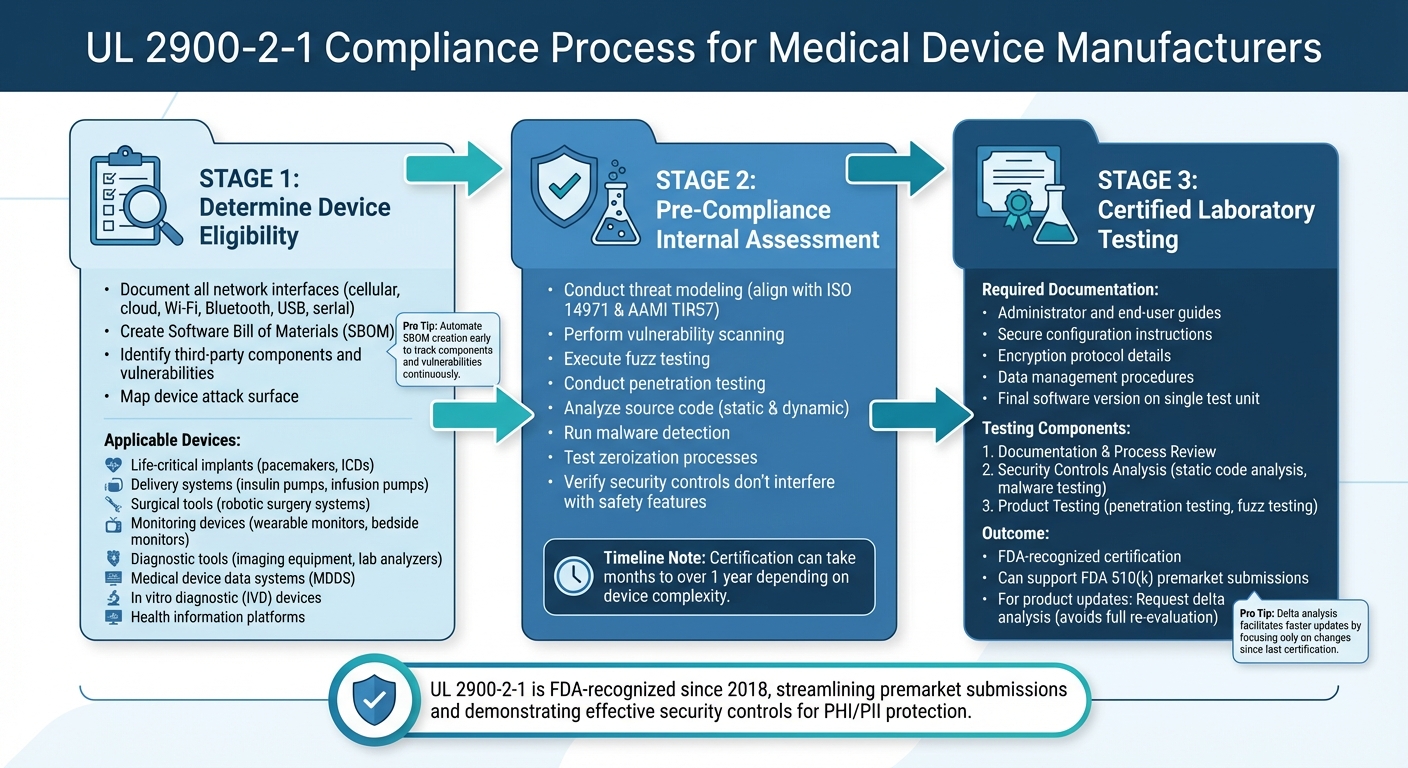
The first step in achieving UL 2900 compliance is figuring out if your product falls under the scope of UL 2900-2-1. This standard applies to any network-connected component in a healthcare or wellness system. That includes medical devices, accessories, medical device data systems (MDDS), in vitro diagnostic (IVD) devices, health IT platforms, and wellness devices. If your device connects to a network via cellular, cloud, Wi-Fi, Bluetooth, USB, or serial interfaces, it requires evaluation.
Start by documenting all external interfaces your device uses. Creating a Software Bill of Materials (SBOM) early is key - it helps identify third-party components and potential vulnerabilities. This step not only sets the stage for certification but also provides a clear picture of your device's attack surface. Once you've confirmed your device's scope, conduct a detailed internal security assessment.
Conducting Pre-Compliance Security Assessments
Before sending your device to a certified testing lab, perform thorough internal security checks to identify and address vulnerabilities. Begin threat modeling as early as possible - certification can take months or even over a year, depending on the device's complexity. Incorporate threat modeling and risk management activities during the concept phase, aligning with standards like ISO 14971 and AAMI TIR57.
"The independent testing process will either confirm that there are no security‐relevant known vulnerabilities, including malware, in your product, or identify vulnerabilities and the resulting controls that should be applied to your product prior to release." – Intertek [5]
Your internal testing should be comprehensive, combining automated and manual techniques such as vulnerability scanning, fuzz testing, penetration testing, source code analysis, and malware detection. If your company has its own cybersecurity lab, consider joining the DATL program for supervised testing. Additionally, verify that your security controls don’t interfere with safety features and test processes like "zeroization" to ensure sensitive data is properly erased during decommissioning. Once internal testing is complete, you can move on to formal certification by a certified laboratory.
Working with a Certified Testing Laboratory
After completing internal assessments, submit your device and documentation to an accredited testing lab. The certification process typically involves three stages: reviewing documentation and processes, analyzing security controls (such as static code analysis and malware testing), and conducting product testing (including penetration and fuzz tests).
For the testing phase, you’ll need to provide several key documents, such as administrator and end-user guides, secure configuration instructions, and details on encryption protocols and data management. Submit a single unit of your device with the final software version for physical testing. Since UL 2900-2-1 is recognized as a consensus standard by the FDA, the documentation and test data from this certification process can also support FDA 510(k) premarket submissions. If you make significant changes to a certified product, request a delta analysis from the testing lab. This analysis identifies which tests need repeating, saving you from undergoing a full re-evaluation.
"UL 2900-2-1 aligns with FDA cybersecurity expectations... using UL 2900-2-1 offers a more efficient process that can lead to UL Solutions certification and help streamline FDA acceptance." – UL Solutions [3]
sbb-itb-535baee
Using UL 2900 in Healthcare Procurement and Risk Management
UL 2900's rigorous testing and certification framework offers healthcare organizations a valuable tool for safer procurement and secure network integration.
Evaluating Vendor Devices with UL 2900 Certification
Healthcare organizations can use UL 2900 certification as a standardized benchmark when assessing vendor products. This certification confirms a device's security measures and provides objective evidence that sensitive data, such as PHI (Protected Health Information) and PII (Personally Identifiable Information), is protected [1]. As UL Solutions highlights:
"Healthcare delivery organizations (HDOs) can use the UL 2900 Standard for procurement, asset tracking, and integration risk management." – UL Solutions [1]
To ensure authenticity, verify certifications through the UL Product iQ database, which includes manufacturer details, product specifications, and testing data. Beyond the public certificate, request the private certification report from the vendor. This report dives deeper into the device's attack surface, threat model, and vulnerabilities, offering critical insights for internal risk assessments. Additionally, confirm that the certification applies to the specific software version you plan to purchase, including any third-party components. If the device has undergone significant updates, check for recertification or delta analysis to ensure continued compliance [1][3]. These steps establish a solid foundation for securely deploying devices in clinical environments.
Deploying Certified Devices in Healthcare Networks
After confirming a device's certification, the focus shifts to its safe integration into healthcare networks. Certification data becomes a key resource for establishing security controls during deployment. The private report's detailed threat model can help evaluate how the new device interacts with your existing IT infrastructure, highlighting potential integration risks [1][3].
Leverage secure configuration guides and interface documentation provided with the certification to streamline the integration process. Incorporate certification data into your asset management system to monitor the device's security status throughout its lifecycle. Additionally, establish a shared responsibility framework with the manufacturer to address critical areas like patch management and end-of-life support. This collaboration ensures patient safety, even if the device is used beyond its supported lifecycle [1][3]. Proper certification practices not only support deployment but also help mitigate broader supply chain risks.
Reducing Supply Chain Risks
UL 2900 certification plays a crucial role in reducing supply chain vulnerabilities. It requires manufacturers to implement strict controls over third-party components, minimizing risks associated with external suppliers [1]. Through independent penetration testing, the standard ensures that weaknesses in third-party components are identified and addressed. Use SBOM (Software Bill of Materials) data to track and manage vulnerabilities in these components. This is particularly critical, considering that 22% of organizations reported a serious IoT security incident in 2024 [2].
The standard also mandates secure decommissioning protocols, such as data zeroization, to protect sensitive information during a device's retirement [3][1]. By aligning your decommissioning procedures with these requirements, you can safeguard PHI throughout the device's entire lifecycle. These practices not only enhance operational security but also strengthen confidence in your supply chain.
UL 2900 and Healthcare Cybersecurity Governance
Building on UL 2900's detailed security controls and compliance benefits, this section explores its role in broader cybersecurity governance. UL 2900 seamlessly integrates with key healthcare cybersecurity frameworks and regulatory requirements, making it a vital tool for the industry.
How UL 2900 Works with Other Standards
UL 2900 was developed with input from the National Institute of Standards and Technology (NIST), aligning it closely with the NIST Framework for Improving Critical Infrastructure [1]. This ensures compatibility with widely used cybersecurity frameworks in healthcare. Acting as a unifying standard, UL 2900 incorporates elements from ISO 14971 (risk management), IEC 62304 (software lifecycle processes), AAMI TIR 57 (product security risk management), and ISO 13485 (quality management systems) [1].
This integration allows organizations to leverage UL 2900 certification data to meet multiple compliance requirements. For instance, documentation produced during UL 2900-2-1 certification - such as threat models, attack surface analyses, and Software Bills of Materials (SBOMs) - can be seamlessly integrated into internal regulatory and quality management systems [3]. Additionally, UL 2900 supports HIPAA's data protection objectives by enforcing security controls designed to safeguard Protected Health Information (PHI) and Personally Identifiable Information (PII) [1]. Its alignment with international standards enhances its regulatory acceptance and implementation across various regions.
Global Adoption and Regulatory Alignment
UL 2900 has gained traction globally, with adoption by regulatory bodies and organizations in numerous countries. The International Medical Device Regulators Forum (IMDRF) references UL 2900 in its cybersecurity management guidelines, and countries like Australia, Canada, China, France, and Vietnam have incorporated the standard into their regional cybersecurity frameworks [1]. UL Solutions also operates in over 80 countries, supporting the standard's implementation on a regional scale [3].
How Censinet Supports UL 2900 Compliance
Managing UL 2900 compliance across diverse vendors and devices is no small task, but tools like Censinet RiskOps™ simplify the process. This platform provides a centralized hub for tracking and managing device certifications throughout their lifecycle, building on the risk management strategies outlined earlier. It enables healthcare organizations to integrate UL 2900 certification data into asset management systems, monitor device security, and maintain visibility across third-party vendors.
Censinet Connect™ further streamlines vendor risk assessments by allowing healthcare delivery organizations to evaluate UL 2900 certifications alongside other security documentation during procurement. Automated workflows make it easier to verify certifications through the UL Product iQ database, request and review private certification reports, and establish shared responsibility agreements with manufacturers for ongoing patch management and end-of-life support. By consolidating all this information into one platform, Censinet RiskOps™ helps mitigate supply chain risks while ensuring continuous compliance with UL 2900 and related cybersecurity standards.
Conclusion
Key Takeaways
UL 2900-2-1 offers a standardized framework recognized by the FDA for securing connected medical devices. Covering every phase of the product lifecycle - from initial research and threat modeling to secure decommissioning - it ensures robust security measures that safeguard both patient safety and sensitive data, such as Protected Health Information (PHI). With over 51% of hospitals and clinics reporting malware incidents on their devices [8] and IoT devices facing attacks every two minutes on average [7], the importance of independent validation cannot be overstated.
For manufacturers, achieving UL 2900 certification serves as third-party verification of their internal security practices, potentially leading to better terms for cyber-risk insurance. On the other hand, healthcare organizations can use the certification as a procurement benchmark, integrating it into asset management strategies and minimizing supply chain risks. Its alignment with frameworks like NIST, ISO 14971, and IEC 62304 also means that one certification effort can streamline compliance across multiple standards.
These benefits lay the groundwork for continued advancements in healthcare IoT security.
The Future of IoT Security in Healthcare
The landscape of IoT security in healthcare is poised to address emerging challenges as the Internet of Medical Things (IoMT) market grows from $13.12 billion in 2025 to an estimated $23.92 billion by 2031 [8]. UL 2900 is evolving to tackle threats like AI-driven diagnostics vulnerabilities, model poisoning, and adversarial inputs, ensuring its relevance in regulatory and risk management frameworks [8]. Additionally, international adoption is expanding through organizations like the International Medical Device Regulators Forum (IMDRF) and its member states [1].
The industry is moving toward a shared responsibility model. Manufacturers are expected to deliver secure devices with clear risk communication, while healthcare organizations implement layered defenses tailored to their specific environments [3]. Tools like Censinet RiskOps™ are aiding this shift by centralizing UL 2900 certification tracking, automating vendor assessments with Censinet Connect™, and maintaining oversight throughout device lifecycles. By combining standardized testing, regulatory alignment, and proactive risk management, this collaborative approach is shaping the future of healthcare IoT security.
FAQs
How is UL 2900-2-1 different from general UL 2900?
UL 2900-2-1 is part of the UL 2900 series, specifically targeting software cybersecurity for network-connected healthcare and wellness devices. While the broader UL 2900 standard spans multiple industries, UL 2900-2-1 hones in on medical environments, prioritizing the protection of patient data and ensuring safety. It includes healthcare-specific requirements and testing protocols designed for medical devices, their accessories, and related systems.
What evidence should hospitals request beyond the UL certificate?
Hospitals need to demand proof of independent third-party testing to identify vulnerabilities, malware, and security weaknesses. This should cover areas like comprehensive security assessments, source code analysis, and documented risk management practices. These steps help ensure that strong cybersecurity measures are thoroughly implemented and maintained.
How often do UL 2900-certified devices need retesting after updates?
Devices certified under UL 2900 need to undergo retesting and reassessment whenever major updates or changes are introduced. This process ensures they stay aligned with cybersecurity standards and consistently meet the necessary security requirements.
