
AI is transforming healthcare, but with this transformation comes risks - especially when systems fail. The stakes are high: errors in AI-controlled medical devices or cyberattacks on healthcare systems can cost lives. A key question arises: who is responsible for managing these risks?
Key Takeaways:
Solutions:
Clear accountability, structured governance, and proactive risk management are essential for safely integrating AI into healthcare.
AI Risk Accountability in Healthcare: Key Statistics and Stakeholder Responsibilities
Who is Liable When AI Goes Wrong in Your Hospital?
sbb-itb-535baee
Defining AI Risk Ownership: Core Principles
Laying down clear principles is the first step in managing AI responsibly. These principles provide a unified framework, ensuring that everyone - from top executives to frontline workers - understands their role in maintaining accountability. They form the backbone of the responsibilities outlined below.
Accountability and Clear Roles
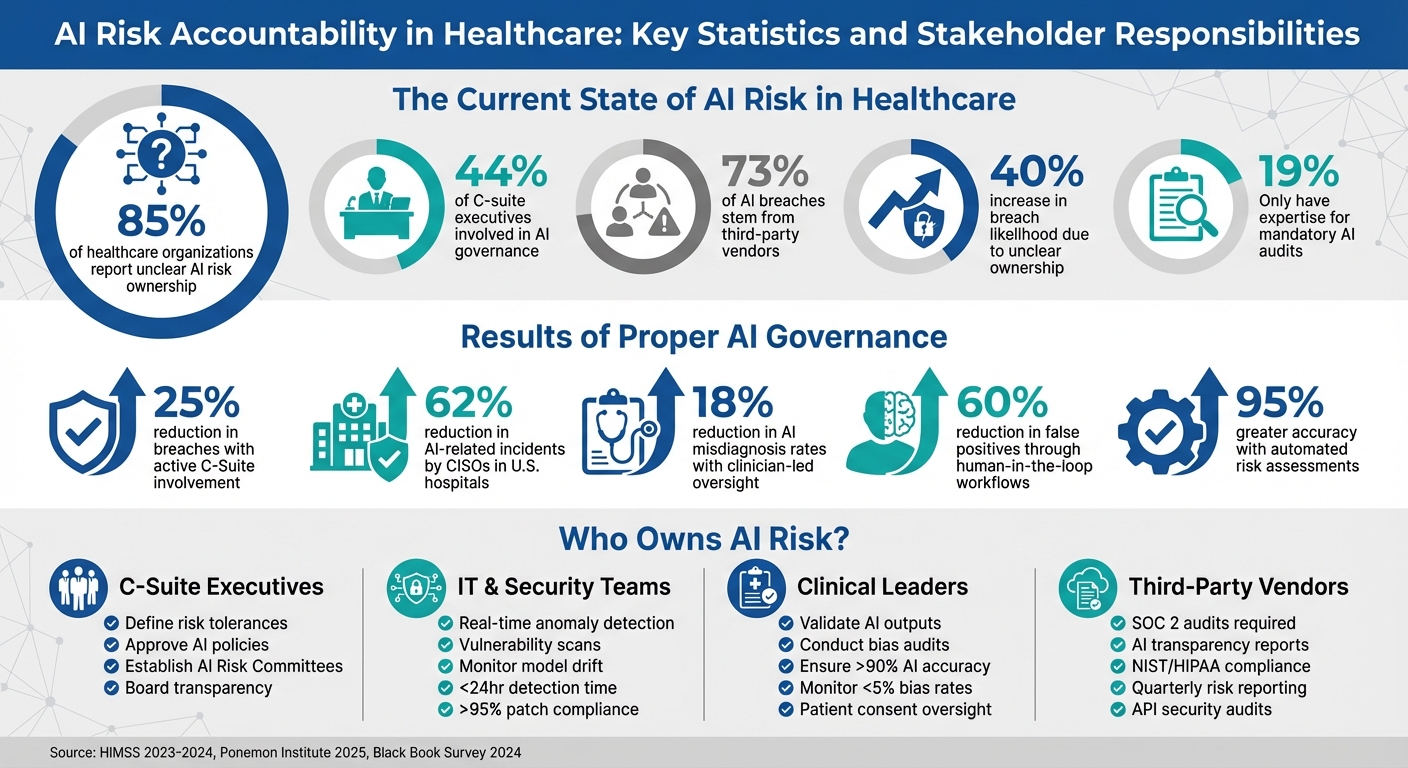
Unclear responsibilities often lead to gaps in oversight. For instance, only 44% of C-suite executives are involved in shaping AI-related processes, and just 33% contribute to governance aimed at reducing AI risks. Even ownership of AI accountability is split, with 24% of organizations assigning it to the CEO and another 24% to the CISO [3].
To avoid such ambiguity, organizations must clearly outline who is responsible for key tasks like monitoring AI performance, investigating incidents, approving new tools, and ensuring compliance. With well-defined roles, teams can respond more effectively and in a timely manner.
Transparency and Governance
Establishing accountability is only part of the equation - strong governance is equally important. Many AI systems operate as "black boxes", relying on statistical patterns rather than transparent rules, which makes it hard to explain their decisions [1]. As Claude Mandy, Chief Evangelist for Data Security at Symmetry Systems, explains:
The 'black box' nature of many AI systems clashes with our obligation to explain decisions that affect people's lives
.
To address this, organizations should implement robust governance frameworks. These might include forming cross-functional AI Risk Committees that bring together experts from security, legal, clinical, and ethics teams. Preparing for mandatory AI audits is also crucial, especially since only 19% of organizations currently have the expertise to handle them [3]. Transparency in the AI supply chain is another key factor - healthcare providers, for example, need confidence in everything from the training data used to the platforms where AI tools are deployed.
Safety and Bias Prevention in AI Systems
Ensuring the safety of AI systems and minimizing bias is essential. Errors in AI often arise from system malfunctions or complex interactions between humans and technology [1]. Compromised training data, or "data poisoning", is another significant threat [4]. Additionally, AI systems sometimes generate inaccurate or misleading outputs - so-called "hallucinations" - that can appear highly credible [1].
To combat these risks, organizations must conduct rigorous, ongoing bias testing. This involves analyzing AI outcomes across demographic groups - such as race, socioeconomic status, and geography - to prevent the technology from deepening existing disparities [2]. Synthetic data can be a useful tool for identifying potential biases, such as racial or regional imbalances, before deploying AI systems. The goal is to move from reacting to incidents after they occur to proactively managing risks. As Gianmarco Di Palma and colleagues highlight:
Clinical Risk management is a solid basis for the integration of AI and blockchain in healthcare... ensuring regulatory compliance on the one hand and supporting the implementation of more robust controls within complex healthcare contexts
.
Assigning AI Risk Ownership Across Your Organization
To effectively manage AI risks, organizations need to assign clear responsibilities at every level. This not only ensures accountability but also helps build a strong foundation of AI governance, particularly in healthcare cybersecurity. A striking statistic highlights the urgency: 85% of healthcare organizations report unclear AI risk ownership, which increases the likelihood of breaches by 40% [10]. The solution? Assigning specific roles and tasks to key stakeholders to ensure no critical areas are overlooked.
C-Suite: Executive Oversight and Governance
The responsibility for AI risk management starts at the top. CIOs, CISOs, and Chief AI Officers play a central role by defining risk tolerances, approving AI policies, and maintaining transparency with the board. According to a 2023 HIMSS report, healthcare organizations with active C-Suite involvement in AI oversight saw a 25% reduction in breaches, thanks to proactive governance frameworks [5][6]. These leaders often establish AI Risk Committees that meet quarterly, using KPI dashboards to monitor governance progress and breach-related costs. Notably, CISOs in U.S. hospitals have reduced AI-related incidents by 62%, as reported in a 2024 HIMSS survey [11]. Once the governance framework is set, IT and security teams take over to implement technical defenses.
IT and Security Teams: Technical Risk Management
IT and security teams are the backbone of AI risk mitigation, focusing on technical safeguards. Their work includes real-time anomaly detection integrated with SIEM systems, regular vulnerability scans, and monitoring for model drift or adversarial attacks. For instance, a Mayo Clinic case study revealed how automated monitoring helped detect a 15% increase in anomalous AI predictions. By isolating affected systems, they successfully prevented potential data breaches [7]. The adoption of zero-trust models for AI systems has surged by 50% since 2023, reflecting a growing emphasis on rigorous security measures. These teams aim to keep the mean time to detect vulnerabilities under 24 hours and maintain patch compliance rates above 95% [6]. Meanwhile, clinical leaders focus on ensuring AI aligns with patient care standards.
Clinical Leaders: Ethical and Operational Oversight
Clinical leaders are tasked with ensuring that AI enhances patient care without sacrificing ethical standards. Their responsibilities include validating AI outputs against clinical guidelines, conducting bias audits for diagnostic tools, and integrating AI into workflows while maintaining care quality. A NEJM Catalyst survey found that clinician-led oversight reduced AI misdiagnosis rates by 18%, thanks to patient-focused validation processes [5][6]. These leaders track AI accuracy, aiming for benchmarks above 90%, and monitor bias rates, keeping them below 5%. They also oversee informed consent for AI-driven decisions and ensure human oversight for high-risk AI models. However, effective accountability also requires managing risks introduced by external vendors.
Third-Party Vendors: Supply Chain Risks
Vendors often pose significant risks through unvetted AI models, insecure APIs, or improper data handling. According to the Ponemon Institute's 2025 report, 73% of AI breaches in healthcare are linked to third-party vendors [12]. To address this, organizations must require SOC 2 audits, AI transparency reports, and adherence to NIST standards from all vendors. A 2024 Black Book survey revealed that 40% of healthcare data breaches involved vendor AI tools [6]. For example, Cleveland Clinic has achieved zero AI-related incidents in 2024 by holding vendors accountable for API audits and requiring quarterly risk score reporting [7]. The demand for vendor risk management platforms has grown 35% annually, driven by regulatory requirements like HHS AI guidelines and the need for continuous oversight.
Building Governance Frameworks for AI Accountability
Once you've assigned clear responsibilities for managing AI risks within your organization, the next step is to formalize those responsibilities through structured governance frameworks. These frameworks prevent accountability from becoming scattered and ensure that AI risks are managed in an organized, consistent manner. Industry-standard frameworks provide healthcare organizations with proven methods to address AI risks while keeping up with evolving regulations. Essentially, such frameworks integrate previously defined roles into formal risk management processes.
Using the NIST AI Risk Management Framework
The NIST AI Risk Management Framework (AI RMF) outlines four key functions: Govern, Map, Measure, and Manage. Together, these functions help establish executive oversight, frame AI systems within their operational context, assess their trustworthiness, and allocate resources for mitigating risks [14][15].
By establishing clear guidelines, this framework supports responsible innovation while keeping risks in check. It also emphasizes collaboration across departments - clinical, IT, legal, marketing, and operations - to ensure accountability [13]. When selecting AI vendors, prioritize companies that are transparent about how their systems work. Avoid solutions that are opaque, even if they seem advanced [13]. The framework’s credibility is underscored by contributions from over 240 organizations spanning industry, academia, and government [14].
Applying Tiered Risk Approaches from the EU AI Act
While the NIST framework provides a comprehensive risk management structure, the EU AI Act offers a tiered regulatory model. Effective as of August 1, 2024, the EU AI Act classifies AI systems into four risk categories: Unacceptable, High, Limited, or Minimal/No Risk [16]. Healthcare AI used for diagnostics, treatment, or decision-support typically falls under the High-Risk category due to its potential impact on patient safety. For these systems, organizations must:
The EU AI Act has a global ripple effect, much like GDPR did for data privacy. Non-compliance with the Act’s provisions, such as the prohibition of certain AI systems, can result in steep fines - up to €35 million or 7% of global annual turnover, whichever is greater [16]. To ensure compliance, healthcare organizations should conduct a "Go/No-Go" analysis for each AI system, documenting its purpose and operational context. For lower-risk applications, like patient-facing chatbots, transparency obligations require informing users when they are interacting with AI.
Creating Human Oversight and Incident Response Plans
Human oversight is critical when using high-risk AI in healthcare. Clinicians must have clear protocols for overriding AI recommendations to reduce bias and prioritize patient safety. Establishing "human-in-the-loop" processes ensures that decisions remain under human control. Additionally, incident response plans should address AI-related failures by including measures like "safe failure modes" and mechanisms to deactivate or override the system immediately [14]. Continuous monitoring and formal incident reporting are also essential to detect issues like model drift or performance degradation during post-market use.
Building diverse oversight teams is equally important. Teams that include a mix of backgrounds and expertise are better positioned to identify unintended consequences and biases in AI systems [14]. All oversight processes should be thoroughly documented, including criteria for decisions, escalation procedures, and audit trails.
"Risk management frameworks are in the category of '-ish,' which means that organizations can be 'compliant-ish,' or somewhat compliant. That is worlds better than complete noncompliance."
Scaling AI Risk Management with Censinet RiskOps
Managing AI risks across hundreds of vendors and internal systems can quickly become overwhelming, even for healthcare organizations with robust staffing. Censinet RiskOps™ tackles this issue by blending AI-powered automation with human oversight, allowing healthcare providers to scale their risk management efforts without compromising on precision or accountability. Here’s how automation, expert input, and real-time dashboards work together to streamline risk management.
Automated Third-Party Risk Assessments with Censinet AI™
Censinet AI™ simplifies the complex process of vendor risk assessments by employing machine learning to analyze questionnaires, security evidence, and compliance documents in real time. By validating data against standards like NIST and HIPAA, it slashes assessment timelines from weeks to mere hours, delivering 95% greater accuracy [18]. For instance, a major U.S. health system used Censinet AI™ to automate risk assessments for over 200 vendors, reducing the time needed per vendor from 40 hours to just 2 hours. Additionally, the platform uncovered 15% more high-risk AI integrations related to patient data privacy, enabling proactive measures that averted potential breaches, saving an estimated $4.5 million [5].
Beyond speed, the platform generates risk scores and comprehensive reports on AI vulnerabilities, such as model bias and data leakage. Healthcare organizations using Censinet AI™ have reported a 25% reduction in overall third-party risk exposure within just six months, along with measurable ROI of $1.2 million in annual savings for large hospital networks [6].
Human-in-the-Loop Automation for Accountability
While automation accelerates processes, Censinet AI™ incorporates human-in-the-loop workflows to ensure critical decisions are guided by expert judgment. High-risk issues - like ethical biases in diagnostic AI models - are flagged by the system but require approval from designated experts for escalations, remediation, or risk acceptance [7]. This hybrid approach ensures complete traceability with audit trails and reduces false positives by 60% through iterative learning.
Organizations can customize role-based workflows, where IT teams handle technical risks and clinical leaders evaluate ethical concerns. AI confidence thresholds determine when human intervention is necessary, maintaining a balance between speed and accuracy. Deployment is quick, typically taking 4–6 weeks, and ongoing monitoring helps enforce a zero-tolerance policy for biased AI outputs [8].
AI Risk Dashboards for Real-Time Governance
Censinet RiskOps™ also provides centralized, interactive dashboards that give healthcare organizations real-time visibility into AI risks. These dashboards display critical data like risk heatmaps, vendor scores, and trend alerts in formats familiar to U.S. healthcare teams - complete with USD cost projections and MM/DD/YYYY date formats [19][9]. Shared views and comment threads allow for cross-team collaboration, enabling swift decision-making.
For example, if a dashboard shows a 15% increase in third-party AI vulnerabilities, it can trigger immediate alerts to the C-Suite, leading to decisive actions like vendor terminations within 24 hours [9]. The platform also automates tiered risk evaluations based on established frameworks, making it possible to manage third-party vendor risk for over 1,000 vendors without the need for custom development.
Conclusion: Building a Culture of AI Accountability
AI accountability in healthcare isn't just a box to check - it’s a critical necessity. It demands clear ownership, structured governance, and the right tools tailored to the complexities of the industry. As Matt Christensen, Sr. Director GRC at Intermountain Health, aptly states:
Healthcare is the most complex industry... You can't just take a tool and apply it to healthcare if it wasn't built specifically for healthcare
.
To navigate this complexity, organizations need enterprise-wide visibility, frameworks like the NIST AI Risk Management Framework and the HSCC SMART toolkit, and automated oversight solutions like Censinet RiskOps™. These elements don’t just reduce compliance headaches - they turn AI challenges into opportunities to drive strategic growth.
Achieving this requires more than just tools and frameworks. It demands precise role definition and seamless collaboration across all levels of the organization - executives, technical teams, and external partners. When these roles are supported by human-in-the-loop automation, they create a robust accountability structure that ensures resilience and adaptability.
At its core, AI accountability relies on human expertise. While technology can streamline processes and provide data-driven insights, only humans can interpret the nuances of that data, make ethical decisions, and ensure AI is used responsibly in sensitive healthcare environments. By defining roles clearly, adopting proven frameworks, and using tools designed specifically for healthcare, organizations can confidently embrace AI while maintaining trust, adhering to regulations, and upholding ethical standards.
FAQs
Who should ultimately own AI risk in a hospital?
AI-related risks in hospitals should be the responsibility of the organization's leadership, including executive teams and governance committees. These leaders must ensure proper accountability and oversight while implementing risk management frameworks. This includes tackling critical concerns such as data security, compliance, and ethical considerations surrounding AI use.
What does 'high-risk AI' mean for healthcare teams?
In healthcare, the term high-risk AI applies to technologies that could endanger patient safety, compromise data security, or fail to meet regulatory requirements. These risks can manifest in various ways, such as incorrect diagnoses, harmful treatment recommendations, breaches of sensitive patient data, or biased algorithms leading to unequal outcomes.
Addressing these challenges demands robust oversight. This includes implementing clear policies around data privacy, ensuring algorithms are transparent, and maintaining thorough monitoring processes. Frameworks like those from NIST can play a crucial role in keeping AI systems safe, ethical, and in line with regulations like HIPAA and FDA standards.
What should we require from AI vendors to reduce breach risk?
To lower the risk of breaches, it's essential to ensure AI vendors adopt stringent data security practices. They should also comply with relevant regulations, such as HIPAA, and offer clear assurances regarding their system's performance and efforts to reduce bias. Additionally, having solid incident response plans and continuous monitoring in place strengthens accountability and reduces potential weak points.
Related Blog Posts
- The Healthcare AI Paradox: Better Outcomes, New Risks
- Board-Level AI: How C-Suite Leaders Can Master AI Governance
- The AI Risk Professional: New Skills for a New Era of Risk Management
- Boardroom to Bedside: Making AI Governance Everyone's Responsibility
{"@context":"https://schema.org","@type":"FAQPage","mainEntity":[{"@type":"Question","name":"Who should ultimately own AI risk in a hospital?","acceptedAnswer":{"@type":"Answer","text":"<p>AI-related risks in hospitals should be the responsibility of the organization's leadership, including executive teams and governance committees. These leaders must ensure proper accountability and oversight while implementing risk management frameworks. This includes tackling critical concerns such as data security, compliance, and ethical considerations surrounding AI use.</p>"}},{"@type":"Question","name":"What does 'high-risk AI' mean for healthcare teams?","acceptedAnswer":{"@type":"Answer","text":"<p>In healthcare, the term <em>high-risk AI</em> applies to technologies that could endanger patient safety, compromise data security, or fail to meet regulatory requirements. These risks can manifest in various ways, such as incorrect diagnoses, harmful treatment recommendations, breaches of sensitive patient data, or biased algorithms leading to unequal outcomes.</p> <p>Addressing these challenges demands robust oversight. This includes implementing clear policies around data privacy, ensuring algorithms are transparent, and maintaining thorough monitoring processes. Frameworks like those from NIST can play a crucial role in keeping AI systems safe, ethical, and in line with regulations like HIPAA and <a href=\"https://www.fda.gov/\" target=\"_blank\" rel=\"nofollow noopener noreferrer\">FDA</a> standards.</p>"}},{"@type":"Question","name":"What should we require from AI vendors to reduce breach risk?","acceptedAnswer":{"@type":"Answer","text":"<p>To lower the risk of breaches, it's essential to ensure AI vendors adopt stringent data security practices. They should also comply with relevant regulations, such as HIPAA, and offer clear assurances regarding their system's performance and efforts to reduce bias. Additionally, having solid incident response plans and continuous monitoring in place strengthens accountability and reduces potential weak points.</p>"}}]}
